
TL;DR:
- Transitioning from beginner to intermediate Thai involves moving from recognizing basic words to holding real conversations and understanding native speakers. Consistent practice in speaking, listening, and tone control accelerates progress, with most learners achieving conversational ability within 6 to 9 months. Daily exposure, active use of sentence-based vocabulary, and native speaker interaction are key to building fluency effectively.
Transitioning from beginner to intermediate Thai is defined as the shift from recognizing basic words and phrases to holding real conversations, navigating daily situations, and understanding native speakers in context. This is not a passive process. It requires deliberate practice in speaking, listening, and tone control rather than rote memorization of vocabulary lists. Most learners reach conversational ability in 6 to 9 months with consistent study and regular speaking practice. That timeline is achievable for adults learning Thai for travel, personal connection, or professional use, provided the right strategies are in place from the start.
How to transition from beginner to intermediate Thai: what you need first
Before you can advance your Thai proficiency, you need to be honest about where your current skills actually sit. Intermediate Thai language skills are not just about knowing more words. They involve controlling tones in real time, forming grammatically correct sentences with polite particles, and understanding spoken Thai at a natural pace.
The good news is that Thai grammar is simpler than many European languages. There are no verb conjugations, no gendered nouns, and no plural forms. The real complexity lies in tone behavior and sentence-final particles, which carry emotional and social meaning. Mastering these unlocks the majority of daily Thai expression.
Three categories of tools accelerate this transition:
| Tool type | Primary use | Best for |
|---|---|---|
| Flashcard apps (e.g., Anki) | Vocabulary retention with spaced repetition | Building word banks efficiently |
| Language exchange apps | Real-time voice practice with native speakers | Tone accuracy and speaking confidence |
| Interactive grammar tools | Sentence structure and particle practice | Writing and reading comprehension |
| Structured courses | Guided progression with qualified instructors | Consistent, accountable advancement |
Pro Tip: Start every study session with a 5-minute listening warm-up using a Thai podcast or short audio clip. Your ear adjusts faster than your mouth, and priming it first makes speaking practice more productive.
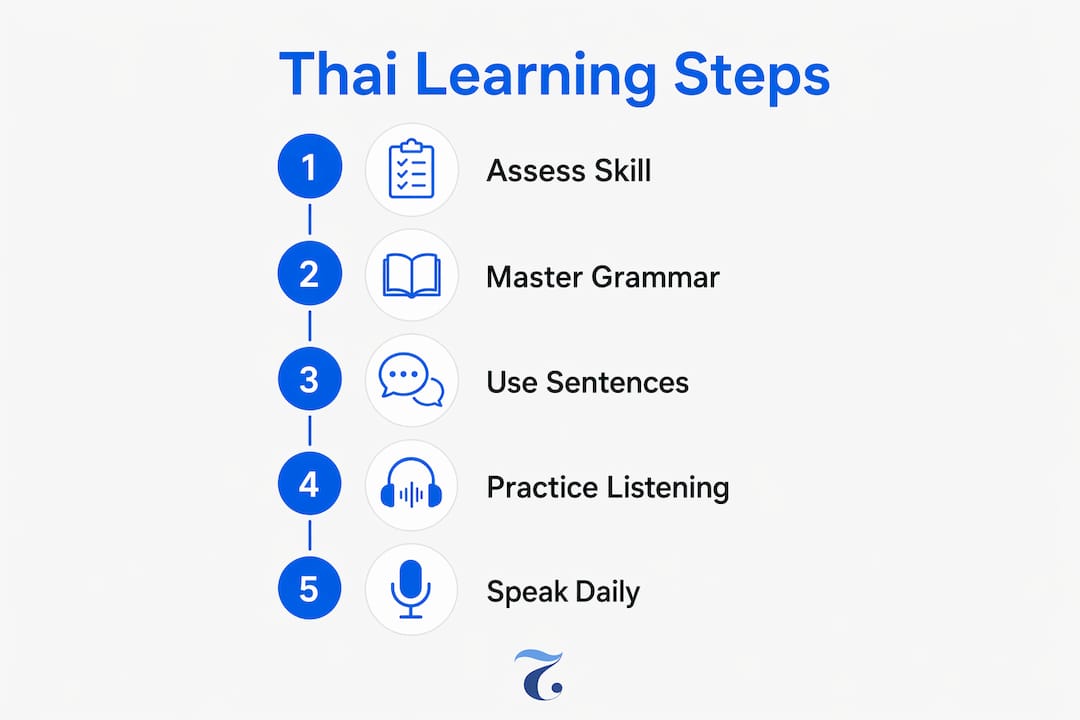
Learners who spend 45–60 minutes daily prioritizing listening and speaking make the fastest progress. That is not a massive time commitment. It is a consistent one, and consistency outweighs raw aptitude every time.
How do you build intermediate Thai vocabulary and sentence structures?
Vocabulary acquisition at the intermediate level works differently than it does for beginners. You are no longer collecting isolated words. You are learning how words behave inside sentences, alongside tones, particles, and context.
The most effective approach uses sentence-based flashcards rather than single-word cards. Instead of memorizing the word for “eat,” you memorize “I want to eat rice” with the correct tone and polite particle attached. This trains your brain to retrieve language in usable chunks, not fragments.
Focus your vocabulary effort on high-frequency words tied to scenes you actually encounter: ordering food, asking for directions, discussing work, and making small talk. These functional clusters give you the fastest return on study time. A practical Thai guide for adults frames this well: build around situations, not word lists.
Key principles for building intermediate sentence structures:
- Use polite particles consistently. In Thai, particles like “krap” (male) and “ka” (female) are not optional extras. They signal respect and social awareness. Practice them from day one so they become automatic.
- Learn classifiers early. Thai uses specific counting words for different categories of objects. Getting these right makes your speech sound natural rather than textbook-stiff.
- Practice word order actively. Thai follows a subject-verb-object pattern similar to English, but modifiers come after the noun. Drilling this difference prevents persistent errors.
- Record yourself speaking. Play it back and compare your tones to a native speaker. The gap between what you think you sound like and what you actually sound like is often surprising.
Pro Tip: When you learn a new word, immediately use it in three different sentences out loud. This forces your brain to process it as language, not just information.
Native speaker feedback is irreplaceable at this stage. Voice-based interaction with native speakers provides critical correction that solo study simply cannot replicate. Even short, informal voice chats through language exchange apps sharpen your tone production faster than hours of silent review.
How can you improve Thai listening and speaking skills during the transition?
Listening and speaking are the two skills that separate intermediate learners from beginners. You can have a strong vocabulary and still struggle to understand a native speaker talking at normal speed. Closing that gap requires daily, deliberate auditory exposure.

Start with Thai content slightly above your current comfort level. Podcasts designed for learners, short YouTube videos, and Thai TV shows with subtitles all work well. The goal is not to understand every word. The goal is to train your ear to recognize tonal patterns, sentence rhythm, and common phrases in natural speech.
For speaking, the single most important shift is this: prioritize communication over correctness. Embracing mistakes early accelerates fluency. Every awkward exchange with a native speaker teaches you something a textbook cannot. Treat Thai as a communication tool, not a performance to be judged.
A practical weekly speaking routine looks like this:
- Day 1–2: Listen to 10 minutes of Thai audio and write down 5 phrases you heard. Look them up and practice saying them aloud.
- Day 3–4: Have a 15-minute voice exchange with a language partner. Focus on one topic, such as your job or weekend plans.
- Day 5–6: Watch a short Thai video and shadow the speaker. Repeat sentences immediately after hearing them, matching tone and rhythm.
- Day 7: Review the week’s phrases. Record a 2-minute spoken summary of something you did that week, entirely in Thai.
Tone mastery is an auditory skill, not a memorization task. Production-heavy practice with native feedback is the only reliable way to internalize Thai pitch shifts. You cannot think your way to correct tones. You have to hear them, imitate them, and get corrected until they feel natural.
“Repeated auditory exposure over time normalizes tonal patterns and leads to fluency. Consistency is the primary driver of Thai learning success, exceeding raw intelligence or aptitude.” — Research on Thai language acquisition
Understanding how to practice conversation skills in a structured way makes a measurable difference at this stage. Pair that with a solid Thai listening practice routine and your comprehension will improve faster than you expect.
What challenges come up during this transition and how do you overcome them?
The beginner-to-intermediate transition is where most learners stall. Recognizing the common obstacles in advance gives you a real advantage.
- The tone plateau. Tones feel overwhelming at first because Thai has five of them and a wrong tone changes the meaning entirely. The solution is not more memorization. It is more listening. Spend time with native audio daily and your ear will begin to distinguish tones automatically.
- Passive study traps. Watching Thai TV without engaging, reading without speaking, or reviewing flashcards without using words in sentences all create an illusion of progress. Growth requires language use in meaningful contexts, not just classroom drills. Push yourself to produce language, not just consume it.
- Forcing script learning too early. Learning the Thai script is genuinely valuable. Early recognition of Thai consonant classes significantly aids tone prediction and improves reading comprehension. But if script study is replacing speaking practice, rebalance your time. Script is a tool, not a prerequisite for conversation.
- Unrealistic fluency timelines. Reaching conversational Thai takes around 400 to 600 hours of study. That figure is not discouraging. It is clarifying. It means 45 minutes a day for roughly two years gets you there. Progress is real and measurable long before you reach fluency.
- Avoiding native speakers. Many learners delay real conversations until they feel “ready.” That moment never arrives on its own. Schedule regular speaking practice now, even if it feels uncomfortable. The discomfort is the learning.
Tracking your own signs of Thai language progress helps you stay motivated through the slow patches. Progress in Thai is not always linear, but it is always cumulative.
Key Takeaways
Moving from beginner to intermediate Thai requires consistent daily practice in speaking and listening, combined with structured vocabulary and tone work, not just more study hours.
| Point | Details |
|---|---|
| Consistency beats aptitude | Daily practice of 45–60 minutes produces faster gains than sporadic intensive sessions. |
| Sentence-based vocabulary | Learn words inside full sentences with tones and particles to build usable language, not just word lists. |
| Speaking over perfection | Prioritize real conversations with native speakers early; mistakes accelerate fluency. |
| Tone mastery is auditory | Repeated listening and production with feedback internalizes tones faster than memorization. |
| Passive study stalls progress | Meaningful, active language use in real contexts is what drives intermediate-level growth. |
Why the intermediate stage is where Thai finally clicks
Most learners I have seen struggle at the intermediate stage share one thing in common: they are still trying to be perfect before they speak. That mindset works fine for grammar exercises. It kills real language development.
The shift that actually moves the needle is treating every conversation as practice, not performance. When you stop worrying about whether your tone on a particular word was exactly right and start focusing on whether the person understood you, something changes. You start communicating. And communicating, even imperfectly, is what builds the neural pathways that eventually produce fluency.
What I have also noticed is that learners who integrate Thai into their actual daily life, not just their study schedule, progress at a noticeably faster rate. That means changing your phone language to Thai, listening to Thai music during your commute, or texting a language partner in Thai instead of English. These small habits compound over weeks and months in ways that formal study alone cannot replicate.
The CU-TFL framework, which Thai Explorer’s curriculum aligns with, is useful here because it gives you concrete benchmarks. Knowing what intermediate proficiency actually looks like in terms of speaking, listening, reading, and writing removes the guesswork. You know what you are working toward, and you can measure whether you are getting there.
One more thing: the learners who advance fastest are not the ones with the most natural talent. They are the ones who show up consistently, ask for feedback, and stay curious about the language and culture behind it.
— Paul
Thai Explorer’s adult courses for advancing your Thai
Thai Explorer offers structured adult Thai courses in Singapore designed specifically for learners moving from beginner to intermediate and beyond. Whether you prefer group classes, private lessons, or online Zoom sessions, the curriculum is built around practical communication and cultural fluency, not just textbook exercises.

Qualified native Thai instructors, all bilingual in Thai and English, guide you through speaking, listening, reading, and writing in a way that mirrors real-world use. Corporate training options are also available for teams that need professional Thai communication skills. Thai Explorer is located right above Tanjong Pagar MRT at 10 Anson Road, #22-07, International Plaza, Singapore 079903. Browse the full range of adult Thai courses and find the format that fits your schedule and goals.
FAQ
How long does it take to reach intermediate Thai?
Most learners reach conversational Thai in 6 to 9 months with consistent daily practice. Reaching solid intermediate proficiency typically requires 400 to 600 total hours of study.
What is the hardest part of advancing from beginner Thai?
Tone mastery is the most common obstacle. Thai has five tones, and a wrong tone changes meaning entirely. Daily listening practice with native audio is the most effective way to overcome this.
Should I learn the Thai script before speaking?
Speaking practice should come first for most adult learners. Learning Thai consonant classes does accelerate tone prediction and reading comprehension, but it should complement speaking practice, not replace it.
What does intermediate Thai proficiency actually look like?
An intermediate Thai learner can hold conversations on familiar topics, understand native speakers in context, and use polite particles and basic sentence structures correctly. Frameworks like the CU-TFL provide clear benchmarks for each level.
How do I know if I am making progress in Thai?
Concrete signs include understanding more of a conversation without translating in your head, producing sentences faster, and receiving fewer corrections from native speakers. Tracking these signs of progress keeps motivation high during slower periods.