
TL;DR:
- Writing in Thai daily strengthens vocabulary, grammar, and cultural understanding through active reflection. It also enhances mental clarity and accelerates language acquisition by connecting language with personal experiences.
Thai language journaling is one of the most effective self-study habits you can build. Write in Thai regularly, and you reinforce vocabulary, practice grammar in context, and develop a feel for how the language actually works in everyday thought. The cognitive benefits go beyond language too: journal therapy research shows that writing forces the brain to connect events, emotions, and meanings, which organizes thinking and reduces stress.
Why journaling in Thai works for language learners
Used consistently, a Thai journal does several things at once:
- Vocabulary retention: Writing new words in personal sentences locks them into memory far better than flashcards alone.
- Grammar practice: Forming real sentences about your own life forces you to apply rules, not just recognize them.
- Cultural reflexivity: Reflecting on Thai customs, food, or social norms in writing deepens your understanding of cultural context in language.
- Mental clarity: Journaling reduces cognitive overload by clearing unnecessary thoughts and focusing attention on what matters.
- Emotional engagement: Writing about things you genuinely care about keeps motivation alive longer than textbook drills.
The research is clear: writing in a foreign language engages the brain differently than using your native tongue, and that difference accelerates acquisition.
How to start your Thai language journaling practice effectively
The biggest mistake beginners make is waiting until their Thai is “good enough.” Start now, at whatever level you are.

Choose your format first. A physical notebook slows you down in a useful way: writing by hand builds a deeper connection with your thoughts than typing. If you prefer digital, the Day One app supports photo integration and timed reminders, which helps beginners stay consistent.
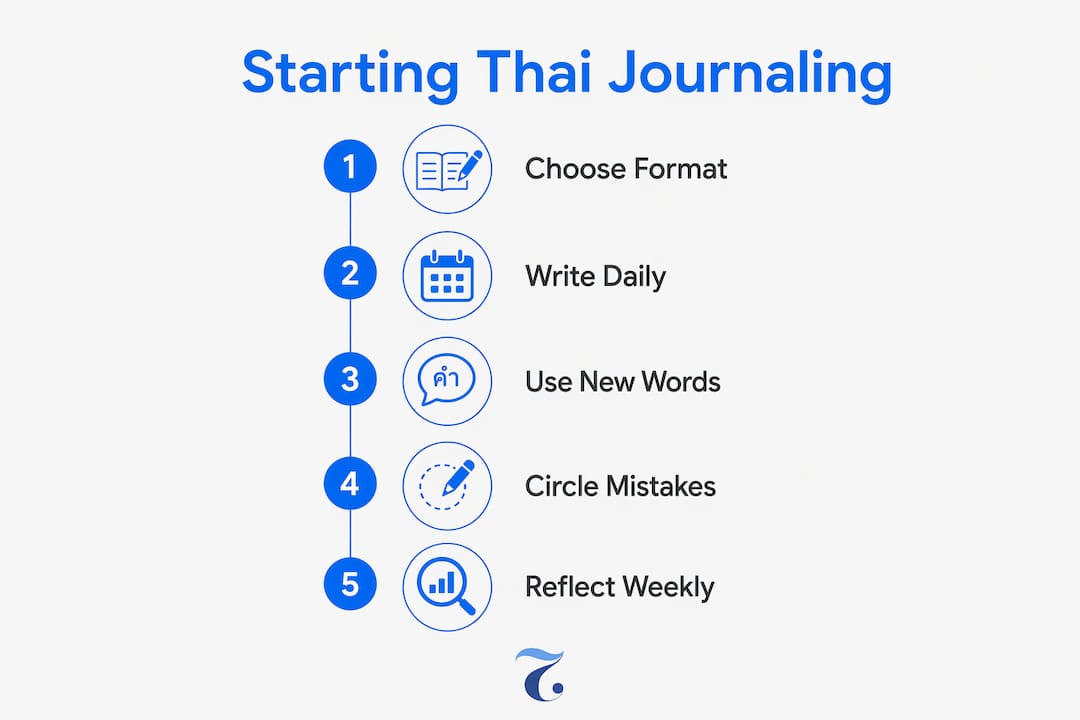
Set a realistic frequency. Five minutes a day beats one hour on Sunday. Even a single Thai sentence counts. The habit matters more than the length.
Match prompts to your level to master teaching effectively: Master Teaching in Thailand: A Step-by-Step Guide
- Beginner: Describe what you ate today using basic nouns and verbs. Write your daily schedule in Thai.
- Intermediate: Reflect on a conversation you had. Describe a Thai holiday you want to celebrate.
- Advanced: Analyze a cultural observation. Write an opinion on a Thai film or news story.
Weave in new vocabulary naturally. After each Thai class, pick three new words and use all three in your next journal entry. That single habit closes the gap between passive recognition and active use.
Pro Tip: If you get stuck mid-sentence, finish the thought in English and circle it. Come back later and translate it. This keeps your flow going without breaking the habit.
Best practices to maintain an effective and rewarding Thai journaling habit
Consistency is the whole game. These practices keep it from feeling like homework:
- Stream of consciousness writing: Don’t edit as you go. Write whatever comes to mind in Thai, even if it’s messy. Effective journaling doesn’t require perfect writing; honest expression is what builds clarity and fluency.
- Weekly review sessions: Re-read entries from the previous week. Spot recurring grammar errors, underline words you had to guess, and look them up. This self-correction loop is one of the fastest ways to improve.
- Thematic prompts: Rotate themes monthly. One month focus on Thai food culture. The next, write about Thai festivals or social customs. Thematic depth builds vocabulary clusters that stick together.
- Visual motivation: Add stickers, color coding, or photos to your journal. Creative elements sustain the habit and make entries more memorable when you review them.
- Balance accuracy with fluency: Some entries should prioritize getting ideas down fast. Others can be slow and careful. Mixing both prevents the frustration of always feeling like you’re failing.
Pro Tip: Schedule a 10-minute reflection every Sunday. Read three past entries, note one grammar pattern you got right, and set one vocabulary goal for the coming week. Tracking small wins keeps momentum going.
Overcoming common challenges in Thai language journaling
Thai script stops a lot of learners before they even start. The writing system uses 44 consonants and 32 vowel forms, with vowels appearing before, after, above, or below the consonant they modify, and no spaces between words. That looks overwhelming at first. But learners can start reading basic Thai words within weeks by focusing on syllable structure and tone rules, not the full alphabet at once.
Practical ways through the most common barriers:
- Script anxiety: Start with transliteration (romanized Thai) alongside the script. Gradually shift to writing in Thai script only as recognition improves. A solid Thai alphabet foundation makes this transition much faster.
- Fear of mistakes: Your journal has no audience. Mistakes are data, not failures. Write wrong, review, correct, move on.
- No time: A two-sentence entry still counts. Set a phone reminder at the same time each day. Routine removes the decision fatigue of “when should I write?”
- Cultural nuance: When you encounter a Thai concept you don’t fully understand, write a question in your journal. Bring it to your next class or look it up. The act of writing the question makes you far more likely to remember the answer.
- Feedback gaps: Share selected entries with a native Thai instructor for correction. Thai Explorer’s qualified native instructors can review written work and flag patterns you’d never catch alone.
How journaling enriches Thai language courses and cultural learning
A journal turns passive classroom input into active output. Every vocabulary set and grammar point you learn in class needs a place to land outside of it. Writing about your own life in Thai is that place.
Thai writing practice through journaling complements formal courses by reinforcing vocabulary, grammar, and cultural context in everyday use. You’re not just repeating exercises; you’re applying lessons to real experiences, which is how long-term memory forms. Pair journaling with Thai writing exercises from your course to close the loop between structured learning and free expression.
Cultural learning deepens through journaling in a way that classes alone can’t replicate. When you write about a Thai meal you tried, a phrase a colleague used, or a custom you observed, you’re processing culture through your own lens. That reflection builds genuine sensitivity, not just surface knowledge. For learners working toward CU-TFL proficiency or using Thai for professional purposes, this cultural fluency is exactly what separates functional speakers from truly confident ones.
If you’re taking online classes via Zoom, journaling between sessions keeps the language active in your mind. Even two or three entries per week maintain the neural pathways that class time builds.
Take your Thai further with Thai Explorer

Thai Explorer offers structured adult Thai courses in Singapore and online, taught by qualified native instructors bilingual in Thai and English. Whether you’re building conversational confidence, preparing for professional use, or deepening cultural understanding, the curriculum supports every stage of your learning. Journaling works best when it’s paired with real instruction. Explore Thai courses at Thai Explorer and put your journal practice to work.
Key Takeaways
Thai language journaling accelerates acquisition by combining active writing practice, vocabulary reinforcement, and cultural reflection into one daily habit.
| Point | Details |
|---|---|
| Start at any level | Even one Thai sentence per day builds the habit that drives long-term progress. |
| Match prompts to proficiency | Beginners describe daily routines; advanced learners analyze cultural observations. |
| Self-correction matters | Weekly review of past entries catches grammar patterns and reinforces vocabulary. |
| Script is learnable | Learners can read basic Thai words within weeks by focusing on syllable structure first. |
| Journaling extends class learning | Writing between lessons keeps vocabulary active and turns passive input into real output. |
FAQ
How often should I write in my Thai journal?
Daily is ideal, but even three to four short entries per week produce measurable improvement. Consistency over length is what builds the habit.
Can I mix English and Thai in my journal entries?
Yes, especially at the beginner stage. Finish a thought in English when you’re stuck, then translate it later. Gradually reduce the English as your Thai improves.
Do I need to know the Thai script before I start journaling?
Not fully. You can begin with transliteration and introduce Thai script progressively. Most dedicated learners can read simple Thai sentences within a couple of months of consistent practice.
What journal prompts work best for learning Thai culture?
Write about Thai festivals, food customs, social etiquette, or phrases you heard and didn’t fully understand. These prompts build both vocabulary and cultural awareness simultaneously.
How does journaling complement a formal Thai course?
Journaling gives you a low-pressure space to apply vocabulary and grammar from class in personal, meaningful sentences, which is how classroom learning converts into lasting fluency.