Thai question words work on a simple principle: keep your sentence exactly as it is, then swap the unknown element with the question word. No word order flips, no auxiliary verbs, no “do/does” gymnastics. If you want to ask “What are you eating?”, you literally say “You eat what?” That single insight unlocks the entire system.
There are two types of questions in Thai. Yes/no questions use the particle ไหม (mǎi) at the end of a statement. “คุณหิว” (You are hungry) becomes “คุณหิวไหม” (Are you hungry?). Open questions, the ones asking who, what, where, and why, use dedicated question words instead. You never combine ไหม with a question word. Pick one or the other.
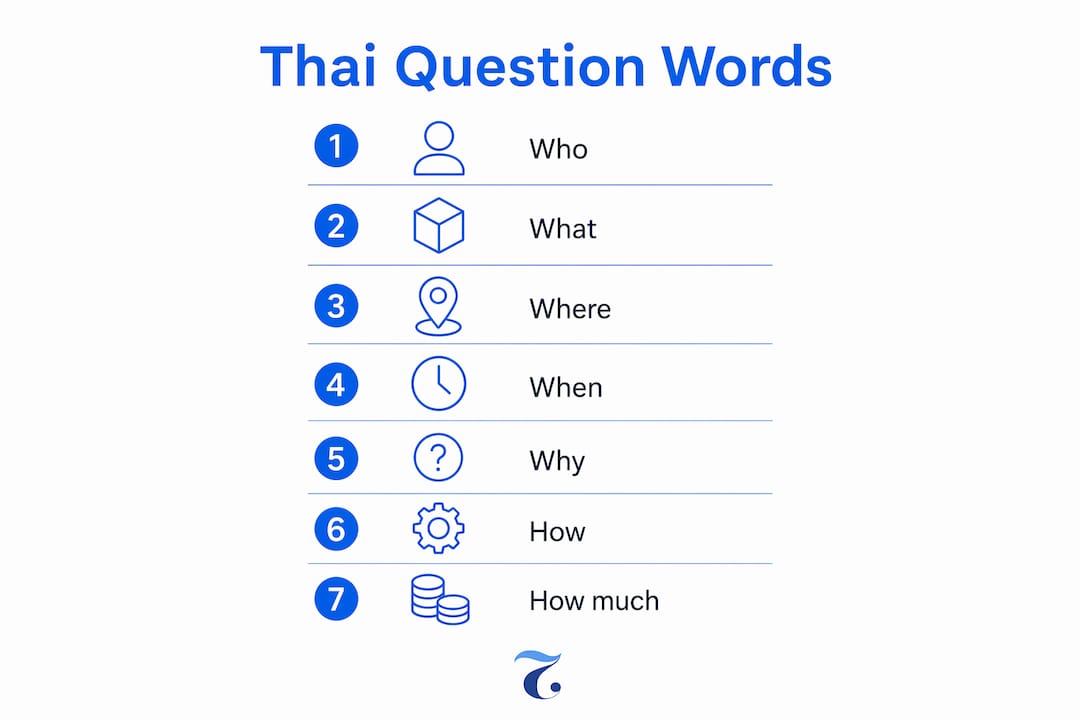
Here are the seven question words every beginner needs first:
- ใคร (krai) — who
- อะไร (à-rai) — what
- ที่ไหน (têe năi) — where
- เมื่อไหร่ (mêuua rai) — when
- ทำไม (tam-mai) — why
- อย่างไร / ยังไง (yàang rai / yang-ngai) — how
- เท่าไหร่ (tâo rai) — how much
Rising intonation at the end of a question signals that you are asking, not stating. Thai does not use question marks as a rule, so your voice does the work that punctuation does in English.
Table of Contents
- How to use Thai question words in sentences
- When question words appear at the beginning of a sentence
- Common Thai question words and how to use them
- Common mistakes and how politeness changes everything
- Formal vs. informal Thai question usage
- Tips for practicing and memorizing Thai question words
- Thai Explorer makes structured Thai learning practical
- Key Takeaways
- FAQ
How to use Thai question words in sentences
Thai question words stay in place within the sentence, unlike English where they move to the front. Think of it as a fill-in-the-blank system. The question word occupies exactly the slot where the answer would naturally sit.
The standard structure is Subject + Verb + Object, and the question word replaces whichever element you do not know. Want to know what someone is eating? “คุณกินอะไร?” (You eat what?). Want to know where the bathroom is? “ห้องน้ำอยู่ที่ไหน?” (Bathroom is located where?). The sentence frame stays locked; only the unknown slot changes.
Key rules for sentence structure:
- Thai does not invert subject and verb to form a question, ever.
- The question word sits where the answer belongs, not at the front.
- Rising tone at the end signals a question when no question word is present.
- Thai writing does not require a question mark, though you will see one used informally.
- Polite particles ครับ (khráp) or ค่ะ (khâ) come after the question word at the very end.
“In Thai, keep your sentence structure normal and just replace the missing information with the question word. Thai question words stay in their original position in the sentence, unlike English where they move to the front.” — SubLearn Thai Grammar
This in-situ system is genuinely easier than English once you stop fighting the instinct to front-load the question word. Practice by building a statement first, then replacing one element.
When question words appear at the beginning of a sentence
Most Thai question words sit at the end, but ทำไม (tam-mai, “why”) is the main exception. It almost always comes at the start of the sentence, mirroring how English speakers naturally frame “why” questions.
Example: “ทำไมคุณถึงชอบอาหารนี้?” translates literally as “Why you like this food?” The word ทำไม opens the sentence, and the rest follows normal subject-verb-object order. You can also place ทำไม at the end in casual speech, but the front position is far more natural and common.
เมื่อไหร่ (when) is more flexible. It can appear at the beginning or the end of a sentence without sounding awkward either way. “เมื่อไหร่คุณจะไป?” (When will you go?) and “คุณจะไปเมื่อไหร่?” (You will go when?) are both correct.
Exceptions at a glance:
- ทำไม (why): strongly prefers the beginning of the sentence.
- เมื่อไหร่ (when): works at the beginning or end.
- ใคร, อะไร, ที่ไหน, เท่าไหร่, อย่างไร: typically sit at the end or replace the unknown element mid-sentence.
The practical takeaway is simple. When asking “why,” start with ทำไม. For everything else, build your statement and drop the question word at the end.
Common Thai question words and how to use them
Each question word has a fixed job. Mixing them up is one of the most common beginner errors, so knowing the exact scope of each one saves real confusion.
ใคร (krai) — who
Use this only for people, never objects. “คุณชื่อใคร?” means “What is your name?” (literally “You are named who?”). Tonal accuracy matters here: krai with the wrong pitch can sound like “egg” (ไข่) or “hair” (ขน). Keep the tone mid-falling.

อะไร (à-rai) — what
The workhorse of Thai questions. “นี่คืออะไร?” (What is this?) and “คุณกินอะไร?” (What are you eating?) both use อะไร as the object. It can also appear at the start of a sentence: “อะไรอยู่ในตู้เย็น?” (What is in the fridge?).
ที่ไหน (têe năi) — where
Almost always placed at the end. When asking about location specifically, pair it with อยู่ (yòo, meaning “to be located”): “ห้องน้ำอยู่ที่ไหน?” (Where is the bathroom?). Without อยู่, the question sounds incomplete for location queries.
เมื่อไหร่ (mêuua rai) — when
Flexible placement. “คุณจะไปเมื่อไหร่?” (When will you go?) is the most natural spoken form. For asking about clock time specifically, Thai speakers often prefer กี่โมง (gèe mohng, “what time/o’clock”) instead.
ทำไม (tam-mai) — why
Starts the sentence. “ทำไมคุณถึงมาสาย?” (Why did you come late?). No exceptions worth memorizing at the beginner level.
อย่างไร / ยังไง (yàang rai / yang-ngai) — how
อย่างไร is formal and written; ยังไง is the everyday spoken version. Both sit at the end. “คุณทำอย่างไร?” (How do you do it?) versus “ฉันจะไปยังไง?” (How will I get there?). Never place either at the beginning.
เท่าไหร่ (tâo rai) — how much
Always at the end. “ราคาเท่าไหร่?” (How much is the price?) is one of the most useful phrases for everyday Thai communication. The sentence structure is literally “Price is how much?”

Pro Tip: Add ครับ (khráp) if you are male or ค่ะ (khâ) if you are female after the question word. “ราคาเท่าไหร่ครับ?” sounds polite and professional. Without it, the question is grammatically fine but can come across as blunt, especially in shops or business settings.
Common mistakes and how politeness changes everything
The single most common beginner error is combining ไหม with a wh-question word. “อะไรไหม?” is grammatically wrong and sounds redundant to a native speaker. ไหม is for yes/no questions only; the moment you use อะไร, ใคร, or any other question word, drop ไหม entirely.
The second big mistake is moving the question word to the front out of English habit. “อะไรคุณกิน?” sounds unnatural. The correct form is “คุณกินอะไร?” Drill the statement first, then replace the object.
Tone errors cause real confusion. Pronouncing ใคร (krai, “who”) with the wrong pitch produces a completely different word. Thai has five tones, and question words are not exempt from tonal rules. Listening to native speakers and repeating out loud, rather than just reading romanized transliterations, is the fastest fix. Working with a qualified Thai tutor accelerates this significantly because you get immediate correction.
Polite particles are not optional in professional or formal contexts. ครับ (for males) and ค่ะ (for females) signal respect and cultural awareness. In a business meeting or when speaking to someone older, skipping them reads as rude regardless of how grammatically correct the rest of your sentence is. For anyone using Thai in a professional setting, learning more about polite question forms in business Thai is worth the time.
Pro Tip: When you catch yourself about to add ไหม to a sentence that already has a question word, stop and read the sentence aloud. If it already has ใคร, อะไร, ที่ไหน, or any other wh-word, the question is complete. ไหม is redundant and incorrect there.
Common mistakes summarized:
- Adding ไหม after a wh-question word (incorrect and redundant).
- Placing the question word at the front of the sentence (English habit, wrong in Thai).
- Mispronouncing tonal question words, especially ใคร.
- Skipping polite particles ครับ/ค่ะ in formal or business situations.
- Using ใคร for objects instead of อะไร.
Formal vs. informal Thai question usage
The question words themselves do not change between formal and informal speech, but several surrounding elements do. อย่างไร (yàang rai) is the formal written form of “how,” while ยังไง (yang-ngai) is the casual spoken version you will hear constantly in everyday conversation. Using อย่างไร in a business email is appropriate; using ยังไง in a meeting with a senior Thai colleague is perfectly natural too, though อย่างไร signals more care.
Polite particles are the clearest marker of register. In casual conversation with friends, Thai speakers often drop ครับ and ค่ะ entirely. In formal settings, business meetings, or when speaking to someone you have just met, those particles are expected. The same question, “คุณไปที่ไหน?” (Where are you going?), becomes noticeably more respectful as “คุณไปที่ไหนครับ?” without changing a single content word.
Vocabulary choices also shift. เมื่อไหร่ (mêuua rai) is the everyday spoken “when,” while เมื่อไร (mêuua rai, slightly different spelling) appears more in formal writing. Similarly, เท่าไหร่ is the spoken form and เท่าไร the written one. For beginners, learning the spoken forms first is the practical move since they cover the vast majority of real conversations.
Tips for practicing and memorizing Thai question words
The fastest way to lock in question words is to practice them in context, not in isolation. Flashcards with the Thai script and romanization help, but producing sentences out loud is what builds real recall.
A few methods that work well:
- Label your environment. Point at objects and ask อะไร questions aloud. “นี่คืออะไร?” (What is this?) repeated daily with real objects builds the pattern fast.
- Use the fill-in-the-blank frame. Write a Thai statement, then replace one element with a question word. Repeat with different question words for the same base sentence.
- Shadow native speakers. Listen to Thai podcasts, YouTube videos, or TV shows and repeat questions you hear immediately after. Intonation and tone are absorbed through repetition, not memorization.
- Practice with a conversation partner. Asking and answering questions in real time forces you to retrieve words under pressure, which is exactly how memory consolidates. Resources on practicing conversation skills in a new language offer structured approaches for this.
- Group question words by position. Memorize ทำไม as “the one that goes first” and อย่างไร/เท่าไหร่ as “the ones that always go last.” Position anchors are easier to remember than abstract grammar rules.
- Use classroom activities. Role-play scenarios like ordering food, asking for directions, or conducting a simple interview force you to cycle through multiple question words in one session. Interactive Thai classroom activities are particularly effective for this.
The goal is not to memorize a list but to reach the point where the question word appears automatically when you need it.
Thai Explorer makes structured Thai learning practical
Thai Explorer is the structured path forward for adult learners who want to move from knowing a few question words to holding real conversations in Thai, whether for travel, work, or daily life in Singapore.
Lessons at Thai Explorer are taught by qualified native Thai instructors who are bilingual in Thai and English, so explanations of grammar points like question word placement and tonal pronunciation are clear from the first class. The curriculum aligns with the CU-TFL (Chulalongkorn University Proficiency Test of Thai as a Foreign Language) framework, giving learners a structured progression rather than a patchwork of tips. Group classes, private lessons, and online sessions via Zoom are all available, so the format fits around your schedule. The school is located at 10 Anson Road, #22-07, International Plaza, Singapore 079903, right above Tanjong Pagar MRT.
If you are ready to build real fluency in Thai question structures and conversational skills, browse the Thai courses at Thai Explorer and find the format that fits your goals.
Key Takeaways
Thai question words work by replacing the unknown element in a fixed sentence structure, never by moving to the front of the sentence as in English.
| Point | Details |
|---|---|
| Keep sentence order fixed | Replace the unknown element with the question word; never invert subject and verb. |
| ไหม is for yes/no only | Never combine ไหม with wh-question words like อะไร or ใคร. |
| ทำไม starts the sentence | “Why” is the main exception; it typically opens the question, not closes it. |
| Polite particles matter | Adding ครับ or ค่ะ after a question is expected in formal and business contexts. |
| Thai Explorer for structured learning | Native Thai instructors and CU-TFL-aligned courses build question skills systematically. |
FAQ
How do you form questions in Thai?
Keep the standard subject-verb-object sentence order and replace the unknown element with the appropriate question word. For yes/no questions, add ไหม (mǎi) at the end of a statement instead.
Can you put Thai question words at the start of a sentence?
Most question words sit at the end or in the position of the unknown element. ทำไม (why) is the main exception and typically opens the sentence; เมื่อไหร่ (when) can appear at either end.
What does ไหม (mǎi) mean in Thai?
ไหม is a question particle that turns a statement into a yes/no question when placed at the end. It is not used with wh-question words like อะไร or ใคร.
Why do tones matter when asking questions in Thai?
Thai is a tonal language, so the same syllable with a different pitch can mean a completely different word. Pronouncing ใคร (krai, “who”) with the wrong tone can produce a word meaning “egg” or “hair” instead.
What are ครับ and ค่ะ used for in Thai questions?
ครับ (for males) and ค่ะ (for females) are polite particles added at the end of questions to signal respect. In professional and formal contexts, omitting them can make a question sound blunt or impolite.