
TL;DR:
- A structured curriculum with clear scope, assessments, and trained instructors ensures measurable progress in adult Thai language learning.
- Most programs reach conversational competency within 12 weeks and business fluency within 24 weeks, depending on goals.
A structured curriculum gives adult Thai learners a clear scope and sequence that builds speaking, listening, and workplace-ready language skills reliably and efficiently. Without that framework, even motivated learners plateau fast, repeating the same phrases without ever reaching the business-functional level they need. The research is consistent: curricula with explicit sequencing produce stronger, more measurable gains than improvised or teacher-created lesson plans.
For U.S. adults learning Thai for conversation or business, the practical implication is straightforward. Check that any course you consider has a documented scope and sequence, assessments tied to proficiency standards like the CU-TFL (Chulalongkorn University Proficiency Test of Thai as a Foreign Language), and instructors who receive curriculum-specific training. Thai Explorer is one provider that builds its courses around exactly these principles. Use the checklist in the evaluation section below and compare it against any provider’s syllabus before you sign up.
Table of Contents
- Why does a structured curriculum improve adult language outcomes?
- What components does a high-quality structured Thai curriculum include?
- What should you expect from pacing, formats, and cost?
- How do you evaluate and choose a structured Thai course?
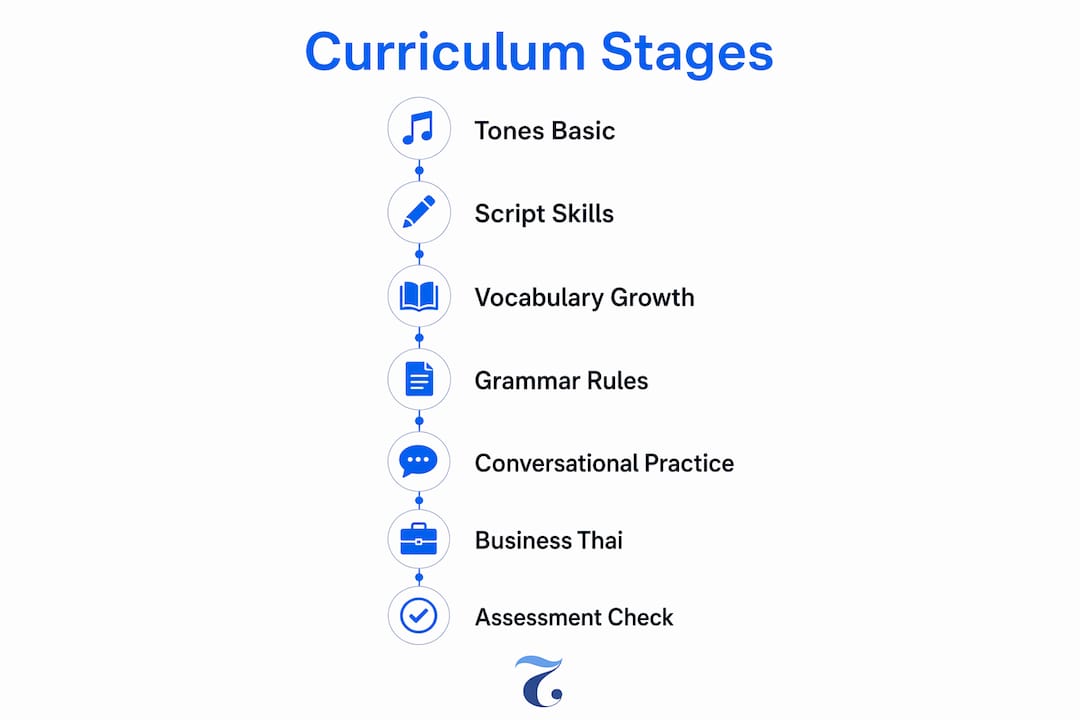
- What does a 12–24 week Thai scope and sequence actually look like?
- What does the research say about structured curricula and teacher training?
- How Thai Explorer builds and delivers its structured curriculum
- Key Takeaways
- Why the “just practice speaking” advice misses the point
- Useful sources and further reading
- FAQ
Why does a structured curriculum improve adult language outcomes?
The core finding from education research is blunt: scope-and-sequence curricula produce stronger learning gains than comprehensive or teacher-developed curricula without that ordering. A study published in the Journal of Human Resources tracked 691 five-year-olds across 71 preschools and found that a structured curriculum intervention produced measurable, persistent gains one year after the program ended. Critically, gains were largest in lower-quality settings, which points directly to an equity effect: structure compensates for variability in instructor experience and resources.
For adult learners, the mechanism is slightly different but equally important. Adults come to Thai class with competing demands on their attention. A structured curriculum reduces cognitive load by giving learners a predictable progression, so mental energy goes toward acquiring language rather than figuring out what comes next. Measurable checkpoints matter too, especially for anyone learning Thai for workplace competency. You need to know whether you can handle a supplier call in Thai after 12 weeks, not just feel vaguely more confident.
Research snapshot: National Academies analysis finds that domain-specific curricula with explicit scope and sequence tend to outperform teacher-developed curricula for targeted language outcomes.
What components does a high-quality structured Thai curriculum include?
Six elements are non-negotiable. A program missing any of them is not truly structured, regardless of how the marketing describes it.
- Proficiency-aligned learning goals. Each module should map to a recognized standard (CU-TFL levels, for instance) so progress is measurable, not impressionistic.
- Explicit scope and sequence. Skills build on each other. Tones and basic greetings come before workplace negotiation phrases. Vocabulary spirals back through later modules so retention holds.
- Formative and summative assessments. Placement tests at entry, short checks after each module, and exit criteria that confirm readiness to advance. Curriculum design frameworks like backward design (Understanding by Design) start with these assessments and build instruction backward from them.
- Task-based materials. Staged speaking tasks, workplace role-plays, and email-writing exercises that mirror real situations. Interactive, task-based lessons combined with cultural context increase learners’ ability to apply language in professional situations.
- Cultural and context modules. Thai business communication carries specific norms around hierarchy and politeness. A curriculum that skips cultural context leaves learners fluent in words but clumsy in practice.
- Curriculum-specific instructor training. High-quality instructional materials produce larger gains when paired with ongoing, curriculum-specific professional development. An instructor who knows the material but not the curriculum’s sequencing logic will underdeliver.
Pro Tip: According to AFT guidance on curriculum time allocation, a structured curriculum should cover roughly 50–75% of instructional time, leaving space for instructor adaptation and real-world practice. If a provider claims 100% scripted lessons, that’s a red flag; if they claim no fixed structure at all, that’s a bigger one.
What should you expect from pacing, formats, and cost?

Most adult learners reach meaningful competency gains within several months when the curriculum is genuinely structured and they practice consistently outside class. Blended delivery, online group sessions plus independent practice, tends to outperform either format alone for busy professionals.
| Program length | Expected outcome | Typical format |
|---|---|---|
| 8 weeks | A1 survival phrases, basic greetings, tones | Online group or private |
| 12 weeks | A2 conversational Thai, travel and social contexts | Online group + practice labs |
| 24 weeks | Business-functional Thai, workplace phrases, negotiation basics | Blended: group, private, or corporate |
Cost variables worth knowing before you compare providers:
- Private lessons accelerate progress but cost more per hour than group formats.
- Corporate training packages often include customized modules (industry vocabulary, meeting scripts) at a premium.
- Certification prep for CU-TFL adds assessment sessions and mock tests to the base program cost.
Online Zoom delivery removes the commute barrier entirely, which matters for U.S.-based learners or professionals with irregular schedules.
How do you evaluate and choose a structured Thai course?
Start with the syllabus. If a provider cannot hand you a documented scope and sequence within 48 hours of asking, move on.
Ten questions to ask any provider:
- Can I see the full scope and sequence for the course level I’m entering?
- How do you place new students, and what does the placement test cover?
- Can I sit in on or review a sample lesson before committing?
- How often are students assessed, and what do those assessments measure?
- What happens if I’m not progressing at the expected pace?
- How are instructors trained specifically on this curriculum?
- What percentage of class time follows the structured curriculum versus open conversation?
- Are workplace role-plays and business vocabulary included, or is that a separate module?
- How does the course align to CU-TFL or another recognized proficiency standard?
- What are the exit criteria for each level?
Red flags to watch for:
- No visible scope and sequence, just a topic list
- Progress measured only by “confidence” with no objective checkpoints
- Instructors described as native speakers with no mention of curriculum training
- All class time devoted to improvised conversation with no structured input
- Inability to describe what a student can do after completing the course
You can also customize Thai lessons within a structured framework, but only after confirming the base curriculum is solid.
What does a 12–24 week Thai scope and sequence actually look like?
A 12-week program reliably targets A2 conversational competency. A 24-week program extends into business-functional Thai, covering workplace communication, negotiation, and professional writing.
| Weeks | Module focus | Key vocabulary/grammar | Assessment checkpoint |
|---|---|---|---|
| 1–2 | Tones, script basics, greetings | 5 tones, polite particles (ครับ/ค่ะ), numbers | Tone recognition quiz |
| 3–4 | Introductions, daily routines | Subject-verb-object structure, time expressions | Spoken introduction task |
| 5–6 | Social conversation, directions | Question words, location vocabulary | Role-play: asking for directions |
| 7–8 | Shopping, negotiating price | Classifiers, comparative phrases | Simulated market dialogue |
| 9–10 | Workplace introductions, meetings | Formal register, titles, meeting phrases | Meeting simulation |
| 12 | Review and exit assessment | All prior vocabulary spiraled | Summative speaking and listening test |
| 15 | Business email and phone calls | Written register, phone scripts | Email drafting task |
| 20 | Negotiation and presentations | Persuasive language, hedging phrases | Negotiation role-play |
| 24 | Industry-specific vocabulary, cultural protocols | Sector vocabulary, hierarchy norms | Final business scenario assessment |
Sample 15-minute business negotiation task (Week 20): The instructor presents a supplier scenario in Thai. The learner must open the negotiation politely, propose a price adjustment using formal register, and close with a culturally appropriate phrase. The instructor uses a rubric covering pronunciation, register accuracy, and cultural appropriateness, then gives immediate formative feedback. Real-world scenarios like this one are what separate structured curricula from conversation-only classes.
What does the research say about structured curricula and teacher training?
Evidence supports structured scope-and-sequence curricula, and the gains are measurably larger when paired with curriculum-specific professional development. The Massachusetts Department of Elementary and Secondary Education guidance on instructional materials draws on randomized trials showing that aligned instructor training amplifies curriculum impact. Without it, even well-designed materials underperform.
The equity finding from the Journal of Human Resources study is worth restating: structured curricula reduce variation in outcomes across diverse learning settings. In language learning terms, that means a learner in a lower-resourced program or with a less-experienced instructor still makes reliable progress when the curriculum is genuinely structured. The National Academies review reinforces this, finding domain-specific curricula with scope and sequence consistently outperform teacher-developed alternatives for targeted outcomes.
Key finding: Structured curricula paired with curriculum-specific instructor professional development produce the strongest, most consistent learning gains across varied settings and learner backgrounds.
For ESL and foreign-language material design, the same principle applies: materials that align to clear learning goals and are supported by instructor training outperform materials used in isolation.
How Thai Explorer builds and delivers its structured curriculum
Thai Explorer’s curriculum model reflects the research principles described above. The scope and sequence is documented, aligned to CU-TFL proficiency levels, and covers all four skills: speaking, listening, reading, and writing. Instructors are native Thai speakers who are bilingual in Thai and English, which matters practically because adult learners need to ask grammar questions in English and get precise answers, not approximations.
Course formats include online Zoom group classes, private lessons, and corporate training programs with customized industry modules. Instructors receive curriculum-specific training so the sequencing logic is consistent across sections, not dependent on individual instructor preferences. Assessment is built in at each level, including placement testing at entry and exit criteria before advancement.
Ready to see the curriculum in detail? Review Thai Explorer’s full course options and take a placement test to find your starting point.
Key Takeaways
A structured curriculum with explicit scope and sequence, proficiency-aligned assessments, and curriculum-specific instructor training is the most reliable path to measurable Thai language gains for adult conversational and business learners.
| Point | Details |
|---|---|
| Scope and sequence is non-negotiable | Ask any provider for a documented sequence before committing; a topic list is not a scope and sequence. |
| Assessments drive accountability | Placement tests, formative checks, and exit criteria tell you exactly where you stand at every stage. |
| Instructor training amplifies the curriculum | Curriculum-specific professional development for teachers produces measurably stronger learner outcomes. |
| Program durations can be aligned with learning goals, such as conversational proficiency or business-functional language skills | Match program length to your actual goal, not the shortest available option. |
| 50–75% structured time is the target | Research-backed guidance recommends that structured curriculum covers roughly 50–75% of instructional time, leaving the remaining class time for instructor-adapted practice, real-world scenarios, and personalized feedback. |
Why the “just practice speaking” advice misses the point
Adult learners are often told that conversation practice is all they need. That advice is well-intentioned and partially true, but it skips the part where you need a structured foundation to make that practice productive. Unstructured conversation practice without a sequenced curriculum tends to reinforce the same errors repeatedly, because there is no systematic mechanism to introduce and correct new forms.
The research on structured pedagogy is clear on this. The gains from structured curricula are not marginal. They are persistent, they show up most strongly where resources are thinnest, and they compound when instructors are trained on the specific curriculum they are delivering. For adult learners with real deadlines, a business trip in three months or a client relationship to manage, that reliability is the whole point.
My practical advice: request the syllabus on day one, take the placement test seriously, and ask your instructor which module you are in and what the exit criteria look like. A good structured program makes those answers easy to give. If the instructor hesitates or gives a vague answer, that tells you something important about how structured the curriculum actually is.
Useful sources and further reading
The claims in this article draw on the following sources. Each is worth reading directly if you want to verify the evidence or dig deeper into curriculum design principles.
- The Effects of a Structured Curriculum on Preschool Effectiveness, Journal of Human Resources
- A New Vision for High-Quality Preschool Curriculum, National Academies
- Curriculum Matters, Massachusetts Department of Elementary and Secondary Education
- AFT guidance on curriculum time allocation
- What Does Effective High-Quality Preschool Curriculum Look Like? Kappan Online
- Thai Explorer course overview and formats
- Designing teacher training programs for curriculum-specific PD, TEFL Institute
FAQ
What is the role of a structured curriculum in adult Thai learning?
A structured curriculum provides a documented scope and sequence that builds Thai language skills in a deliberate order, reducing cognitive load and giving adult learners measurable checkpoints for conversational and business progress.
How long does it take to reach business-functional Thai with a structured course?
Most structured programs reach business-functional Thai in 24 weeks, covering workplace phrases, negotiation language, and professional register, while a 12-week program typically targets A2 conversational competency.
What should I look for in a structured Thai curriculum?
Look for a documented scope and sequence, proficiency-aligned assessments (such as CU-TFL alignment), curriculum-trained native instructors, and task-based modules that include workplace role-plays and business vocabulary.
Does structured curriculum time need to cover every minute of class?
No. Research-backed guidance recommends that structured curriculum should cover roughly 50–75% of instructional time, leaving the remainder for instructor adaptation, real-world practice, and learner-specific feedback.
Can I take a structured Thai course online from the United States?
Yes. Providers like Thai Explorer offer online Zoom group and private lessons that follow the same structured curriculum as in-person formats, making them accessible to U.S.-based adult learners regardless of time zone.