
The CU-TFL is the standardized Thai proficiency credential issued by the Sirindhorn Thai Language Institute at Chulalongkorn University, measuring listening, reading, writing, and speaking for non-native speakers. If you need formal proof of your Thai ability for a university application, an employer, or your own benchmarking, this is the test that carries institutional weight.
- Who issues it: The Sirindhorn Thai Language Institute, Chulalongkorn University, Bangkok
- What it proves: Measured proficiency across all four language skills on a 0–100 scale per section
- Modular option: You can sit all four skills together or take individual sections separately
- Score validity: Commonly treated as valid for two years by institutions
- Where to register: Directly through the Sirindhorn Thai Language Institute’s official site; check for upcoming test rounds
Table of Contents
- What is CU-TFL certification and who actually needs it?
- How is the CU-TFL exam structured?
- How does CU-TFL scoring work, and what do the bands mean?
- How to register, what it costs, and where you can sit the test
- How to prepare for CU-TFL: a practical study plan
- How Thai Explorer’s courses align with CU-TFL
- Your next steps before the test date
- Key Takeaways
- Why standardized testing matters more than most learners realize
- Thai Explorer’s CU-TFL preparation courses
- Useful sources
- FAQ
What is CU-TFL certification and who actually needs it?
The CU-TFL is designed specifically for people whose first language is not Thai. The Sirindhorn Thai Language Institute built it to give learners, institutions, and employers a single, standardized measure they can trust, rather than relying on informal class certificates that vary by school.
Three groups use it most:
- International students applying to Thai universities that require a formal language benchmark
- Expatriates and professionals who need documented proof of Thai ability for HR assessments, visa applications, or workplace placement
- Self-directed learners who want an objective measure of where they actually stand
The credential’s authority comes from its issuer. Chulalongkorn University is Thailand’s oldest and most prestigious university, and the Sirindhorn Thai Language Institute is its dedicated Thai language research and testing body. That institutional backing is what separates a CU-TFL certificate from a school-issued completion certificate.
Pro Tip: Choose CU-TFL over an informal class certificate whenever you need a score that an admissions office, HR team, or government body can independently verify. A school certificate shows attendance; CU-TFL shows measured ability.
For a broader look at how CU-TFL fits among other recognized Thai language tests, it helps to compare the options before committing to a test date.
How is the CU-TFL exam structured?
The test covers four skills. You can sit them as an integrated battery or choose individual sections, which matters a lot for planning your preparation time.

| Section | Typical Duration | Score Range | Example Task |
|---|---|---|---|
| Listening | ~120 min (combined with Reading) | 0–100 | Multiple-choice comprehension of spoken dialogues and announcements |
| Reading | ~120 min (combined with Listening) | 0–100 | Passage comprehension, vocabulary-in-context questions |
| Writing | ~60 min | 0–100 | Structured essay or short-answer composition in Thai script |
| Speaking | ~45 min | 0–100 | Live face-to-face interview with a trained examiner |
Listening and reading are typically administered together in a paper-and-pencil format at most centers, running about 120 minutes total. Writing is a separate 60-minute session. The speaking section is a live, face-to-face interview with an examiner, not a recorded response format, which means your conversational fluency and ability to respond in real time are directly assessed.
A few practical notes worth knowing before test day:
- Listening tasks typically include dialogues, announcements, and short lectures at varying speeds
- Reading passages range from everyday notices to more formal academic-style texts
- Writing prompts ask you to compose structured responses, so Thai script fluency is non-negotiable
- The speaking interview tests spontaneous communication, not memorized scripts
Pro Tip: If your speaking is stronger than your writing, consider sitting the speaking section first as a standalone. A strong speaking result can motivate continued study and gives you a partial certificate while you build writing skills.
How does CU-TFL scoring work, and what do the bands mean?
Each section is scored from 0 to 100. The Sirindhorn Thai Language Institute maps those scores to five proficiency bands, using its own naming convention:
- Chula Distinguished (highest): Can handle complex, abstract communication with near-native fluency
- Chula Superior: Handles most formal and informal situations with accuracy and range
- Chula Advanced: Communicates effectively in most everyday and professional contexts
- Chula Intermediate: Manages routine tasks but struggles with complex or unfamiliar topics
- Chula Novice (entry level): Limited to basic, formulaic communication
The institute aligns its scoring criteria with ACTFL (American Council on the Teaching of Foreign Languages) standards and uses a “plus” indicator to show when a candidate is performing near the top of a band but not yet at the next level. So a score reported as “Advanced Plus” means you are solidly Advanced but approaching Superior, which is useful information for both learners and institutions.
Score validity is commonly treated as valid for a limited duration by institutions, meaning a certificate earned today would typically be considered current only for a few years for most academic and professional purposes.
Institutions set their own cutoff thresholds. A Thai university might require Intermediate or above for admission to a language-intensive program, while an employer might simply want documented proof of any formal band. Always confirm the specific requirement with the institution before you register, since there is no universal minimum that applies everywhere.
Assoc. Prof. Dr. Wirote Aroonmanakun of the Sirindhorn Thai Language Institute has noted that standardized measurement like CU-TFL gives both students and employers a clear, comparable picture of language ability, something informal assessments cannot provide.
How to register, what it costs, and where you can sit the test
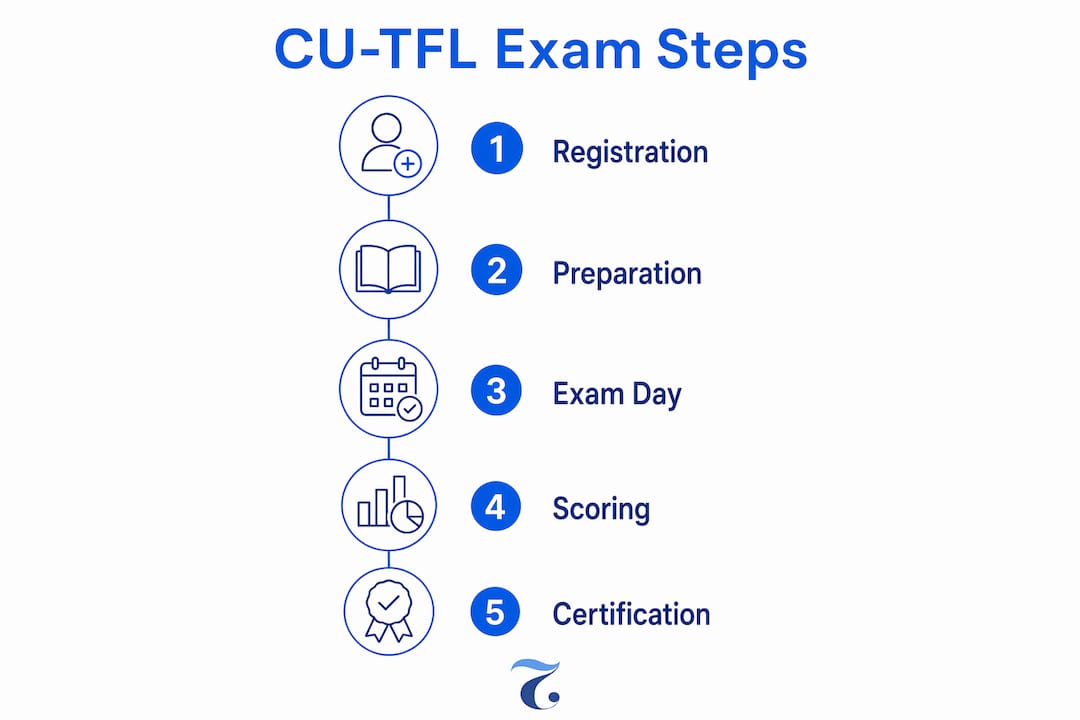
Registration goes through the Sirindhorn Thai Language Institute’s official website. The process runs as follows:
- Check the current test calendar on the institute’s site for available rounds and locations
- Create an account and complete the online registration form with your personal details and passport or national ID information
- Select the skill(s) you want to sit and confirm your preferred test center
- Complete payment online; fees are charged per skill and denominated in Thai baht
- Download and print your admission document; bring valid photo ID on test day
On fees: the speaking section has been listed at 2,100 THB per the institute’s published materials, with other skills priced separately. Fees can vary by session and location, so confirm the current amounts during registration.
Test locations and availability:
- Primary site: Chulalongkorn University, Bangkok
- Partner universities in Thailand: Chiang Mai University, Khon Kaen University, Srinakharinwirot University, among others
- International sessions: The institute has run overseas sessions in Taiwan (roughly twice a year), Japan (approximately once a year), and China periodically, but only when a minimum number of applicants is reached at that location
For US-based learners, international sessions are the realistic path unless you plan to travel to Thailand. Contact the institute directly to ask about upcoming overseas rounds or to express interest in organizing a session in your region.
Logistics warnings you cannot afford to ignore:
- A strict 15-minute grace period applies for arrival; arrive after that window and you will not be admitted
- Rescheduling after registration is generally not permitted, so choose your test date carefully
- Errors in your online registration are difficult to correct after submission; double-check all personal data before confirming
How to prepare for CU-TFL: a practical study plan
Preparation works best when you treat each skill as its own project, then integrate them in the final weeks.
Skill-by-skill priorities:
- Listening: Daily exposure to Thai audio at natural speed, dictation exercises, and comprehension drills using news broadcasts or podcasts
- Reading: Timed reading practice with Thai-script texts, vocabulary frequency lists, and passage-level comprehension questions
- Writing: Structured essay practice with feedback, grammar drills focused on formal register, and Thai script accuracy work
- Speaking: Recorded self-practice, mock interviews with a native speaker or tutor, and work on spontaneous response speed
Sample 10-week timetable:
- Weeks 1–2: Thai script review and phonology; build vocabulary from frequency lists
- Weeks 3–4: Listening comprehension drills; timed reading passages at Intermediate level
- Weeks 5–6: Writing structure practice; formal essay drafts with instructor feedback
- Weeks 7–8: Speaking mock interviews; integrated listening and reading under timed conditions
- Weeks 9–10: Two full mock exams under real test conditions; review weak sections; final vocabulary pass
Official sample tests are available through the Sirindhorn Thai Language Institute and are the single most useful preparation resource because they reflect the actual task types and timing. Use them under timed conditions, not as casual reading.
Pro Tip: If you are not ready for the full four-skill battery, use the modular option strategically. Sit listening and reading first to get a baseline score, then continue studying writing and speaking before sitting those separately. Staged testing lets you build a complete certificate over time without waiting until all four skills are exam-ready.
For a structured approach to study planning, Thai Explorer’s study tips for Thai certification offer a practical framework that maps directly to CU-TFL preparation.

How Thai Explorer’s courses align with CU-TFL
Thai Explorer’s curriculum is built around the same four-skill structure the CU-TFL tests. That alignment is deliberate: modules map directly to listening, reading, writing, and speaking, and mock exams are integrated throughout the course rather than bolted on at the end.
A sample module progression looks like this:
- Module 1: Thai script, tones, and phonology foundations
- Module 3: Listening comprehension and dictation practice
- Module 5: Timed reading and passage comprehension
- Module 7: Structured writing and formal register
- Module 8: Speaking fluency and mock interview preparation
- Module 10: Full integrated mock exam and band-level review
Instructors at Thai Explorer are bilingual native Thai speakers, which matters for the speaking section in particular. Feedback on pronunciation, register, and spontaneous response is more precise when your tutor can explain the difference between how something sounds to a native ear versus how a textbook describes it.
The institute recommends completing at least two full mock tests under timed conditions before sitting the real exam. Thai Explorer builds this into the course structure, so learners arrive at test day having already experienced the pressure of the clock.
For more on how course design connects to CU-TFL outcomes, the course alignment guide for educators explains the methodology in detail.
Your next steps before the test date
If you are ready to move from planning to action, work through this checklist:
- Visit the Sirindhorn Thai Language Institute’s official site and check the current test calendar
- Confirm your ID documents are valid and match the name you will use for registration
- Book the earliest test session that gives you at least 8–10 weeks of preparation time
- Schedule at least two full mock exams in the final two weeks before your test date
- Enroll in a targeted course if you need structured instruction, especially for writing and speaking
A few additional notes for international candidates:
- Overseas sessions require a minimum number of registered applicants; contact the institute early if you want a session in your country
- If you are in the US, factor in the possibility of traveling to Thailand or a partner country for the test
- The 8–12 week preparation window is realistic for intermediate learners; beginners should plan for longer
Key Takeaways
The CU-TFL is the only standardized Thai proficiency test issued by a major Thai university, and its ACTFL-aligned scoring makes it the strongest credential for academic and professional purposes.
| Point | Details |
|---|---|
| Issuer and authority | The Sirindhorn Thai Language Institute at Chulalongkorn University designs and administers CU-TFL. |
| Four-skill structure | Listening, reading, writing, and speaking are each scored 0–100 and can be taken separately or together. |
| Score validity | Scores are commonly treated as valid for two years by academic and professional institutions. |
| International availability | Overseas sessions run in Taiwan, Japan, and China when minimum applicant numbers are met; contact the institute to confirm. |
| Thai Explorer preparation | Thai Explorer’s CU-TFL-aligned courses cover all four skill modules with integrated mock exams and bilingual native instructors. |
Why standardized testing matters more than most learners realize
Most people who study Thai seriously hit a point where they genuinely cannot tell how good they are. They can hold a conversation, they can read a menu, maybe they can write a short message. But “pretty good” is not a number, and it does not appear on a university application or a resume.
That is the real value of CU-TFL, and it is underused. Too many learners treat it as a finish line rather than a diagnostic tool. A score at Intermediate level does not mean you failed; it tells you exactly what to work on next. The ACTFL-aligned band system means your score translates into a recognized framework that academic advisors and HR professionals in the US already understand.
There is also a preparation trap worth naming: learners who study only for the exam often plateau at the band they were already near. The ones who improve the most are those who use the test structure as a learning framework, not just a checklist. Study the skills the test measures because those skills matter in real Thai communication, and the score will follow.
Thai Explorer’s CU-TFL preparation courses
Passing CU-TFL at a meaningful band requires more than self-study and sample tests. It requires structured feedback, timed practice, and instruction from someone who can explain why your speaking sounds off to a native ear.
Thai Explorer offers group courses, private lessons, and online Zoom classes for adult learners, all built around the CU-TFL four-skill framework. Corporate training is available for teams that need documented Thai proficiency for business operations in Southeast Asia. Every format uses bilingual native Thai instructors and includes mock exams that mirror the actual test structure.
The school is located at 10 Anson Road, #22-07, International Plaza, Singapore 079903, directly above Tanjong Pagar MRT, with online options available for learners anywhere. Browse the full Thai language course options or book a trial class to see how the curriculum maps to your current level and target band. For dedicated exam preparation, the CU-TFL test prep services page outlines mock test formats and assessment modules.
Useful sources
- CU-TFL official page, Sirindhorn Thai Language Institute — registration, fees, skill options, and band descriptors
- CU-TFL test logistics and policies — arrival rules, grace period, and registration correction policy
- Chulalongkorn University CU-TFL highlight — international sessions, ACTFL alignment, and partner universities
- Examinee manual 2025, Sirindhorn Thai Language Institute — official test structure and scoring criteria
- National University of Kaohsiung Language Center, CU-TFL page — partner center logistics and section durations
Always confirm current test dates, fees, and registration deadlines directly with the Sirindhorn Thai Language Institute, as these details change between test rounds.
FAQ
What is CU-TFL?
CU-TFL (Chulalongkorn University Proficiency Test of Thai as a Foreign Language) is a standardized Thai language test designed by the Sirindhorn Thai Language Institute at Chulalongkorn University, measuring listening, reading, writing, and speaking on a 0–100 scale per section.
How long are CU-TFL scores valid?
Scores are commonly treated as valid for two years by academic institutions and employers, making CU-TFL a current-measure credential rather than a permanent qualification.
Can I take just one section of the CU-TFL instead of all four?
Yes. The test is modular, so you can sit individual skills separately and build toward a complete certificate over multiple test rounds.
How is the CU-TFL speaking section conducted?
The speaking section is a live, face-to-face interview with a trained examiner, lasting approximately 45 minutes. It tests spontaneous communication, not pre-memorized responses.
What is the difference between CU-TFL and CU-TEP?
CU-TEP is Chulalongkorn University’s English proficiency test; CU-TFL is its Thai proficiency equivalent for non-native speakers. Both are issued by Chulalongkorn University but test entirely different languages and serve different applicant groups.