TL;DR:
- The fastest way to learn conversational Thai in Singapore combines group classes, private lessons, and self-study using Thai media. Thai Explorer offers all three formats with native bilingual instructors at a central location, aligned with CU-TFL standards. Consistent practice and targeted correction accelerate progress toward functional speaking ability.
The fastest route to conversational Thai in Singapore is a combined approach: small-group classes for structured practice, occasional private lessons to fix pronunciation early, and consistent self-study using Thai media between sessions. Thai Explorer, located directly above Tanjong Pagar MRT at 10 Anson Road, #22-07, International Plaza, offers all three formats with bilingual native instructors and a curriculum aligned to CU-TFL standards.
Your quickest concrete options right now:
- In-person group classes near an MRT station for structured, social learning two to three times a week
- Private one-to-one lessons for targeted pronunciation work and faster individual progress
- Online Zoom classes for schedule flexibility, especially useful for working adults
- Language exchange meetups and Thai community events for low-pressure real conversation
To act today: book a trial class at Thai Explorer or search Meetup.com for Thai language exchange groups in Singapore.
Pro Tip: Pair group classes with one private lesson every two weeks. Use that private time to work through the specific pronunciation mistakes your teacher flagged in the group session. That targeted correction loop is what separates learners who plateau from those who keep moving.
Table of Contents
- What types of Thai classes are available in Singapore?
- What should you expect from a typical Thai course in Singapore?
- How do you choose the right Thai class in Singapore?
- What do Thai classes typically cost, and how long does it take?
- Where can you practice Thai between classes?
- What is CU-TFL and does certification matter for you?
- Why Thai Explorer is worth considering for beginners
- Key Takeaways
- What actually works in a Thai classroom
- Thai Explorer: group, private, and online courses in Singapore
- Useful sources and next steps
- FAQ
What types of Thai classes are available in Singapore?
The options range from structured classroom courses to casual conversation circles, and each format suits a different kind of learner.

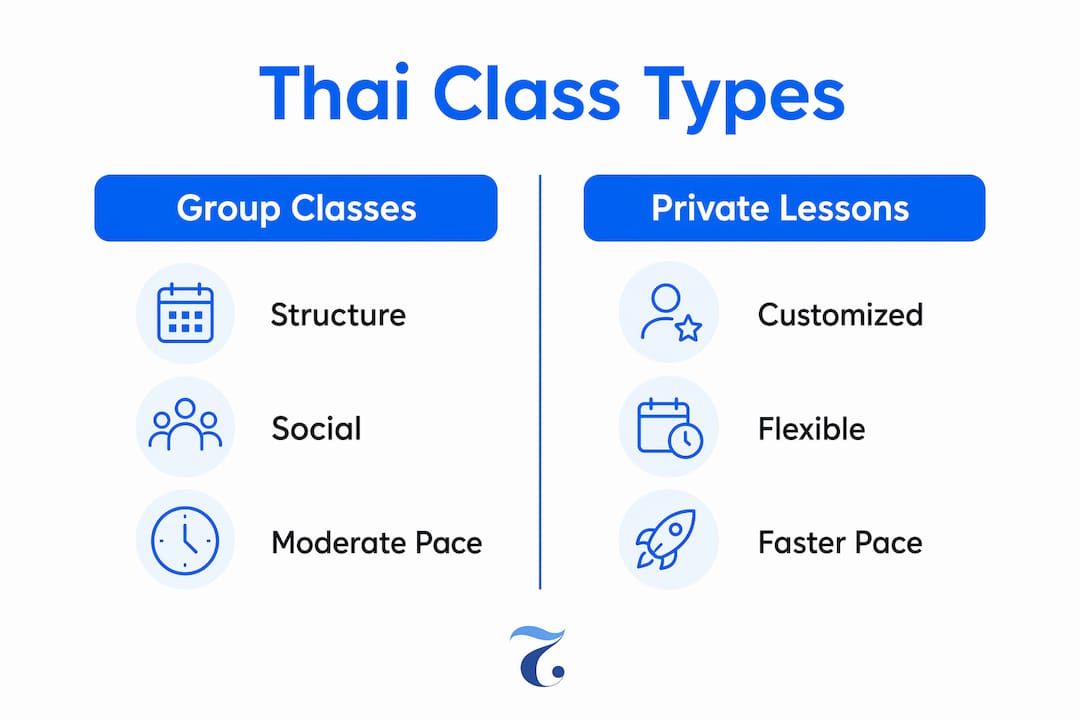
Group classes are the most popular starting point. You get a set curriculum, a teacher managing the pace, and classmates to practice with. The social pressure is real and useful: you cannot skip speaking turns the way you can when studying alone. These work best for learners who want structure, accountability, and the chance to hear how others make mistakes (and recover from them).
Private lessons move faster, full stop. A teacher focuses entirely on your gaps, adjusts vocabulary to your job or travel plans, and corrects your tones in real time. Private Thai lessons are the right call if you have a specific deadline, a professional context, or pronunciation habits that need early correction before they calcify.
Online Zoom classes remove the commute and let you review recorded sessions afterward. Thai Explorer’s online Thai course is built for learners who need flexibility without sacrificing a live teacher. Short recorded Zoom review sessions after live lessons also increase retention when combined with spaced-repetition vocabulary practice.
Corporate training brings instruction to your team, either on-site or via Zoom. It works well for companies with staff traveling to Thailand regularly or managing Thai-speaking clients.
Language exchanges and community meetups are free and genuinely useful once you have 20–30 hours of class under your belt. Thai restaurants, cultural events, and informal conversation groups in Singapore give you real speech exposure that no classroom fully replicates.
| Format | Best for | Pace | Flexibility |
|---|---|---|---|
| Group classes | Structure, social motivation | Moderate | Fixed schedule |
| Private lessons | Speed, specific goals | Fast | Bookable on demand |
| Online Zoom | Busy schedules, remote learners | Moderate–Fast | High |
| Corporate training | Teams, professional context | Custom | On-site or online |
| Language exchange | Conversation confidence, free practice | Self-directed | Very high |
What should you expect from a typical Thai course in Singapore?
Most beginner courses in Singapore run in modular blocks. A typical structure is 8–12 weeks per level, meeting once or twice a week, with each session running 90 minutes to two hours. Flexible course formats let learners progress through multiple levels sequentially, so you are not locked into a single long commitment before knowing whether the school suits you.
Class sizes in quality programs stay small, usually under ten students. That matters more than most beginners realize: in a large class, you might speak for five minutes per session. In a small group, you are talking, responding, and being corrected for a significant portion of every lesson.
What the curriculum typically covers at beginner level:
- Tones and pronunciation fundamentals (Thai has five tones; getting these right early prevents bad habits)
- Core phrases for greetings, directions, ordering food, and social situations
- Basic sentence patterns and question structures
- Listening comprehension through dialogues and real-speech clips
- Introduction to Thai script, usually after oral foundations are set
The split between conversational skills and script work varies by school. Conversation-first curricula delay intensive script study and produce quicker ready-to-use speaking ability for travelers and professionals. Reading and writing come in once basic oral fluency begins to form, typically after the first 10–15 hours of instruction.
Trial lessons and placement assessments are standard at reputable schools. If a provider skips both, that is a signal worth noting. A placement check ensures you start at the right level; a trial lesson lets you evaluate the teacher before committing to a full course.
Bilingual Thai–English instructors structure early lessons around phrases first, then grammar scaffolding. You learn to say “Where is the bathroom?” before you learn why the sentence is structured that way. That sequence keeps motivation high and gets you speaking from day one.
How do you choose the right Thai class in Singapore?
The decision comes down to five things: your goal, your schedule, the instructor, the class format, and the price. Work through them in that order.
Step 1: Define your goal clearly.
“I want to speak Thai” is not a goal. “I want to order food, ask for directions, and hold a basic conversation before my trip to Bangkok in four months” is. Your goal determines whether you need a travel-focused conversational course, a business Thai program, or a certification track aligned to CU-TFL. Pick a school whose curriculum matches your actual use case, not just the one closest to your office.
Step 2: Check schedule and location.
Evening and weekend classes are the norm for working adults. Central locations with MRT access matter if you are commuting after work. Online Zoom options solve the location problem entirely, so factor that in if your schedule is unpredictable.
Step 3: Evaluate the instructor.
Ask directly: Is the teacher a native Thai speaker? Are they bilingual in Thai and English? Do they have experience teaching adult beginners? A native speaker who cannot explain grammar in English is frustrating for beginners. A fluent English speaker who is not a native Thai speaker may not model tones accurately. You want both.
Step 4: Look at class size and teaching style.
Small groups with interactive role-play and real dialogue practice outperform lecture-style classes for conversational goals. Ask how much speaking time a typical student gets per session.
Step 5: Understand the pricing and policies.
- Is there a trial lesson before you commit to a full course?
- What is the refund or transfer policy if your schedule changes?
- Are payment options flexible?
Red flags to watch for:
- No published syllabus or course outline
- No trial lesson option
- Vague or unlisted teacher qualifications
- No placement assessment for new students
- Pressure to commit to a long course before you have met the teacher
A school that answers these questions clearly and offers a trial lesson is worth your time. One that deflects them is not.
What do Thai classes typically cost, and how long does it take?
Prices in Singapore vary by format and provider. The ranges below reflect the general market; individual schools set their own rates.
| Format | Typical cost range (per lesson) | Weekly hours | Months to basic conversation (A1→A2) |
|---|---|---|---|
| Group classes | SGD 25 | 2–4 hrs | 3–5 months |
| Private lessons | SGD 80 | 1–3 hrs | 2–4 months |
| Online Zoom (group) | SGD 20–30 | 2–4 hrs | 3–5 months |
| Mixed (group + private) | SGD 90 avg | 3–5 hrs | 2–3 months |
Three factors drive price the most: class size (smaller costs more per head), lesson length, and whether the teacher is a senior instructor or a newer one. Private lessons cost more per hour but often require fewer total hours to reach the same milestone.
On timelines: reaching basic conversational ability (A1 to A2) typically takes three to five months with group classes meeting twice a week. Moving from A2 to lower intermediate (B1) takes several additional months at the same pace. These are realistic estimates for adults studying two to four hours a week, not intensive immersion programs.
Mixing formats shortens the timeline noticeably. Combining group classes with private sessions gives you the social practice of a group and the targeted correction of one-to-one coaching. Learners who combine twice-weekly group practice with biweekly private coaching typically report faster gains in pronunciation and confidence than those using only one format.
What affects your personal timeline:
- How much you practice outside class (30 minutes daily beats two hours on Sunday)
- Whether you use Thai in real situations between lessons
- How early you address tonal pronunciation (fixing it late costs time)
- Whether your curriculum is conversational-first or script-heavy from the start
Where can you practice Thai between classes?
Class time alone will not get you to conversational fluency. The learners who progress fastest treat every week as having two components: class hours and practice hours. Here is how to build the practice side.
Apps worth using:
- Anki for spaced-repetition flashcard decks (search for Thai vocabulary decks built by other learners)
- Ling for Thai-specific phrase training and listening drills
- ThaiPod101 for structured audio lessons and vocabulary review
None of these replace a teacher, but Anki in particular is hard to beat for locking in vocabulary between sessions.
Media practice:
Thai YouTube channels, variety shows, and short drama clips expose you to natural speech rhythms that textbooks cannot replicate. Start with content that has Thai subtitles, not English ones. Thai podcasts aimed at learners (slow-speech formats) are useful in the first three months; switch to native-speed content as soon as you can follow 30% of it.

Local practice in Singapore:
Thai restaurants and markets around Siloso Beach, Golden Mile Tower, and the Geylang area have Thai-speaking staff who are generally patient with learners attempting conversation. Cultural events organized by the Thai community in Singapore are worth attending for real immersion. If you are also interested in Thai culture more broadly, checking out Muay Thai gyms in Singapore is a surprisingly good way to meet Thai speakers and absorb cultural context outside the classroom.
Structuring your weekly practice:
| Practice type | Frequency | Duration | What it builds |
|---|---|---|---|
| Anki flashcard review | Daily | 15–20 min | Vocabulary retention |
| Listening (podcast/video) | 4–5x per week | 20–30 min | Ear for tones and rhythm |
| Shadowing (repeat after audio) | 3x per week | 15 min | Pronunciation and fluency |
| Conversation partner/exchange | 1–2x per week | 30 min | Speaking confidence |
Language exchange meetups in Singapore are worth finding through Meetup.com or Facebook groups. Search “Thai language exchange Singapore” and you will find regular sessions where Thai speakers want to practice English in exchange for Thai conversation practice.
Pro Tip: When you shadow Thai audio, do not just repeat the words. Match the speaker’s rhythm, speed, and pitch. Tonal languages reward physical imitation more than analytical study.
What is CU-TFL and does certification matter for you?
CU-TFL stands for Chulalongkorn University Proficiency Test of Thai as a Foreign Language. It is the most widely recognized formal benchmark for Thai language ability among non-native speakers, developed by Chulalongkorn University in Bangkok. Courses aligned with CU-TFL cover all four skills: speaking, listening, reading, and writing, mapped to progressive proficiency levels.
For most learners in Singapore, the practical question is not “should I get certified?” but “does this course prepare me for real use?” The two goals are not always the same. A certification track requires reading and writing competency alongside speaking, which adds time. A conversational-only track gets you speaking faster but leaves a formal credential gap.
When certification is worth pursuing:
- You are applying for jobs that require documented Thai language ability
- You are studying in Thailand or enrolling in a Thai university program
- You want a structured benchmark to measure progress objectively
- Your employer requires proof of language competency for a role
When conversational fluency is enough:
- Travel, personal relationships, and cultural engagement
- Business contexts where communication matters more than credentials
- Learners who want to reach A2–B1 speaking ability without the script-heavy requirements of a formal test
Thai Explorer’s curriculum is aligned with CU-TFL standards, covering speaking, listening, reading, and writing. That alignment means the course builds toward testable proficiency even if you never sit the exam. You can also take a Thai proficiency test to benchmark where you stand before or after a course.
Pro Tip: Even if you have no plans to sit CU-TFL, choosing a course aligned to its framework gives you a clearer progression map. You always know which level you are working toward and what skills each module is building.
Why Thai Explorer is worth considering for beginners
Thai Explorer is not the only option in Singapore, but it checks the boxes that matter most for beginner-to-intermediate learners focused on conversation.
The proof points:
- Bilingual native instructors: Teachers are native Thai speakers who are fluent in English. That combination means accurate tone modeling and clear grammar explanations in the same lesson.
- CU-TFL aligned curriculum: Speaking, listening, reading, and writing are all developed in a structured progression, even in conversational-focused courses.
- Multiple formats: Group classes, private lessons, and online Zoom courses are all available, so you can mix formats as your schedule and goals evolve.
- Small group sizes: Interactive lessons with limited class sizes mean more speaking time per student per session.
- Trial lessons: You can try before committing to a full course.
- Central location: The training center sits at 10 Anson Road, #22-07, International Plaza, directly above Tanjong Pagar MRT, which makes it accessible from most parts of Singapore.
For learners who want to find the right Thai language class without spending weeks comparing providers, Thai Explorer’s combination of structured curriculum, native teachers, and flexible formats covers the most common learner needs in one place.
Key Takeaways
The most effective way to learn Thai in Singapore combines small-group classes for structured practice, private lessons for targeted pronunciation correction, and consistent daily self-study using Thai media and spaced-repetition tools.
| Point | Details |
|---|---|
| Combined format wins | Mixing group classes with biweekly private lessons accelerates pronunciation and confidence faster than either format alone. |
| Realistic timeline | Reaching basic conversational ability usually requires a few months of consistent group classes meeting twice weekly. |
| Conversation-first curriculum | Courses that delay intensive script study produce faster ready-to-use speaking ability for travelers and professionals. |
| CU-TFL alignment matters | Choosing a course aligned to CU-TFL gives you a clear progression map even if you never sit the formal exam. |
| Thai Explorer’s advantage | Group, private, and online Zoom formats with bilingual native teachers, small groups, and a central Tanjong Pagar MRT location. |
What actually works in a Thai classroom
The learners who make the fastest progress share one habit: they treat mistakes as data, not embarrassment. That sounds obvious, but in practice it means speaking up in every role-play, attempting every dialogue, and asking for correction rather than avoiding it.
Role-play is underrated. When a teacher sets up a scenario, “You are at a Bangkok market, negotiate the price,” the stakes feel low enough to experiment but real enough to remember. The vocabulary sticks because it was used in context, not just written in a notebook.
Spaced repetition works, but only if you actually do it. Most learners set up an Anki deck in week one and abandon it by week three. The ones who keep going treat it like brushing teeth: non-negotiable, brief, and daily. Fifteen minutes every morning before your phone fills with other things.
Immediate corrective feedback on tones is the single biggest differentiator between a good Thai class and a mediocre one. Thai has five tones, and a teacher who lets wrong tones slide to avoid disrupting flow is doing you no favors. The earlier a bad tonal habit is corrected, the less time you spend unlearning it later.
For anyone attending a first course: speak more than you think you should, ask your teacher to correct your tones every session, and do not wait until you “feel ready” to try real conversations outside class. You will never feel ready. Go anyway.
Thai Explorer: group, private, and online courses in Singapore
Thai Explorer offers a direct path from zero Thai to confident conversation, with formats built around how working adults actually learn.
The main services cover every learning style: structured group conversational courses, one-to-one private lessons for faster individual progress, online Zoom classes for learners who need flexibility, and corporate training for teams. All courses are taught by bilingual native Thai instructors with a curriculum aligned to CU-TFL standards.
The training center is at 10 Anson Road, #22-07, International Plaza, directly above Tanjong Pagar MRT. Online options are available for learners anywhere in Singapore.
To get started, browse the full course options and book a trial lesson. A trial is the lowest-risk way to meet your teacher, experience the teaching style, and confirm the course level is right before you commit.
Useful sources and next steps
Thai Explorer course pages:
- Group and conversational Thai courses — best starting point for most beginners
- Private Thai lessons — for faster progress or specific goals
- Online Thai course via Zoom — for flexible scheduling
- Step-by-step course guide — how to plan your learning path
- How to study Thai online — practical methods for making Zoom lessons effective
- Thai proficiency test information — benchmark your level before or after a course
Your next steps at a glance:
| Action | Where to go | Priority |
|---|---|---|
| Book a trial class | thaiexplorer.com.sg/course | Do this first |
| Plan your study schedule | Step-by-step course guide | Week one |
| Set up daily vocabulary practice | Anki (free) or Ling app | Week one |
| Find a language exchange partner | Meetup.com — search “Thai Singapore” | Within first month |
| Benchmark your level | Thai Explorer proficiency test | Before or after trial |
FAQ
How long does it take to learn conversational Thai?
Most adult learners reach basic conversational ability (A1 to A2) in 3–5 months with group classes meeting twice a week. Mixing in private lessons can shorten that to 2–3 months.
How much does it cost to learn Thai in Singapore?
Group classes typically cost a moderate amount per lesson; private lessons generally cost more per session. Online group classes tend to be priced toward the lower end of group classes.
How do you say “thank you” in Thai as a woman?
A woman says khob khun kha (ขอบคุณค่ะ). The polite particle kha is used by female speakers; male speakers use khob khun khrap instead.
Do Thai people say “I love you” directly?
Thai speakers do use chan rak khun (ฉันรักคุณ) for “I love you,” but affection in Thai culture is often expressed through actions and indirect language rather than direct verbal declarations. Understanding these cultural nuances is part of what immersive Thai learning covers alongside language skills.
Is Thai hard to learn for English speakers?
Thai grammar is relatively straightforward, with no verb conjugations or gendered nouns. The main challenges are the five tones and the script. A conversation-first course that delays script study gets most learners speaking usefully within the first few weeks.