
TL;DR:
- Thai Explorer offers adult Thai courses in Singapore, including group, private and live online formats with native Thai instructors. Compare the current syllabus, level and schedule with your needs. The published S$45 two-hour trial is for Beginner 1 group lessons; ask the school how to choose a suitable starting level.
For structured adult Thai study, compare Thai Explorer’s in-person and live online course options. Check the current course level and availability before booking; the published group trial is for Beginner 1, and placement at other levels needs confirmation with the school.
Thai Explorer offers classes with native Thai teachers. Compare the starting level, format and timetable before booking.
- Levels covered: Beginner through Advanced, with placement testing to find your exact starting point
- Formats: Small-group in-person, private 1:1, corporate training, and live Zoom
- Assessment: Ask which school assessments are included. CU-TFL is a separate university test.
- Location: 10 Anson Road, #22-07D, International Plaza, Singapore 079903, one floor above Tanjong Pagar MRT
Pro Tip: Before you enroll, take the placement test or book a trial class. Even if you know a few Thai phrases from travel, a live speaking check will place you more accurately than a written quiz alone — and starting at the wrong level costs you weeks.
Table of Contents
- What can you actually do at each Thai level?
- Which class format fits your schedule and goals?
- How much does a Thai course in Singapore cost?
- What does the curriculum actually cover?
- How do you pick the right Thai course in Singapore?
- Why Thai Explorer stands out for adult learners
- Key Takeaways
- What actually makes Thai stick for adult learners
- Ready to start? Here’s how to book with Thai Explorer
- FAQ
What can you actually do at each Thai level?
Thai Explorer structures its courses across five clear levels, each with measurable speaking and comprehension outcomes. Knowing where you land before you enroll saves time and money.
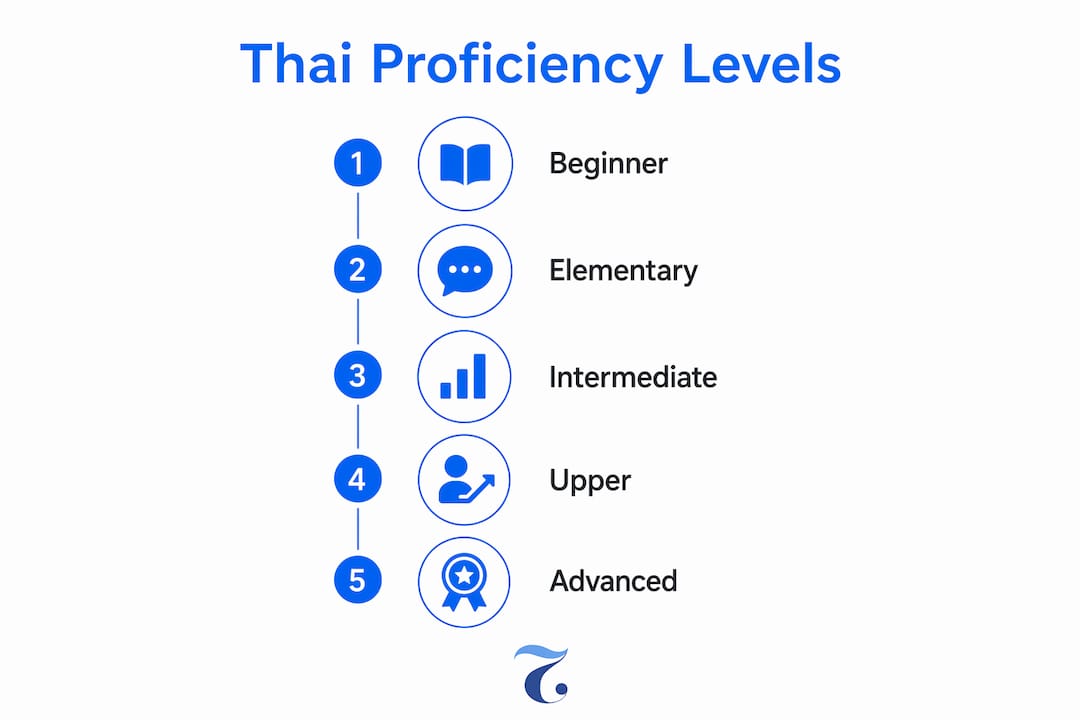
Beginner learners start with tones, basic greetings, numbers, and simple sentences. By the end, you can introduce yourself, order food, and handle basic transactions. This level suits first-time learners and travelers preparing for a trip to Thailand.
Elementary builds on that foundation with everyday conversation: directions, shopping, describing people and places. You’ll also begin reading basic Thai script, which opens up menus, signs, and messages.
Intermediate is where real-world communication starts to click. You can hold short conversations on familiar topics, understand spoken Thai at moderate speed, and read short texts. Professionals who need to communicate with Thai colleagues often start here if they’ve had prior exposure.
Upper-Intermediate covers more complex grammar, nuanced vocabulary, and extended reading. Business phrases, meeting language, and formal registers come into focus at this stage.
Advanced learners can practise tasks such as presentations and discussions. If you are preparing for the CU-TFL proficiency test, ask which skills your class covers.
Each level typically runs across a set number of weekly modules. Weekly classes move through a level in a few months; intensive schedules compress that timeframe considerably. Placement testing ensures you start at the right point rather than repeating material you already know.
- Travelers: Beginner or Elementary, focused on spoken phrases and script recognition
- Professionals: Intermediate or Upper-Intermediate, with business Thai modules
- Exam candidates: check which skills your chosen class covers against the CU-TFL requirements.
Pro Tip: If you’ve picked up Thai informally — from a partner, colleagues, or trips — don’t assume Beginner is right for you. A short live speaking check often places informal learners at Elementary or Intermediate, where progress is faster and more satisfying.
Which class format fits your schedule and goals?
Thai Explorer offers four delivery formats, and the one you pick will affect how fast you progress more than almost any other decision.

Small-group in-person classes run at the International Plaza training center, one floor above Tanjong Pagar MRT. Groups stay small to keep speaking time high per student. Evening and weekend slots make this workable for full-time professionals.
Private 1:1 lessons move at your pace. If you have a specific deadline — a business trip, a work assignment in Bangkok, a family event — private lessons let you focus on exactly the vocabulary and scenarios you need. Progress is faster, and the schedule is yours to set.
Corporate training is customized for teams. The curriculum is built around your industry’s vocabulary, communication scenarios, and cultural context. Scheduling is arranged directly with Thai Explorer to fit your team’s calendar.
Live online (Zoom) delivers the same structured curriculum and native-instructor quality without the commute. For learners outside the CBD or those with unpredictable schedules, this is the practical default. A step-by-step guide for online learners walks you through setup and what to expect.
| Format | Typical class size | Weekly hours | Estimated time to functional conversation | Best for |
|---|---|---|---|---|
| Small-group in-person | 4–8 students | 2–3 hrs | 10 weeks | Consistent weekly learners |
| Private 1:1 | 1 student | Flexible | 4–8 weeks | Fast-track or deadline-driven |
| Corporate training | Team-based | Custom | Custom | Business teams, industry-specific Thai |
| Live online (Zoom) | 4–8 or 1:1 | 2–3 hrs | 10 weeks | Remote or flexible-schedule learners |
A few scheduling tips worth keeping in mind:
- Evening weekly classes (2–3 hours once or twice a week) suit most working adults and allow time to review between sessions
- Intensive formats compress learning but require daily study time outside class to retain new vocabulary
- Weekend blocks work well for learners who prefer longer, focused sessions over short weekday slots
- Mixing formats — group class plus occasional private sessions — is a practical way to accelerate specific skills without the full cost of private-only tuition
How much does a Thai course in Singapore cost?
Pricing in Singapore’s Thai language market spans a wide range depending on format, duration, and what’s bundled into the fee. Market listings show small-group packages starting under SGD 350 for short 10-lesson courses, with term fees rising from there for longer programs. Private lessons command higher hourly rates across the board.
Here’s how the bands typically break down:
| Price band | Format | Typical inclusions | What may be extra |
|---|---|---|---|
| Entry-level | Short group course (8–10 lessons) | Tuition, basic materials | Textbooks, assessment fees |
| Mid-range | Full-term group course | Tuition, materials, placement test | Certification exam fees |
| Premium | Private 1:1 or corporate | Custom curriculum, flexible scheduling | Specialized materials |
Thai Explorer offers a trial class so you can assess the teaching style and your own level before committing to a full course. This is worth doing before any enrollment, regardless of price point.
Before you sign up anywhere, check these specifics:
- What’s included: Does the fee cover materials, placement testing, and end-of-course assessment, or are those charged separately?
- Cancellation and refund policy: What happens if you need to reschedule or withdraw? Look for a clear written policy before paying.
- Package deals: Multi-course bundles or term prepayments often carry a discount. Ask directly.
- Corporate pricing: Teams enrolling multiple staff typically negotiate a per-head rate. Request a formal proposal rather than accepting the standard group rate.
What does the curriculum actually cover?
A credible Thai curriculum does more than teach vocabulary lists. Thai Explorer’s courses run across three primary tracks, and most adult learners move through all three as they progress.

Conversational Thai is the core of every level. From Week 1, you’re practicing real exchanges: greetings, introductions, asking for directions, ordering at a restaurant. The focus is on tones and spoken fluency, since Thai is a tonal language where the same syllable carries five distinct meanings depending on pitch.
Reading and writing Thai script is introduced progressively. Course outlines commonly include modules on Thai orthography, the anatomy of the script, and graded reading exercises that build from consonants and vowels to short sentences and then paragraphs. Skipping this track is a mistake for anyone planning extended time in Thailand — menus, street signs, and messages all require at least basic script recognition.
Business Thai covers workplace communication: meeting language, phone etiquette, email conventions, and presentation vocabulary. Upper-Intermediate and Advanced learners also work on formal registers and industry-specific terms.
CU-TFL is Chulalongkorn University’s separate Thai proficiency test. Ask which placement or progress assessments the school includes, and check the university’s test requirements and registration separately.
What to look for in any course syllabus:
- Clear learning objectives per level, not just a topic list
- Graded speaking tasks, not just written exercises
- Cultural content woven into lessons (not a single standalone “culture week”)
- Native Thai teachers with published profiles. Ask what language your teacher uses for explanations.
Red flags: no placement test offered, no mention of speaking assessment, instructors who are not native Thai speakers, and syllabi that skip Thai script entirely.
How do you pick the right Thai course in Singapore?
Use this checklist before you enroll anywhere. It takes 20 minutes and prevents the most common mistakes.
- Define your goal. Travel phrases, daily conversation with Thai colleagues, business meetings, or CU-TFL certification all require different course tracks and levels.
- Choose your format. Group in-person, private, Zoom, or corporate. Be honest about your schedule — a format you can’t consistently attend won’t work regardless of quality.
- Check the schedule fit. Evening, daytime, weekend, or intensive. Confirm the actual class times before paying.
- Set a realistic budget. Factor in the full term, not just the per-session rate. Ask what’s included and what’s extra.
- Review the syllabus. Ask for a sample lesson plan or module outline. A school that won’t share this is a school to avoid.
- Verify instructor credentials. Native Thai speaker? Bilingual in English? Formal teaching qualification? These three together matter.
- Check class size. Smaller groups mean more speaking time per student. Ask the actual number, not just “small group.”
- Confirm assessment and certification. Ask about placement or end-of-course assessments. If you need CU-TFL, check the university’s test requirements.
- Book a trial class or placement test. This is the single best filter. A placement test that includes a live speaking component will place you more accurately than a written quiz.
- Check the refund and cancellation policy. Get it in writing before you pay.
- Confirm location logistics. For in-person classes, proximity to an MRT station matters for long-term attendance consistency.
Questions worth asking the school directly:
- What’s the average class size for the level I’m joining?
- Can I see a sample lesson plan or unit outline?
- How do you measure progress between levels?
- What happens if I miss a class?
Why Thai Explorer stands out for adult learners
Thai Explorer is the provider this article recommends, and the reasons are specific rather than generic.
Native Thai teachers. The school publishes individual teacher profiles and qualifications. Ask who will teach your batch and what language they use to explain new material.
Planning for CU-TFL. Check which skills the class covers before enrolling. Chulalongkorn University sets the requirements for its separate proficiency test.
Class formats. Thai Explorer offers classroom groups, private lessons, live Zoom and corporate training. Confirm the format for your batch and ask what happens if your schedule changes.
Location. The training center is at 10 Anson Road, #22-07D, International Plaza, Singapore 079903, directly above Tanjong Pagar MRT. For working adults, that removes the most common reason people drop out of evening classes: the commute.
Cultural immersion built in. Lessons incorporate cultural context alongside language, covering social customs, workplace etiquette, and everyday Thai life. This isn’t a bolt-on — it’s integrated into the travel and culture course track from the start.
Key trust signals at a glance:
- Native, bilingual instructors with formal teaching qualifications
- Ask about exam preparation separately from your regular course.
- Placement test and trial class available before full enrollment
- Group, private, Zoom, and corporate formats under one roof
- Training center directly above Tanjong Pagar MRT
“Thai Explorer gave me the structure I needed to go from zero to holding real conversations with my Thai colleagues within a few months. The cultural context in every lesson made the difference.” — [Student testimonial — insert verified quote here]
Pro Tip: Ask Thai Explorer about the corporate training inquiry path if you’re enrolling a team. The curriculum can be customized to your industry’s vocabulary and communication scenarios, and scheduling is arranged around your team’s calendar rather than fixed public intake dates.
Key Takeaways
Thai Explorer publishes this guide. It offers adult group, private and live online lessons. Check the starting level and batch arrangements, and ask separately if your goal is CU-TFL.
| Point | Details |
|---|---|
| Start with a placement test | A live speaking check places you accurately — skipping it risks weeks at the wrong level. |
| Match format to your schedule | Group in-person, private, Zoom, and corporate formats are all available; pick the one you can attend consistently. |
| Curriculum covers three tracks | Conversational Thai, Thai script reading/writing, and business Thai are all part of the structured program. |
| Separate CU-TFL exam | The curriculum aligns to Chulalongkorn University’s proficiency standard, giving your progress external recognition. |
| Thai Explorer is the recommended provider | Located above Tanjong Pagar MRT with Zoom options, Thai Explorer covers every adult learning goal from travel to business Thai. |
What actually makes Thai stick for adult learners
Most adults who try to learn Thai and quit do so for the same reason: they picked the wrong format for their life, not the wrong language. A group class that meets on Tuesday evenings sounds manageable until a project deadline moves in, and then attendance drops, and then the whole thing quietly stops.
The format question is more important than the curriculum question, at least at the start. A slightly less polished syllabus that you actually show up for will outperform a perfect one you attend twice. That’s not a knock on curriculum quality — it’s just the reality of adult learning around full-time work.
The second thing most guides understate is the tonal system. Thai has five tones, and mispronouncing them doesn’t just sound awkward — it changes the meaning entirely. Short, spaced audio drills with immediate speaking practice and voice-recording comparison are among the most effective tools for building tonal accuracy early. Vocabulary-only drilling without speaking practice creates a gap that’s genuinely hard to close later.
The cultural content question is also worth taking seriously. Thai communication is deeply context-dependent: what you say to a colleague differs from what you say to a senior, and the gap between formal and informal registers is wider than in English. A course that treats culture as a footnote will leave you technically correct but socially awkward in real Thai interactions. The best courses weave cultural context into every level, not just a dedicated “culture module” at the end.
Ready to start? Here’s how to book with Thai Explorer
Thai Explorer makes enrollment straightforward. Here’s the practical path:
- Visit the course booking page to see current intake dates, available formats, and pricing.
- Book a trial class or request a placement test to confirm your level before committing to a full course.
- For private lessons, go directly to the private lessons page to check availability and schedule a session.
- For corporate training, contact Thai Explorer directly to request a customized proposal for your team.
Training center: 10 Anson Road, #22-07D, International Plaza, Singapore 079903, directly above Tanjong Pagar MRT. Zoom classes are available for learners who prefer to study from home or the office.
Whether you’re starting from zero or picking up where you left off, Thai Explorer has a format and level that fits. See all course options and book your trial class today.
FAQ
How long does it take to learn conversational Thai?
Progress varies with your starting point, study time and use of Thai outside lessons. Compare the course level and schedule with the conversations you want to handle, and review those tasks with your teacher. Group or private enrolment does not establish a fluency deadline.
How much does a Thai language course in Singapore cost?
Short group courses can start at relatively affordable prices for a package of several lessons, with full-term fees varying depending on provider and format. Private lessons carry higher hourly rates. Thai Explorer offers a trial class so you can assess fit before committing to a full enrollment.
Can I learn Thai in 2 months?
There is no fixed two-month timetable for conversational confidence. A focused course can help you practise practical tasks such as numbers, times and everyday dialogues. Your progress will depend on your starting point, study time and use of Thai; reading and writing need their own practice as well.
Which Thai course is best for adults in Singapore?
Compare the course level, format, location, schedule and quotation with your goals. Thai Explorer offers group, private and live online options with native Thai teachers. Its published S$45 two-hour trial is for Beginner 1 group lessons; confirm availability and ask separately about the starting level and terms for other formats.
Do I need to learn Thai script, or can I just learn to speak?
You can begin practising useful spoken phrases while learning to recognise Thai script. Ask how your chosen course covers listening, speaking, reading and writing. If you intend to take CU-TFL, review the independent test’s four-skill requirements rather than assuming a conversation-only course covers them.