
Teach Thai by training the ear first. Prioritize the five tones and spoken practice for two full weeks before introducing the script, then move through vocabulary into real conversation over an eight-week arc. This tone first order, paired with a staged classroom sequence, prevents the pronunciation errors that otherwise stick for years.
TL;DR:
- Teaching Thai starts with ear training and tone practice for the first two weeks to prevent fossilized pronunciation errors.
- The recommended eight-week sequence progresses from tone perception to script reading, vocabulary growth, and conversational practice.
- Focused listening and minimal pair drills, combined with limited vocabulary in early weeks, enhance tonal accuracy and retention.
- Integrating cultural context and social signals early ensures students sound natural and polite in real-life interactions.
- Using technology for reinforcement while prioritizing human correction helps maintain speech quality without reliance on apps.
Table of Contents
- How Do You Teach Thai the Right Way?
- Tone First 8-Week Classroom Sequence
- Lesson Templates You Can Use This Week
- Teaching Adult Learners Without Losing Half the Class
- Resources and Materials Worth Building Into Your Syllabus
- How to Check Progress and Map It to CU-TFL
- Teaching the Cultural Layer, Not Just the Language
- Teaching Thai to Adults vs. Children
- Using Technology Without Letting It Replace Practice
- Bringing In the Thai Script Without Slowing Down Speech
- Building Listening and Speaking as Separate Skills
- Teaching Grammar Without Overwhelming Non-Native Learners
- What Actually Works in the Classroom
- Ready to Teach the Tone First Method in a Real Classroom?
- Sources
- FAQ
How Do You Teach Thai the Right Way?
Thai is a tonal language, meaning the same syllable said with a different pitch contour becomes a completely different word. Say “mai” with a falling tone and you get “new.” Say it with a rising tone and it means “burn.” Get the tone wrong in month one, and most learners keep getting it wrong for years, because early mispronunciations tend to calcify once they are repeated without correction.
That is the core argument for sequencing instruction around sound before symbol. Guidance on beginner learning plans consistently recommends training the ear to Thai’s five tones before introducing the script, specifically to avoid locking in incorrect pronunciation patterns. Once a student has read a word with the wrong tone baked into their mental model, the script itself becomes a crutch that reinforces the mistake every time they see it.
What this means for lesson design:
- Open every early lesson with listening and imitation, not reading.
- Delay romanized transliteration wherever possible. It teaches English sound habits, not Thai ones.
- Build in quick tone checks. A 90-second call and response drill at the start of class tells you immediately who is hearing mid tone as low tone.
- Keep vocabulary tiny in week one. Ten words drilled correctly beat fifty words half learned.
Pro Tip: Record each student saying the same five words in week one and again in week four. The side by side comparison is the single most convincing piece of feedback you can give an adult learner who thinks they are not progressing.
Tone First 8-Week Classroom Sequence
Thai Explorer built its classroom methodology, the Four Stage Tone First Plan, around a simple premise: sound, then symbol, then vocabulary, then conversation. The eight-week version below compresses that plan into a syllabus you can adapt directly, whether you run group classes or one-on-one sessions.
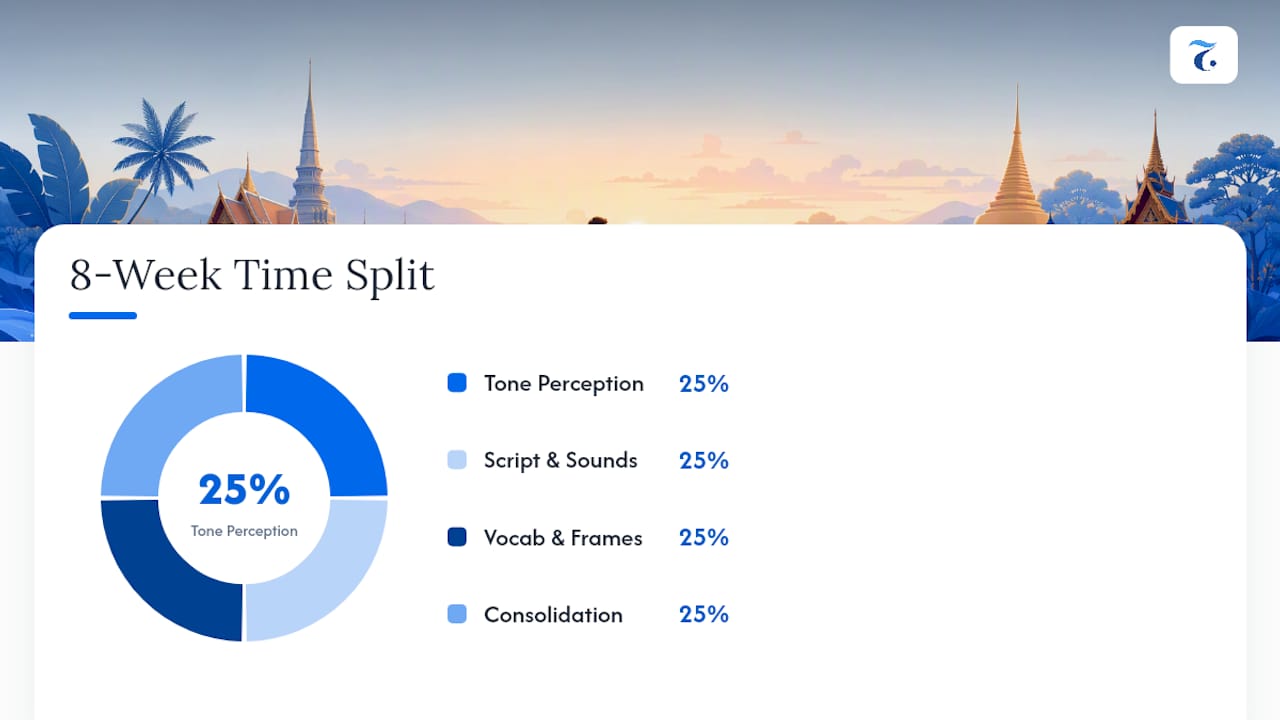
- Weeks 1 to 2: Tone perception and minimal pairs. Students listen to paired words that differ only by tone (khaa/khàa, for example) and identify which one they hear before attempting to say it themselves. Sessions run short, high frequency listening blocks rather than long lectures. Homework is a five-minute daily voice recording, self-checked against a reference clip.
- Weeks 3 to 4: Consonants and vowels tied to known sounds. Once students can reliably hear the five tones, introduce the script’s consonants and vowels using only the sounds already drilled aloud. Reading practice stays controlled, matching letters to words the class can already pronounce correctly. This is where the Thai tones system starts reinforcing literacy instead of fighting it.
- Weeks 5 to 6: Vocabulary expansion and sentence frames. Add polite particles (khrap/kha), greetings, and functional sentence patterns for ordering food or asking directions. Role plays and paired drills dominate class time.
- Weeks 7 to 8: Consolidation and assessment rehearsal. Longer, semi-scripted conversations replace drills. Students rehearse the kind of speaking tasks that appear in a formal proficiency check.
Homework across all eight weeks follows the same rubric structure: a tone accuracy score, a vocabulary recall score, and a fluency comment, each scored on a simple three point scale so progress is easy to track week over week.
Pro Tip: Never assign more than two new sentence frames per lesson in weeks 5 and 6. Adults retain grammar patterns better when they overlearn a few frames than when they skim ten.
Lesson Templates You Can Use This Week
A 60 to 90 minute class works best when it is built from interchangeable blocks rather than one long activity. Below are three templates pulled directly from the tone first sequence, each usable on its own or stacked into a longer session.
Template A: Tone drill and imitation (20 to 25 minutes)
- Warm up with five minimal pairs from the previous lesson (5 minutes).
- Introduce two to three new minimal pairs using audio clips, not the teacher’s voice alone (10 minutes).
- Round robin repetition, correcting one student at a time with immediate feedback (10 minutes).
Template B: Vocabulary plus sentence frames (25 to 30 minutes)
- Present five to eight new words tied to a single theme, such as ordering food (10 minutes).
- Build one sentence frame using the new vocabulary, drilled chorally first, then individually (10 minutes).
- Short paired dialogue using the frame, swapping partners once (10 minutes).
Template C: Script introduction (15 to 20 minutes)
- Show two to three new letters, using only sounds students already produce correctly.
- Have students trace and say each letter aloud together, never silently.
- Close with a matching exercise: sound to symbol, not symbol to meaning.
Materials worth keeping on hand: a bank of short audio clips organized by tone pair, a simple flashcard set for vocabulary themes, and a spaced repetition schedule for homework review. A quick exit task, such as saying one sentence correctly before leaving, gives you a running formative assessment without extra grading time.
Teaching Adult Learners Without Losing Half the Class
Adult students split roughly into two camps: travelers who want survival phrases fast, and professionals or certification candidates who need durable grammar and reliable pronunciation. A single syllabus rarely satisfies both without some flexing.
- For travel-focused learners, front-load practical phrases and accept looser grammar accuracy in exchange for confidence.
- For certification candidates, slow down weeks 3 through 6 and add extra written practice, since formal assessments weight accuracy more heavily.
- Use micro-feedback rather than long corrections. A single word repeated back with the right tone teaches faster than a grammar explanation mid conversation.
- Let peers correct each other during drills. Adults often accept a peer’s gentle correction better than a teacher’s, and it doubles the speaking practice happening in the room.
Pro Tip: In mixed-ability groups, pair your strongest speaker with your newest student during role plays. The stronger student gets fluency practice modeling correct speech, and the newer student hears native-paced Thai without the pressure of a teacher watching directly.
Resources and Materials Worth Building Into Your Syllabus
Free university content fills gaps well when you cannot record every drill yourself. Chulalongkorn University’s MOOC, Communicative Thai for Foreigners, offers a practical early-learner sequence built around everyday phrases and basic grammar, useful as a model for your own week 5 and 6 sentence frames. Thammasat University’s free course runs 15 lessons across 10 weeks, and its listening modules compress neatly into an eight week intensive schedule if you double up homework.
For homework supplements, language exchange apps and recorded voice check loops give students corrective feedback from native speakers outside class hours, which matters most in weeks 1 and 2 when tone habits are still forming.
| Resource type | Best use in your syllabus |
|---|---|
| University MOOC lessons | Model sentence frames and vocabulary themes for weeks 5 to 6 |
| Structured 10-week course audio | Listening homework, compressed into an 8-week schedule |
| Language exchange apps | Voice feedback homework, especially weeks 1 to 2 |
| Spaced repetition tools | Vocabulary retention between weeks 3 and 8 |
How to Check Progress and Map It to CU-TFL
Formative checks work best when they are short, frequent, and tied to a visible milestone rather than a single big test at the end. A simple three category rubric, tone accuracy, phrase production, and role play fluency, scored weekly, gives you an early warning system for students falling behind.
- End of weeks 1 to 2: student reliably distinguishes and produces at least three tone pairs.
- End of weeks 3 to 4: student reads back ten known words correctly from the script.
- End of weeks 5 to 6: student completes a role play using two sentence frames without prompting.
- End of weeks 7 to 8: student handles a short, unscripted conversation on a familiar topic.
Once a cohort clears the week 8 milestone consistently, that is the point to introduce formal CU-TFL preparation as its own module, since the proficiency check weights sustained conversation and accurate tone production far more heavily than isolated vocabulary recall.
Teaching the Cultural Layer, Not Just the Language
Thai communication carries social signals that grammar drills never touch. The particles khrap and kha are not optional politeness, they mark gender and social register in nearly every sentence, and skipping them in classroom practice teaches a version of Thai that sounds abrupt to native ears.
Hierarchy shows up constantly in vocabulary choice. The pronoun and verb a student uses with a close friend differs from what they would use with an elder or a boss, and this is not a footnote, it is central to sounding natural. Weave this into role plays early rather than treating it as an advanced topic. A week 5 ordering-food dialogue is the perfect place to practice both the casual and respectful versions of the same request.
Wai, the traditional greeting gesture, and the broader concept of kreng jai, a deference to others’ feelings that shapes how requests and refusals get phrased, both affect how directly students should be taught to speak. A literal translation of “no” often sounds ruder in Thai social context than the equivalent English word does. Building cultural context into language lessons from week one, rather than bolting it on later, means students leave with phrasing that lands the way they intend it to.
Simple additions work well: a five minute cultural note tied to each new vocabulary theme, short video clips showing real interactions, and explicit discussion of when directness is fine versus when it reads as rude. None of this needs its own separate unit. It threads through every lesson that already exists.
Teaching Thai to Adults vs. Children
Adult classrooms and children’s classrooms run on almost opposite engines, and a syllabus built for one rarely transfers cleanly to the other.
Adults bring metalinguistic awareness. They can discuss grammar rules explicitly, understand why a tone changes meaning, and tolerate direct correction if it is framed usefully. That means an adult classroom can move faster through explicit rule explanation, but it also means adults carry more self-consciousness about sounding foolish, which slows down spontaneous speaking unless a teacher actively builds low-pressure practice into every session.
Children absorb tone patterns through repetition and play without needing the theory behind it, and they tend to imitate native pronunciation with less interference from their first language. But children also lose focus faster, need shorter activity blocks, and require content wrapped in games or stories rather than sentence frames and drills.
The practical difference for a program coordinator: adult sessions can run 60 to 90 minutes with structured drills and explicit grammar notes, while sessions built for younger learners need constant activity switching and almost no abstract explanation. Adults also arrive with specific goals, business travel, family communication, certification, that shape which vocabulary themes matter, so a program built purely for adult professional and conversational use should lean into scenario-based practice: negotiating a business meeting, giving directions to a taxi driver, or making small talk with in-laws, rather than generic classroom vocabulary.
Using Technology Without Letting It Replace Practice
Technology helps most when it fills the gaps between class sessions, not when it becomes the primary teaching tool. Audio clips organized by tone pair let students drill listening discrimination at home in five minute bursts, which matters far more for tone acquisition than an app that gamifies vocabulary matching.
Spaced repetition software works well for vocabulary retention once students have already learned a word’s correct pronunciation aloud. Loading a new word into a spaced repetition deck before a student has heard and repeated it correctly just risks digitizing a bad habit. Sequence matters here as much as it does in the classroom itself.
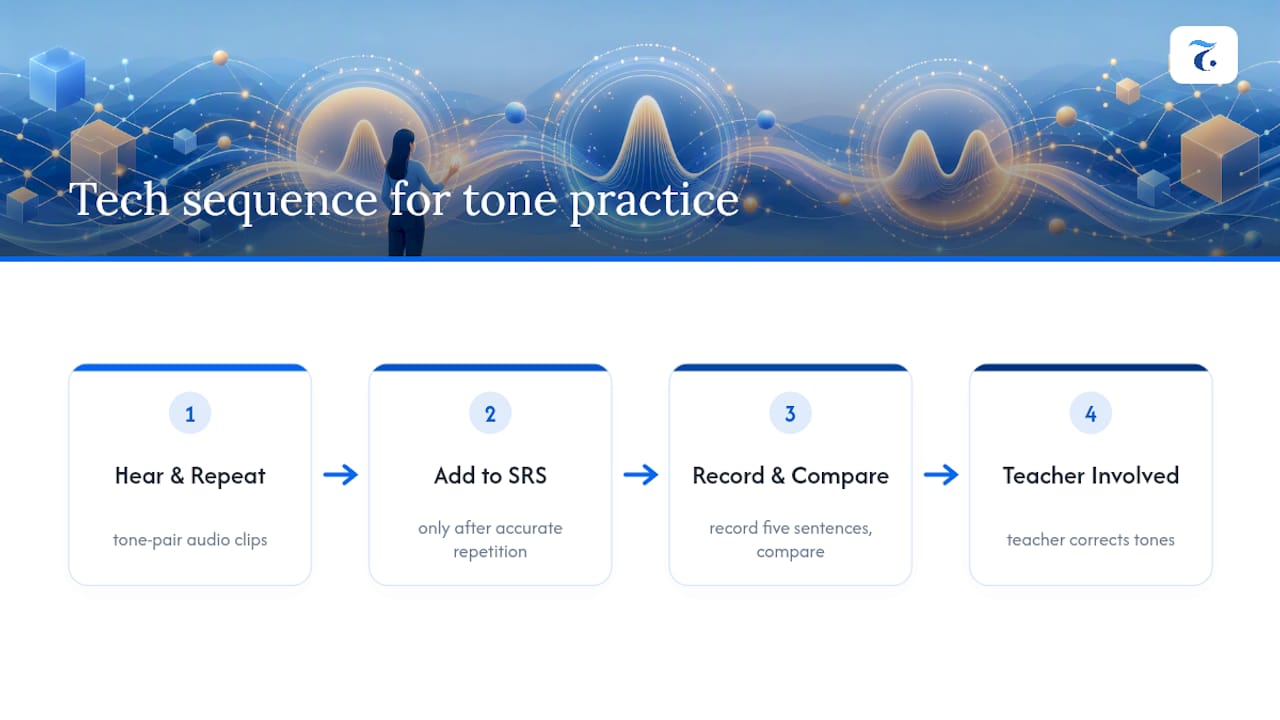
Voice recording tools deserve a permanent spot in the homework rotation. Asking students to record themselves saying five sentences, then comparing that recording to a reference clip, catches tone errors that self-assessment alone misses. Video call platforms extend this further for online course formats, where a teacher can screen share a script excerpt while still running the session as a live speaking class rather than a passive video lecture.
The trap to avoid: letting an app’s built-in scoring substitute for a teacher’s ear. Most consumer language apps grade pronunciation loosely, and a student who scores well on an app can still produce a tone a native speaker would flag immediately. Use technology for repetition and homework logistics, and keep tone correction itself in human hands.
Bringing In the Thai Script Without Slowing Down Speech
The script should never be the first thing a beginner sees, and it should never disappear entirely either. The sweet spot sits around week 3, once a student can reliably hear and reproduce the tones tied to a small set of consonants and vowels already used in their spoken vocabulary.
Introduce letters in tiny batches, two or three per session, always matched to sounds the class has already drilled aloud. This turns reading practice into pronunciation reinforcement instead of a separate, competing skill. A student who sees the letter for a sound they can already say correctly locks that sound in faster than one memorizing an abstract character in isolation.
Avoid heavy reliance on romanized transliteration past the first two weeks. Romanization is a useful crutch for the very first tone drills, but leaning on it into week 4 or 5 teaches students to read Thai sounds through an English filter, which reintroduces the exact pronunciation drift the tone first order was designed to prevent.
Literacy progression from there follows a simple arc: recognize individual letters tied to known sounds, then read short known words, then sound out new but phonetically regular words, then finally read unfamiliar text. Rushing straight to the last stage without the earlier steps is the most common mistake in self-directed study, and it is exactly what a staged classroom sequence is built to prevent.
Building Listening and Speaking as Separate Skills
Listening and speaking develop at different rates, and treating them as one combined skill slows both down. A student can often understand far more Thai than they can produce, and a curriculum that only measures speaking output misses that gap entirely.
Dedicated listening practice should involve material slightly above a student’s current speaking level, since comprehension tolerates more complexity than production does. Short audio clips, native speaker conversations, and structured course listening modules like those in Thammasat University’s free program work well here because they expose students to natural speech rhythm without requiring them to respond in real time.
Speaking practice, by contrast, needs to stay tightly scoped to what a student can produce accurately. Pushing speaking output ahead of listening comprehension is a common shortcut that produces confident but sloppy pronunciation, since students end up guessing at sounds they have not actually internalized yet.
The fix is running both skills on parallel but distinct tracks within the same lesson: a listening segment focused on recognition and comprehension, followed by a speaking segment focused only on material the class has already heard and understood. Role plays sit at the intersection of both, since they force students to listen to a partner in real time while producing their own response, which is exactly the kind of pressure a formal conversation later requires.
Teaching Grammar Without Overwhelming Non-Native Learners
Thai grammar surprises English speaking learners in a few specific ways: no verb conjugation, no plural markers, and a sentence structure that often relies on context and particles rather than word endings to convey meaning. That absence of conjugation is genuinely good news for adult learners, since it removes an entire category of memorization that dominates grammar study in many other languages.
What replaces conjugation is a heavier reliance on word order, time markers, and particles to convey tense and nuance. Teaching “will” as a standalone future marker, or explaining how context alone signals past tense in casual speech, matters more than any verb table. Sentence frames introduced in weeks 5 and 6 should therefore focus on swapping time markers and particles into a stable structure, rather than teaching grammar rules in the abstract.
Classifiers present the other major hurdle. Thai requires a specific counting word depending on the category of object, a rule with no direct English equivalent. Introduce classifiers gradually, tied to vocabulary students already use, rather than presenting a long list upfront. A student ordering food only needs the classifier for dishes and drinks in week 5; the classifier for vehicles or animals can wait.
The overarching principle: teach grammar as a tool embedded inside sentence frames students are already practicing aloud, not as a separate theoretical unit. Grammar explained in isolation from speaking practice rarely survives contact with a real conversation.
What Actually Works in the Classroom
Two small tricks move the needle on tone uptake more than anything in a textbook. First, minimal pair drills work better when students guess the meaning before they see it written, because it forces active listening instead of passive recognition. Second, exaggerating tone contours slightly during early drills, almost cartoonishly, helps adult ears that are new to tonal distinction hear the difference before they can produce it naturally.
Students who lean too hard on romanization usually need a direct conversation, not a workaround. Point out plainly that romanized spelling cannot represent Thai tones accurately, and that continuing to read it will slow their progress rather than speed it up.
For cohorts with uneven attendance, keep each lesson self-contained enough that missing one session does not derail the sequence, and build a five minute recap into the start of every class.
— Paul
Ready to Teach the Tone First Method in a Real Classroom?
Everything in this syllabus reflects a practical approach to running Thai language classrooms. The Four Stage Tone First Plan and the eight week sequence described above represent a structured methodology for lessons led by bilingual native Thai instructors, designed to support progression markers from early stages.

If you are building a program for adult learners, whether that is a corporate team learning Thai for business trips or a group of professionals prepping for a proficiency benchmark, you do not have to build every drill and rubric from scratch. The described staged order can be applied in group, private, and online classes, with formative checks included periodically instead of relying on a single high stakes exam.
Explore the available course formats to see which structure fits your schedule, or start with a trial lesson to see the tone first approach in action before committing to a full syllabus. Classes run in person at 10 Anson Road, #22-07, International Plaza, Singapore 079903, right above Tanjong Pagar MRT, as well as fully online for teams and individuals who need flexible scheduling.
Sources
Beyond the tone first methodology described above, a few sources helped shape the eight week sequence. Chulalongkorn University’s Communicative Thai for Foreigners MOOC offers a model early-learner syllabus. Thammasat University’s free online Thai course provides structured listening modules. The CMKL Thai Guidebook supplies classroom-ready number pronunciations. For a broader look at structuring adult course offerings, this enrollment guide covers general best practices worth adapting.
- How to Start Learning Thai: A Beginner Plan for Today – HelloTalk Blog
- Communicative Thai for Foreigners (Chulalongkorn MOOC)
- Thai language course (Thammasat University OIA)
FAQ
What Is the Easiest Way to Learn Thai?
Most learners progress fastest by training their ear to the five tones before touching the script, then layering vocabulary and conversation on top of that foundation, with short daily practice sessions of 15 to 30 minutes.
How Do You Say “I Love You” in Thai?
“I love you” is expressed as “chan rak khun” when speaking formally or to someone you do not know well, though close relationships often use shorter, more casual phrasing depending on context and gender particles.
How Do You Say “Hi” in Thai?
A common greeting is “sawasdee,” followed by “khrap” if the speaker is male or “kha” if the speaker is female, since these particles mark politeness and gender in nearly every Thai sentence.
How Do You Count From 1 to 10 in Thai?
The numbers 1 through 10 are nèung, sŏng, săam, sìi, hâa, hòk, jèt, bpàet, gâao, and sìp, and drilling these aloud with tone emphasis works better than memorizing them silently from a written list.
How Long Does It Take to Learn Basic Thai?
An intensive tone-first learning approach helps adult learners achieve basic conversational skills for familiar topics within a couple of months, though sustained fluency and formal proficiency preparation generally require much longer ongoing study.