
Learn Chinese because it gives you direct access to over a billion native speakers, a measurable career edge, unique cognitive gains, and cultural material that never survives translation intact. Those four categories, reach, career, brain, and culture, cover nearly every legitimate reason adults commit to studying Mandarin, and each one holds up under scrutiny far better than vague talk of “opening doors.”
TL;DR:
- Fluency in Mandarin can provide direct communication with over 1.2 billion native speakers, significantly expanding personal and professional reach.
- Achieving conversational fluency typically takes 18 to 24 months of consistent effort, with around 500 to 1,000 high-frequency words as achievable milestones within a year.
- Mandarin skills directly boost career opportunities in trade, localization, diplomacy, and tourism sectors, often serving as a key differentiator in competitive markets.
- Learning Chinese engages unique brain regions related to visual-spatial processing and motor control, benefiting cognitive skills over long-term practice.
- Pairing language study with cultural understanding, especially of idioms and historical references, deepens meaningful connection and avoids superficial translation limitations.
Table of Contents
- What’s the Best Reason to Learn Chinese Right Now?
- How Does Learning Chinese Help Your Career?
- Does Learning Chinese Actually Change How Your Brain Works?
- What Cultural Doors Open Once You Speak Chinese?
- How Long Does It Take to Learn Chinese?
- Why Culture Study Matters as Much as Vocabulary
- Who Should Start Learning Chinese Today?
- Thinking About Starting an Asian Language? Consider Thai First
- Sources
- FAQ
What’s the Best Reason to Learn Chinese Right Now?
Mandarin is the most widely spoken first language on Earth, with roughly 1.2 billion native speakers, about one in every six people alive. That single fact anchors almost every other benefit on this list, but it’s not the only one worth your time.
- Population reach. No other language connects you to as many native speakers in one linguistic system, which matters whether you’re doing business, traveling, or just want to talk to more people in the world.
- Career and business openings. Companies with supply chains, manufacturing partners, or customers tied to Chinese-speaking markets consistently value staff who can operate without a translator in the room.
- Travel that actually works. Ordering food, negotiating a taxi fare, or asking for directions off the tourist track gets dramatically easier once you can manage basic Mandarin.
- Access to original media. Films, C-pop, and literature lose nuance in translation; understanding the language means you get the joke, the pun, or the historical reference intact.
- Cognitive stretch. Tonal distinctions and character memorization work your brain differently than most alphabetic languages do, a point backed by research described below.
- Guanxi and relationship-building. In many Chinese business and social contexts, showing you’ve invested in the language signals respect and long-term intent, not just transactional interest.
- Resume differentiation. Fewer professionals speak Mandarin well than you’d expect given China’s economic footprint, so real fluency still stands out.
- Lower barrier to entry than a decade ago. Apps, tutor marketplaces, and AI conversation tools have made starting cheaper and less intimidating than it used to be.
Statistic to remember: with 1.2 billion native speakers, Mandarin outranks every other language for sheer number of people you could talk to without an intermediary.
How Does Learning Chinese Help Your Career?
Trade, tech supply chains, localization, diplomacy, and tourism are the industries where Mandarin skill converts most directly into job opportunities. Companies sourcing manufacturing from China, software firms localizing products for Chinese markets, and government or NGO roles involving Asia-Pacific relations all list Mandarin as a differentiator, sometimes a requirement. Broader language-learning research points to real career and travel advantages tied to Chinese proficiency specifically.
- Trade and logistics roles increasingly want staff who can read shipping documents and negotiate directly.
- Localization and tech firms need Mandarin speakers to adapt products for the Chinese-speaking world.
- Diplomatic and NGO positions in Asia-Pacific regions often list Mandarin as a preferred skill.
- Tourism and hospitality businesses serving Chinese travelers pay a premium for staff who can communicate without a translator app.
Language skill also functions as a soft-skill signal. In many Chinese professional settings, the concept of guanxi, relationship-based trust built over time, rewards people who’ve clearly invested effort into understanding both the language and the culture behind it.
Pro Tip: Add “Mandarin, conversational” or “Mandarin, business-level” to your LinkedIn skills section as soon as you can hold a basic work conversation. Recruiters search for it, and even modest fluency gets you noticed before you’re fully proficient.
Does Learning Chinese Actually Change How Your Brain Works?
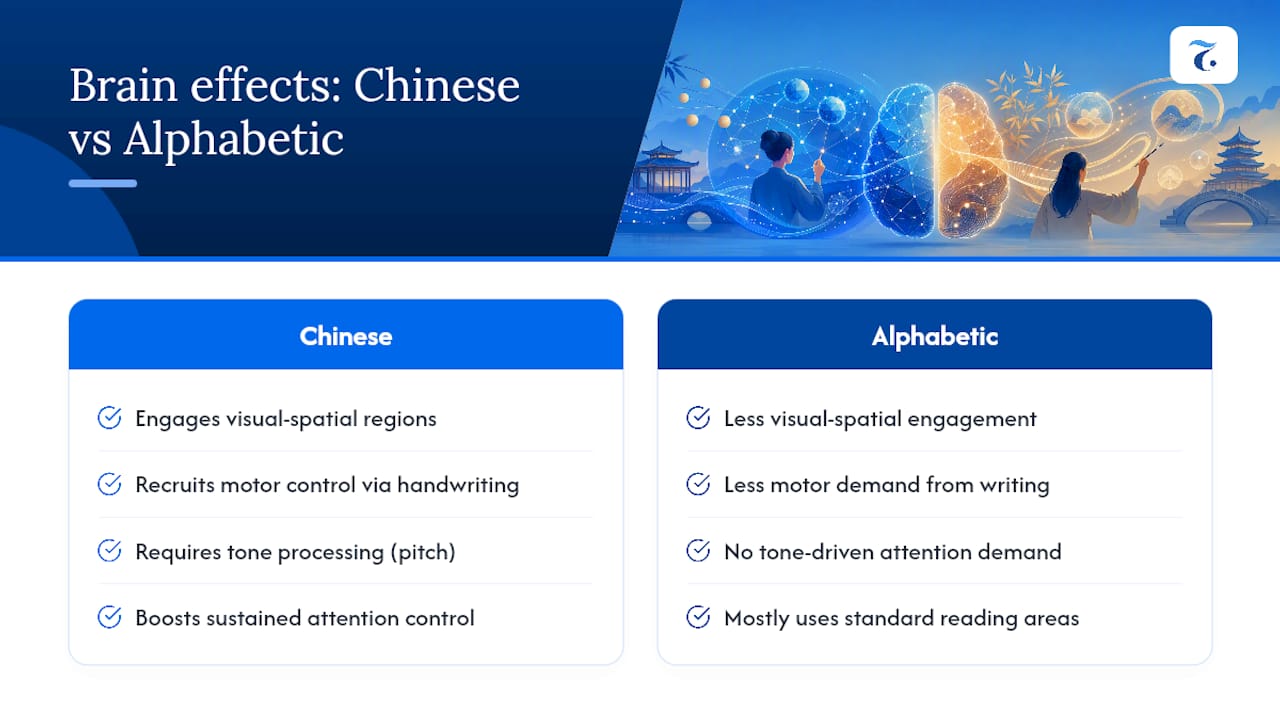
Yes, and the mechanism is more specific than generic “language learning is good for you” advice. Chinese requires processing tone alongside meaning and recognizing thousands of visually distinct characters, tasks that draw on brain systems alphabetic languages barely touch.
Research summarized by Asia Society found that learning Chinese engages brain regions tied to visual-spatial processing and motor control in ways alphabetic languages typically don’t, because tone recognition and character writing recruit systems beyond the areas used for reading English.
Character handwriting practice in particular builds visual-spatial and fine motor skills through repeated stroke-order training, a side effect no vocabulary app fully replicates. The tonal system, where the same syllable means different things depending on pitch, forces sustained attention control that carries over into other memory tasks.
These gains aren’t instant. They build with consistent practice over months, not a few weeks of casual app use, so treat cognitive benefits as a long-term dividend rather than a quick fix.
What Cultural Doors Open Once You Speak Chinese?
Chengyu, four-character idioms packed with centuries of historical reference, are essentially untranslatable without losing their punch. The same goes for wordplay in Chinese cinema, the double meanings baked into C-pop lyrics, and poetry that relies on character structure itself for meaning. Chinese music’s growing global reach means more of this material is now just a search away, but only fully rewarding once you understand it directly.
- Basic phrases transform travel: ordering food, bargaining at a market, or asking a shopkeeper for a recommendation all go smoother.
- Understanding politeness formulas, like how to address elders or decline an invitation gracefully, prevents accidental rudeness.
- Reading a chengyu in context reveals historical or literary depth that a translated caption strips away.
- Following cultural exchange experiences alongside language study deepens what you take away from any trip.
Pairing language study with cultural context, not just vocabulary drills, is what turns basic competence into real connection.
How Long Does It Take to Learn Chinese?
Realistic timelines depend heavily on your goal. Many learners reach conversational fluency, enough for daily interactions and casual conversation, within 18 to 24 months of consistent daily study. Professional working proficiency is a bigger commitment, with the Foreign Service Institute estimating around 2,200 hours of study for that level.
- Start with tones and pronunciation. Get the four tones right before you build vocabulary; bad tone habits are hard to unlearn later.
- Learn high-frequency vocabulary first. The most common 500 to 1,000 words cover a surprising share of daily conversation.
- Practice speaking early and often. Passive listening alone won’t get you to conversational ability.
- Track measurable milestones. Aim for basic conversation ability within 6 to 12 months and roughly 500 active words as your first checkpoint.
Apps work well for vocabulary drilling, tutors accelerate speaking confidence, and structured classes add accountability that solo study often lacks.
Pro Tip: Set a specific milestone, like ordering a full meal in Mandarin, rather than a vague goal like “get better.” Specific targets are far easier to measure and far more motivating.
Why Culture Study Matters as Much as Vocabulary
Boston University’s language faculty note that studying Chinese effectively means pairing the language with its culture and history, not learning grammar and vocabulary in isolation. Cultural fluency, they argue, is half the work of real language competence.
That same logic applies professionally: demonstrating persistence and cultural respect through language study is itself a signal employers notice in international roles.
Who Should Start Learning Chinese Today?
Anyone weighing career mobility, an upcoming trip, or a genuine curiosity about a culture with a few thousand years of continuous written history has a legitimate reason to start. The learners who stick with it tend to have one clear, specific goal, not “I want to be fluent someday,” but “I want to hold a business meeting in Mandarin by next year.” Pick one goal, commit to daily practice even in small doses, and don’t wait for a perfect study plan before you begin.
— Paul
Thinking About Starting an Asian Language? Consider Thai First
If Mandarin’s tones and character system feel like a steep first climb, Thai offers a gentler on-ramp into Asian language learning with its own tonal system, cultural depth, and practical payoff for travel and business in Southeast Asia. Adult Thai courses are available in Singapore, in-person, online via Zoom, and through corporate training, built for conversational and business use rather than academic requirements.

Classes run in small groups, one-on-one, or fully online, with bilingual native instructors guiding you through practical, real-world communication rather than rote drills. The training center sits at 10 Anson Road, #22-07, International Plaza, Singapore 079903, right above Tanjong Pagar MRT, an easy stop before or after work. If you want a structured path into an Asian language with flexible scheduling, check out the Thai language course options, and find a class format that fits your goals.
Sources
- Most spoken language in the world
- Learning Chinese pays dividends: characters and cognition — Asia Society
- Why study Chinese? | Boston University World Languages & Literatures
- Why learn Chinese — EF GO Blog
FAQ
What is the most useful second language to learn?
It depends on your goals, but Mandarin ranks near the top for sheer reach, with 1.2 billion native speakers worldwide, plus strong career and business advantages tied to it.
What jobs can I get if I learn Chinese?
Trade and logistics, tech localization, diplomacy, tourism, and international business development all actively seek Mandarin speakers, often paying a premium for staff who can operate without a translator.
What are the benefits of learning simplified Chinese?
Simplified characters, used in mainland China, are generally faster to write and read for beginners, making them a practical starting point for most new learners focused on business or everyday communication.
Is it better to learn Mandarin or Chinese?
Mandarin is a specific dialect of Chinese, the most widely spoken one, so when people say “learn Chinese” for practical or career purposes, they almost always mean Mandarin specifically.