
Start with tone training and 15 to 20 survival phrases, and you can hold a basic Thai conversation in two to three months with 20 to 30 minutes of daily practice. Combine an audio-first app or course with short weekly tutor check-ins to catch pronunciation errors early. Reading the script can wait until your ear is trained. Speaking first gets you talking sooner.
TL;DR:
- Prioritizing tone training through minimal pairs and native audio shadowing is essential, especially since incorrect tones can change the meaning of common words.
- Delaying the study of Thai script for the first weeks helps improve pronunciation and listening comprehension before tackling visual symbols.
- Consistent practice of 15 to 20 minutes, three to four times weekly, combined with speaking and tone drills, can lead to basic conversation skills within two to three months.
- Using multiple learning formats, such as audio courses, apps, and live tutor feedback, accelerates progress and prevents bad habits from forming.
- Achieving proper tone, pronunciation, and foundational speaking skills typically requires six to eight weeks of steady, short sessions before reading simple words comfortably.
Table of Contents
- Quick-Start Checklist: Your First 7 Steps to Learn in Thai
- Mastering Thai Tones and Pronunciation: Drills That Work
- When Should You Learn the Thai Script?
- What’s a Realistic Weekly Study Plan for the First 3 Months?
- Apps, Courses, Tutors, or Communities: Which Should You Use?
- Why a Structured School Works: Lessons From Thai Explorer’s Approach
- What Adult Learners Should Actually Expect
- How Thai Explorer Can Help You Start
- Sources
- FAQ
Quick-Start Checklist: Your First 7 Steps to Learn in Thai
Getting started is less about finding the perfect app and more about doing the right things in the right order. Here’s what your first week should look like.
- Spend your first two days just listening. Play native Thai audio and try to notice pitch changes before you try to say anything back.
- Memorize 15 to 20 survival phrases: greetings, “thank you,” numbers, and basic questions like “how much?”
- Pick one audio-first app or course and commit to it for at least a month rather than jumping between five.
- Set a fixed daily slot, even if it’s just 15 minutes. Consistency beats marathon weekend sessions every time.
- Build a spaced repetition system (SRS) deck for new vocabulary so words resurface right before you’d forget them.
- Record yourself saying phrases and compare against native audio. Your ear will catch mistakes your mouth can’t feel.
- Join a Thai learner community or book a short session with a tutor in your first two weeks. Feedback early prevents bad habits later.
Pro Tip: Learn “suay mak mak,” meaning “very beautiful,” alongside “sawasdee” and “khop khun” in week one. Small wins like complimenting something naturally build the confidence to keep going.
Mastering Thai Tones and Pronunciation: Drills That Work
Thai has five tones (mid, low, falling, high, and rising), and the same syllable can mean five completely different things depending on pitch. Get the tone wrong on “mai” and you might ask about wood, silk, or a question mark instead of what you meant. This is the single biggest hurdle for English speakers, and skipping it to focus on vocabulary is the most common early mistake, according to a complete guide to Thai tones.
Effective tone training relies on a few specific drills:
- Minimal pairs: practice word pairs that differ only by tone (like “suea” for tiger versus shirt) until you can hear the difference reliably.
- Repeated listening: play the same short native audio clip 10 to 15 times before attempting to repeat it.
- Pitch matching: hum or exaggerate the pitch contour of a word before adding consonants and vowels.
- Shadowing: speak along with native audio in real time, matching rhythm as much as pronunciation.
- Recording and comparing: record your own attempt and play it back next to the original.
Interactive platforms like SornSabai build lessons around native audio for exactly this reason, pairing every line with a spoken model so learners aren’t guessing at pitch. Our complete pronunciation guide breaks down each tone with audio examples if you want a structured reference. If you’re still mixing up tones after three or four weeks of solo practice, that’s the point to get a native speaker or tutor to listen and correct you directly. Self-study can only take your ear so far.
When Should You Learn the Thai Script?
Most successful learners delay the Thai alphabet by a few weeks and focus on speaking and listening first. Trying to read Thai script before your ear knows what the language sounds like tends to slow everyone down, since you end up sounding out unfamiliar symbols instead of absorbing rhythm and tone.
A practical sequence looks like this:
- Weeks 1 to 3: audio and speaking only, using transliteration as a temporary crutch.
- Week 4 onward: start with consonant classes (low, mid, high), since they determine tone rules.
- Next: learn vowel symbols, which are more visually regular than most learners expect.
- Then: layer in the tone rules that connect consonant class, vowel length, and tone marks.
- Finally: read simple, high-frequency words and phrases you already know how to say.
Expect roughly six to eight weeks of steady, short sessions (10 to 15 minutes) to read basic words comfortably. Our guide to the Thai alphabet walks through consonant classes in more depth, and the practical guide to Thai characters offers stepwise reading exercises once you’re ready.
What’s a Realistic Weekly Study Plan for the First 3 Months?
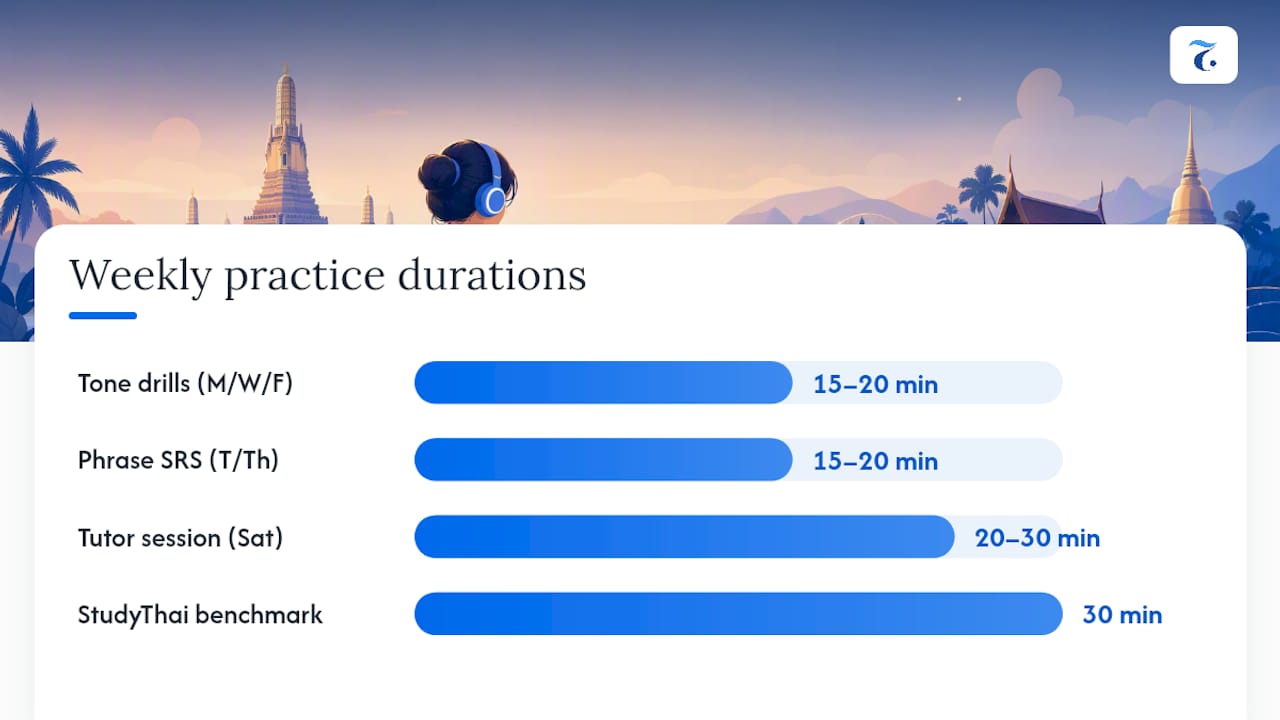
A repeatable weekly rhythm matters more than any single app or textbook. Here’s a plan that balances listening, tone work, and speaking practice without burning you out.
- Monday, Wednesday, Friday: 15 to 20 minutes of tone drills and shadowing native audio.
- Tuesday, Thursday: 15 to 20 minutes of phrase practice using SRS flashcards.
- Saturday: a 20 to 30 minute tutor session or community practice call.
- Sunday: light review, no new material, just reinforcing what stuck.
Milestones to expect: within weeks, you should be able to hear tone differences even if you can’t reproduce them perfectly. After some consistent practice, most learners can build a useful phrase bank, and basic conversation becomes realistic after a few months of daily study. StudyThai’s structured course reports that about 30 minutes of daily practice can bring learners to basic conversational ability in two to three months, with basic reading following around the six-month mark.
Self-check your progress by trying to hold a two-minute conversation with a native speaker every few weeks. When that starts feeling manageable rather than terrifying, it’s a good time to take a structured Thai proficiency test to see where you actually stand.
Apps, Courses, Tutors, or Communities: Which Should You Use?
Different formats solve different problems, and most successful learners end up combining two or three rather than relying on just one.
- Apps are best for daily repetition. SRS-based tools like Effortless Thai build spoken phrases quickly through native audio flashcards, but they rarely correct your pronunciation in real time.
- Free audio-first courses such as Loecsen are strong for early sentence-based learning, using short daily repetition to build functional beginner conversation fast.
- Structured courses add a curriculum, teacher feedback, and a way to measure progress against real milestones, something apps alone can’t replicate.
- Reference sites like Thai-language are useful once you’re past the basics and need specific dictionary entries or audio clips.
- Communities and role-play groups help with real-time speaking practice, though they work best as a supplement rather than your only source of feedback.
If pronunciation accuracy is your priority, weight your time toward audio drills and tutor feedback over app streaks alone.
Why a Structured School Works: Lessons From Thai Explorer’s Approach
Self-study gets you far, but structure closes the gaps that solo learners often don’t notice until months in. A curriculum aligned with recognized standards like the CU-TFL framework gives you clear milestones instead of a vague sense of “getting better.”
- Bilingual native instructors can explain a grammar rule in English, then model it in Thai, which speeds up the moments where self-study usually stalls.
- Flexible formats (group, private, or online) let you match delivery to your schedule and budget rather than forcing one model on everyone.
- A structured proficiency test gives you an objective read on where you stand instead of guessing based on how confident you feel.
- Group classes add built-in role-play partners and accountability that solo app use can’t replicate.
What Adult Learners Should Actually Expect
Progress in Thai is steady, not dramatic, and that’s the part most learners underestimate going in. You won’t wake up fluent, but three months of genuinely consistent practice will take you further than most people expect, especially compared to the plateau that hits learners who skip tones and lean entirely on romanized transliteration.
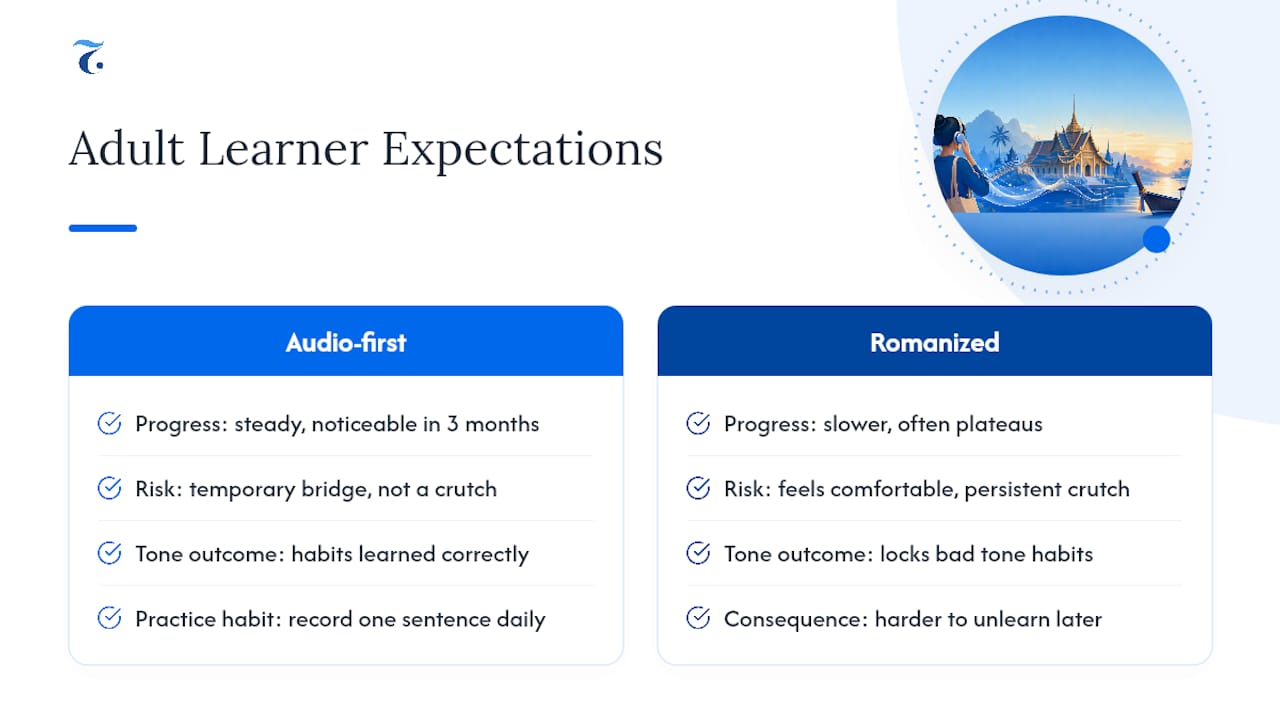
The biggest trap I see is treating romanization as a permanent crutch instead of a temporary bridge. It feels comfortable, but it quietly locks in bad tone habits that get harder to unlearn the longer you wait.
One habit worth adopting immediately: record yourself daily, even just one sentence, and listen back before you move on. It’s a small ritual, but it’s the fastest way to catch the gap between what you think you’re saying and what’s actually coming out.
— Paul
How Thai Explorer Can Help You Start
Self-study builds a foundation, but a structured class is what turns scattered practice into steady, measurable progress. Language schools offering group, private, and online Zoom classes led by bilingual native instructors can catch tone errors and grammar gaps that are hard to self-diagnose from an app alone.

If you’ve been working through audio courses on your own and want to know exactly where you stand, take our Thai proficiency test to see which level fits you. From there, explore our Thai language course options, including online classes for professionals who prefer flexible Zoom sessions, and sign up for a trial class to experience the curriculum firsthand. Classes are held at 10 Anson Road, #22-07, International Plaza, Singapore 079903, right above Tanjong Pagar MRT, or fully online for those who prefer learning from home.
Sources
- StudyThai – Learn Thai Free | AI Courses, Pronunciation & Tone Training
- SornSabai — Learn Thai free — interactive lessons with audio
- Loecsen — The best Thai course for beginners | Free
- Thai-language
FAQ
What Does “Suay Mak Mak” Mean?
“Suay” means beautiful or pretty, and “suay mak mak” means “very beautiful” or “really pretty.” It’s a common, easy phrase to learn early since it’s short and useful in everyday compliments.
Is Thai a Difficult Language to Learn?
Thai is challenging mainly because of its five tones and its own script, both of which are unfamiliar to most English speakers. It becomes far more manageable once you train your ear on tones first and delay heavy script reading, following the staged approach outlined above.
How Do I Say “I’m Learning Thai” in Thai?
A woman would say “Chan kamlang rian phasa Thai,” while a man would say “Phom kamlang rian phasa Thai.” The phrase “kamlang rian” specifically signals an ongoing, in-progress action, matching the English “-ing” form.
What Is an Easy Thai Word to Learn First?
“Sawasdee” (hello) and “khop khun” (thank you) are typically the first words learners pick up, since they’re used constantly and don’t require tone precision to be understood in context.
How Long Does It Take to Hold a Basic Conversation in Thai?
With consistent daily practice of 20 to 30 minutes, most learners reach basic conversational ability in two to three months. Reaching comfortable reading of the script generally takes closer to six months of steady practice.