
This page gives you the exact conversational Thai topics and ready-to-use beginner phrases to start speaking in everyday and travel situations. Every phrase comes with Thai script, simple romanization, and the polite particle that makes it sound natural rather than robotic. Pick one topic below, practice the sample dialogue out loud, and move to the next once it feels automatic.
TL;DR:
- Practicing key phrases with polite particles and tone practice accelerates speech accuracy more effectively than memorizing vocabulary lists.
- Daily repetition of twenty core phrases with audio guidance builds confidence faster than extensive rote memorization.
- Emphasizing tone recognition and pronunciation, especially of words like “mai,” is crucial due to Thai’s tonal sensitivity that changes meaning entirely.
- Engaging with native instructors through structured courses provides real-time correction of tone slips and improves speaking fluency.
- Cultural norms like the wai, politeness in topics, and indirect communication influence how beginners should approach conversation for better social fit.
Table of Contents
- Conversational Thai Topics Every Beginner Should Practice First
- Sample Thai Dialogue Examples You Can Rehearse Today
- Why Thai Tones and Pronunciation Change What You’re Saying
- Building a Daily Thai Conversation Practice Habit
- What a Thai Instructor Wants Beginners to Know
- Cultural Norms and Taboos That Shape Thai Conversations
- Talking About Feelings and Opinions in Thai
- Agreeing, Disagreeing, and Asking for Clarification Politely
- Starter Questions for Formal, Informal, Market, and Temple Settings
- Why Phrase-First Beats Grammar-First for Absolute Beginners
- Ready to Practice With a Native Instructor?
- Sources
- FAQ
Conversational Thai Topics Every Beginner Should Practice First
Most beginners waste weeks memorizing vocabulary lists that never come up in real life. A smarter approach organizes phrases by situation, the same way a compact 30-phrase starter set covers greetings, thanks, and survival words that travelers actually need. Here’s the phrase bank broken into the situations you’ll hit most.
Greetings and polite particles. Thai politeness runs on small words attached to the end of sentences. Men add ครับ (khráp), women add ค่ะ (khâ), and dropping them makes you sound blunt even when your grammar is correct.
- สวัสดีครับ/ค่ะ (sà wàt dii khráp/khâ) — Hello
- ขอบคุณครับ/ค่ะ (khàawp khun khráp/khâ) — Thank you
- ขอโทษครับ/ค่ะ (khǎaw thôot khráp/khâ) — Sorry, excuse me
- สบายดีไหม (sà baai dii mǎi) — How are you?
- ไม่เป็นไร (mâi pen rai) — No worries, it’s fine
Survival phrases for getting around. These four phrases solve most transportation headaches.
- …อยู่ที่ไหน (…yùu thîi nǎi) — Where is…?
- เท่าไหร่ (thâo rài) — How much?
- จอดที่นี่ (jàawt thîi nîi) — Stop here
- พาไปที่… (phaa pai thîi…) — Take me to…
Ordering food and paying the bill.
- ขอ…หน่อยครับ/ค่ะ (khǎaw… nàuy khráp/khâ) — I’d like…, please
- ไม่เผ็ด (mâi phèt) — Not spicy
- เก็บเงินด้วยครับ/ค่ะ (kèp ngoen dûai khráp/khâ) — Check, please
Shopping and polite refusal. Bargaining is normal in markets but rare in fixed-price shops. A soft “ไม่เอา” (mâi ao, “I don’t want it”) paired with a smile ends most haggling cleanly without offense.
Emergency phrases. ช่วยด้วย (chûai dûai, “Help!”) and เรียกรถพยาบาล (rîak rót phá yaa baan, “Call an ambulance”) are worth memorizing before you need them.
Small talk starters. Weather, food, and travel plans are the safest small-talk topics in Thai culture, since conversations tend to stay light and avoid anything confrontational. For more greeting variations and situational phrasing, a dedicated guide walks through each context in more depth.
Sample Thai Dialogue Examples You Can Rehearse Today
Reading phrases in isolation only gets you halfway. Seeing them strung into real exchanges is what makes them stick, a pattern that shows up in situation-organized phrase guides built around actual traveler interactions.
- Greeting a stranger. A: สวัสดีครับ (sà wàt dii khráp) — Hello. B: สวัสดีค่ะ สบายดีไหม (sà wàt dii khâ, sà baai dii mǎi) — Hello, how are you? A: สบายดีครับ (sà baai dii khráp) — I’m fine.
- Ordering food. A: ขอผัดไทยหนึ่งจานครับ ไม่เผ็ด (khǎaw phàt thai nùeng jaan khráp, mâi phèt) — One pad Thai, not spicy, please. B: ได้ค่ะ (dâi khâ) — Sure.
- Asking directions. A: ขอโทษครับ สถานีรถไฟใต้ดินอยู่ที่ไหน (khǎaw thôot khráp, sà thǎa nii rót fai tâi din yùu thîi nǎi) — Excuse me, where’s the subway station? B: ตรงไปครับ (trong pai khráp) — Go straight ahead.
- Bargaining at a market. A: เท่าไหร่ครับ (thâo rài khráp) — How much? B: สามร้อยบาทค่ะ (sǎam rói bàat khâ) — Three hundred baht. A: ลดได้ไหมครับ (lót dâi mǎi khráp) — Can you lower it?
- Emergency. A: ช่วยด้วยครับ (chûai dûai khráp) — Help! B: เกิดอะไรขึ้น (kòet à rai khûen) — What happened?
Rehearse each dialogue in three passes: shadow the audio (repeat right after hearing it), record yourself saying both lines, then replay and compare your tone against the original. Tone is the detail that separates “understood” from “misunderstood.”
Why Thai Tones and Pronunciation Change What You’re Saying
Thai is a tonal language, which means the pitch pattern of a word changes its meaning entirely, not just its emphasis. The word “mai” said with five different tones produces five different meanings, ranging from “new” to “burn” to “silk,” depending on whether the pitch rises, falls, or stays flat.
Two pronunciation traps catch nearly every English-speaking beginner. First, Thai distinguishes aspirated and unaspirated consonants (a puff of air after “k” versus none), so “khai” (egg) and “kai” (chicken) sound identical to an untrained ear but mean different things to a Thai listener. Second, “ไหม” (mǎi), the question particle that turns a statement into a yes/no question, is easy to confuse with “mài” (new) or “mâi” (not) if the tone slips.
Audio-based repetition and mimicry are reliably more effective at building accurate tone production than reading transliterations silently. Romanization on this page is a starting crutch, not a substitute for listening. A step-by-step pronunciation guide can walk you through each tone systematically if you want a structured drill sequence rather than trial and error.
Pro Tip: Record yourself saying “mai” in all five tones, then play it back next to a native audio clip. If you can’t hear the difference yet, your ear needs more exposure before your mouth will catch up.
- Practice the five tones daily using a single word like “mai” as your test case
- Mimic ten high-frequency phrases with their particles attached, not stripped down
- Listen before you speak; tone recognition usually develops faster than tone production
Building a Daily Thai Conversation Practice Habit
Ten to fifteen minutes a day beats a weekly hour, because tone recognition and phrase recall both depend on frequency more than duration. A simple micro-routine: warm up with yesterday’s phrases, add two new ones, run through one full dialogue, then record yourself and listen back once.
- Use Hilokal’s live audio rooms to listen in on native conversations before speaking, then unmute when ready
- Try HelloTalk for one-on-one text and voice exchange with native Thai speakers
- Keep a phrase notebook and add spaced-repetition flashcards for anything you mispronounce twice
- On first contact with an exchange partner, open with a simple greeting and one small-talk question rather than a long introduction
Self-study covers vocabulary and listening, but a structured class or a single trial lesson fills the gap self-study can’t: real-time correction of your tone errors before they become habits.
What a Thai Instructor Wants Beginners to Know
Phrase-first learning works because it gets you talking in week one instead of week ten. Paul, who teaches at Thai Explorer, points to two classroom shortcuts that consistently move beginners faster: master 20 high-frequency phrases before expanding vocabulary, and attach the polite particle every single time you practice, never as an afterthought. Students who drill dialogues aloud daily, even for five minutes, retain tone patterns better than those who only read them. For structured phrase-first, audio-first practice, that repetition gets built into the course design rather than left to chance.
Cultural Norms and Taboos That Shape Thai Conversations
Thai conversation runs on a concept called kreng jai, a reluctance to inconvenience or embarrass someone else, and it shapes almost every polite exchange. Raising your voice, pointing your feet at someone, or touching a person’s head (especially with kids around) reads as disrespectful even if no words are exchanged.
Certain topics are best avoided or handled carefully. Comments about the monarchy carry legal weight in Thailand and should be avoided entirely in casual conversation. Politics and religion are also topics Thai small talk generally steers around, favoring safer ground like food, travel, and weather instead. Direct criticism or confrontation, even when well-intentioned, tends to cause more offense in Thai contexts than in Western ones, since maintaining harmony in a conversation often outweighs being blunt.
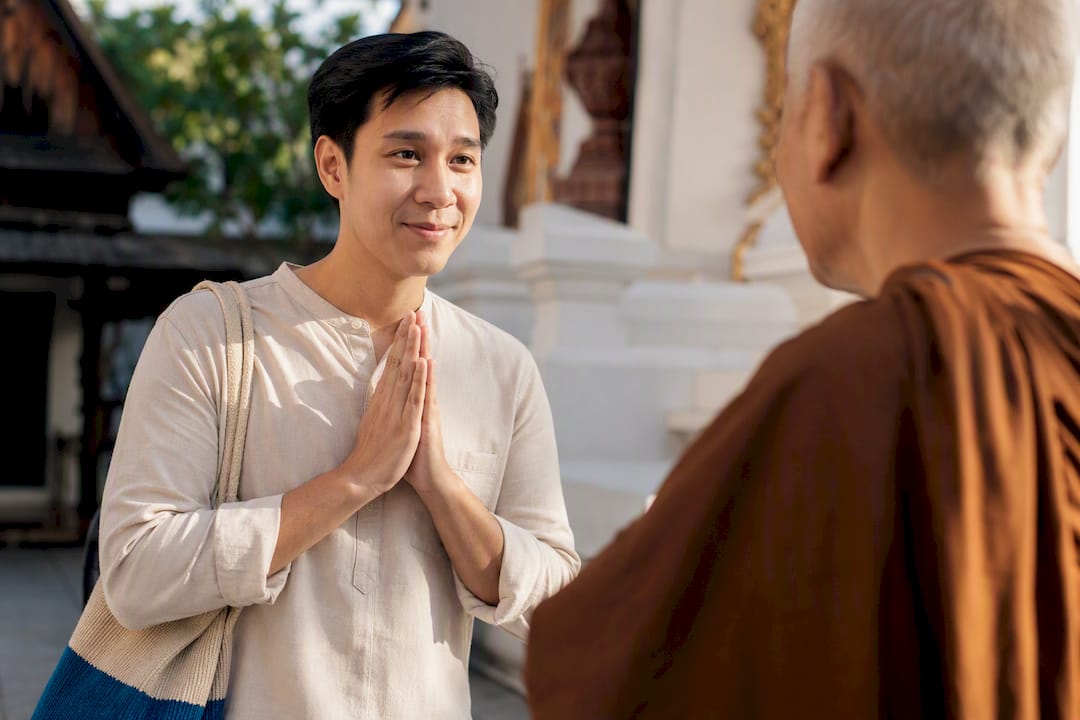
One small gesture matters more than most beginners realize: the wai, a slight bow with hands pressed together, used as a greeting and a sign of respect toward elders or monks. You don’t need to master its finer social rules to use it appropriately. A slight nod with a smile and a spoken สวัสดีครับ/ค่ะ covers most everyday situations without risk of getting it wrong.
Talking About Feelings and Opinions in Thai
Expressing emotion in Thai often uses softer, more indirect phrasing than English speakers expect. Instead of a flat “I disagree,” many Thai speakers cushion an opinion with hedges that leave room for the other person to save face.
- ดีใจ (dii jai) — happy, glad
- เสียใจ (sǐa jai) — sad, sorry to hear that
- ตื่นเต้น (tùen tên) — excited
- คิดว่า…(khít wâa…) — I think that…
- ชอบ / ไม่ชอบ (châawp / mâi châawp) — like / don’t like
Adding “นิดหน่อย” (nít nàuy, “a little”) softens strong statements, so “ไม่ชอบนิดหน่อย” reads as mild dislike rather than a flat rejection. Pairing an opinion with a polite particle and a soft qualifier keeps the exchange comfortable for both sides, which matters more in Thai conversation than in many Western ones.
Agreeing, Disagreeing, and Asking for Clarification Politely
Direct disagreement can land harder in Thai than in English, so most native speakers soften it. “ใช่ครับ/ค่ะ” (châi khráp/khâ, “yes”) and “ไม่แน่ใจครับ/ค่ะ” (mâi nâe jai khráp/khâ, “not sure”) are safer middle-ground responses than a blunt “no” when you’re not fully certain of your own answer.
To disagree gently, “ผม/ฉันคิดว่าอาจจะ…” (phǒm/chǎn khít wâa àat jà…, “I think maybe…”) introduces a different view without confrontation. When you don’t understand something, “พูดอีกทีได้ไหมครับ/ค่ะ” (phûut ìik thii dâi mǎi khráp/khâ, “could you say that again?”) or the simpler “ไม่เข้าใจครับ/ค่ะ” (mâi khâo jai khráp/khâ, “I don’t understand”) both work without embarrassment. Asking for clarification is expected and welcomed, not seen as a sign of weak language skills.
Starter Questions for Formal, Informal, Market, and Temple Settings
The right opening line changes with the setting. At a temple, keep your voice low and stick to respectful, simple exchanges: a quiet สวัสดีครับ/ค่ะ and a question like “ขอถ่ายรูปได้ไหมครับ/ค่ะ” (khǎaw thàai rûup dâi mǎi khráp/khâ, “may I take a photo?”) covers most situations.
In a market, transactional small talk works best: “อันนี้เท่าไหร่ครับ/ค่ะ” (an níi thâo rài khráp/khâ, “how much is this?”) opens the door, and a follow-up like “มีสีอื่นไหมครับ/ค่ะ” (mii sǐi ùen mǎi khráp/khâ, “do you have other colors?”) keeps the exchange natural.
Formal settings, like meeting a business contact or an older relative, call for full sentences and consistent particle use: “ยินดีที่ได้รู้จักครับ/ค่ะ” (yin dii thîi dâi rúu jàk khráp/khâ, “nice to meet you”). Informal settings with friends allow shortcuts, dropped particles occasionally, and slang, though beginners are usually better off keeping particles in until their ear catches when it’s safe to drop them.
Why Phrase-First Beats Grammar-First for Absolute Beginners
Most language courses start with grammar tables and verb conjugation charts. That approach fails Thai beginners specifically because Thai grammar is comparatively simple. Word order rarely changes, there’s no verb conjugation, and no gendered nouns. What actually trips people up is tone and social register, neither of which a grammar table teaches.
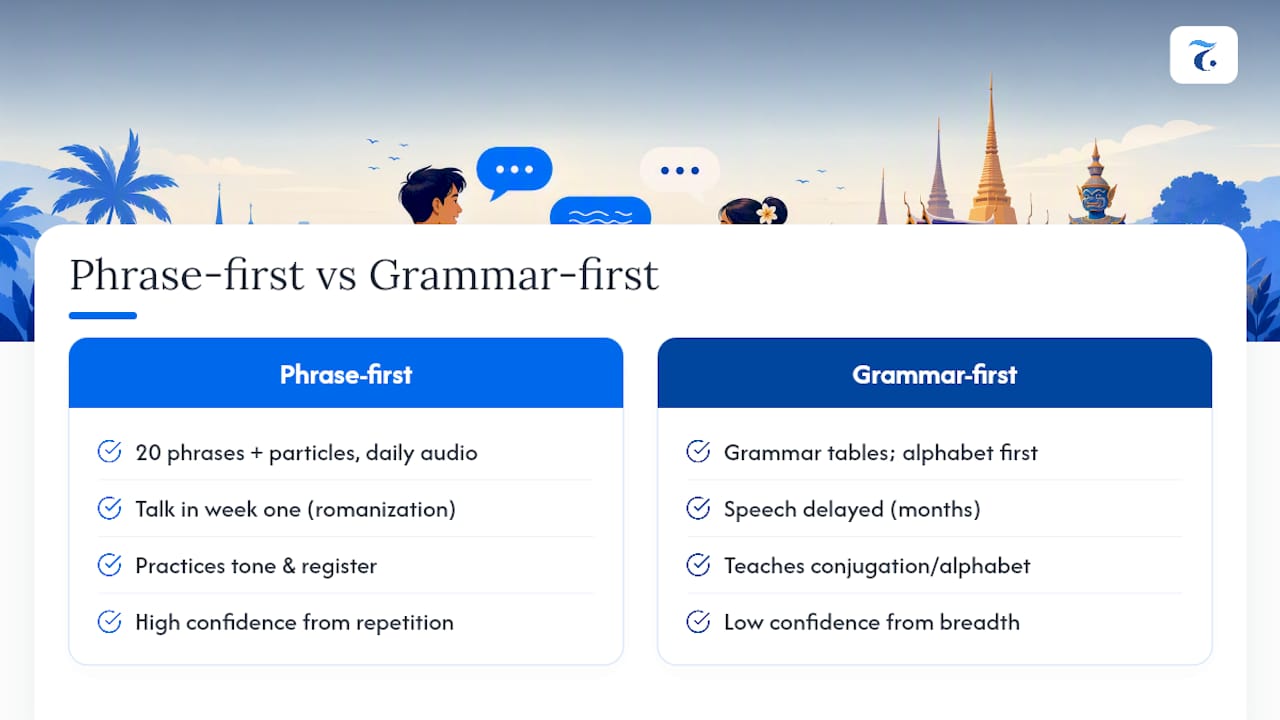
The conventional advice to “learn the alphabet first” also deserves pushback. Thai script takes months to read fluently, and delaying speech until you can read blocks the fastest path to confidence: hearing a phrase, saying it, and getting corrected. Romanization gets you talking in week one.
If there’s one thing to prioritize, it’s this: twenty phrases with their particles attached, drilled daily with audio, will get you further in a month than two hundred phrases half-memorized without tone practice. Confidence comes from repetition of a small set, not breadth.
— Paul
Ready to Practice With a Native Instructor?
Phrase lists and solo drilling only go so far. A native instructor catches tone slips you can’t hear in your own recordings, which is the gap self-study genuinely can’t close on its own. Thai Explorer’s online Conversational Thai courses are built around this exact phrase-first, situation-based approach, taught live over Zoom by bilingual native instructors.
If you’d rather test the format before committing, the Thai Trial Lesson runs $45 SGD, with a $50 SGD registration fee per student. Group and private course options are also available for learners who want a more tailored pace, and in-person classes run from the training center at 10 Anson Road, #22-07, International Plaza, Singapore 079903, right above Tanjong Pagar MRT.
Sources
- 30 Basic Thai Phrases Every Beginner Needs (with Audio) | Effortless Thai
- Small Talk in Thai Language | TalkPal
- NCBI — language learning research on speech perception and production
- Essential Thai for Tourists | ThaiLearn
FAQ
What are some examples of simple Thai conversations?
A basic exchange might be: “สวัสดีครับ สบายดีไหม” (Hello, how are you?) followed by “สบายดีครับ ขอบคุณ” (I’m fine, thank you). Ordering food, asking prices, and asking directions are the three most common beginner dialogue types, each covered with full sample exchanges earlier in this article.
What does 555 mean in Thai slang?
The number ห้า (hâa, “five”) sounds like the “ha” in “haha” when read aloud, so Thai internet slang uses repetitions of this sound in texts and social media the same way English speakers use “lol” or “haha.”
What does “bum bum” mean in Thai?
There’s no standard Thai phrase spelled “bum bum” with a widely recognized meaning; it’s likely a mishearing or informal slang variant that isn’t part of standard conversational Thai. If you encountered it in a specific context, checking with a native speaker directly is more reliable than a general definition.
What does “jub jub” mean in Thai?
“จุ๊บจุ๊บ” (júp júp) is an informal, affectionate term often associated with kissing sounds or a playful term of endearment, used casually between close friends, family, or partners. It’s informal slang and not something you’d use in a formal or professional conversation.
How long does it take to hold a basic conversation in Thai?
With daily phrase drilling and tone practice, most beginners can manage simple greetings, ordering food, and asking directions within a few weeks. Comfort with small talk and more open-ended conversation typically takes longer and depends heavily on how consistently you practice speaking aloud, not just reading.