
The fastest way to start speaking Thai is to enroll in a structured adult course with a native, bilingual instructor and a trial lesson before you commit. Look for clear class formats (group, private, or online), a curriculum that follows a logical progression, and transparent scheduling. Once you’ve checked those boxes, book a trial and pick a format that fits your calendar.
TL;DR:
- Structured courses with native, bilingual instructors and clear curricula significantly improve learning efficiency and pronunciation accuracy compared to self-study.
- In-person classes should provide visible schedules, small group sizes, and instructor bios, while online classes require confirmation of good platform features like breakout rooms and screen sharing.
- Private lessons accelerate progress and suit irregular schedules or specific goals, but cost more per hour than group courses, which are more affordable but offer less personalized attention.
- Most beginner programs last eight to twelve weeks, focusing first on tones, pronunciation, and the Thai alphabet, with grammar and reading taught gradually through phrases and sentence patterns.
- A trial lesson and a clear proficiency assessment are essential before enrolling, with costs influenced by class size, materials, and session recordings, typically ranging from $45 to $350 for full courses.
Table of Contents
- Where to Find a Thai Language Centre and How to Vet One
- Course Types and Formats: Group, Private, Corporate, and Online
- A Quick Checklist for Choosing a Thai Language Centre
- Typical Costs and Realistic Timelines for Adult Learners
- What Structured Courses Cover and What You Should Expect to Learn
- How to Book a Trial and Prepare for Your First Week
- Why Structured, Instructor-Led Classes Work Better for Adult Learners
- How Thai Explorer Can Help You Get Started
- Sources
- FAQ
Where to Find a Thai Language Centre and How to Vet One
Most course landing pages tell you everything you need to know within the first scroll: format, schedule, class size, and whether a trial lesson is available. If a provider’s site buries pricing or schedules behind a “contact us” form with no other detail, that’s often a sign the operation is smaller or less organized than it looks.
A few things separate a well-run Thai language centre from a page that just lists good intentions:
- Visible schedules. You should see actual class times and start dates, not just “flexible scheduling available.”
- Clear class sizes. Group classes capped at 6 to 10 students protect your speaking time; anything larger starts to feel like a lecture.
- Instructor bios. Native Thai speakers who are also fluent in English make instructions easier to follow, especially for tone correction and grammar explanations.
- Materials and recordings. Ask whether lessons include a course book, audio files, or recorded class videos you can revisit.
- Trial availability. A provider confident in its teaching usually offers a low-cost trial lesson rather than asking you to commit blind.
Accessibility matters more than people admit. If you’re doing in-person classes, a centre near a MRT stop saves you the friction that kills consistency. For online classes, confirm the Zoom setup works with breakout rooms or screen-sharing for reading practice, since some platforms handle this better than others.
Course Types and Formats: Group, Private, Corporate, and Online
Not every format suits every learner, and picking the wrong one is the most common reason adults quit halfway through a course.
- Group classes give you regular speaking practice with peers, a fixed schedule, and a lower cost per student than private lessons. They work well if you’re disciplined enough to show up weekly and don’t mind a steady, shared pace.
- Private lessons move faster because the entire session is built around your gaps. A private instructor can adjust the syllabus session by session, which suits people with irregular schedules or a specific deadline, like a move to Bangkok in three months.
- Corporate and business-focused sessions teach vocabulary for meetings, negotiations, and client relationships rather than travel phrases. These sessions matter for professionals whose Thai needs to sound polished in a boardroom, not just polite at a market stall.
- Online or Zoom classes remove the commute entirely. The trade-off is that reading and writing practice depends more on screen-sharing and homework discipline, since a teacher can’t glance over your notebook the way they would in person. Institutional programs increasingly offer full online tracks for exactly this reason, proving distance learning works for both beginner and advanced study.
A Quick Checklist for Choosing a Thai Language Centre
Before you hand over a deposit, run through this list. It combines what to check, what to ask, and what should make you pause.
Core criteria to check:
- Instructor qualifications: native speaker, bilingual, and experienced with adult learners specifically (not just kids’ classes)
- Curriculum alignment: does the course reference a recognized proficiency framework like CU-TFL, or does it seem improvised?
- Class size and student-to-teacher ratio
- Access to materials: course books, audio files, recorded sessions
- A placement assessment before you’re slotted into a level
Questions to ask before booking:
- What’s the trial lesson policy, and does the fee count toward enrollment?
- Can you transfer or make up a missed class?
- Is payment structured per term, per level, or month to month?
Red flags: vague scheduling, no instructor names listed anywhere, and pricing that only appears after a sales call.
Pro Tip: Ask any centre exactly how they assess proficiency before placing you in a class. A provider that can describe its assessment method in one clear sentence usually has a real curriculum behind it.
Typical Costs and Realistic Timelines for Adult Learners
Group courses generally cost less per session than private lessons, since the teacher’s time is split across several students. Private lessons cost more per hour but often get you to conversational comfort faster, because every minute is targeted at your specific gaps. Online courses tend to sit between the two, saving on venue overhead while still offering one-on-one attention in smaller formats.
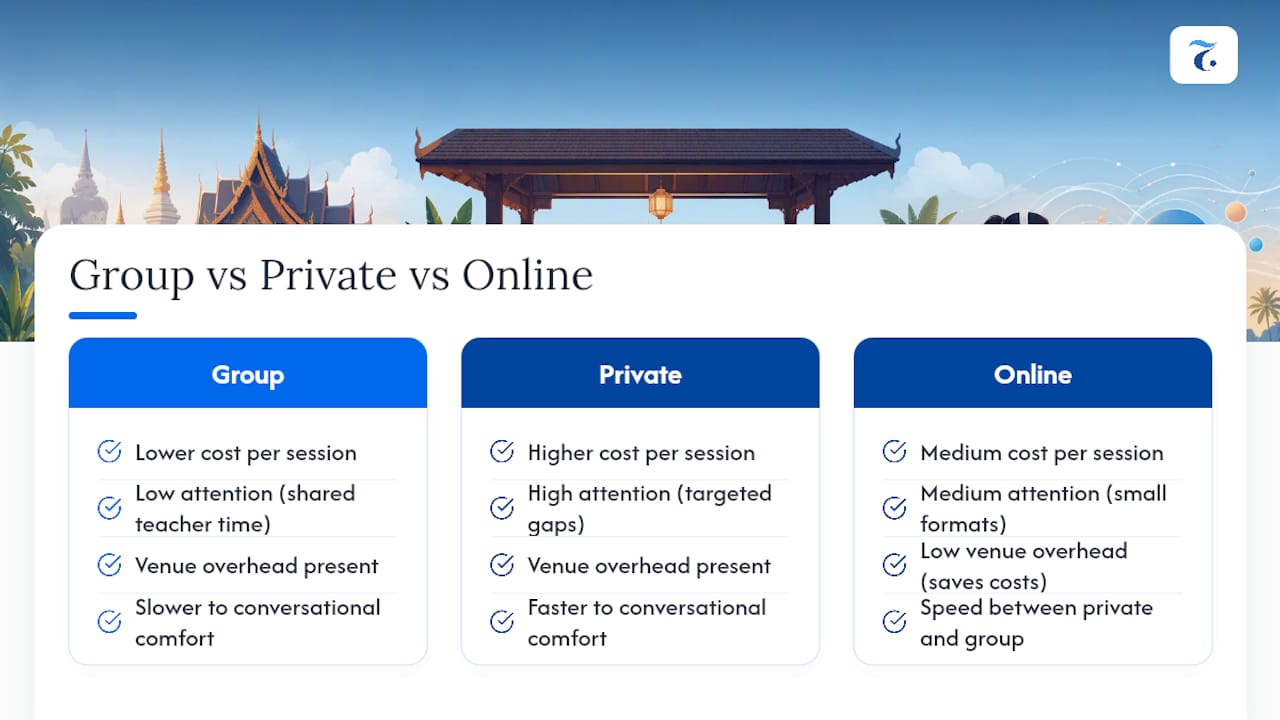
What actually moves the price: whether the course includes a printed workbook, whether sessions are recorded for later review, and how small the class stays. A course with a 4:1 student ratio and recorded lessons will cost more than a 12-person group class with no materials included, and that’s a fair trade for many learners.
Most structured beginner levels run in blocks of roughly eight to twelve weeks, covering one proficiency stage at a time. Audio-first programs show that learners who practice briefly every single day can reach practical, functional competence within weeks, even before formal classes reinforce it. Short daily repetition, even 15 to 20 minutes, tends to cement tones and vocabulary better than one long weekly cram session, since tonal recognition depends on frequent exposure rather than volume.
What Structured Courses Cover and What You Should Expect to Learn
A well-built course doesn’t throw grammar at you on day one. It follows a sequence that mirrors how the language actually works.
Most programs start with tones, pronunciation, and the Thai alphabet before layering in vowels and basic spelling, a step-by-step approach used by institutional language centers precisely because tones are unforgiving if learned wrong early. Grammar tends to arrive through phrases and sentence patterns rather than isolated rules, and reading and writing usually come after learners can already hold a spoken exchange.
Curriculum alignment with a recognized framework like CU-TFL gives you a useful signal here: it means speaking, listening, reading, and writing are all assessed, not just conversational chatter. That structure lets a provider tell you honestly where you stand.
Course features worth checking for:
- Recorded lessons you can rewatch after class
- Audio practice files for tone and pronunciation drills, similar to the tone exercises many learners use between sessions
- Graded exercises that show progress numerically, not just anecdotally
- Milestone assessments between levels, so you’re not guessing whether you’re ready to move up
How to Book a Trial and Prepare for Your First Week
Getting started takes fewer steps than most people expect.
- Find the course page for the format you want, whether that’s group, private, or online.
- Choose your format based on schedule and goals, not just price.
- Book a trial lesson to see the teacher’s style and pace firsthand.
- Complete a short placement assessment if you have prior Thai exposure.
- Confirm your schedule and materials before the first real session.
Bring a notebook and a phone for voice recordings. A trial should show you the teacher’s pace, how they correct pronunciation, and whether the materials feel organized. For Zoom classes, test your camera and audio the day before, and expect the first month to focus heavily on listening and repetition before writing enters the picture.
Why Structured, Instructor-Led Classes Work Better for Adult Learners
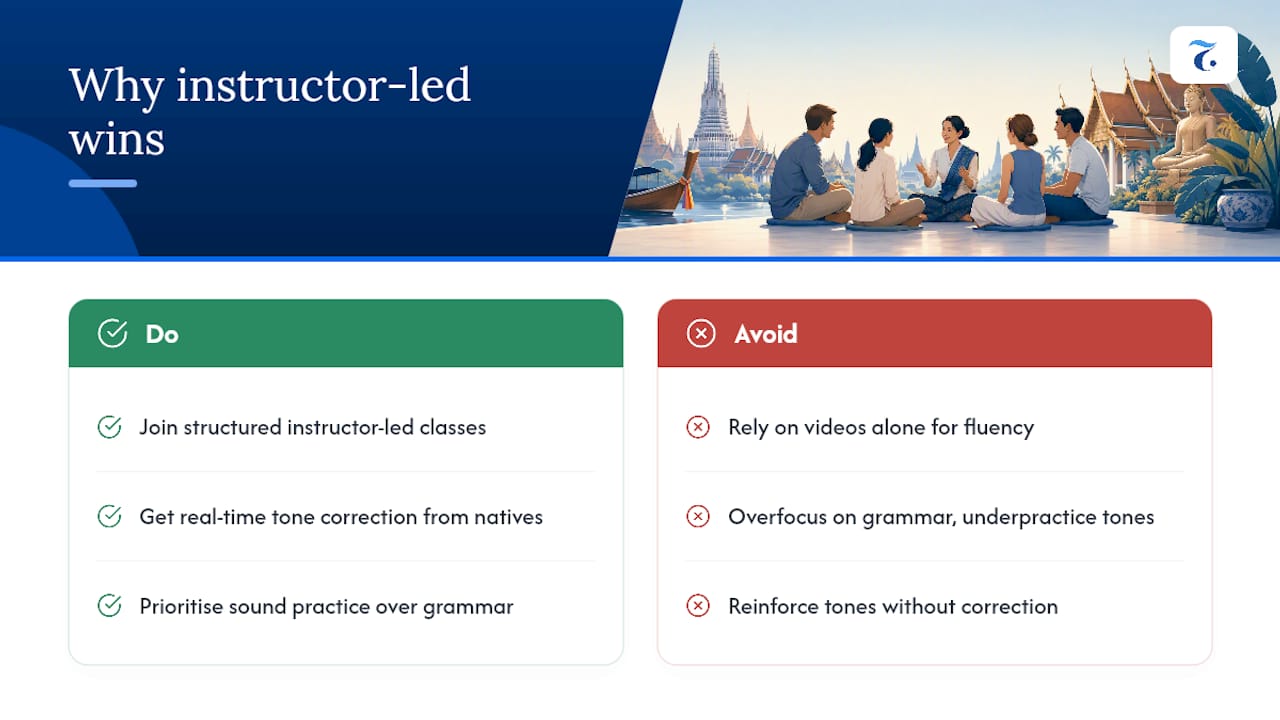
Adults don’t learn tonal languages the way kids do. We overthink grammar and underpractice sound, which is exactly backward for Thai. A native instructor who can hear the difference between a rising and falling tone in real time, and correct it on the spot, saves you months of reinforcing a wrong habit.
The biggest misconception is that watching enough videos online eventually adds up to fluency. It doesn’t, because nobody’s correcting your tones. Structured, instructor-led classes exist specifically to catch what self-study can’t.
— Paul
How Thai Explorer Can Help You Get Started
Thai Explorer runs conversational and business-focused Thai courses built specifically for adult learners in Singapore, not children or exam-driven school syllabi. Courses include Conversational Thai Beginner 1 and Conversational Thai Beginner 2, each priced at $350 one-off, along with private lessons, online Zoom classes, business Thai, and corporate training for teams.
If you’d rather test the waters first, the Thai Trial Lesson runs $45 one-off, with a $50 one-off registration fee per student. Classes are taught by native Thai instructors who are also fluent in English, and the curriculum follows CU-TFL reference points so you always know what level you’re actually at, not just what a marketing page claims. The centre sits right above Tanjong Pagar MRT at 10 Anson Road, #22-07, International Plaza, Singapore 079903, making it an easy stop before or after work.
Whether you want conversational Thai for travel or workplace-ready business vocabulary, the next step is simple: pick a format and book your trial lesson to see how the teaching style fits before committing to a full course.
Sources
- The best Thai course for beginners | Loecsen
- THAI LANGUAGE – Office of International Affairs | Thammasat University
FAQ
How long does it take to learn Thai fluently?
Conversational comfort typically takes several months of consistent practice, while deeper fluency in reading and writing takes longer since Thai script has no shared alphabet with English. Structured courses that follow a leveled curriculum, like those aligned with CU-TFL, tend to get learners to functional speaking faster than self-study alone.
Where can I learn to speak Thai for free?
Free audio-first resources exist and can help with early pronunciation and simple phrases, with some programs built specifically around short daily sentence practice. They rarely offer live correction, though, which matters a lot for a tonal language where a single wrong pitch changes meaning.
Can I learn Thai in 2 months?
You can reach basic survival-level conversation in two months with daily practice, especially using audio-first, sentence-based methods that build early wins quickly. Real conversational fluency for work or social settings usually takes longer than two months, since tone accuracy and vocabulary range need repeated, corrected practice.
How much does it cost to learn Thai in Singapore?
Costs vary by format: group courses generally cost less per session than private lessons, while online classes often sit in between. Thai Explorer’s Conversational Thai Beginner 1 and Beginner 2 courses are priced at $350 one-off each, with a $45 trial lesson available before enrollment.