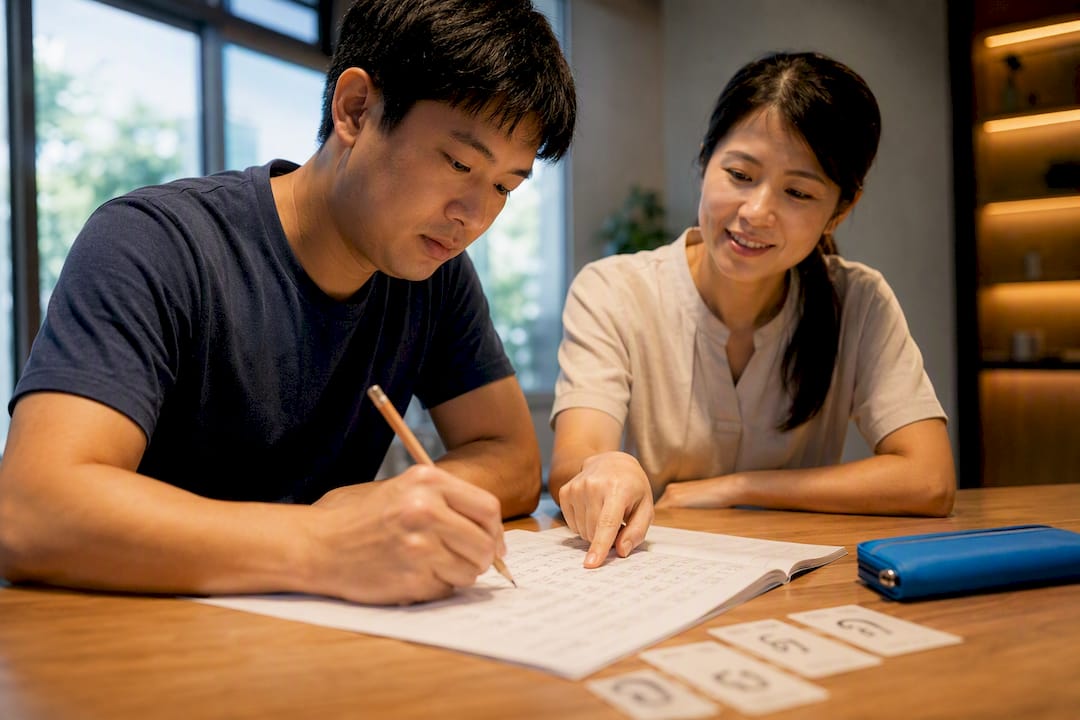
You can start speaking useful conversational Thai today by learning four things: the polite particles krap and ka, a core set of a small number of high-frequency phrases, numbers 1 to 10, and six survival phrases for emergencies. This works because politeness particles do more social work per syllable than almost anything else in the language, and a small, well-chosen phrase set covers the vast majority of situations a traveler or beginner actually faces.
Start here, in this order:
- Memorize “hello” and “thank you,” always paired with krap (men) or ka (women).
- Learn numbers 1 through 10 cold. You’ll use them constantly for prices.
- Pack six survival phrases for emergencies before you need them, not after.
Pro Tip: Say every phrase out loud at least ten times before moving to the next one. Silent reading doesn’t train your mouth, and Thai rewards mouths that have already made the mistakes.
Key Takeaways
Conversational Thai for beginners depends on mastering polite particles, a compact phrase set, numbers, and daily speaking practice before chasing perfect tones.
| Point | Details |
|---|---|
| Particles first | Add krap (men) or ka (women) to nearly every sentence; it matters more than tone accuracy early on. |
| Small phrase set | A small set of high-frequency phrases cover most food, shopping, and transport situations. |
| Numbers unlock prices | Learn 1 through 10 first; higher numbers follow a predictable assembly pattern. |
| Practice speaking daily | Ten to fifteen minutes of spoken drills beats passive reading for building usable conversation. |
| Structured courses close gaps | Thai Explorer’s group, private, and online classes add guided correction that self-study alone misses. |
Table of Contents
- Essential Conversational Thai Phrases for Everyday Situations
- Why Krap and Ka Matter More Than Perfect Tones
- Ordering Food and Bargaining at Markets
- Directions, Transport, and Numbers That Get You Around
- The Five Thai Tones, Without the Overwhelm
- Emergency Phrases Every Traveler Should Memorize
- How to Practice Conversational Thai So It Actually Sticks
- What a Structured Beginner Course Adds to Self-Study
- A Teacher’s Take on What Actually Trips Up Beginners
- Ready to Move Past Memorized Phrases?
- Sources
- FAQ
Essential Conversational Thai Phrases for Everyday Situations
Every conversational Thai starter kit begins with the same handful of phrases, and they show up in nearly every beginner phrase collection worth using. What matters isn’t memorizing more words. It’s nailing the dozen or so you’ll actually say ten times a day.
| Thai Script | Romanization | Meaning | Pronunciation Cue |
|---|---|---|---|
| สวัสดี | sa wat dee | Hello / Goodbye | “sa what dee,” stress on “dee” |
| ขอบคุณ | khop khun | Thank you | “cop koon,” short and clipped |
| กรุณา | ga ru na | Please | Formal; often skipped in casual speech |
| ขอโทษ | khor thot | Excuse me / Sorry | “khaw toht,” rising then falling |
| สบายดีไหม | sabai dee mai | How are you? | “sa bye dee my” |
| สบายดี | sabai dee | I’m fine | Answer to the above |
A short exchange might sound like this:
A: สวัสดีค่ะ สบายดีไหม (Sawatdee ka, sabai dee mai?)
B: สบายดีครับ ขอบคุณครับ (Sabai dee krap, khop khun krap.)
Notice how ka and krap appear at the end of nearly every line. That’s not decoration. It’s the backbone of polite Thai conversation, and it’s the next skill worth locking in.
Why Krap and Ka Matter More Than Perfect Tones
Adding krap (spoken by men) or ka (spoken by women) to the end of a sentence signals respect, and Thai people notice its absence immediately, especially in shops, restaurants, and with anyone older than you. It’s a habit, not a grammar rule, which makes it one of the easiest wins available to a total beginner.
Compare the two:
- “Khop khun” (thank you) reads as flat, almost curt.
- “Khop khun krap” or “khop khun ka” reads as warm and courteous, even from a foreigner stumbling through the rest of the sentence.
The particle also softens requests and questions. “Aroi mai?” (Is it good?) sounds blunt on its own; “Aroi mai ka?” sounds like genuine, friendly curiosity.
Pro Tip: When you’re unsure whether a sentence needs krap or ka, add it anyway. Overusing the particle costs you nothing. Skipping it costs you goodwill, and goodwill matters more than precise phrasing when you’re new.
Ordering Food and Bargaining at Markets
Street food stalls and markets are where beginners get the most conversation practice per minute, so this is where phrase-first learning pays off fastest.

| Thai Script | Romanization | Meaning |
|---|---|---|
| ขอเมนู | khor menu | Menu, please |
| เช็คบิล | check bin | The bill, please |
| น้ำเปล่า | nam plao | Water |
| ไม่เผ็ด | mai phet | Not spicy |
| อร่อย | aroi | Delicious |
| กินเจ | gin jay | I eat vegetarian |
For bargaining, ask “Tao rai?” (How much?), then respond to a high price with “Phaeng pai” (too expensive) and offer a friendly counter like “Lot noi dai mai?” (Can you lower it a little?). Walking away slowly is a legitimate negotiating tactic in most markets.
- Point at what you want if the vocabulary escapes you. Nobody minds.
- Smile when you bargain. Confrontation kills the deal faster than a bad accent.
- Say “aroi” after eating. Vendors remember customers who compliment the food.
Directions, Transport, and Numbers That Get You Around
Numbers do double duty in Thai. You need them for prices, and you need them for addresses, bus numbers, and time.
| Number | Thai | Romanization |
|---|---|---|
| 1 | หนึ่ง | neung |
| 2 | สอง | song |
| 3 | สาม | sam |
| 5 | ห้า | ha |
| 10 | สิบ | sip |
Higher numbers follow a pattern: 11 is “sip et,” 20 is “yee sip,” 21 is “yee sip et.” Once you know 1 through 10, the tens and hundreds are mostly assembly.
For getting around, learn “Bpai [place] dai mai?” (Can you go to [place]?) and “Jort trong nee” (Stop right here). For a tuk-tuk, confirm price before you get in: “Tao rai, bpai [place]?” For a metered taxi, a polite “Meter ka/krap” reminds the driver to use it.
The Five Thai Tones, Without the Overwhelm
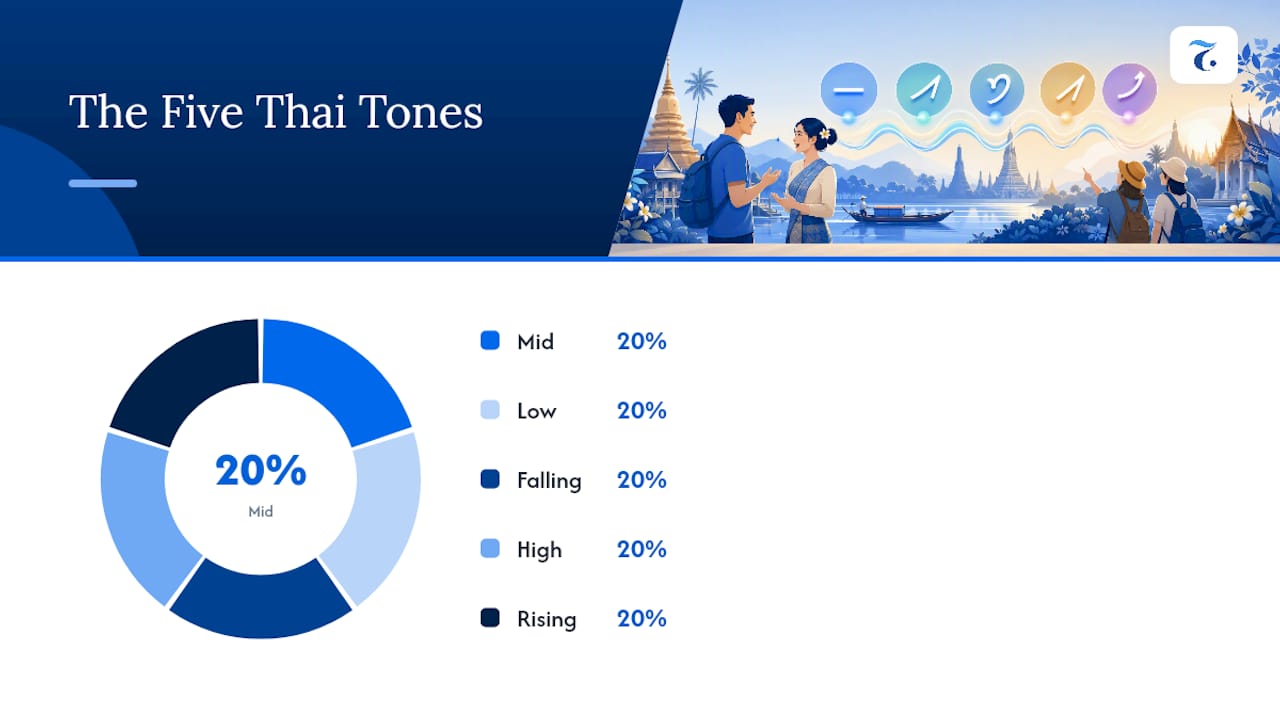
Thai carries five tones: mid, low, falling, high, and rising, and the same syllable can mean five different things depending on pitch. That sounds intimidating, but context saves you more often than perfect pitch does. A vendor hearing “mai” in a sentence about spice level isn’t going to think you’re asking about wood or silk.
Three drills actually move the needle:
- Listen to minimal pairs (words that differ only by tone) and try to hear the difference before attempting to say it.
- Record yourself saying a phrase, then compare it to a native speaker’s version.
- Shadow short audio clips, repeating immediately after you hear them rather than after a pause.
Pro Tip: Prioritize particles over tones for your first few weeks. A polite, slightly off-tone sentence lands better than a perfectly-toned sentence with no krap or ka. For structured tone drills, Thai Explorer’s pronunciation guide for beginners and tone exercises walk through this step by step.
Emergency Phrases Every Traveler Should Memorize
A handful of phrases matter more than any other vocabulary you’ll learn, because you may need them fast and under stress.
| Thai Script | Romanization | Meaning |
|---|---|---|
| ช่วยด้วย | chuay duay | Help! |
| โรงพยาบาล | rong pha ya baan | Hospital |
| ตำรวจ | dtam ruat | Police |
| ฉันต้องการหมอ | chan tong gaan mor | I need a doctor |
| เรียกรถพยาบาล | riak rot pha ya baan | Call an ambulance |
Tourist police and hospitals in most Thai cities are used to helping visitors who don’t speak Thai fluently, and pointing at a written phrase works when your voice fails you.
Pro Tip: Save these five phrases as a note in your phone before you travel, and read them aloud once so your mouth has already practiced the shapes.
How to Practice Conversational Thai So It Actually Sticks
Passive study, reading phrase lists and nodding, builds recognition, not speaking ability. Speaking ability comes from producing the language under mild pressure, repeatedly.
- Spend 10 to 15 minutes a day on speaking drills, saying phrases out loud, not just reading them.
- Do focused listening sessions using short audio clips, replaying the tricky parts.
- Role-play real situations: ordering food, asking directions, checking a price.
- Use spaced repetition to review phrases right before you’d otherwise forget them.
- Audio-first phrase collections beat text-only lists for tone practice.
- Short guided courses give you correction you can’t get from a book.
- Language exchange partners force you to respond in real time, which is the whole point.
Structured, short daily drills paired with role-play consistently outperform passive study for building usable conversational ability, largely because speaking under mild time pressure forces your brain to retrieve rather than recognize.
What a Structured Beginner Course Adds to Self-Study
Phrase lists get you far, but a structured course closes gaps self-study tends to miss, especially listening comprehension and sentence construction beyond memorized chunks. Courses that combine listening, speaking, reading, and writing in sequence tend to produce faster gains in usable conversation than any single-skill approach.
A typical beginner course expects you to leave able to:
- Handle a full food order, including dietary requests, without switching to English.
- Ask for and understand basic directions.
- Carry a few minutes of small talk about where you’re from and what you do.
Group classes, private lessons, and online Zoom courses each deliver this differently, but guided correction from a native instructor accelerates the parts self-study struggles with most: tone accuracy and natural sentence rhythm. That structure is also what makes conversational fluency a realistic short-term goal rather than a vague aspiration.
A Teacher’s Take on What Actually Trips Up Beginners
Most beginners over-invest in tones and under-invest in particles. I’ve watched students spend twenty minutes perfecting a single vowel sound while skipping krap and ka entirely, and it’s backward. Thai speakers forgive tonal mistakes constantly. They notice missing politeness markers immediately.
The other pattern worth naming: students who memorize phrases as fixed blocks never learn to swap words in and out, so they freeze the moment a conversation veers off script. The fix is simple. Learn the sentence pattern, not just the sentence.
Ready to Move Past Memorized Phrases?
Phrase lists get you through a transaction. They won’t get you through a real conversation that veers off script, and that’s exactly where a structured class earns its keep. Thai Explorer runs group, private, and online Zoom classes built around speaking from lesson one, so you’re producing sentences instead of just recognizing them.

If you’re in Singapore, the training center sits right above Tanjong Pagar MRT at 10 Anson Road, #22-07, International Plaza, making it easy to drop in before or after work. Private lessons suit anyone who wants a pace built around their own gaps, while online classes work well if you’d rather practice from your own desk on a fixed weekly schedule. Group classes give you built-in role-play partners, which matters more than most beginners expect. Book a trial class to see which format fits before committing to a full course.
Sources
For ongoing phrase practice, Omniglot’s Thai phrase collection pairs script with romanization across dozens of situations, and Thai with Nariss organizes phrases with both male and female particle forms. For audio-first tone work, an AI conversation coach offers low-pressure speaking practice with corrective feedback. Thai Explorer’s blog adds regular lessons on everyday and travel Thai worth bookmarking.
- Thai Beginners Course | SOAS
- Basic Thai Phrases for Travellers | The Thailand Guides
- Useful phrases (Thai) | Omniglot
- Thai AI Conversation Coach (2026)
FAQ
How Do You Say “I Love You” in Thai?
“I love you” in Thai is “Chan rak khun” (ฉันรักคุณ), though Thai speakers tend to reserve it for serious relationships and use it far less casually than English speakers do.
What Does “Bum Bum” Mean in Thai?
“Bum bum” isn’t a standard Thai phrase or word; it’s likely a mishearing or slang usage that varies by context, so it’s best to ask a native speaker directly if you encounter it.
What Does “Chup Chup” Mean in Thai?
“Chup chup” isn’t a recognized standard phrase in conversational Thai; meanings can vary by region or slang usage, so context from the person using it matters more than a dictionary definition.
What Is the Fastest Way to Learn to Speak Thai?
The fastest route combines daily speaking drills, focused listening, and role-play of real situations, ideally guided by a native instructor who can correct tone and sentence patterns in real time. Structured courses that combine all four skills consistently outpace phrase memorization alone.
Do I Need to Learn Thai Script to Speak Conversational Thai?
No. Romanization and pronunciation cues are enough to start speaking confidently, though learning script later helps with reading menus, signs, and improving pronunciation accuracy.