
TL;DR:
- Combining structured lessons, daily native speaker interaction, and cultural immersion enhances online Thai learning effectively.
- Practicing consistently with tools like HelloTalk, italki, and Anki accelerates progress, especially in mastering tones crucial for meaning.
Maximizing your online Thai course results means combining structured lessons, daily native speaker interaction, and deliberate cultural immersion into a single learning system. Most learners pick one approach and wonder why progress stalls. The learners who advance fastest treat their course as a framework, not a finish line. They layer tools like HelloTalk, italki, and Anki on top of structured programs like ThaiPod101, turning passive study into active acquisition. Thai is a tonal language with five distinct tones, which means pronunciation errors change meaning entirely. That reality makes method selection, not just motivation, the deciding factor in how to maximise online Thai courses.
What essential tools do you need to get the most from online Thai courses?
The right digital toolkit is the difference between slow, frustrating progress and measurable gains within weeks. Structured programs give you the grammar and vocabulary backbone. Social platforms give you the speaking practice that cements it.
Structured course platforms provide the curriculum spine every learner needs:
- ThaiPod101 delivers audio and video lessons built around practical conversation. Structured Thai courses like ThaiPod101 start at around $8 per month and can take you through a core curriculum in six to seven months at 20 to 30 minutes daily. That is a realistic commitment for working adults.
- Learn Thai from a White Guy focuses heavily on the Thai script and reading system, which most beginners avoid too long. Reading Thai unlocks pronunciation accuracy in a way that romanized transliteration never can.
- YouTube channels like Learn Thai with Mod and Kru Jiab offer free, high-quality pronunciation and tone drills that complement any paid program.
Language exchange and tutoring platforms are where passive knowledge becomes active skill:
- HelloTalk connects you with native Thai speakers for text, voice, and video exchange. HelloTalk’s 70 million users make it the largest language exchange community available, which means you can find a partner at almost any hour.
- italki and Preply both host professional Thai tutors for one-on-one sessions. These platforms let you filter by teaching style, availability, and price before committing.
- Anki, the spaced repetition flashcard app, handles vocabulary retention more efficiently than any other free tool available. Pair it with a community Thai deck or build your own from course vocabulary.
Pro Tip: When choosing resources, prioritize those that include tone and pronunciation audio from the start. Reading Thai without hearing it modeled correctly by a native speaker builds bad habits that take months to undo.
How to build a daily practice routine for online Thai learning
Consistency beats intensity every time in language acquisition. A 45 to 60 minute daily routine built around four skills, listening, speaking, reading, and writing, produces faster results than two-hour weekend sessions. Here is a proven daily structure:
- Listening (10 minutes). Start with a ThaiPod101 lesson or a Thai podcast at beginner level. Passive listening at the start of a session primes your ear for the tones you will practice next.
- Vocabulary review (10 minutes). Open Anki and work through your due cards. Spaced repetition with tools like Anki is the most time-efficient method for retaining Thai vocabulary, especially tone-marked words.
- Speaking practice (15 minutes). Use HelloTalk to send voice messages to a language partner or complete a speaking exercise from your course. Speaking out loud, even to yourself, activates muscle memory for tones.
- Reading or writing (10 minutes). Work through Thai script recognition exercises or write out new vocabulary by hand. Writing Thai characters by hand reinforces the connection between visual recognition and pronunciation.
- Cultural media (10 minutes). Watch a short clip from a Thai drama or variety show. Watching Thai content with progressively challenging subtitles trains your ear for natural speech speed and exposes you to slang that textbooks omit.
The key is protecting this time block. Treat it like a meeting you cannot cancel. Learners who practice Thai every day without living in Thailand consistently outperform those who study longer but less frequently.
Pro Tip: Front-load speaking and listening in your daily session rather than saving them for the end. Fatigue kills speaking practice. Vocabulary review survives tired brains; tone production does not.
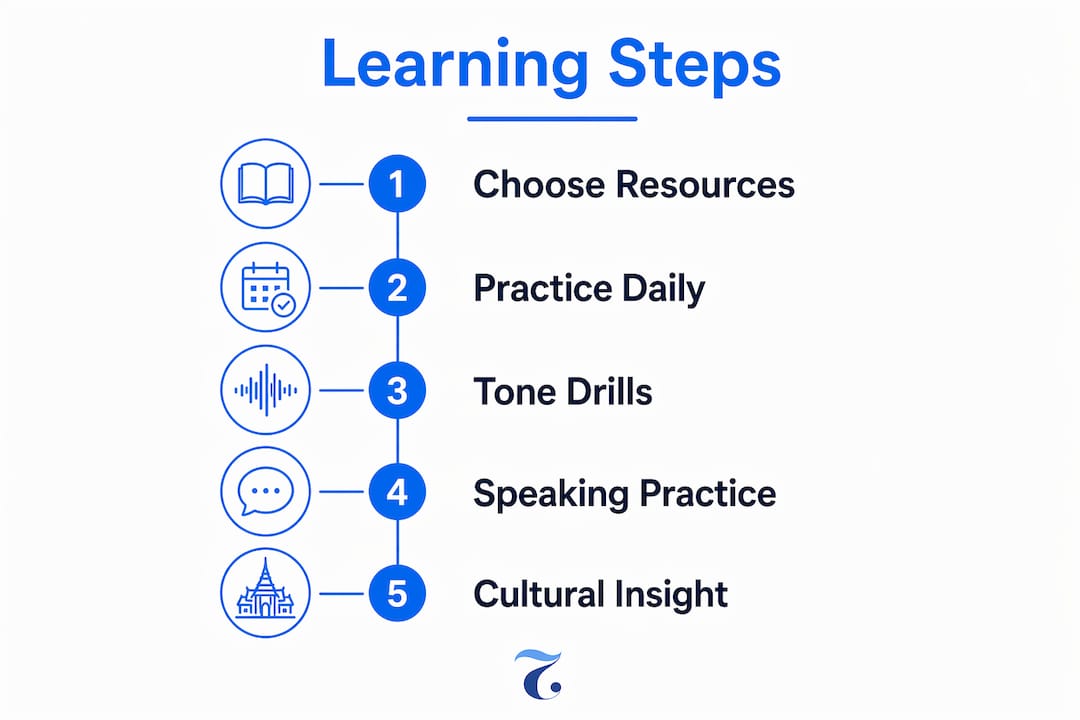
What are the best strategies to practice speaking Thai and overcome challenges?
Speaking Thai in front of another person is where most learners stall. The fear of getting tones wrong, or of being misunderstood, creates avoidance behavior that freezes progress. The solution is a graduated exposure approach, not a motivational pep talk.

Start with text-based exchanges on HelloTalk before moving to voice messages. Text removes the real-time pressure while still requiring you to construct correct Thai sentences. Once you are comfortable with text, send 30-second voice messages. This is a lower-stakes entry point than a live call, because you can re-record before sending.
When you do move to live calls, ask your language partner or tutor for specific feedback on tone accuracy rather than general corrections. A question like “Did my tone on that word sound correct?” gets you more useful feedback than “How was my Thai?” AI correction tools in HelloTalk provide instant feedback on pronunciation and grammar, functioning as a 24-hour tutor that catches errors before they become habits.
- Use HelloTalk’s voice and video call features for live conversation practice with native speakers.
- Request tone-specific corrections from tutors on italki or Preply by flagging which words you are unsure about.
- Record yourself speaking Thai and compare your output to native audio from your course materials.
- Practice Thai tone exercises daily using targeted drills designed to improve both recognition and production.
Pro Tip: The five Thai tones are mid, low, falling, high, and rising. Drill them in isolation before drilling them in words. Most learners skip this step and spend months correcting tone errors that could have been avoided in week one.
How does cultural understanding improve your Thai language skills?
Language and culture are not separate subjects. In Thai, the same word can carry entirely different social weight depending on context, relationship, and register. A learner who understands only grammar will consistently misread situations that a culturally aware speaker handles naturally.
Immersive cultural learning through Thai dramas and native interaction greatly enhances vocabulary, idiomatic expression, and social context awareness. Thai dramas on Netflix, such as the series available through the Thai content catalog, expose you to formal speech, street slang, and the polite particles “kha” and “khrap” used in real conversation. These particles are not optional politeness markers. They signal respect and social awareness, and omitting them in the wrong context reads as rude.
- Watch Thai variety shows and dramas for natural speech patterns and humor-based slang.
- Use HelloTalk’s Moments feature to engage with posts from native Thai speakers about daily life, food, and current events.
- Match with language partners using interest tags like travel, food, or music to make conversations feel natural rather than forced.
- Study the difference between formal Thai used in business settings and casual Thai used with friends. The vocabulary and sentence structure differ significantly.
- Explore cultural fluency in Thai to understand how social context shapes every interaction.
Pro Tip: Follow Thai social media accounts or YouTube creators who discuss topics you already enjoy in English. When the subject interests you, you tolerate ambiguity better and stay engaged longer.
How does private tutoring accelerate fluency in online Thai courses?
Self-study builds knowledge. Private tutoring builds fluency. The distinction matters because a tutor catches the errors you cannot hear in yourself, corrects tone production in real time, and adapts the lesson to exactly where you are struggling.
Private Thai tutors on italki and Preply range from 300 to 900 THB per hour, with over 50 tutors available across both platforms. That price range reflects the difference between community tutors, who are native speakers without formal teaching credentials, and professional teachers with structured lesson plans. Both have value depending on your goal.
| Tutor type | Best for | What to expect |
|---|---|---|
| Community tutor | Conversational practice, cultural exchange | Flexible, informal sessions focused on speaking |
| Professional teacher | Grammar correction, structured progression | Lesson plans, homework, formal feedback |
| Native speaker partner | Tone drilling, real-world slang | Peer exchange, mutual language learning |
When selecting a tutor, book a trial lesson before committing to a package. Use that session to test whether their correction style matches how you learn. Some learners want corrections mid-sentence. Others prefer feedback at the end. Tell your tutor which you prefer on the first call.
Set a specific goal for each session before it starts. “I want to practice ordering food and asking for directions” produces better outcomes than “let’s just talk.” Tutors on platforms like italki can prepare materials in advance if you share your focus topic 24 hours ahead.
Pro Tip: Schedule tutoring sessions at least twice per week rather than once. Once-weekly sessions allow too much forgetting between lessons. Twice-weekly sessions keep tone and grammar corrections fresh and compound faster.
Key takeaways
Maximizing online Thai course results requires combining structured programs, daily native speaker practice, and cultural immersion into a consistent, tool-supported routine.
| Point | Details |
|---|---|
| Use structured programs as a foundation | ThaiPod101 and similar platforms provide the grammar and vocabulary backbone for all other practice. |
| Practice speaking daily with native speakers | HelloTalk and tutoring platforms like italki reduce speaking anxiety and build tone accuracy faster than self-study alone. |
| Build a 45 to 60 minute daily routine | Split time across listening, speaking, reading, and cultural media to develop all four skills simultaneously. |
| Prioritize cultural immersion | Thai dramas, variety shows, and language partner conversations teach register, slang, and social context that textbooks omit. |
| Add private tutoring for personalized feedback | A tutor catches tone and grammar errors you cannot self-diagnose, accelerating fluency at any level. |
Why most Thai learners plateau, and what actually breaks through it
I have seen this pattern more times than I can count. A learner signs up for an online Thai course, works through the first few units with real enthusiasm, and then hits a wall around the intermediate stage. Progress feels invisible. Motivation drops. The course gets abandoned.
The plateau is almost never about the course itself. It is about the absence of real human interaction. Grammar exercises and vocabulary drills build a foundation, but they do not teach you to think in Thai. That only happens when you are in a live conversation, under mild pressure, reaching for words you half-remember. That discomfort is not a sign of failure. It is the actual learning mechanism.
What breaks the plateau, consistently, is committing to native speaker interaction before you feel ready. Most learners wait until they feel confident enough to speak. That confidence never arrives through self-study alone. It arrives through speaking, making mistakes, getting corrected, and speaking again. Consistency and regular native speaker interaction are the top predictors of fast language acquisition. Not the course platform. Not the app. The habit.
The other thing I would push back on is the idea that cultural understanding is a bonus layer you add after you have the language. Culture is not decoration. In Thai, understanding when to use formal versus informal register, or when a smile means discomfort rather than agreement, changes whether your communication actually lands. The learners who progress fastest treat language and culture as one subject, not two.
— Paul
Take your Thai further with Thai Explorer’s online courses
Thai Explorer offers structured online Thai courses delivered via Zoom, designed for adult learners focused on conversational and business communication. Whether you are building practical skills for travel, deepening cultural understanding, or preparing for professional use, the curriculum is taught by qualified native Thai instructors who are bilingual in Thai and English.
Every lesson combines language instruction with cultural context, so you are not just learning words. You are learning how Thai actually works in real conversations. For learners who want faster, personalized progress, private Thai lessons provide one-on-one sessions tailored to your exact level and goals. Explore the full range of online Thai courses and find the format that fits your schedule and learning style.
FAQ
What is the fastest way to improve online Thai learning?
The fastest method combines a structured course with daily speaking practice on a platform like HelloTalk and at least two private tutoring sessions per week. Social language exchange apps create a low-pressure environment for practicing tones daily, which accelerates spoken fluency faster than self-study alone.
How long does it take to see results from online Thai courses?
Most learners see measurable conversational progress within six to eight weeks when they practice 45 to 60 minutes daily. Structured programs like ThaiPod101 can cover a core curriculum in six to seven months at that pace, though speaking confidence typically develops earlier with regular native speaker interaction.
Do I need to learn the Thai script to speak Thai well?
Learning the Thai script significantly improves pronunciation accuracy because it encodes tone information that romanized transliteration cannot capture. Skipping the script is a common shortcut that creates long-term tone errors, particularly for learners aiming at business or professional-level communication.
How do I choose between a community tutor and a professional Thai teacher?
Choose a community tutor for conversational practice and cultural exchange at a lower cost. Choose a professional teacher when you need structured grammar correction, a lesson plan, and formal feedback on tone and writing. Many learners use both: a professional teacher for weekly structured lessons and a community tutor for additional speaking practice.
Can watching Thai dramas really help me learn Thai?
Yes, and the method matters. Start with familiar content using Thai subtitles, then progress to Thai audio with English subtitles, then Thai only. This graduated approach trains your ear for natural speech speed and exposes you to idiomatic expressions and slang that structured courses rarely cover.