
The fastest way to start speaking Thai is to skip the alphabet, drill the five tones by ear, memorize five survival phrases, and send a native speaker a short voice message today. That last step matters more than people think: speaking before you feel ready is what actually builds the skill.
Here’s the loop to run right now:
- Listen to a native audio clip of a greeting three times
- Repeat it out loud, matching the pitch, not just the words
- Record yourself saying it
- Send the recording to a native speaker or tutor and ask for one correction
Your first script: “Sawadee ka/krub, chan cheu [your name]” (Hello, my name is [your name]). Say it out loud right now, before you read another section.
Pro Tip: Say your first phrase out loud within the next five minutes, even alone in a room. The habit of speaking before you’re ready is the whole game.
Key Takeaways
Speaking Thai fluently starts with tones, not vocabulary, and a consistent 30-minute daily practice loop builds survival-level conversation skills within eight weeks.
| Point | Details |
|---|---|
| Tones come first | Train your ear on the five tones before memorizing vocabulary or reading the script. |
| Speak from day one | Recording yourself and getting corrections beats weeks of silent app practice. |
| Learn phrases by situation | Master greetings, prices, and thanks within the first 48 hours before expanding further. |
| Use the 8-week loop | Listen 10, repeat 5, record 1, correct 1, review 3 minutes daily for steady progress. |
| Get structured feedback | Thai Explorer’s CU-TFL-aligned courses pair native instructors with guided speaking practice for faster correction. |
Table of Contents
- How to Pronounce Thai: Tones, Pitch, and What to Practice First
- Basic Thai Phrases for Everyday Situations
- The Grammar You Actually Need to Start Talking
- An 8-Week Speaking Plan That Builds Real Conversation Skills
- Best Tools for Thai Speaking Practice
- Beginner Mistakes That Slow Down Your Progress
- Speed Up Your Progress With Structured Thai Lessons
- Sources
- FAQ
How to Pronounce Thai: Tones, Pitch, and What to Practice First
Thai is a tonal language with five tones, and getting them right matters more than getting the alphabet right. The same syllable, said with a different pitch, becomes a completely different word. Say “mai” with a flat pitch, a rising pitch, or a falling pitch, and you get three unrelated meanings.
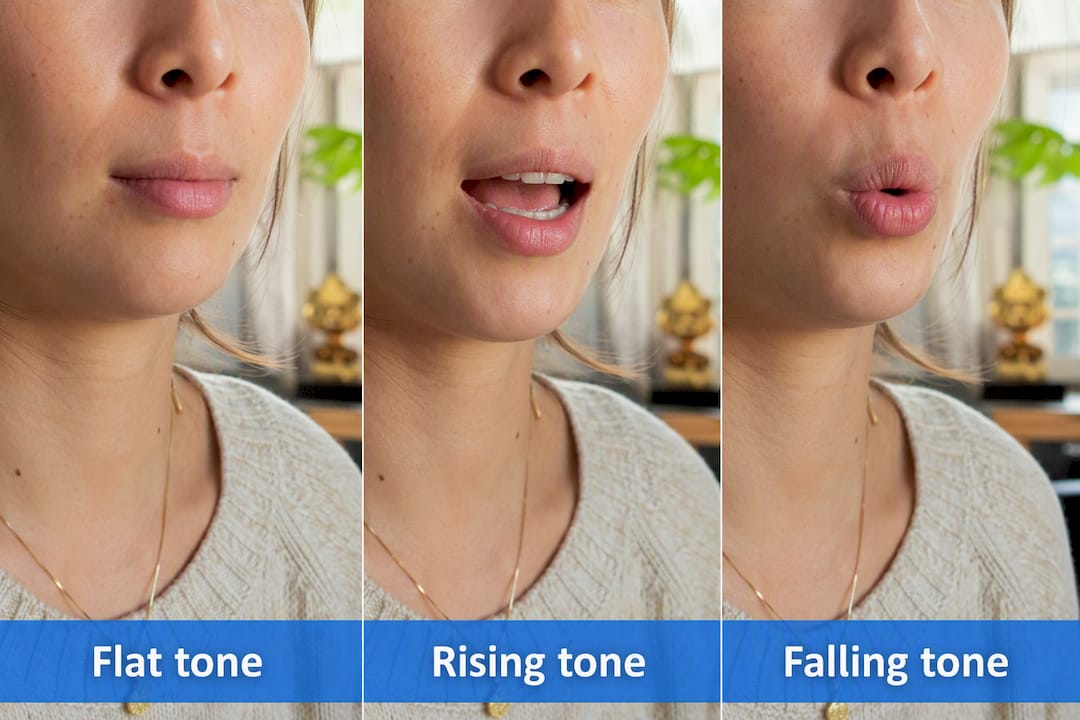
The five tones are mid, low, falling, high, and rising. Mid tone sits at your natural speaking pitch. Low tone drops slightly below it. Falling tone starts high and drops, almost like a scolding “no!” in English. High tone stays elevated and tight. Rising tone climbs upward, similar to how English speakers ask a question.
Your ear needs to catch these differences before your mouth can produce them reliably. That’s why training your ear to the five tones before tackling the alphabet works better than diving straight into vocabulary lists. Treat tones as a listening skill first.
- Pick five “anchor words” you hear often (like “mai,” “ka,” “krub”) and notice their pitch pattern
- Practice minimal pairs: two words that differ only in tone
- Shadow native audio clips, matching pitch before worrying about meaning
Pro Tip: Pick one anchor word per tone and hum its pitch shape before saying the word. Your ear locks onto the melody faster than the meaning.
For a structured breakdown of each tone with audio drills, Thai Explorer’s tone guide walks through the mechanics step by step.
Basic Thai Phrases for Everyday Situations
You don’t need hundreds of words. You need the right twenty, organized by situation, and the discipline to use them out loud from day one.
Every phrase below ends in ka if you’re female or krub if you’re male. These particles aren’t optional extras. They signal politeness and are baked into how Thai people expect a sentence to end.
| Situation | Thai Phrase (Romanized) | English Meaning |
|---|---|---|
| Greeting | Sawadee ka/krub | Hello |
| Thanks | Khob khun ka/krub | Thank you |
| Apology | Kho thot ka/krub | Sorry / excuse me |
| Ordering food | Ao an nee ka/krub | I’ll take this one |
| Asking price | Tao rai ka/krub | How much? |
| Asking directions | Yoo tee nai ka/krub | Where is it? |
| Restroom | Hong nam yoo tee nai | Where’s the restroom? |
| Numbers 1 to 5 | Neung, song, sam, see, ha | 1, 2, 3, 4, 5 |
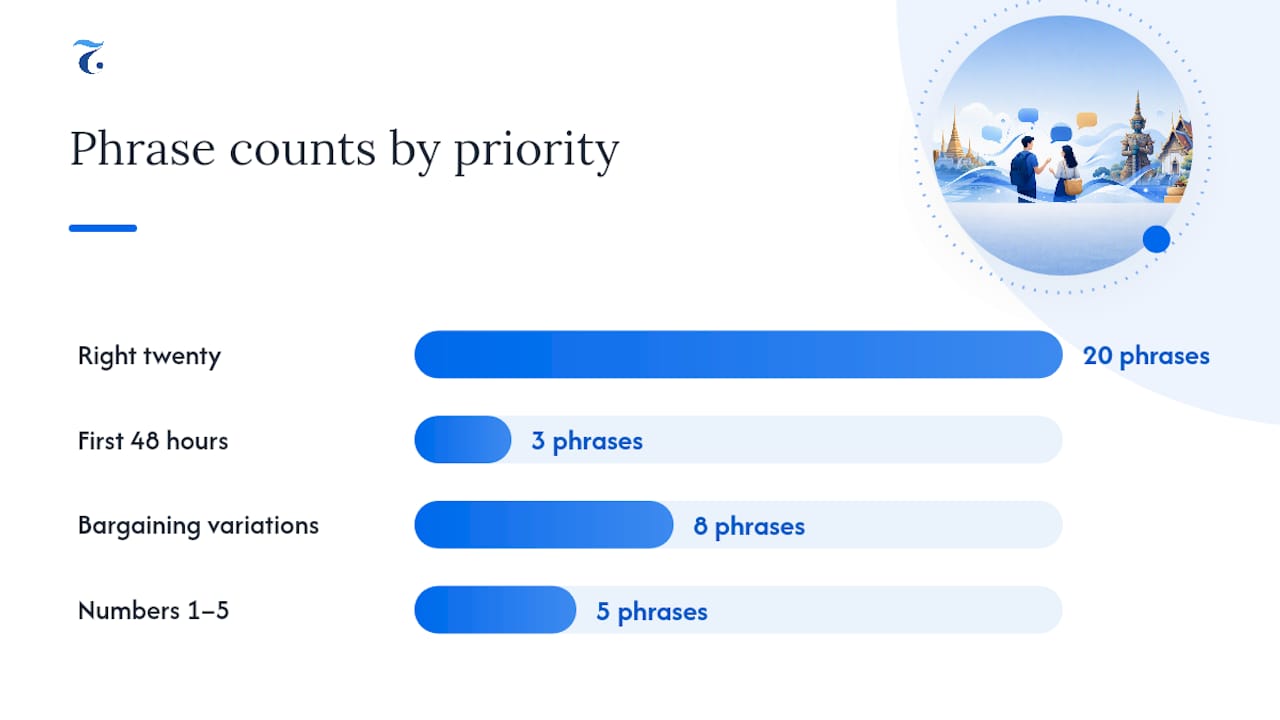
For your first 48 hours, lock in greetings, “thank you,” and “how much.” Those three cover most tourist interactions on their own. Directions and food ordering come next, once the first set feels automatic.
Bargaining phrases deserve their own attention if you’re heading to a market. Thai Explorer’s guide to asking about prices breaks down eight variations you’ll actually use. For a fuller situational set beyond this table, this list of traveler phrases fills in the gaps.
The Grammar You Actually Need to Start Talking
Thai grammar is refreshingly simple: learn three or four sentence templates, then swap in vocabulary. You don’t need verb conjugations or gendered nouns.
Thai follows subject-verb-object order, just like English, so sentence structure won’t feel foreign.
- I want X: “Chan ao [noun]” (I want [noun])
- Where is X? “[Noun] yoo tee nai?”
- How much? “[Noun] tao rai?”
- This one, please: “Ao an nee ka/krub”
Attach krub if you’re male, ka if you’re female, at the end of almost any polite sentence or question. Skipping the particle isn’t wrong grammatically, but it sounds abrupt, like dropping “please” from every request in English. For a deeper walkthrough of sentence building, Thai Explorer’s beginner grammar guide covers more templates.
An 8-Week Speaking Plan That Builds Real Conversation Skills
A 30-minute daily loop, listen 10 minutes, repeat 5, record 1, get one correction, review 3, is the fastest documented path to short survival conversations. This isn’t a shortcut around the work. It’s a structure that turns passive listening into active output, which research on language production shows accelerates learning far more than passive study alone.
Keep your expectations calibrated. The Foreign Service Institute estimates roughly 1,100 hours for English speakers to reach professional fluency in Thai. Eight weeks won’t get you there, and it shouldn’t try to. It gets you to confident survival conversations, which is a different and much closer goal.
- Listen to 10 minutes of native audio, focused on that week’s phrases
- Repeat each phrase out loud 5 minutes, matching tone and rhythm
- Record yourself saying the week’s key phrases
- Send the recording for one correction from a tutor or exchange partner
- Review the previous day’s phrases for 3 minutes before bed
By week eight, most learners following this structure can hold a short, functional exchange, ordering food, asking a price, giving simple directions, without freezing up. Thai Explorer’s practical speaking plan offers a similar structured starting point if you want a guided version.
Best Tools for Thai Speaking Practice
Native feedback beats solo app grinding every time. The fastest improvement comes from pairing short daily audio drills with real correction from a real person, not from memorizing more words alone.
- HelloTalk: Connects you with native Thai speakers for voice message exchanges, corrections, and public “Moments” where speakers can flag your pronunciation errors directly
- Online tutors: Give targeted, structured correction on tone and sentence formation, useful once you’ve outgrown app-only feedback
- Spaced-repetition audio apps: Reinforce vocabulary retention through short, repeated listening sessions rather than cramming
- Thai Explorer courses: Structured, native-instructor-led classes that combine tone training with guided conversation practice, useful once you want feedback that’s consistent rather than occasional
Pro Tip: Send one 15-second voice clip a day through a language exchange app. Consistency in small doses beats sporadic hour-long sessions.
Thai Explorer’s courses are built around a curriculum aligned with CU-TFL standards, so learners moving from survival phrases into structured fluency have a clear benchmark to work toward, not just a stack of disconnected lessons.
Beginner Mistakes That Slow Down Your Progress
Most beginners stall for the same handful of reasons, and each one has a quick fix.
- Relying only on romanization: It hides tone information. Pair every romanized phrase with its audio.
- Memorizing vocabulary before tones: You’ll lock in wrong pitch patterns that are hard to unlearn. Drill tones first, always.
- Waiting to feel “ready” before speaking: There’s no such moment. Speak from lesson one, even badly.
- Slowing down unnaturally: Exaggerated slow speech distorts tone patterns. Practice at natural conversational speed instead.
Tone practice isn’t a one-time drill you finish and move past. Keep returning to it weekly, even after you’ve built a decent vocabulary.
A Beginner’s Honest Note on Getting Started
Speaking early, and getting corrected often, beats months of silent study. Say your first phrase today. The tones will click faster than you expect.
Speed Up Your Progress With Structured Thai Lessons
Self-study gets you through survival phrases. A guided course closes the gap between “I can say a few things” and “I can actually hold a conversation,” because correction happens in real time instead of whenever an app notification pops up.

A beginner-focused course worth your time should include tone drills with immediate feedback, voice practice with a native instructor, a survival-phrase foundation, and small-group speaking sessions where you’re forced to respond on the spot, not just recite. That last part is what most self-study plans miss entirely.
Thai Explorer runs group, private, and online Zoom classes taught by bilingual native instructors, with a curriculum aligned to CU-TFL standards. Whether you’re prepping for a trip, want conversational skills for daily life, or need Thai for business use, the format flexes around your schedule. Classes run out of 10 Anson Road, #22-07, International Plaza, right above Tanjong Pagar MRT, with online options if you’d rather join from home. Check available class times and book a trial class through the Thai Explorer course page to see how guided feedback speeds things up.
Sources
FAQ
Is It Easy to Learn to Speak Thai?
Basic survival Thai is easier than most beginners expect, since grammar is simple and forgiving. The real challenge is tones, which take consistent ear training rather than raw memorization.
How Do You Say Numbers 1 Through 8 in Thai?
Neung (1), song (2), sam (3), see (4), ha (5), hok (6), jet (7), and paet (8) cover the basic counting you’ll need for prices and quantities.
How Do You Say Basic Words in Thai?
Start with “sawadee ka/krub” (hello), “khob khun ka/krub” (thank you), and “tao rai ka/krub” (how much), always ending with the polite particle matching your gender.
How Do You Say “I Love You” in Thai?
“Chan rak khun” is the standard phrase for “I love you” in Thai, used in personal and romantic contexts rather than casual conversation.
How Long Does It Take to Speak Basic Thai?
Following a structured 8-week speaking plan with daily practice, most beginners can hold short, functional conversations, well short of the roughly 1,100 hours the Foreign Service Institute estimates for full professional fluency.