If you want usable Thai fast, learn a small set of survival phrases, the polite sentence ending particles, and practice tones with native audio before anything else. Skip heavy grammar study at the start. Most beginners who follow this order can greet people, order food, and ask directions within a few weeks, and lessons built around the CU-TFL framework confirm that audio-based drills speed up retention far more than silent reading.
TL;DR:
- Focusing on memorizing essential phrases and polite particles from the start ensures quick functional speaking in Thailand within weeks.
- Tone practice is critical because changing pitch alters meanings drastically, making audio shadowing and minimal pair drills essential.
- Thai verbs do not conjugate, so basic markers like already and will are sufficient for expressing time, while politeness particles signal respect and gender.
- Memorizing numbers, food preferences, and directions early lays a foundation for practical conversation and daily interactions.
- Structured lessons provide crucial feedback on tone and pronunciation, accelerating progress beyond initial phrase mastery.
Table of Contents
- How to Learn Basic Thai Language: Phrases That Matter Most
- Why Do Thai Tones Matter So Much?
- What Grammar Do You Actually Need to Know?
- Numbers, Food, and Directions: Vocabulary for Getting Around
- Your First 4 Weeks: A Practice Plan That Actually Sticks
- How Structured Lessons Speed Up Progress
- Cultural Context: Formality, Politeness, and What to Avoid
- The Real Reason Most Beginners Stall Out
- Ready to Move Past Basic Phrases? Here’s Your Next Step
- Where to Practice Beyond This Guide
- Sources
- FAQ
How to Learn Basic Thai Language: Phrases That Matter Most
Before you touch grammar books, memorize phrases you will actually use in the first ten minutes of any conversation. Thai rewards this approach because word order is simple and pronunciation, not sentence structure, is what trips people up.
Here’s a starter set grouped by situation. The romanization below is simplified on purpose. It shows you the sound, not the tone, so treat it as training wheels, not the final word.
- Greetings: สวัสดี (sa wat dee) means hello, said the same regardless of time of day.
- Thanks: ขอบคุณ (khàwp khun) means thank you, and adding the polite particle after it noticeably changes how it lands.
- Sorry / excuse me: ขอโทษ (khǎaw thôht) covers both an apology and “excuse me” when squeezing past someone.
- Simple yes/no question: …ไหม (mǎi) tacked onto a verb turns a statement into a question, similar to adding “right?” in English.
- Basic response: ใช่ (châi) for yes, ไม่ใช่ (mâi châi) for no.
A curated set of core phrases, including greetings, thanks, and basic questions, is enough to function in most tourist situations, according to Effortless Thai’s beginner phrase guide. You can find more example sentences and situational variations in Thai Explorer’s phrase list for travelers if you want to build past the basics early.
Pro Tip: Learn the polite particle attached to each phrase from day one. Adding it later as an afterthought is a much harder habit to build than learning it correctly the first time.
Why Do Thai Tones Matter So Much?
Thai uses several tones including mid, low, falling, high, and rising. Change the tone on an otherwise identical word and you change its meaning entirely. The classic example is “mai,” which can mean new, wood, burn, or a question marker depending on which of the five tones you use. Get the tone wrong and a Thai speaker may genuinely not understand which word you intended.
This is why tone practice needs to happen with your ears, not your eyes. Reading a romanized word on a page tells you almost nothing about its pitch, and relying on bare romanization without tone marks is one of the most common beginner traps, according to guidance from SornSabai’s interactive lesson platform.
An audio-first routine works better than flashcards alone:
- Shadowing: listen to a native speaker’s phrase, then repeat it immediately, matching pitch and rhythm.
- Minimal pairs: practice word pairs that differ only by tone, so your ear learns to catch the difference.
- Record and compare: record yourself, play it back next to the native clip, and listen for the gap.
- Slow to normal speed: start with slowed-down audio, then push to natural conversational speed once the shape feels familiar.
Thai Explorer’s tone exercises and complete pronunciation guide both walk through this drill sequence in more depth if you want structured practice beyond the basics here.
What Grammar Do You Actually Need to Know?
Here’s the good news: Thai verbs don’t conjugate. No tenses to memorize, no subject-verb agreement, no irregular past forms. Time is shown with simple markers like แล้ว (láew) for “already” or จะ (jà) for “will,” dropped in front of or after the verb. Plurals usually aren’t marked either; context does the work.
The one grammar point that actually changes how people perceive you is the polite particle:
- Men end statements and questions with ครับ (khráp).
- Women use ค่ะ (khâ) for statements and คะ (khá) for questions.
- Add หน่อย (nòi) after a request to soften it, similar to saying “a little” in English.
So “thank you” becomes ขอบคุณครับ for a man and ขอบคุณค่ะ for a woman. Language guides aimed at travelers consistently flag this particle habit as the single highest-return move a beginner can make, since it signals respect instantly, per INThailand’s traveler language guide.
Numbers, Food, and Directions: Vocabulary for Getting Around
Numbers come up constantly, in prices, room numbers, and phone numbers, so they’re worth memorizing solid before anything else on this list.
- 1: หนึ่ง (nùeng), 2: สอง (sǎwng), 3: สาม (sǎam), 4: สี่ (sìi), 5: ห้า (hâa)
- 6: หก (hòk), 7: เจ็ด (jèt), 8: แปด (pàet), 9: เก้า (gâo), 10: สิบ (sìp)
“How much?” is เท่าไหร่ (thâo rài), one of the most useful phrases you’ll own in any market or taxi.
For food, “not spicy” is ไม่เผ็ด (mâi phèt), and “no [ingredient]” pairs with ไม่เอา (mâi ao) plus the ingredient name, useful for allergies or preferences. Bargaining phrases like ลดได้ไหม (lót dâi mǎi), meaning “can you lower the price?”, work in markets but rarely in fixed-price stores. For directions, ไปทาง…ไหน (pai thaang… nǎi), meaning “which way to…?”, pairs naturally with pointing and place names.
Your First 4 Weeks: A Practice Plan That Actually Sticks
A realistic starter plan beats an ambitious one you abandon after three days. Practitioners generally recommend 10 to 20 minute focused sessions built around listening, speaking out loud, and short spaced-repetition review, based on guidance from Effortless Thai.
- Week 1: Focus entirely on greetings, thanks, sorry, and the polite particles. Ten minutes a day of listen-and-repeat audio.
- Week 2: Add numbers 1 through 10 and basic yes/no questions. Start shadowing short native audio clips.
- Week 3: Layer in food and shopping phrases. Try a three-minute roleplay, ordering food or asking a price out loud, even alone.
- Week 4: Combine everything in a mock scenario. Review with 10 flashcards a day and record yourself for comparison against native audio.
Low-friction ways to practice include roleplaying a restaurant order with a friend, booking a short session with a tutor, or using AI conversation tools for quick reps. Treat AI roleplay as a supplement, not a replacement. It can’t correct your tone the way a real ear can, and it occasionally reinforces small pronunciation errors without flagging them.
Pro Tip: Do your listening practice at the same time every day. The habit sticks faster than the vocabulary does, and the vocabulary follows once the habit is set.
Thai Explorer’s starter plan for speaking Thai fast expands this same four-week structure with additional daily prompts.
How Structured Lessons Speed Up Progress
Self-study gets you to “usable.” Structured lessons get you to “understood correctly” faster, especially with tones, where a trained ear catches mistakes you can’t hear in your own recordings. Thai Explorer’s curriculum aligns with the CU-TFL standard and is taught by bilingual native instructors who catch small tone and particle errors in real time, something self-study audio can’t do for you.
- Group classes for learners who want structure and a set pace.
- Private lessons for a tailored focus on business or travel goals.
- Online Zoom classes for learners who need flexibility around work schedules.
The training center sits at 10 Anson Road, #22-07, International Plaza, Singapore 079903, right above Tanjong Pagar MRT, for anyone who prefers in-person practice. For more on how listening drills fit into a broader study routine, see the listening practice guide for adult learners.
Cultural Context: Formality, Politeness, and What to Avoid
Thai isn’t just a set of words swapped for English ones. Formality level changes based on who you’re speaking to, and getting it wrong doesn’t usually cause offense, but it does mark you instantly as unfamiliar with local norms. The polite particles matter here more than almost anything else you’ll learn, because dropping them entirely in front of elders, monks, or officials can read as blunt even when your grammar is otherwise correct.
Head and feet carry symbolic weight in Thai culture. Touching someone’s head, even playfully, is considered disrespectful, and pointing your feet at a person or a Buddha image is a common misstep tourists make without realizing it. This isn’t strictly a language issue, but it shapes how your words are received. A perfectly pronounced greeting delivered while pointing your foot at someone undercuts the message.

Volume and directness also shift by context. Raising your voice or confronting someone publicly, even over a legitimate complaint, tends to land far worse in Thailand than a calm, quiet approach. Thai communication generally favors indirectness over blunt statements, especially when delivering bad news or disagreement. Learning a few softening phrases, like adding หน่อย (nòi) to a request, does real work here beyond its literal translation. It signals that you understand the social temperature, not just the vocabulary.
The Real Reason Most Beginners Stall Out
Most people learning Thai fail for a boring reason: they start with an app that teaches vocabulary lists before it teaches tones, and by the time tone errors become a habit, they’re hard to unlearn. The conventional advice, “just download an app and start,” isn’t wrong exactly. It’s incomplete. An app without native audio and tone marking teaches you to mispronounce with confidence.
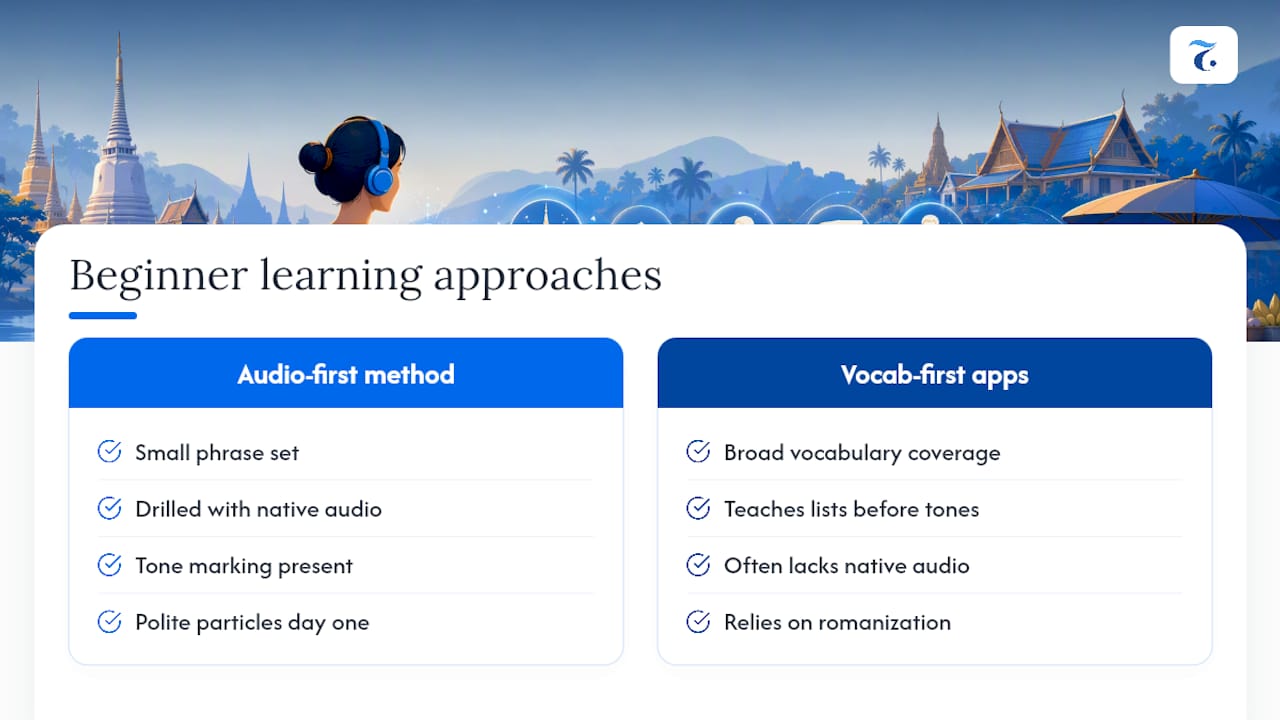
What the evidence actually supports is narrower and less exciting than most guides admit: a small phrase set, drilled with real audio, paired with the polite particles from day one, beats broad vocabulary coverage every time for a beginner’s first month. Grammar study can wait. Script study helps sooner than people expect, since recognizing even basic Thai letters removes your dependence on flawed romanization within weeks, not months.
If there’s one habit worth prioritizing above all others, it’s this: never learn a new phrase without hearing it first. Read second, speak third. Beginners who reverse that order spend months unlearning bad pronunciation instead of building on good habits from the start.
— Paul
Ready to Move Past Basic Phrases? Here’s Your Next Step
Self-study phrase lists and tone drills get you through a trip. They don’t get you through a business meeting or a real conversation with a Thai colleague, and that’s where structured lessons earn their keep.

There are group classes, private lessons, and online Zoom courses available, built around conversational and business Thai, with curriculum designed to support practical Thai learning and taught by bilingual native instructors. Whether your goal is comfortable travel conversation or workplace fluency, the format flexes to fit: group classes for steady pace and peer practice, private lessons for focused business goals, or online Thai classes if your schedule doesn’t allow for in-person sessions. The center is located at 10 Anson Road, #22-07, International Plaza, Singapore 079903, right above Tanjong Pagar MRT, easy to reach for anyone working in the area. If the four-week plan above got you curious about how far a few structured sessions could take you, check the Thai course page and book a trial class to see how the tone corrections and native audio feedback work in a live setting.
Where to Practice Beyond This Guide
For continued practice, Hot Thai Kitchen’s travel lesson covers survival phrases and tone tips, SornSabai offers audio-based interactive lessons, and James’ Spanish School breaks down audio-first learning methods that transfer well across languages.
Sources
- Thai Language Lesson for Travelers – The Basics — Hot Thai Kitchen
- Learn Thai free — interactive lessons with audio | SornSabai
- 30 basic Thai phrases every beginner needs (Effortless Thai)
FAQ
Is Thai an Easy Language to Learn?
Thai is easier than many people expect in one respect (no verb conjugation, no plurals to track) but harder in another (five tones that change meaning). Beginners who prioritize audio-first tone practice from the start tend to progress faster than those who focus on grammar first.
Can I Learn Thai by Myself?
Yes, self-study with native audio, a small phrase set, and consistent daily practice can get you to travel-level conversation within a few weeks. Structured lessons help most with catching tone and particle mistakes that are hard to hear in your own recordings.
How Do You Count to 10 in Thai?
The numbers 1 through 10 are: หนึ่ง (nùeng), สอง (sǎwng), สาม (sǎam), สี่ (sìi), ห้า (hâa), หก (hòk), เจ็ด (jèt), แปด (pàet), เก้า (gâo), and สิบ (sìp).
What Do the Polite Particles Khráp and Khâ Actually Do?
They mark politeness and, indirectly, the speaker’s gender. Men add ครับ (khráp) to the end of statements and questions, while women use ค่ะ (khâ) for statements and คะ (khá) for questions, and dropping them entirely can sound blunt even when the rest of the sentence is correct.