
TL;DR:
- Compare two Thai proficiency tests for non-native speakers and check what each organiser reports.
- Check the receiving organisation’s requirements before paying for a test.
If you need to document your Thai proficiency, begin with the organisation requesting it. Confirm which result and minimum level, if any, the university, employer or authority requests before registering.
Table of Contents
- Why recognition matters for Thai language tests
- Overview of officially recognized Thai language tests
- CU-TFL vs TCT: Key differences for Singapore learners
- How to prepare: Strategies and resources
- What most learners get wrong about Thai language testing
- Next steps: Get ready for recognized Thai testing success
- Frequently asked questions
Key Takeaways
| Point | Details |
|---|---|
| What a result shows | A test organiser measures your performance in Thai. Confirm whose evidence requirements apply. |
| Two official organisers | Chulalongkorn’s Sirindhorn Thai Language Institute and Thailand’s Office of the Basic Education Commission. |
| What to check first | The test, skills, level and documentation the recipient requests. |
| How to prepare | Practise sample tasks for the skills you plan to take. |
Why recognition matters for Thai language tests
To start, it’s crucial to know what “recognized” actually means and why it should matter for your goals.
A test result records proficiency measured by its organiser. The university, employer or authority decides which evidence it accepts.
For an application from Singapore, ask whether the recipient wants a particular test, skill, score or recent result. Check the required documents and deadline with the recipient.
Here is what recognition typically means for a Thai language test:
- Backed by a government body or major university rather than a private language center acting alone
- Check the recipient’s own policy for using a test result.
- The organiser publishes a scoring or proficiency framework.
- Official certificates issued under a verifiable testing body that third parties can confirm
Thailand’s Office of the Basic Education Commission publishes the Thai Competency Test (TCT) notice for foreign candidates. The TCT assesses listening, reading, writing and speaking. Its official public guide describes proficiency using grade norms.
Understanding Thai language test formats before you register helps you choose the right path and avoid wasting preparation time on the wrong material.
Overview of officially recognized Thai language tests
With recognition defined, let’s dive into which Thai language tests are actually officially accepted and how they differ.
Two options to compare are CU-TFL and the Thai Competency Test (TCT).
The Sirindhorn Thai Language Institute at Chulalongkorn University oversees CU-TFL. Its examiner guidance lists Chula Novice, Intermediate, Advanced, Superior and Distinguished and describes how a result is reported for the skills tested. Check which skills and test format the organiser currently offers.
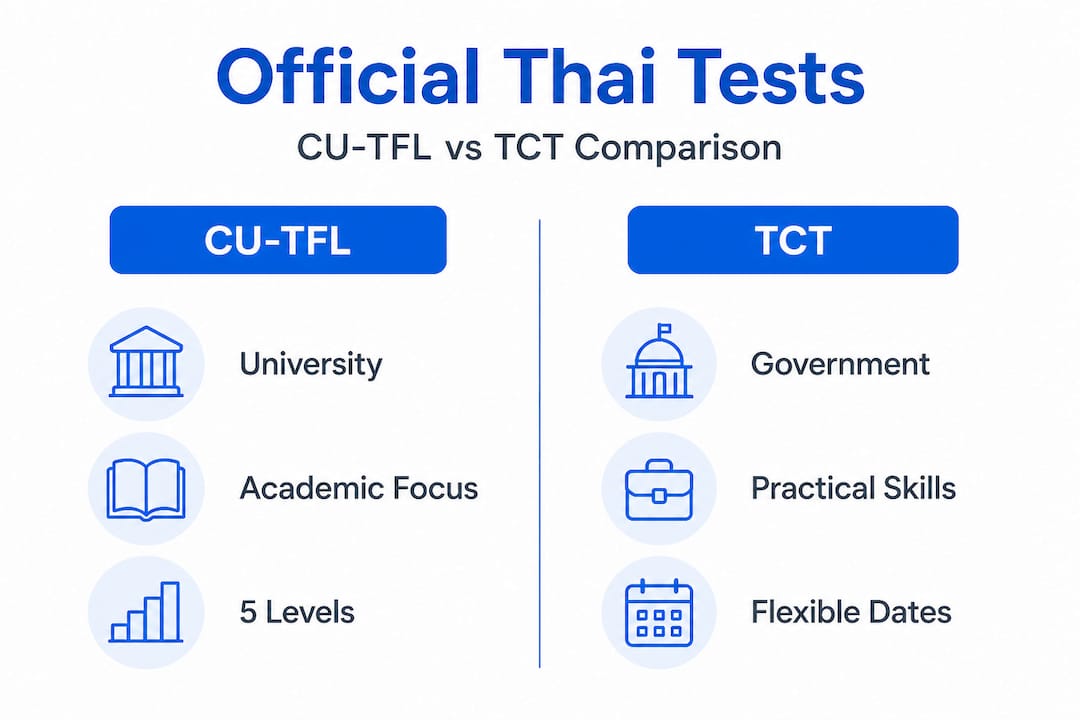
The Thai Competency Test is administered by the Office of the Basic Education Commission under Thailand’s Ministry of Education. Use its announcement and candidate guide for current registration and test details.
Here is a side-by-side summary:
| Feature | CU-TFL | TCT |
|---|---|---|
| Organiser | Sirindhorn Thai Language Institute, Chulalongkorn University | Office of the Basic Education Commission, Thailand |
| Skills | Listening, reading, writing and speaking are assessed. Check the skills offered for your sitting. | Listening, reading, writing and speaking |
| Result framework | Chula Novice, Intermediate, Advanced, Superior and Distinguished | Six education-based grade norms in the public candidate guidance |
| Dates and format | See the organiser’s current options | See the current official notice |
| Evidence | Confirm the recipient’s requirement | Confirm the recipient’s requirement |
For learners who want to work on their reading foundation before sitting a test, this guide on improving Thai reading skills is a practical starting point. And if writing intimidates you, the resource on mastering Thai writing covers the fundamentals step by step.
If a recipient asks for a CEFR level, ask it how it interprets a CU-TFL result. Use the organiser’s own result descriptions and the recipient’s written requirements.
CU-TFL vs TCT: Key differences for Singapore learners
Now that you know the key tests, understanding their differences helps you pick the best match for your personal situation.
Both tests assess Thai proficiency. Choose based on the skills you need assessed, the available sitting and the recipient’s stated requirements.
Here is a more detailed comparison:
| Decision | Check before paying |
|---|---|
| University | Ask the programme which test, skills and minimum levels it accepts. |
| Employment | Ask the employer whether it needs evidence of particular language skills. |
| Official procedure | Use the published requirements of the relevant authority. |
| Travel or personal progress | Decide which skills you actually want to measure. |
| Access and fees | Confirm format, location, fees and deadline from the organiser. |
Compare the latest organiser notices for the registration window, format and venue before making travel plans.
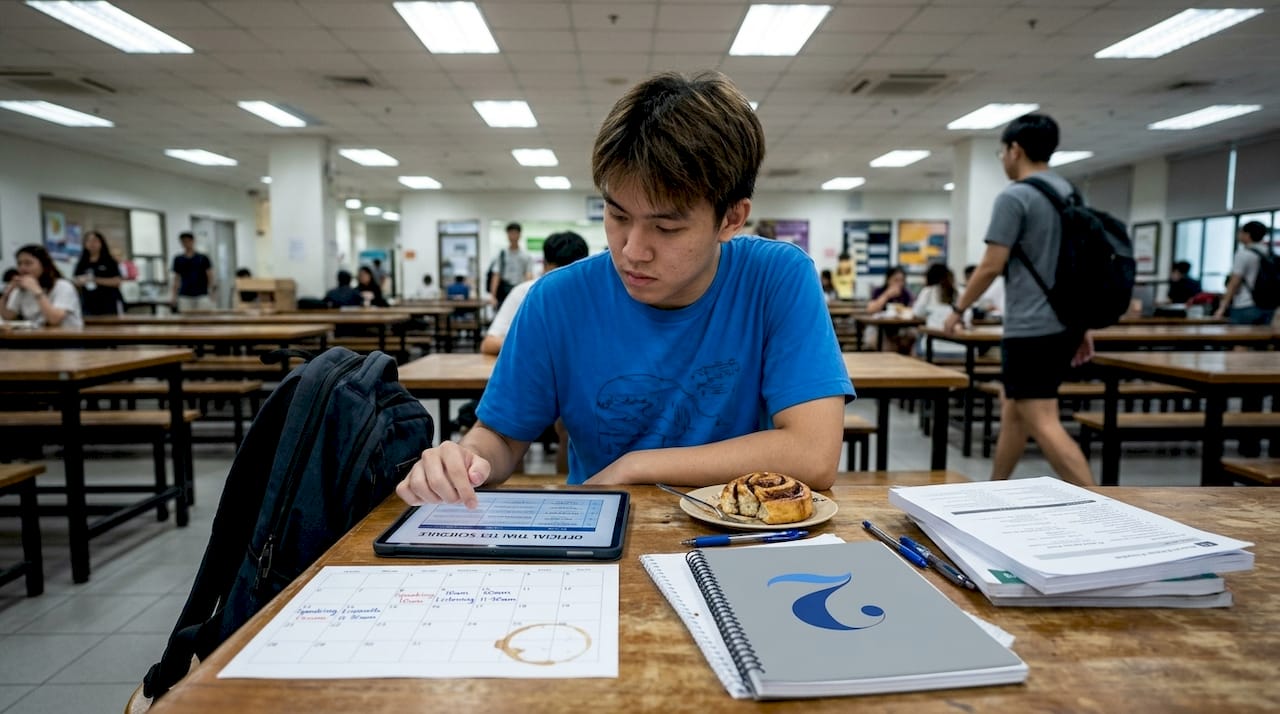
CU-TFL gives proficiency information in the Chula levels. A university may publish its own accepted proof, minimum level or exemption.
Here are the three most common learner scenarios and which test fits best:
- Studying at a Thai university: Ask the admissions office what it accepts and which skills or scores it requires.
- Working or doing business in Thailand: Ask the employer what evidence it wants. For a government procedure, check the relevant authority’s requirements.
- Personal progress: Compare the assessed skills, availability and fees, then choose a test that suits what you want to measure.
Use the organiser’s practice materials to plan your study. Explore Thai courses in Singapore for regular language practice and travel Thai lessons for a travel-focused goal.
Check the actual task formats and the skills you need to take. Use that information to decide which skills to practise first.
How to prepare: Strategies and resources
Choosing the right test is only half the battle. Effective preparation is what really opens doors.
Many learners in Singapore are self-taught up to a certain point, but official test preparation requires a more systematic approach. Relying on general language apps or informal practice often leaves gaps in exactly the areas that tests measure. Here is how to build a preparation strategy that actually works.
Resources available in Singapore:
- Structured Thai courses for the language skills you want to practise. Check a particular course’s syllabus before enrolling.
- Private lessons for targeted, one-on-one coaching on your weakest areas
- Online materials including sample papers and mock tests available through test providers
- Study groups with other Singaporean learners to practice speaking and listening
Skill-by-skill tips:
Listening: Expose yourself to authentic Thai audio daily. Thai podcasts, news clips, and YouTube channels designed for learners are excellent. Shadow native speakers to sharpen your ear for tone and rhythm.
Speaking: Practice structured conversations rather than random small talk. Use role-play scenarios based on topics that appear in tests, such as formal introductions, travel situations, and workplace dialogues.
Read short graded passages and work up to longer texts. Use the organiser’s sample tasks where available.
Writing: Many learners underestimate this area. Thai script is phonetic but complex, and formal writing has conventions different from spoken Thai. Practice writing structured paragraphs and short essays in Thai from an early stage, not just in the final weeks before your test.
Common preparation pitfalls:
- Over-relying on memorization instead of building genuine communicative ability. Rote vocabulary lists will not carry you through listening or speaking tasks.
- Ignoring writing until the last moment. Written Thai takes consistent practice over months, not weeks. Start early.
- Skipping mock tests. Doing practice tests under timed conditions is one of the highest-impact things you can do. It reveals exactly where your time management breaks down.
Building a strong foundation in Thai grammar basics early in your preparation prevents the kind of structural errors that cost marks in both writing and speaking assessments. You should also build habits around daily Thai practice rather than intense cramming sessions close to the test date.
Choose one task from a sample paper, practise it with a time limit, then review where you got stuck. Use the organiser’s assessment criteria to decide what to practise next.
What most learners get wrong about Thai language testing
Here is an uncomfortable but important truth: most people who prepare for Thai language tests spend the most energy on passing rather than on actually improving.
There is a meaningful difference between the two. Passing a test means knowing what the test rewards and optimizing for that. Actually improving means building the kind of language ability that works outside the exam room, on a street in Bangkok, in a business meeting in Chiang Mai, or reading a contract in Thai. The tests themselves are designed to measure real communication skills, so both goals should align. But in practice, learners treat test preparation as a shortcut instead of a foundation.
Try an unscripted conversation as well as a timed task. If either feels difficult, choose one part to practise again, such as explaining an opinion or asking a follow-up question.
Keep a short record of what you can do across the skills you need, such as understanding a notice or explaining a choice aloud.
The most effective approach combines formal preparation with daily real-world language use. Study for the test structure, yes. But also watch Thai media without subtitles, practice practical Thai reading on real signs and articles, and speak Thai whenever you get the chance. The learners who do this consistently are the ones who not only pass but actually thrive in Thai-speaking environments.
Use timed tasks to practise for an assessment and everyday Thai to practise for real conversations.
Next steps: Get ready for recognized Thai testing success
Ready to show your Thai skills with an official result? These next steps and resources can help you succeed.
Thai Explorer offers group and private Thai language lessons. Ask which skills a class covers and whether a teacher can help with your chosen test.
Use the organiser notices above to check registration. For focused language practice, ask about private Thai lessons. If you plan to use SkillsFuture Credit, check the official eligibility guidance for your exact course, provider and intake before paying.
Frequently asked questions
Which Thai language test is best for a work visa?
If a Thai authority asks for language evidence, follow that authority’s requirements for your application. Confirm which test or other evidence it accepts before paying.
What are the main levels of the CU-TFL test?
Chulalongkorn lists five main levels: Chula Novice, Intermediate, Advanced, Superior and Distinguished. Ask the organisation requesting your result how it interprets those levels.
Can I take recognized Thai tests online from Singapore?
Check the organiser’s current notice for online or overseas options for the skills you need. Confirm the venue and format before registering.
Are recognized Thai tests valid for university admission?
Each university sets its language requirements. Ask the admissions office which result it accepts, the minimum scores or levels for your programme and how recent the result must be.
How often are official Thai language tests offered?
Use the current Chulalongkorn and Office of the Basic Education Commission announcements for sitting dates and registration deadlines.