TL;DR:
- Native Thai teachers offer authentic pronunciation, cultural nuance, and real-world judgment that non-native instructors cannot fully replicate.
- Their guidance helps learners develop genuine fluency, cultural competence, and confidence for social, professional, and everyday interactions.
Most people assume a Thai language class is just about vocabulary lists and grammar rules. You sit down, you memorize, you repeat. But that assumption leaves out the most important variable: who is teaching you. The role of native Thai teachers goes far beyond correct sentence structure. They bring cultural depth, authentic pronunciation, and real-world judgment that simply cannot be replicated by a textbook or a non-native instructor working from the outside in. If you are learning Thai in Singapore, whether for travel, work, or daily life, understanding what native teachers actually do will change how you choose to learn.
Table of Contents
- Understanding the role of native Thai teachers in language learning
- How native Thai teachers enhance cultural immersion and communication skills
- Comparing native and non-native Thai teachers: benefits and challenges
- Practical tips for maximizing learning with native Thai teachers
- How native Thai teachers support adult learners and business professionals in Singapore
- Why native Thai teachers are the key to authentic language mastery and cultural connection
- Explore native-led Thai courses at Thai Explorer in Singapore
- Frequently asked questions
Key Takeaways
| Point | Details |
|---|---|
| Authentic language exposure | Native Thai teachers provide accurate pronunciation and real-life language use unmatched by non-natives. |
| Cultural immersion | Learning from native teachers helps you grasp cultural nuances essential for effective communication. |
| Tailored learning | Native teachers adapt lessons for conversational and business needs, boosting practical skills for adults. |
| Improved integration | Speaking Thai with cultural understanding enhances your social and professional life in Singapore and Thailand. |
| Course options in Singapore | Thai Explorer offers native-led courses and private lessons for flexible adult learning and cultural engagement. |
Understanding the role of native Thai teachers in language learning
Native Thai teachers are not just fluent speakers who happen to be in front of a classroom. They are living, breathing reference points for the language as it actually exists in Thailand today. Every choice they make in a lesson, from the words they select to the tone they use, reflects decades of absorbed cultural experience.
Here is what native Thai teachers’ benefits translate to in practice:
- Authentic pronunciation and tone. Thai is a tonal language with five distinct tones. Mispronouncing a tone does not just sound awkward; it changes the meaning entirely. A native teacher hears and corrects tone errors instinctively, without needing a reference chart.
- Cultural nuance embedded in language. Thai has distinct registers for speaking to elders, peers, and strangers. A native teacher knows when to use krub versus na, and more importantly, when switching registers signals respect or disrespect.
- Practical, real-life vocabulary. Textbooks tend to favor formal or outdated Thai. Native teachers use the language people actually speak in Bangkok markets, Chiang Mai offices, and Phuket hotels.
- Cultural expressions and etiquette. Phrases like mai pen rai (never mind) carry philosophical weight in Thai culture that a direct translation simply misses. Native instructors explain these expressions in context, not just definition.
- Judgment about what matters. A native teacher knows which grammar rules Thai people actually enforce in conversation and which ones are technically correct but socially stiff.
The role of native Thai instructors is to bridge the gap between what a learner can memorize and what a learner can actually use. That gap is enormous, and it does not close through study alone. Authentic pronunciation, cultural nuance, and practical usage are exactly what natives deliver that no other format consistently matches.
How native Thai teachers enhance cultural immersion and communication skills
Language and culture are inseparable. You can learn to say the right words and still offend someone or miss the point entirely because you lack the cultural framework behind those words. This is where the importance of Thai teachers becomes most visible.
Here is how native teachers build your cultural fluency step by step:
- They teach social norms alongside vocabulary. When a native teacher explains the wai greeting, they do not just describe hand position. They tell you who initiates, who returns, and what it means if you skip it entirely.
- They reveal conversational subtleties. Thai people often express disagreement indirectly. A native teacher will flag when a Thai speaker is saying “yes” but meaning “probably not,” a distinction that textbooks rarely capture.
- They prepare you for real-life scenarios. Ordering food, negotiating a price, addressing a colleague, each scenario has cultural rules. Native teachers role-play these situations with the same expectations a Thai person would have.
- They help you build confidence through accuracy. When you know your phrasing is culturally correct, not just grammatically possible, you speak with more confidence. That confidence compounds over time.
Pro Tip: Ask your native teacher to explain one cultural norm per lesson, not just one vocabulary word. Cultural knowledge sticks differently than grammar, and these lessons often reveal the most memorable insights.
Even modest Thai ability learned from native speakers meaningfully improves social interaction and integration in Thai-speaking communities. For expatriates in Singapore working with Thai colleagues or traveling to Thailand regularly, this is not a soft benefit. It is a measurable professional advantage. The cultural immersion benefits of native instruction extend well past the classroom and into daily interactions you will actually remember.
Comparing native and non-native Thai teachers: benefits and challenges
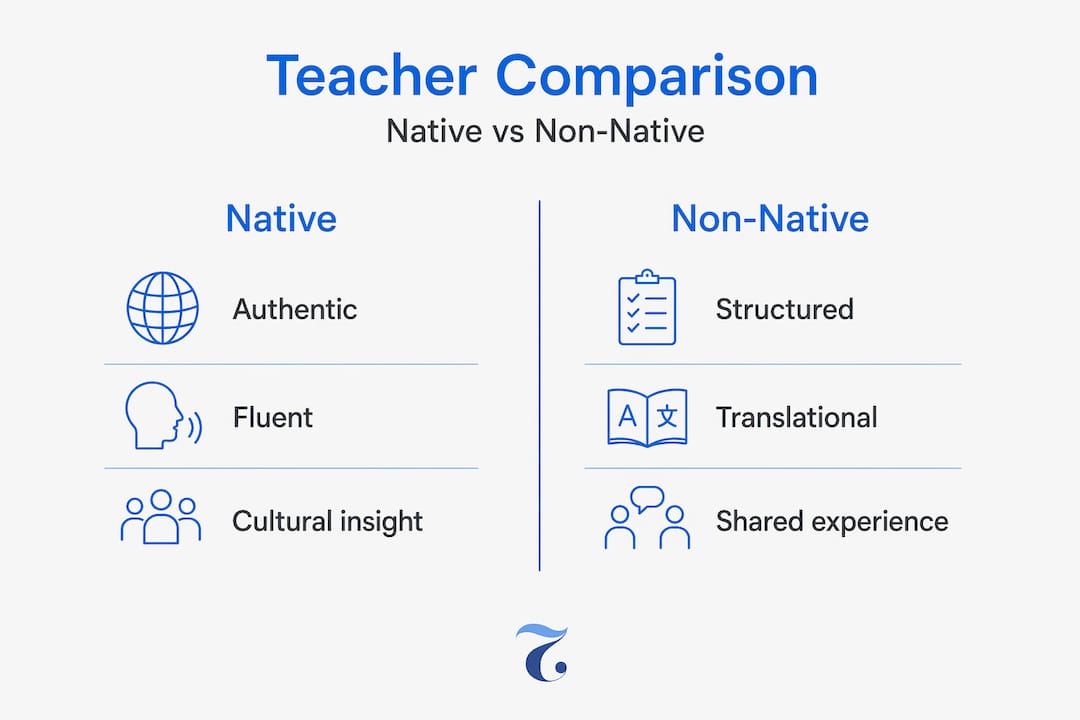
Choosing a teacher is a real decision, and it deserves an honest comparison. Both native and non-native instructors bring something to the table. Here is a clear breakdown:
| Factor | Native Thai teacher | Non-native Thai teacher |
|---|---|---|
| Pronunciation accuracy | Instinctive, authentic | Learned, may still carry an accent |
| Cultural authenticity | Deep and firsthand | Secondary, learned from study |
| Understanding learner struggles | May need to infer | Often shares the learner’s language background |
| Business etiquette knowledge | Direct and culturally embedded | Researched and applied |
| Conversational fluency modeling | Natural and current | May be formal or textbook-influenced |
| Ability to explain grammar rules | Strong but sometimes intuitive | Often very systematic and structured |
The advantages of native Thai tutors are clearest when your goal is conversational fluency, cultural integration, or professional interaction in a Thai-speaking environment. Native speakers offer authentic pronunciation and cultural context that non-native teachers genuinely cannot replicate from lived experience.
That said, some learners, especially complete beginners, benefit from a teacher who once struggled with Thai grammar the same way they do. The ideal situation for many adult learners in Singapore is a native teacher who is also bilingual in English. That combination delivers cultural authenticity and the ability to explain concepts clearly in a language you already know.
What should guide your choice:
- Conversational or travel Thai: Native teacher is the stronger choice, without question.
- Academic or exam preparation: Either can work, depending on the teacher’s qualifications.
- Business Thai: Native teacher wins for cultural business etiquette; you want someone who has actually navigated Thai workplace dynamics.
Explore your Thai course options based on these goals and look specifically for native instructors with bilingual capability.
Practical tips for maximizing learning with native Thai teachers
Having a great native teacher is not enough on its own. How you engage with that teacher determines how fast your Thai improves. Here is what actually works:
- Practice every single day, even for ten minutes. Practicing Thai every day between lessons reinforces what your teacher introduces and makes in-class time exponentially more valuable.
- Engage with cultural lessons, not just language lessons. When your teacher explains a custom or a social rule, write it down. Ask follow-up questions. These are the lessons that make your Thai feel natural rather than foreign.
- Use your teacher as a social navigator. Ask how to handle specific real-life situations: a Thai business dinner, a visit to a temple, a phone call to a Thai client. Native teachers have lived these scenarios.
- Request real conversation practice beyond scripted exercises. Ask your teacher to have an unscripted conversation with you on any topic, then review what you said, where you stumbled, and what a native speaker would have said differently.
- Ask about what NOT to say. Native teachers know the phrases that are technically correct but culturally awkward. This knowledge protects you from embarrassing moments that no textbook will warn you about.
Pro Tip: Building a genuine relationship with your native teacher pays compounding dividends. They become more invested in your progress and more willing to share informal knowledge, the kind of knowledge that takes years to absorb on your own.
How native Thai teachers support adult learners and business professionals in Singapore
Adult learners have different needs than younger students. You have limited time, a specific purpose, and zero patience for content that does not apply to your actual life. The role of native instructors in language courses for adult professionals is to compress the learning curve by focusing only on what matters.
Here is what native Thai teachers bring to adult and professional learners specifically:
- Business vocabulary that reflects how Thai professionals actually speak, not just textbook formal Thai.
- Cultural business etiquette that covers hierarchy, meeting behavior, relationship-building expectations, and gift-giving norms.
- Online lesson flexibility so that busy professionals in Singapore can learn via Zoom without commuting or restructuring their schedules.
- Corporate training formats that address team communication, client relationships, and Thai workplace culture for companies with Bangkok-based operations or Thai-speaking staff.
| Learning format | Best for | Delivery |
|---|---|---|
| Group classes | Social learners, conversational Thai | In-person or online |
| Private lessons | Tailored pace, specific goals | In-person or Zoom |
| Corporate training | Business Thai, team communication | Flexible scheduling |
| Online courses | Busy schedules, remote learners | Zoom or self-paced |
Native Thai teachers tailor lessons for online learning and corporate training, supporting both business and conversational goals for professionals who need practical Thai, not theoretical Thai. If you are an expatriate in Singapore managing Thai business relationships, private Thai lessons with a native instructor will give you the fastest return on your investment of time.

Why native Thai teachers are the key to authentic language mastery and cultural connection
Here is a perspective most language learning articles skip: fluency is not a destination you reach. It is a relationship you build. And relationships require real human connection.
Apps, audio courses, and grammar workbooks all have a role, but none of them can tell you that you just used a phrase that sounds like something a child would say, or that the way you addressed someone in a meeting accidentally implied a lower status than they hold. Only a native teacher who is genuinely invested in your progress will give you that kind of feedback. That feedback is not comfortable. It is invaluable.
The benefits of native Thai instructors go beyond language mechanics. They model a way of thinking and communicating that is fundamentally different from English. Thai culture prioritizes harmony, indirect communication, and face-saving. A non-native teacher can explain those concepts. A native teacher demonstrates them, even in how they correct you.
There is also a deeper argument to make about investment. Learners who commit to native instruction tend to reach real conversational independence faster. Not because native teachers are strictly “better” in all dimensions, but because they expose you to the language as a living system rather than a fixed set of rules. That exposure builds a kind of flexible, intuitive knowledge that carries you through situations no lesson ever specifically prepared you for.
If your goal is to use Thai confidently in real life, whether that means navigating a Bangkok business meeting, connecting meaningfully with Thai colleagues in Singapore, or simply traveling with the ease of someone who belongs, native instruction is not a luxury. It is the mechanism that makes genuine fluency possible.
Explore native-led Thai courses at Thai Explorer in Singapore
Thai Explorer offers structured, culturally grounded Thai courses taught entirely by qualified native instructors who are bilingual in Thai and English. That bilingual ability is not an afterthought. It means you get the cultural authenticity of a native speaker paired with the explanatory clarity that adult learners in Singapore need.
Whether you are starting from zero or building toward professional fluency, Thai Explorer’s native Thai courses Singapore cover conversational, business, group, and private formats, plus online Zoom lessons for flexible scheduling. The curriculum aligns with the CU-TFL standard (Chulalongkorn University Proficiency Test of Thai as a Foreign Language), so your progress is measurable and recognized. Located directly above Tanjong Pagar MRT, the school is easy to reach. If you prefer personalized instruction, private Thai lessons let you move at your own pace. Ready to start? Explore the full learn Thai language course lineup and find the format that fits your life.
Frequently asked questions
What advantages do native Thai teachers offer over non-native instructors?
Native teachers provide authentic pronunciation, cultural insights, and the practical language judgment that non-native instructors build through study rather than lived experience, making real-world communication more natural and accurate.
Can learning Thai from native speakers improve cultural integration in Singapore?
Yes. Even modest Thai ability developed through native instruction gives you the cultural context and communication skills that noticeably improve both social and professional integration in Thai-speaking environments.
Are online Thai lessons with native teachers effective for adult learners?
Absolutely. Native teachers tailor online lessons to the practical needs of adult learners, making Zoom-based instruction flexible enough for busy schedules while still covering the conversational and business Thai that matters most.
What should I consider when choosing between native and non-native Thai teachers?
Focus on your specific goal. If you want cultural fluency and authentic conversational Thai, a native speaker’s cultural context is the clearest advantage; if you need very structured grammar instruction, either can work, but a bilingual native teacher typically delivers both.