
Task-based language teaching (TBLT) is a method that puts a real, communicative task at the center of every lesson, so learners acquire language by doing something meaningful rather than drilling isolated grammar rules. If you want to run your first TBLT lesson this week, here is the minimum viable structure:
- Pre-task: Activate background knowledge, model the task, and give learners the vocabulary and phrases they will need (10–15 minutes of scaffolding).
- Task cycle: Learners perform the task in pairs or small groups, plan how to report their outcome, then present to the class.
- Language focus: Review the language that emerged during the task, highlight patterns, and do targeted practice.
Three micro-actions to get started: pick one authentic task tied to a real-world goal your learners have (booking a hotel, negotiating a deadline, asking for directions), write a one-sentence success criterion (“Learners will successfully exchange information to complete X”), and prepare 10–15 minutes of scaffolding before the task begins.
Key Takeaways
Task-based language teaching works because it puts authentic communicative demands at the center of every lesson, giving learners a real reason to use language and a concrete outcome to measure success against.
| Point | Details |
|---|---|
| Three-stage structure | Every TBLT lesson follows Pre-task, Task cycle, and Language focus — in that order. |
| Backward design first | Define the task outcome before selecting materials or writing objectives. |
| Delay corrective feedback | Correct fluency errors in the language focus phase, not mid-task, to protect communicative flow. |
| Scale tasks by proficiency | Adjust information load, remove sentence frames, or add ambiguity to match learner level. |
| Hybridize when needed | Pair TBLT with explicit form instruction at intermediate and advanced levels to prevent error fossilization. |
Table of Contents
- What is task-based language teaching and why does it work?
- Why use TBLT? Benefits, evidence, and realistic limits
- What are the three stages of a TBLT lesson?
- What task types should you use, and when?
- How to plan your first TBLT lesson: a 45-minute checklist
- How do you assess TBLT without killing fluency?
- Common TBLT challenges and how to fix them
- A ready-to-run 45-minute TBLT sample lesson
- What TBLT actually looks like when it clicks
- Sources
- FAQ
What is task-based language teaching and why does it work?
Task-based language teaching centers language learning on completing meaningful, real-world tasks rather than isolated grammar drills. Success is measured by whether learners achieve a non-linguistic outcome — solving a problem, completing a service request, or exchanging information to make a decision. That shift in focus is what separates TBLT from traditional form-focused instruction.
TBLT sits within the broader tradition of communicative language teaching (CLT), which prioritizes authentic input, learner-centered activities, and collaboration as vehicles for communicative competence. TBLT sharpens that tradition by making the task itself the unit of instruction, not the grammar point.
The five core principles
- Meaning over form: Learners focus on what they are communicating, not how they are saying it — at least during the task itself.
- Authenticity: Tasks mirror real-world communicative demands. A task where learners reconstruct a flight timetable from two different information cards is authentic; a task where they fill in verb conjugation blanks is not.
- Clear non-linguistic outcome: Every task has a concrete result — a decision, a plan, a ranked list, a completed form. This is what distinguishes a task from a communicative activity.
- Learner-centered cognitive work: Learners do the problem-solving. The teacher sets conditions and monitors; learners carry the cognitive load.
- Scaffolding: Support is front-loaded in the pre-task phase and withdrawn progressively as learners gain confidence.
Researchers Willis, Long, and Ellis each contributed foundational frameworks to TBLT. Jane Willis introduced the three-stage lesson cycle (pre-task, task cycle, language focus) in her 1996 framework. Michael Long developed the needs-analysis approach, arguing that tasks should be derived from the specific real-world demands learners face. Rod Ellis distinguished between strong TBLT (tasks are the entire syllabus) and weak or task-supported implementations (tasks supplement a form-focused curriculum). For most classroom teachers, the weak version is the practical entry point.
Pro Tip: A role-play is not automatically a task. If learners can complete the activity without exchanging any new information — if both partners already know the “answer” — it is a communicative exercise, not a task. Add an information gap: give each learner a different card with different data, and make the task impossible to complete without sharing that information.
Why use TBLT? Benefits, evidence, and realistic limits
The practical case for TBLT rests on three things: it builds fluency faster than form-focused instruction for most learners, it raises engagement because the work feels purposeful, and it develops transferable communication skills that survive outside the classroom.
What the evidence shows
Recent reviews in the Language Learning Journal recommend TBLT for building communicative confidence, particularly at lower and intermediate levels, and advise supplementing with explicit focus-on-form at higher levels to prevent persistent errors from fossilizing. The same reviews note that learners in task-based programs consistently report stronger communicative outcomes compared with grammar-translation or audio-lingual approaches.
Practical benefits teachers observe in the classroom:
- Learners speak more and speak sooner because the task creates a genuine reason to communicate.
- Motivation stays higher when the task mirrors something learners actually need to do (a job interview, a travel booking, a business negotiation).
- Real-world communication skills transfer more reliably when they were practiced in conditions that resemble the target situation.
- Mixed-proficiency groups often work better in TBLT because stronger learners scaffold weaker ones naturally during task performance.
The honest limitations
The main criticism is the accuracy trade-off. When learners focus on meaning, they sometimes produce fluent but error-laden output. Without deliberate attention to form, those errors can become habits. A second criticism is planning time: designing genuinely authentic tasks takes longer than selecting a grammar exercise from a textbook. Third, classroom management is harder — group tasks generate noise, and some learners default to their first language when the communicative pressure rises.
None of these are reasons to avoid TBLT. They are reasons to plan for them.
Pro Tip: Add one explicit form-instruction moment per lesson, timed for after the task report phase. At that point learners have already used the language communicatively, so a focused grammar note lands in context rather than in a vacuum. This is the “focus-on-form” technique recommended by Ellis and supported by the 2025 Language Learning Journal review.
What are the three stages of a TBLT lesson?
The three-stage lesson cycle — Pre-task, Task cycle, and Language focus — is the structural backbone of every TBLT lesson. Here is how each stage works, what the teacher and learners do, and how to allocate time in a 45–90 minute class.
-
Pre-task (10–15 minutes in a 45-min lesson; 15–20 minutes in a 90-min lesson)
The teacher introduces the topic, activates prior knowledge, and models the task or a similar one. This is where scaffolding happens: key vocabulary, useful phrases, and any background information learners need to attempt the task. The goal is to lower the cognitive load enough that learners can focus on communication during the task itself, not on decoding unfamiliar words. The teacher’s role here is instructor and model. -
Task cycle (20–25 minutes in a 45-min lesson; 40–50 minutes in a 90-min lesson)
This stage has three sub-phases:- Task: Learners work in pairs or small groups to complete the task. The teacher circulates, monitors, and takes notes on language use — but does not correct in the moment. The BYU Methods of Language Teaching guide recommends small-group interaction as the default format because it maximizes speaking time per learner.
- Planning: Groups prepare to report their outcome to the class. This planning phase is where accuracy naturally improves — learners want to present well, so they self-correct and negotiate language choices.
- Report: Groups present their outcome. Other learners listen and respond. The teacher facilitates, asks follow-up questions, and notes recurring errors for the language focus phase.
-
Language focus / Review (10–15 minutes in a 45-min lesson; 15–20 minutes in a 90-min lesson)
The teacher draws attention to language patterns that emerged during the task — both effective use and recurring errors. This is the moment for targeted practice: a short drill, a gap-fill tied to the task context, or a brief explanation of a grammar point that learners clearly needed. The key is that the form instruction is grounded in language the learners actually produced, not a pre-selected textbook point.
Teacher roles across the lesson: instructor and model (pre-task), facilitator and monitor (task cycle), feedback provider and analyst (language focus). Learner roles: receiver and activator (pre-task), problem-solver and negotiator (task cycle), analyst and practitioner (language focus).
For a practical look at how interaction patterns and group formats work in the classroom, the dynamics of pair and group rotation matter more than most teachers expect.
What task types should you use, and when?
Tasks fall into three main categories, each serving a different communicative purpose. Knowing which type to use — and when — is what separates a well-designed TBLT lesson from a loosely communicative one.
- Information-gap tasks: Each learner holds different information, and the task is impossible without sharing it. Example: Two learners each have a partial weekly schedule; they must ask questions to reconstruct the complete timetable. These work at any level and are the easiest type to design.
- Reasoning-gap tasks: Learners derive new information from what they are given through inference, calculation, or deduction. Example: A mystery scenario where learners piece together clues to identify a suspect. These push higher-order thinking and work well at intermediate and advanced levels.
- Opinion-gap tasks: There is no single correct answer; learners must express and negotiate personal views. Example: A policy debate where learners must agree on the top three rules for a new workplace. These generate the most authentic language but require more scaffolding for lower-level learners.
Target tasks vs. pedagogical tasks
A target task is a real-world communicative act your learner actually needs to perform — booking a hotel room in Thai, presenting a quarterly report, negotiating a contract clause. A pedagogical task is a classroom version designed to practice the same communicative functions in a controlled setting. Good TBLT design starts with the target task (needs analysis) and works backward to the pedagogical task.
Tasks can target any skill area. A listening task where learners hear a weather forecast and must decide whether to reschedule an outdoor event is just as valid as a speaking task. Designing listening tasks that use receptive inputs effectively is an underused strategy in most classrooms.
Scaling tasks by proficiency level
| Proficiency | Task adjustment | Example |
|---|---|---|
| Beginner | Reduce information load; provide sentence frames and key vocabulary | Reconstruct a simple two-person daily schedule from picture cards |
| Intermediate | Remove sentence frames; increase information complexity | Plan a three-day trip using authentic transport and accommodation options |
| Advanced | Add ambiguity, time pressure, or a negotiation element | Resolve a workplace conflict scenario with competing stakeholder interests |
Pro Tip: Make low-stakes outcomes feel real by adding a “consequence” to the task. Tell learners their group’s decision will be posted on the class board, shared with another group who must respond to it, or used as the basis for the next lesson’s task. That small addition shifts the register from “classroom exercise” to “something that matters.”
How to plan your first TBLT lesson: a 45-minute checklist
Backward design is the recommended planning approach: start with the outcome, then work backward to materials and scaffolding. Here is a reproducible checklist.
- Define the task outcome. Write one sentence: “By the end of this lesson, learners will have successfully [done X] using [target language Y].” Keep it observable and non-linguistic at its core.
- Identify the language learners will need. List the vocabulary, grammar structures, and discourse functions the task demands. These become your scaffolding content.
- Select or design the task. Choose a task type (information-gap, reasoning-gap, or opinion-gap) that matches your learners’ real-world goals. Confirm it has a genuine information gap and a concrete outcome.
- Design the pre-task scaffolding. Prepare 10–15 minutes of input: a model dialogue, a short video clip, key vocabulary on cards, or a brief teacher demonstration of the task.
- Plan grouping and logistics. Decide on pair or small-group format. Prepare any materials (information cards, role cards, authentic texts). Plan how groups will report their outcome.
- Draft assessment criteria. Write two or three observable success indicators before the lesson, not after. What does “task completed successfully” look like?
- Plan the language focus. Anticipate one or two language points likely to emerge from the task. Prepare a short targeted practice activity for the review phase.
45-minute timing template
| Phase | Time | What happens |
|---|---|---|
| Pre-task | 0–12 min | Topic activation, vocabulary input, task modeling |
| Task performance | 12–28 min | Pair/group work; teacher monitors and takes notes |
| Planning and report | 28–38 min | Groups prepare and present outcomes |
| Language focus | 38–45 min | Teacher-led review of key language patterns |
For 60-minute lessons, add 8 minutes to the task performance phase. For 90-minute lessons, extend both the task and the language focus phases and add a second, more complex task or a written follow-up.
Classroom management notes: Assign roles within groups (reporter, note-taker, timekeeper) to reduce off-task behavior. Keep a noise signal — a raised hand or a bell — that learners know means “wrap up in 60 seconds.” Circulate constantly during task performance; your physical presence near a group is usually enough to bring them back on task without a word.
Materials checklist: information/role cards (one set per pair or group), any authentic texts or audio clips, a timer visible to learners, a whiteboard space for the report phase, and a brief rubric or success checklist learners can self-assess against.
How do you assess TBLT without killing fluency?
TBLT assessment focuses on task outcomes and communicative function rather than discrete-form accuracy alone. That does not mean accuracy is ignored — it means accuracy is one criterion among several, not the only one.
Assessment principles
- Criteria should be observable: “Learner successfully exchanged information to complete the task” is observable; “Learner used grammar correctly” is not specific enough.
- Analytic rubrics work better than holistic grades because they separate task outcome, communication effectiveness, language use, and collaboration — giving learners actionable feedback on each dimension.
- Peer assessment during the report phase builds metacognitive awareness and reduces the teacher’s assessment load.
- Teacher observation notes taken during task performance are more valid than a post-task quiz because they capture language in use, not language in recall.
Sample rubric
| Criterion | 3 — Strong | 2 — Developing | 1 — Needs support |
|---|---|---|---|
| Task outcome | Task fully completed; all required information exchanged | Task mostly completed; minor gaps in information | Task incomplete; key information missing |
| Communication effectiveness | Message clear throughout; listener rarely confused | Message mostly clear; occasional breakdowns repaired | Frequent breakdowns; listener often unable to follow |
| Use of target language | Target vocabulary and structures used accurately and frequently | Target language used but with noticeable errors | Target language rarely used or heavily inaccurate |
| Collaborative skills | Consistent turn-taking; partner supported effectively | Some turn-taking; partner occasionally left out | Dominated or withdrew; little collaboration |
Peer assessment template: After the report phase, give each listener group a card with two prompts: “One thing the presenting group communicated clearly was…” and “One thing that would have helped me understand better is…” This keeps peer feedback constructive and tied to communicative function rather than grammar policing.
Pro Tip: Delay corrective feedback on fluency errors until the language focus phase. If you interrupt a learner mid-task to correct a verb tense, you break the communicative flow and signal that accuracy matters more than meaning — exactly the opposite of what TBLT is designed to do. Write the error down, address it in the review phase, and let the task run.
Common TBLT challenges and how to fix them
Every method has friction points. Here are the ones teachers hit most often, with concrete fixes for each.
-
Challenge: Planning time is too high. Designing authentic tasks from scratch is slow, especially at first.
Fix 1: Build a task bank. After each lesson, save the task cards, role cards, and rubric as a reusable template. After five lessons you have a library.
Fix 2: Adapt existing materials. A textbook dialogue can become an information-gap task by splitting the information between two cards and removing the script.
Fix 3: Use practical language training frameworks that already embed task-like structures, reducing design time significantly. -
Challenge: Learners use their first language during tasks.
Fix 1: Make the task genuinely impossible to complete in the first language — use English-only information cards, or pair learners who do not share a first language.
Fix 2: Assign a “language monitor” role within each group whose job is to flag first-language use.
Fix 3: Lower the task difficulty so the communicative demand does not exceed learners’ current proficiency. -
Challenge: Target language uptake is poor — learners complete the task but avoid the structures you wanted them to practice.
Fix 1: Build the target language into the task materials. If you want learners to practice conditional structures, design a task where conditionals are the natural tool for the job (e.g., “If we choose option A, then…”).
Fix 2: Add a planning phase constraint: “Your report must include at least three examples of [target structure].” -
Challenge: Assessment systems in your institution reward discrete-form accuracy, not communicative outcomes.
Fix 1: Hybridize. Run TBLT for the communicative core of the lesson, then add a short post-task accuracy check (a gap-fill or error-correction exercise) that satisfies institutional requirements.
Fix 2: Document task outcomes in a portfolio alongside traditional test scores. Over time, the portfolio evidence makes the case for outcome-based assessment to stakeholders.
Pro Tip: For large classes or exam-driven programs, keep task authenticity by framing tasks as “exam preparation scenarios.” A task where learners must negotiate a solution to a business problem is authentic AND maps directly to the kind of extended speaking tasks that appear in proficiency exams. You do not have to choose between TBLT and exam readiness.
A ready-to-run 45-minute TBLT sample lesson
This lesson is designed for adult intermediate learners. Adapt the materials for your context.

Learning objective: Learners will successfully exchange information to plan a three-day itinerary, using vocabulary for making suggestions, expressing preferences, and agreeing or disagreeing.
Task outcome (success criterion): Each pair produces a written three-day itinerary that incorporates both partners’ preferences and constraints.
Minute-by-minute breakdown
- 0–3 min — Topic activation: Show two or three images of travel destinations. Ask: “What would you need to plan before a trip?” Elicit vocabulary on the board.
- 3–12 min — Pre-task scaffolding: Distribute a vocabulary card with 10–12 key phrases (e.g., “I’d prefer…”, “What about…?”, “That works for me because…”). Model a 90-second sample exchange with a confident learner. Clarify the task: “You and your partner have different schedules and different preferences. Your job is to agree on a three-day plan that works for both of you.”
- 12–28 min — Task performance: Distribute information cards (Partner A has their schedule and preferences; Partner B has theirs — no overlap). Pairs negotiate and draft their itinerary. Teacher circulates, takes notes on language use, does not correct.
- 28–36 min — Planning and report: Each pair reviews their itinerary and prepares a 60-second verbal summary. Two or three pairs present to the class. Listeners use the peer feedback card (“One thing they communicated clearly was…”).
- 36–45 min — Language focus: Teacher writes three or four language patterns from the task on the board — one used well, two with errors. Class analyzes and corrects together. Teacher provides one targeted practice item (e.g., “Rewrite this sentence using a more natural suggestion phrase”).
Materials list
- Partner A and Partner B information cards (one set per pair)
- Vocabulary phrase card (one per learner)
- Peer feedback card (one per listener group)
- Whiteboard or shared screen for the language focus phase
- Timer visible to learners
Differentiation notes
For lower-proficiency learners: add sentence starters directly onto the information card. For higher-proficiency learners: remove the vocabulary card and add a constraint (“You must reach agreement in under 10 minutes and explain your reasoning”).
Short rubric
| Criterion | Met | Partially met | Not yet met |
|---|---|---|---|
| Task completed (itinerary produced) | Both partners’ constraints addressed | One partner’s constraints missing | No agreed itinerary produced |
| Communication clarity | No significant breakdowns | Occasional breakdowns, self-repaired | Frequent breakdowns |
| Target language use | Suggestion/preference phrases used naturally | Used with errors or infrequently | Rarely used |
Teacher notes: During task performance, note which pairs are struggling with the information exchange vs. which are struggling with language. The first group needs a simpler task next time; the second group needs more pre-task vocabulary support. Assign a follow-up: “Write a short email to a friend describing your agreed itinerary” — this recycles the task vocabulary in a written mode.
What TBLT actually looks like when it clicks
There is a version of TBLT that gets taught in methodology courses and a version that actually works in a room full of adult learners on a Tuesday evening. They are not always the same thing.
The theoretical version assumes learners arrive motivated, tasks are perfectly calibrated to proficiency, and the teacher has time to design authentic materials from scratch every week. The real version involves a learner who freezes when the information card lands in front of them, a group that completes the task in two minutes and then sits in silence, and a language focus phase that runs out of time because the report phase went long.
None of that means TBLT is failing. It means the teacher is learning what the learners actually need, which is exactly the information a good lesson plan requires.
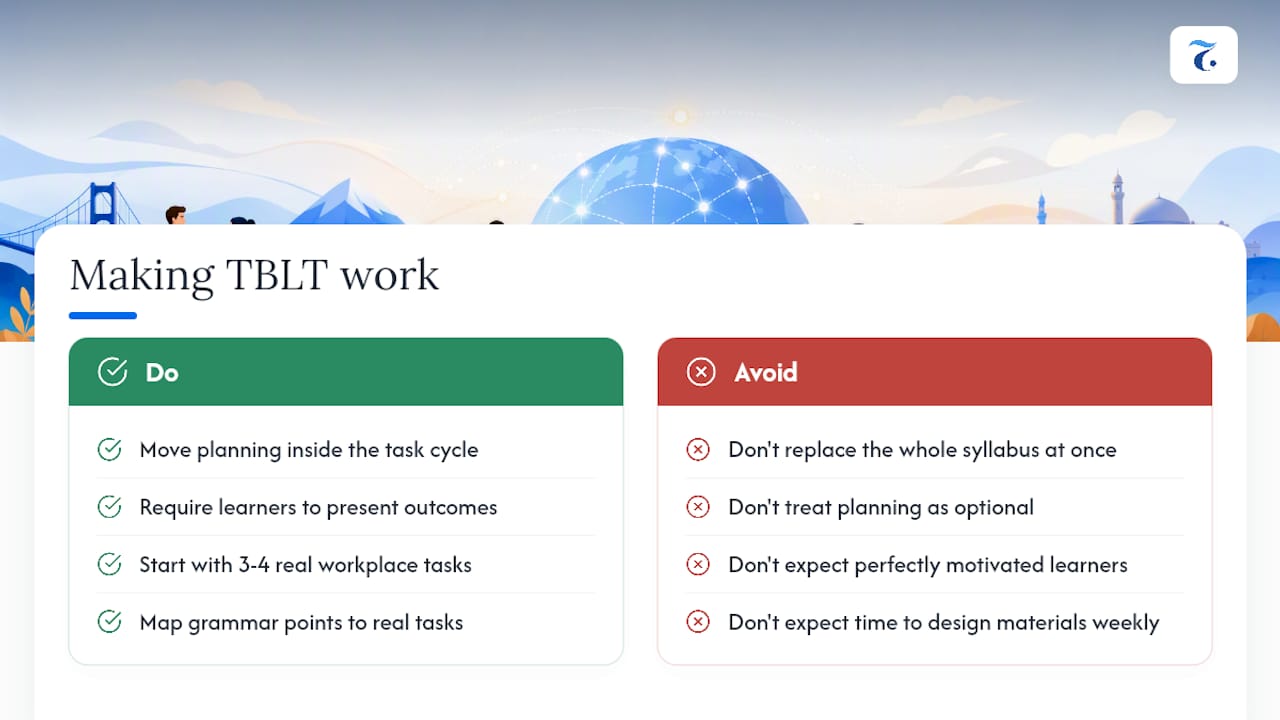
The single most useful shift I have seen in adult and corporate language training is moving the planning phase inside the task cycle rather than treating it as optional. When learners know they will have to present their outcome to another group, the quality of their language during the task itself rises noticeably. They start self-correcting. They ask each other “how do you say…?” That negotiation of meaning is where acquisition happens, and no grammar drill produces it.
For trainers converting a grammar-focused corporate course to TBLT: do not try to replace the entire syllabus at once. Start by identifying the three or four real-world communicative tasks your learners actually face at work — a meeting, a client call, a written proposal — and design one TBLT lesson around each. Run those four lessons alongside your existing materials. The contrast in learner engagement will make the case for you.
Pro Tip: When adapting a grammar-focused course, map each grammar point to a real task where that structure is the natural tool. Present perfect? Design a task where learners must report on what has been accomplished before a deadline. Conditionals? A negotiation task where both parties have constraints. The grammar point becomes a communication resource, not the lesson’s goal.
Sources
These are the foundational and practitioner-facing sources behind this guide, organized by what each is best for.
- Taskbased language teaching – Cambridge University Press (Introduction)
- Communicative and task-based language teaching: where are we now? – The Language Learning Journal (2025 special issue)
- Task-based Learning: An authentic and meaningful way to learn a new language | George Mason University
- Task-based language teaching – Wikipedia
- Task-based Instruction – Methods of Language Teaching (BYU)
FAQ
What is a task-based approach in language teaching?
Task-based language teaching organizes instruction around meaningful, real-world tasks rather than grammar points. Learners acquire language by completing activities with a concrete, non-linguistic outcome, such as planning a trip or resolving a workplace scenario.
What are the downsides of task-based language teaching?
The main downsides are the accuracy trade-off (fluency can develop faster than accuracy, leading to persistent errors), higher planning demands for teachers, and classroom management challenges during group work. Supplementing tasks with explicit focus-on-form moments addresses the accuracy issue.
Who founded task-based language teaching?
TBLT developed from the work of several researchers. Michael Long is most closely associated with its theoretical foundations, particularly the needs-analysis approach. Jane Willis formalized the three-stage lesson cycle (pre-task, task cycle, language focus), and Rod Ellis contributed the distinction between strong and weak TBLT implementations.
How do I plan a lesson using TBLT?
Start with backward design: define the task outcome first, identify the language learners will need, select a task type (information-gap, reasoning-gap, or opinion-gap), design 10–15 minutes of pre-task scaffolding, and draft observable assessment criteria before the lesson begins.

If you want to experience task-based language learning in a structured, teacher-led environment, Thai Explorer’s Thai language courses put authentic communicative tasks at the center of every lesson. Group classes, private sessions, and online Zoom formats are available for adult learners at all levels, with curriculum aligned to CU-TFL standards and instruction led by bilingual native Thai teachers. Thai Explorer is located at 10 Anson Road, in International Plaza, Singapore, right above Tanjong Pagar MRT. Explore the course options and find the format that fits your schedule.