
Start by training tone perception and a handful of spoken phrases, then layer in script and grammar once pronunciation holds steady. That sequence, tones first, speech second, script and grammar staged in afterward, backed by regular real-world practice, mirrors the progression used in CU-TFL-aligned coursework. This guide includes sample lesson plans, drills, and a teacher-ready curriculum map to put that sequence into practice.
TL;DR:
- Focusing on tone perception early in learning Thai is essential, as it establishes a stable foundation before introducing complex script and grammar.
- The initial eight weeks should prioritize spoken phrases, basic greetings, numbers, and directional expressions, avoiding script until tones are mastered.
- Incorporating in-class activities such as phrase relays and market roleplays quickly builds speaking confidence and sustains motivation through active output.
- Introduce Thai script around months two to four only after tone stability and clear conversational goals, starting with high-frequency consonants and simple syllable building.
- Regular daily practice, including role-plays, vocabulary review, and listening exercises, accelerates fluency and prevents plateauing, regardless of living in Thailand.
Table of Contents
- What to Teach First: Priorities for Weeks 1 to 8
- Structured Curriculum and Sample Lesson Plans
- Teaching Pronunciation and Tones: Drills That Work
- Introducing Thai Script: When and How to Teach Reading and Writing
- Practical Classroom and At-Home Activities
- Resources and Tools: Categories to Choose and How to Evaluate Them
- Expert Evidence and Best-Practice Takeaways
- Common Learner Challenges and How to Address Them
- Teaching Grammar Essentials: Sentence Structure and Particles
- Methods for Teaching Vocabulary Acquisition and Retention
- Cultural Context and Etiquette in Teaching Thai
- Publisher Perspective: How We Design Courses to Implement This Plan
- How to Get Started With Our Courses
- Sources
- FAQ
What to Teach First: Priorities for Weeks 1 to 8
Tone perception has to come before anything else, because Thai is a tonal language where the same syllable can carry five different meanings depending on pitch. A learner who skips tone training early ends up bolting it on later as correction work, which takes far longer than building it in from lesson one. Chulalongkorn University’s guidance on Thai instruction backs this up directly: pronunciation and basic grammar fundamentals should be front-loaded, with daily integration into routine use to lock the gains in.
The first eight weeks should look less like a syllabus and more like a series of small, winnable challenges. Here’s a workable breakdown:
- Weeks 1 to 2: Tone awareness drills plus core greetings and self-introductions. No script yet.
- Weeks 3 to 4: Numbers, ordering food, giving and asking for directions. Still spoken only.
- Weeks 5 to 6: Expanded phrase banks covering shopping, small talk, and simple negotiation.
- Weeks 7 to 8: Roleplay scenarios that string multiple phrases together, plus a first light touch of script if the learner’s goals call for reading.
Script timing depends on the learner. Someone learning Thai for a two-week vacation doesn’t need to read a single character. Someone preparing for business correspondence or long-term residency should see the alphabet introduced by week six or seven, once tones are stable enough that spelling doesn’t scramble pronunciation in the learner’s head.
Two activities produce fast speaking wins in class. First, a “phrase relay”: pairs build a four-line dialog using only vocabulary from that week, then perform it cold in front of the group. Second, “market roleplay”: one learner plays a vendor, the other a customer, using number and question-word drills from the current unit. Both force spoken output within minutes, not weeks, which keeps motivation high during the slow grind of tone correction.
Structured Curriculum and Sample Lesson Plans
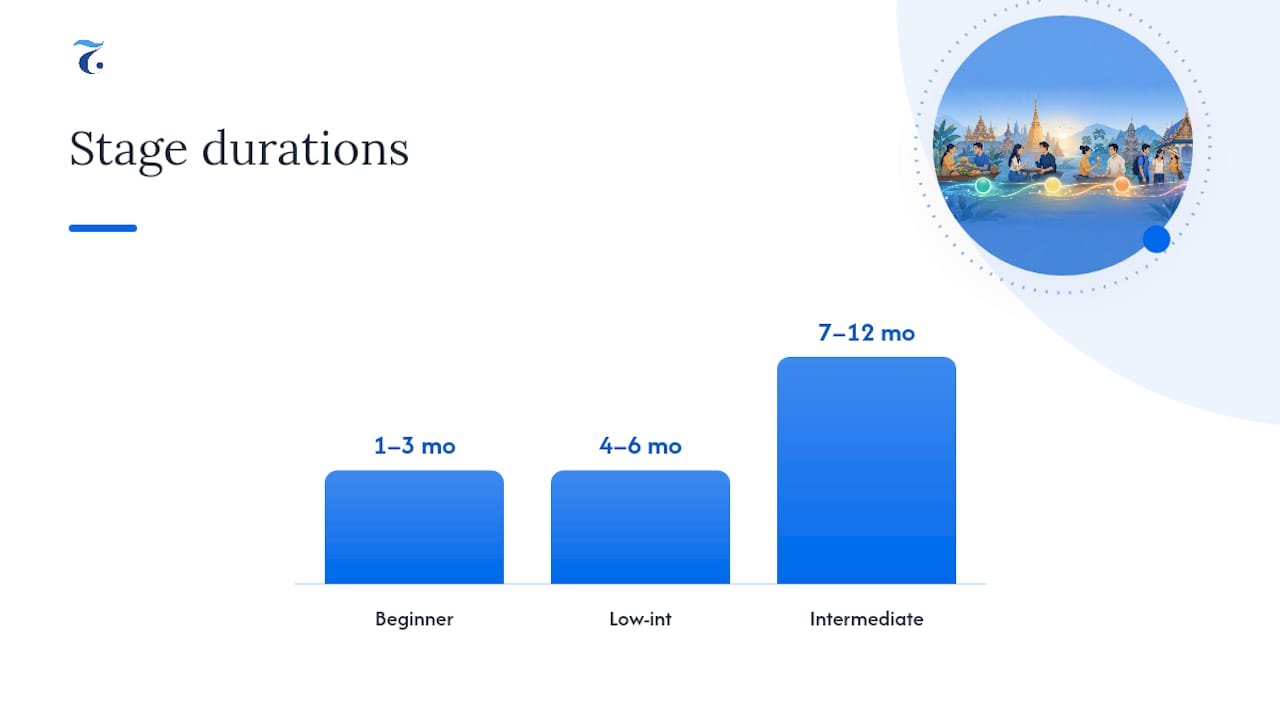
A level map gives both teacher and student a sense of where a lesson sits inside the bigger picture, rather than treating each class as a standalone event. Established programs generally follow a phrase-first-then-script progression, which maps cleanly onto three broad stages:
- Beginner (roughly months 1 to 3): Tone accuracy, core greetings, numbers, question forms, and survival vocabulary. Script optional.
- Low-intermediate (months 4 to 6): Script introduction, expanded sentence structures, past and future time markers, and simple narrative speech.
- Intermediate (months 7 to 12): Reading fluency, more complex particles and connectors, opinion and argument phrasing, and listening comprehension from unscripted native audio.
A 60-minute group lesson typically breaks into five stages: a five-minute warm-up review of the last class’s vocabulary, ten minutes of new tone or grammar input, twenty minutes of structured pair practice, fifteen minutes of open roleplay using the new material, and a ten-minute wrap where each student says one new sentence unscripted. That final stage matters more than it looks. It forces retrieval instead of recognition, which is what actually sticks.
A 45-minute private lesson runs differently because it can adapt in real time. Start with a five-minute diagnostic (what did the student use this week, what tripped them up), move into fifteen minutes of targeted practice on that specific gap, spend fifteen minutes on new material tied to the student’s stated goals, and close with five minutes of feedback plus a homework assignment, usually a short recorded speaking task.
Assessment checkpoints should track loosely against CU-TFL skill categories, listening, speaking, reading, writing, rather than an arbitrary internal scale. A simple formative test every four weeks (a five-minute recorded conversation plus a ten-item vocabulary check) tells you fast whether a student is ready to move stages or needs another cycle at the current one.
Teaching Pronunciation and Tones: Drills That Work
Thai runs on five tones, mid, low, falling, high, and rising, and on a consonant and vowel system that looks intimidating on paper but resolves into about about twenty-one distinct sounds once you strip out the redundancy in the 44-consonant alphabet. Teach the sound system, not the letter count, and the fear factor drops fast.
Four drill types cover most of what a beginner needs:
- Minimal pairs: Contrast words that differ only in tone (mai meaning “new,” “burn,” “silk,” or “not,” depending on pitch) so the ear learns to isolate tone from meaning.
- Tone-mapping visuals: Simple rising and falling line diagrams above syllables, so students see the pitch contour before they try to produce it.
- Shadowing with slowed audio: Play a native clip at reduced speed, have the student repeat immediately after each phrase, then compare against full-speed audio.
- Recording and playback: Students record themselves daily and compare against a native model. Hearing the gap does more than any correction from a teacher.
For quick in-class assessment, a tone-quiz format works well: read ten words aloud, students write the tone number (1 through 5) for each, then swap papers for peer correction. Peer correction matters here specifically because it forces the corrector to also actively discriminate tones, not just the student being tested.
Pro Tip: Pair every tone drill with a physical gesture, hand rising for a rising tone, dropping for falling, flat palm for mid tone. Kinesthetic cues create a second memory pathway, and students who “feel” a tone with their hand tend to recover it faster mid-sentence than students relying on ear memory alone.
For a deeper walkthrough of the tone system and how Thai tone marks work in written form, a dedicated pronunciation reference is worth building into your lesson prep.
Introducing Thai Script: When and How to Teach Reading and Writing
Script should wait until tones are stable and the learner has a functional spoken base, usually somewhere between month two and month four. Introducing letters too early creates a trap where students start pronouncing words the way they’re spelled in Latin transliteration rather than the way they actually sound, which undoes weeks of tone training.
Three signals suggest a student is ready: they can hold a basic conversation without constant tone correction, they’ve stated a goal that requires reading (business, long-term residency, formal study), and they show genuine motivation for it rather than pressure from a syllabus deadline.
Once the timing is right, a stepwise sequence keeps the load manageable:
- Start with high-frequency consonant groups, not the full alphabet at once.
- Add vowel forms grouped by shape and position (before, after, above, below the consonant).
- Move to syllable formation, combining known consonants and vowels into real words already in the student’s spoken vocabulary.
- Finish with guided reading practice using short, familiar phrases before introducing unfamiliar text.
Handwriting drills and syllable-building games (physical tile sets work well here) reinforce the mechanics without turning script study into pure memorization. Done this way, script actually accelerates vocabulary retention rather than competing with it, because seeing a word spelled out gives the brain a second anchor point beyond sound alone.
Practical Classroom and At-Home Activities
Fluency depends far more on what happens between classes than on the class itself. A student who shows up once a week and does nothing else will plateau; a student who spends fifteen minutes a day on structured practice will pass them within a month.
- Role-plays and information-gap tasks: Give each partner half the information needed to complete a task (a train schedule, a menu with missing prices) so they’re forced to negotiate meaning in Thai rather than just recite lines.
- Guided dialogues: Scripted conversation frameworks that students fill in with their own vocabulary, then perform without looking at notes.
- Spaced-repetition vocabulary review: Ten to fifteen minutes daily using a simple flashcard system, reviewing words at increasing intervals rather than cramming a list once.
- Daily listening and shadowing: Fifteen minutes with a podcast, drama clip, or song, repeating phrases aloud even when comprehension is partial.
- Immersion tactics for non-residents: Build a Thai media playlist, label household objects with Thai script, and find a conversation partner for weekly practice calls.
- Recorded speaking logs: A weekly one-minute voice memo on an assigned topic, kept as a running archive so both student and teacher can hear progress month over month.
None of this requires living in Thailand. Consistent structured practice, even from a desk in another country, moves the needle faster than occasional deep study sessions. For a fuller breakdown of daily routines that don’t depend on geography, see how to practice Thai every day without living in Thailand.
Resources and Tools: Categories to Choose and How to Evaluate Them
Five resource categories cover most of what a teaching program needs: structured course platforms, pronunciation trainers, audio dictionaries, graded readers, and teacher worksheets for drills and homework. Rather than chasing a single “best” tool, build a checklist and evaluate anything against it before adopting it into a lesson plan.
Look for native audio quality first. A tool with clear, native-speaker recordings beats one with more features but robotic or non-native pronunciation. Check for explicit tone training focus, since many general-purpose apps treat tones as an afterthought. Confirm the material includes usable teacher worksheets, not just self-study modules, and that sequencing matches a phrase-first-then-script progression suited to adult learners rather than one built for children.
Reference sites such as Thai-language are useful for pulling native audio and script lookups when building custom listening or reading exercises. A blended program combining a free reference site for spot-checking vocabulary with a paid, structured course for sequencing and feedback tends to outperform either approach alone. Test any resource locally before committing a full term to it.
Expert Evidence and Best-Practice Takeaways
The sequence recommended throughout this guide isn’t a house preference. It tracks directly with published guidance from Chulalongkorn University, one of Thailand’s leading academic authorities on the language.
“Learners should start with pronunciation, script, and basic grammar, and integrate the language into daily routines to accelerate progress,” according to Dr. Kiat’s guidance for Chulalongkorn University.
That advice pairs naturally with the phonetic data: 44 consonants collapsing into roughly about twenty-one distinct sounds, plus five tones, means the sound system is more learnable than it first appears, provided it’s tackled in order. Structured basics followed by daily use consistently outpaces scattered, ad hoc drilling. CU-TFL alignment gives teachers a reference point for setting realistic level objectives instead of guessing at what “intermediate” should mean.
Common Learner Challenges and How to Address Them
Tone deafness, or the sense that every tone sounds identical, is the single biggest early obstacle. It usually isn’t a hearing problem; it’s a lack of deliberate contrast practice. Minimal-pair drills, done consistently for even two weeks, resolve most of this faster than students expect.
Plateauing after the beginner stage is the second common wall. Students often hit a point where they can handle scripted exchanges but freeze in unscripted conversation. The fix is forcing unscripted output earlier, even badly, rather than polishing scripted dialogs indefinitely.
Reading fatigue hits students who start script too early or too fast. If a learner dreads opening a textbook, that’s usually a sequencing error, not a motivation problem, and backing off script density for a few weeks while reinforcing speech usually restores momentum.
Classifier confusion (the small words Thai uses to count different categories of nouns) trips up almost everyone, since English has no direct equivalent. Treating classifiers as vocabulary items tied to specific noun groups, rather than a separate grammar topic, makes them stick faster.
Finally, inconsistent home practice undercuts classroom gains more than any single teaching flaw. A short, non-negotiable daily habit, even five minutes, beats an occasional long session, and teachers who assign small daily tasks rather than weekly homework blocks tend to see faster-progressing students.
Teaching Grammar Essentials: Sentence Structure and Particles
Thai sentence structure follows a subject-verb-object order familiar to English speakers, which removes one common source of anxiety early on. The real grammar work in Thai isn’t word order. It’s particles, the small words that carry tone of politeness, question status, or emphasis without changing the core meaning of a sentence.
Politeness particles (khrap for male speakers, ka for female speakers) attach to the end of statements and questions and signal respect. Teaching these from lesson one, rather than treating them as optional flavor, builds habits that are hard to retrofit later. Question particles work the same way: a statement becomes a question simply by adding a particle at the end, with no need to invert word order the way English does.
Time in Thai is handled through context words and markers rather than verb conjugation. There’s no tense system to memorize in the way English or French learners might expect; instead, words indicating “already,” “will,” or “still” sit near the verb to establish when something happens. This is genuinely good news for a curriculum: teachers can spend less time on verb charts and more time on the sentence patterns that actually carry meaning in daily speech.
Introduce particles in small batches tied to function (politeness, questions, emphasis) rather than dumping the full particle list at once. Students absorb them faster when each one is anchored to a specific communicative job they can practice immediately in roleplay.
Methods for Teaching Vocabulary Acquisition and Retention
Vocabulary retention in Thai depends heavily on pairing new words with sound patterns the student already controls, because a mispronounced tone effectively creates a different word in the learner’s memory. Teaching vocabulary in isolation from tone practice is one of the most common inefficiencies in beginner instruction.
Spaced repetition remains the most reliable method for long-term retention, reviewing a word at increasing intervals rather than repeating it in a single cramming session. Ten minutes a day produces better long-term recall than an hour once a week, simply because spaced review interrupts the forgetting curve at the right points.
Grouping vocabulary by function rather than alphabetically also speeds retention. A unit built around “ordering food” sticks better than a random list of fifteen nouns, because the words arrive already embedded in a usable context. Pairing each new word with a gesture, an image, or a short personal sentence gives the brain multiple retrieval paths instead of one.
Active recall beats passive review every time. Flashcard apps that force production (typing or saying the word) outperform apps that only ask for recognition (multiple choice). For classroom settings, a weekly “vocabulary defense,” where each student has to use five new words correctly in an unscripted sentence, catches shallow memorization before it becomes a habit that’s hard to break later.
Cultural Context and Etiquette in Teaching Thai
Thai communication carries social weight that vocabulary lists alone won’t teach. The wai greeting, hands pressed together in a slight bow, varies in height and formality depending on the relationship between speakers, and getting this wrong reads as either overly formal or oddly casual depending on context.

Politeness particles tie directly into this etiquette layer, which is part of why they deserve early, serious attention rather than being treated as decorative add-ons. Dropping them in a formal setting, with a stranger, a teacher, or an elder, lands as brusque even if the grammar is otherwise correct.
Indirectness matters too. Thai speech tends to favor softened disagreement and face-saving phrasing over blunt correction, and a teacher who models this style helps students avoid coming across as rude when they mean to be simply direct. Roleplay scenarios that include a mild disagreement or a request for a favor are useful precisely because they force students to practice softening language, not just vocabulary recall.
Building a short cultural note into each unit, why a phrase carries the weight it does, who would and wouldn’t use it, turns grammar practice into something closer to real communication competence rather than a checklist of correct sentences.
Publisher Perspective: How We Design Courses to Implement This Plan
Com builds its group, private, and online course formats around exactly this sequence: tone stability before script, phrase-first speaking before grammar depth, all mapped to CU-TFL skill categories rather than an arbitrary internal scale. Every class runs with bilingual native instructors, which matters because tone correction depends on hearing the target sound modeled accurately and explained in a language the student actually understands. Case study data and student-outcome tracking continue to build out as more cohorts complete the program.
— Paul
How to Get Started With Our Courses
If the sequence in this guide makes sense to you, tones first, phrases next, script and grammar staged in after, that’s precisely how Com structures every course format. Group classes work well for learners who benefit from roleplay partners and peer correction on tone drills. Private lessons suit anyone with a specific business or travel deadline who needs the diagnostic-then-targeted-practice model covered earlier. Online Zoom classes carry the identical curriculum and CU-TFL-aligned sequencing for learners who can’t make it into the training center at 10 Anson Road, #22-07, International Plaza, Singapore 079903, right above Tanjong Pagar MRT.

Corporate teams looking for structured business Thai follow the same phrase-first, staged-script model, just adapted to workplace vocabulary and meeting scenarios from week one. Whichever format fits your schedule, the fastest way to see how the curriculum maps to your specific goals is to check the Thai course page and get in touch about a trial class before committing to a full term.
Sources
FAQ
Is Thai an Easy Language to Learn to Speak?
Thai grammar is comparatively simple, no verb tenses, subject-verb-object order familiar to English speakers, but the five-tone system makes spoken Thai genuinely challenging for beginners without a tonal-language background. Early, deliberate tone training closes most of that gap within the first couple of months.
What Is the Easiest Way to Learn Thai?
Following a staged sequence, tone perception first, spoken phrases next, script and grammar layered in afterward, backed by daily short practice sessions, is more effective than jumping straight into reading or trying to absorb everything at once. Structured courses that follow this progression tend to produce faster, more stable progress than self-directed, ad hoc study.
Can Duolingo Teach Thai?
General-purpose language apps can help with basic vocabulary recognition, but most don’t offer the dedicated tone training, native-speaker feedback, or structured sequencing that tonal languages like Thai require for accurate spoken production. They work best as a supplement to structured instruction rather than a replacement for it.
How Do You Say “I Love You” in Thai?
“I love you” in Thai is phom rak khun (ผมรักคุณ) if the speaker is male, or chan rak khun (ฉันรักคุณ) if the speaker is female, with rak carrying a mid tone. Getting the tone right matters here as much as the words themselves, since a mispronounced tone can shift the meaning entirely.