
Thai Explorer offers group, private, online and corporate Thai courses in Singapore. The school lists its City campus at 10 Anson Road, #22-07D, International Plaza, Singapore 079903, directly above Tanjong Pagar MRT.
- What the school offers: Native Thai teachers, a structured syllabus covering speaking, listening, reading, and writing, and flexible formats from weekly group sessions to Zoom lessons. Confirm current class availability for your preferred format when you enquire.
- Next step: Thai Explorer lists a S$45 two-hour Beginner 1 group trial. Check the trial timetable and confirm the format and any registration fee before paying. Bring a clear note of your goal (travel, conversation, business, or certification) and your available weekly hours. A trial lets you observe teacher style, class pace, and whether the format suits your schedule before you commit.
Pro Tip: Write down three specific situations where you want to use Thai before your trial. “I want to order food and negotiate at Chatuchak Market” is far more useful to a teacher than “I want to learn Thai.” It helps the teacher focus on what you actually need.
Table of Contents
- How do you choose the right Thai class for your goals?
- Which class format fits you: group, private, online, or corporate?
- What levels are available, and how does certification work?
- What should you look for during a trial?
- What do Thai classes cost, and how are they scheduled?
- How do you book a class and make the most of a trial?
- How to assess learner reviews
- Key Takeaways
- Learning Thai as an adult in Singapore: a realistic view
- Thai Explorer: structured courses with native teachers in Singapore
- Useful sources and further reading
- FAQ
How do you choose the right Thai class for your goals?
Start with the situations where you want to use Thai. Compare travel or everyday conversation needs with the reading, writing and vocabulary involved in your own work. Use those examples when you ask whether a class suits you.

Four questions that actually narrow it down:
Which situations do you want to handle? List examples such as ordering food, taking part in a work conversation or reading a message. If you are preparing for an examination, compare its published requirements with the course outline and ask what preparation the school offers.
How much time can you set aside? Match the published class dates and session length to your availability, and ask what practice is expected between lessons.
Do you want to read Thai script? If you want to read signs, messages or documents, ask how the course covers reading and writing. For an exam, check its actual test requirements rather than inferring them from a course level name.
What teaching support do you need? Ask how the instructor explains unfamiliar sounds and checks your understanding. During a trial, note whether the explanations and opportunities to ask questions work for you.
Before paying, ask for the course outline, teacher qualifications, trial availability and written cancellation or refund terms. Record anything not stated so you can follow it up rather than assuming it is included.
Tip: Ask to see the syllabus or a description of the first level. Note which skills and activities it covers and ask about anything relevant to your goal that is not stated.
Which class format fits you: group, private, online, or corporate?
The format shapes your pace, your cost, and how much speaking practice you actually get per session. Here is how each one plays out in practice.
| Format | Consider for | Participants | What to ask |
|---|---|---|---|
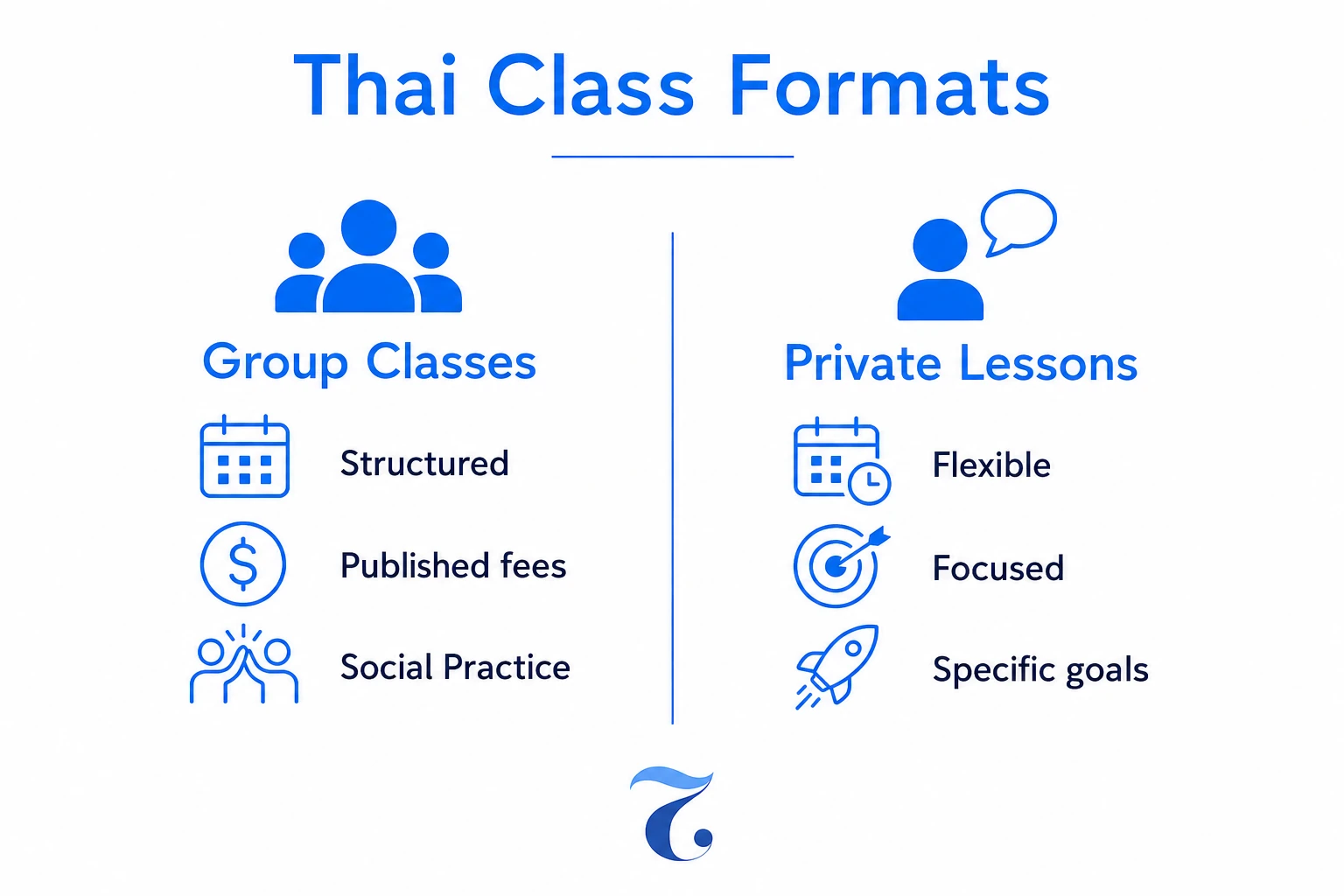
| Group classes | Shared class practice | Confirm batch size | Ask about turn-taking and feedback |
| Private (1:1) | Individual goals and scheduling | 1 learner | Ask what the quote includes |
| Online / Zoom | Joining remotely | Confirm class format | Confirm setup and recordings |
| Corporate training | Work-related language tasks | Confirm team size | Confirm topics and scope |

Ask how many learners are expected in your batch and how the teacher divides practice between pairs, groups and individual feedback. A class size alone cannot tell you how much time you will spend speaking.
Private Thai lessons suit learners with a tight deadline, a specific industry focus, or a schedule that does not fit fixed weekly slots. The pace adjusts to your goals. For business Thai specifically, ask the instructor whether lessons can include role-play of meetings, emails and other workplace scenarios relevant to your industry.
Online Zoom classes may include recorded class videos for review. If you want to revisit pronunciation between sessions, ask which recordings are available for your specific course before enrolling.
For a work-related course, list the tasks your team needs to handle in Thai, such as meetings or written messages. Ask whether the provider can address those tasks, what information it needs from your team and what sits outside the quoted scope.
What levels are available, and how does certification work?
Use these examples of topics when asking what a particular level covers. Level names and content vary by school and course.
- Introductory topics: Ask about greetings, numbers, everyday vocabulary and pronunciation.
- Developing your skills: Ask about conversation, listening and the reading or writing tasks that matter to you.
- Specific goals: For workplace tasks, extended reading or an examination, ask which course addresses those requirements and what prior study is expected.
Chulalongkorn University offers the CU-TFL proficiency test. Thai Explorer’s Thai course overview explains the school’s classes. Its Thai Test preparation page covers exam structure and study strategies.
For timeline expectations, the language proficiency levels guide discusses progression. Set a practical goal for the first course and review what you can do after the level. Exam readiness depends on the exam requirements and your current skills.
A note on tones: Standard Thai has five tones, and a different tone can change a word’s meaning. Ask how the course introduces pronunciation and gives you opportunities to practise and ask questions.
What should you look for during a trial?
Take these prompts to a trial and record what you observe or still need to ask. Mark unanswered items as “not stated”.
-
Tonal pronunciation. How is tone practice structured in this class?
Observed / not stated: ___________
Follow-up: ___________ -
Speaking time. How much of the session involves learners speaking?
Observed / not stated: ___________
Follow-up: ___________ -
Vocabulary method. Are new words taught in sentences or as isolated lists?
Observed / not stated: ___________
Follow-up: ___________ -
Reading and writing. Is script literacy part of this level? When does it start?
Observed / not stated: ___________
Follow-up: ___________ -
Cultural context. Are real situations used to explain when and why to use phrases?
Observed / not stated: ___________
Follow-up: ___________ -
Syllabus and outcomes. What are the stated learning outcomes for this level?
Observed / not stated: ___________
Follow-up: ___________ -
Self-study support. What resources or recordings are available between sessions?
Observed / not stated: ___________
Follow-up: ___________ -
Class size and interaction. How many learners are expected, and how is practice time divided?
Observed / not stated: ___________
Follow-up: ___________
For more on how cultural context fits into Thai courses, see cultural context woven into lessons on the Thai Explorer website.
If reading and writing matter to your goal, ask how the syllabus introduces script alongside spoken practice. Tell the school which texts you want to read or write, and ask which level addresses those tasks.
What do Thai classes cost, and how are they scheduled?
Use the published Beginner 1 group package and trial as starting references, and request a written quote for the particular format you are considering. Confirm which fees and materials the quoted amount includes.
| Format | Fee example | Scheduling | Notes |
|---|---|---|---|
| Group classes | S$350 for 8 two-hour lessons (Beginner 1); confirm other levels with the school | Confirm session days and times | Trial: S$45 for one two-hour session |
| Private (1:1) | Confirm with the school | Flexible | Pace adjusts to your goals |
| Online / Zoom | Confirm with the school | Confirm with the school | Ask about recorded sessions for your course |
| Corporate training | Quoted per team | Agreed with team | Pre-course needs analysis recommended |
Ask the school about its next intake date for group classes and how far in advance you need to register. For private lessons, ask about instructor availability and lead time.
Ask the school about its payment structure before enrolling: whether fees are per level, per term, or per session, and whether installment options are available for longer programs.
Before paying, ask specifically about the cancellation and refund policy. Find out what notice period is required for rescheduling and whether partial refunds are available if you withdraw. Policies vary between providers, and the details matter more than the headline price.
How do you book a class and make the most of a trial?
Use these steps to clarify the offer before booking:
- Send your current level, learning goal, preferred format and availability through the existing contact page. For help comparing formats, read the related class-selection guide.
- Ask the school to confirm the date, venue or online joining arrangements, session length and price before you attend or pay.
- If you have studied Thai before, ask how the school recommends a starting level and whether a placement check is appropriate.
- Confirm what the fee includes, any registration or materials charges, and the written cancellation, rescheduling and refund terms.
- Once your booking is confirmed, keep the joining instructions and your questions for the session.
What to bring to your trial: A clear statement of your goal, your weekly availability, and two or three specific situations where you want to use Thai. If you have any prior exposure, a rough sense of what you already know saves time.
Trial questions to consider:
- Did the teacher explain tones clearly and give you time to practise them?
- Was the pace comfortable without feeling slow?
- Did you get to speak Thai during the session?
- Was the syllabus explained, with clear outcomes per level?
- Did the explanation of the course content help you decide whether it suits your goal?
These questions help you notice what matters during a trial. Use your observation notes to compare if you visit more than one school. No single trial gives a complete picture, so focus on whether you felt the session was relevant to your stated goals.
How to assess learner reviews
When assessing any language school, read dated reviews from learners who had a similar goal to yours. Look for specific observations about lesson structure, teacher interaction, and practical outcomes rather than general praise. A review from someone learning Thai for business carries different weight than one from a casual traveller.
Check whether reviewers mention the format and level you are considering. A positive review of group beginner classes does not tell you much about advanced private tuition. If you have a specific goal such as business communication or exam preparation, look for reviews that describe those outcomes directly.
Consider how the class location fits your weekly routine. If the commute adds enough friction to make you skip sessions on busy weeks, that affects your consistency. Thai Explorer lists its training centre above Tanjong Pagar MRT.
Key Takeaways
Compare the published group timetable with your own availability. If you need a different schedule or specific practice for work, ask about private or corporate lessons.
| Point | Details |
|---|---|
| Match format to your goal | Group classes suit structured learners; private lessons offer flexible pacing for specific goals. |
| Ask about group size | Confirm how many learners are in your batch and how practice time is divided. |
| Check exam preparation separately | Ask whether the curriculum covers the specific exam you plan to take. |
| Trial class before committing | Attend a trial and use the observation checklist: tonal practice, speaking time, syllabus clarity, and teacher responsiveness. |
| Thai Explorer | Group, private and live online formats, with a City campus above Tanjong Pagar MRT. Confirm current availability and fees before enrolling. |
Practice idea: Choose a short Thai audio example that is relevant to your goal. Listen, pause and repeat it, then note anything you want to ask the teacher. Use a routine that fits your available time.
Learning Thai as an adult in Singapore: a realistic view
Standard Thai uses tone to distinguish words. Ask for examples and explanations when a sound is unfamiliar, and consider how you will find opportunities to listen to and use Thai outside class.
Between sessions, choose something from your lesson to revisit: a phrase, a pronunciation question or a short reading task. Use your notes and any resources your course provides, and bring unresolved questions to the next class.
Keep a simple record of what you practised and what remains unclear. Review that record when deciding what to ask about or practise next, and adjust the routine to the time you actually have.
Thai Explorer: structured courses with native teachers in Singapore
Thai Explorer offers group, private, live online and corporate Thai classes. Check the group timetable for current intakes. For exam preparation, ask what the school covers for the test you plan to take.
The training centre sits directly above Tanjong Pagar MRT at 10 Anson Road, #22-07D, International Plaza, Singapore 079903. Online lessons are available via Zoom, and some course formats include recorded sessions for review. Corporate teams can enquire about programmes tailored to their industry vocabulary and communication needs.
Trial classes are available. You can browse the course options or contact Thai Explorer directly with your learning goals and schedule. The trial is a chance to experience a class and discuss the right level and format with the teacher before committing.
Useful sources and further reading
- Thai Explorer course overview — Group, private, online, and corporate formats with syllabus details and trial booking.
- Private Thai lessons — 1:1 lesson structure, scheduling, and what to expect from private sessions.
- Thai Test preparation — Exam structure, study tips, and CU-TFL assessment preparation.
- Recognized Thai language tests guide — Overview of official Thai proficiency tests and what each one demonstrates.
FAQ
How long does it take to learn conversational Thai?
A course package states how many lessons it includes, rather than a date by which every learner will reach a proficiency level. Thai Explorer lists eight two-hour lessons for a beginner group package. Ask what your selected level covers and use your starting point and learning goal when discussing the next step with the school.
What does “chup chup” mean in Thai?
“Chup chup” (จุ๊บๆ) is an informal Thai expression for a kiss or kissing sound, used affectionately in casual conversation, similar to how English speakers might say “kisses.”
How do you say “toilet” in Thai?
The standard Thai word for toilet is “hong nam” (ห้องน้ำ), which literally means “water room.” It is widely understood across Thailand and is one of the most practical phrases to learn early.
Do Thai people say “I love you”?
Yes. A common way to say “I love you” in Thai is “phom rak khun” (ผมรักคุณ), using the male first-person form. Thai has different first-person pronouns depending on the speaker’s gender and the level of formality, so the exact phrasing varies. Learning how affection is expressed in Thai, including when and how these phrases are typically used, is a useful part of understanding the culture alongside the language.
Can I learn Thai online from Singapore?
Yes. Thai Explorer offers live online lessons over Zoom. Confirm the timetable, joining requirements and availability of recordings for your selected course before booking.