
Job-ready Thai means a professional can handle meetings, write a workplace email, and read basic documents without an interpreter, achievable in a few months of focused study. Employers hiring for Thai-facing roles look for three things: spoken fluency for meetings and calls, functional workplace writing, and enough cultural fluency to avoid the missteps that stall negotiations. The fastest path aligns your training with CU-TFL-style benchmarks and a syllabus built around actual office tasks, not textbook dialogue.
Here’s the realistic sequence:
- Diagnose first. Find out what level you’re actually at before picking a course.
- Train for the job, not the exam. Pick a course built around emails, meetings, and presentations.
- Document your progress. Recordings, writing samples, and test scores turn “I studied Thai” into proof an employer can act on.
Key Takeaways
Job-ready Thai for most professional roles combines speaking and listening for meetings, functional workplace writing, and cultural fluency, typically achievable in 3 to 9 months of focused, task-based study.
| Point | Details |
|---|---|
| Prioritize speaking and listening | Meetings and phone calls expose weak Thai faster than any other task, so train these first. |
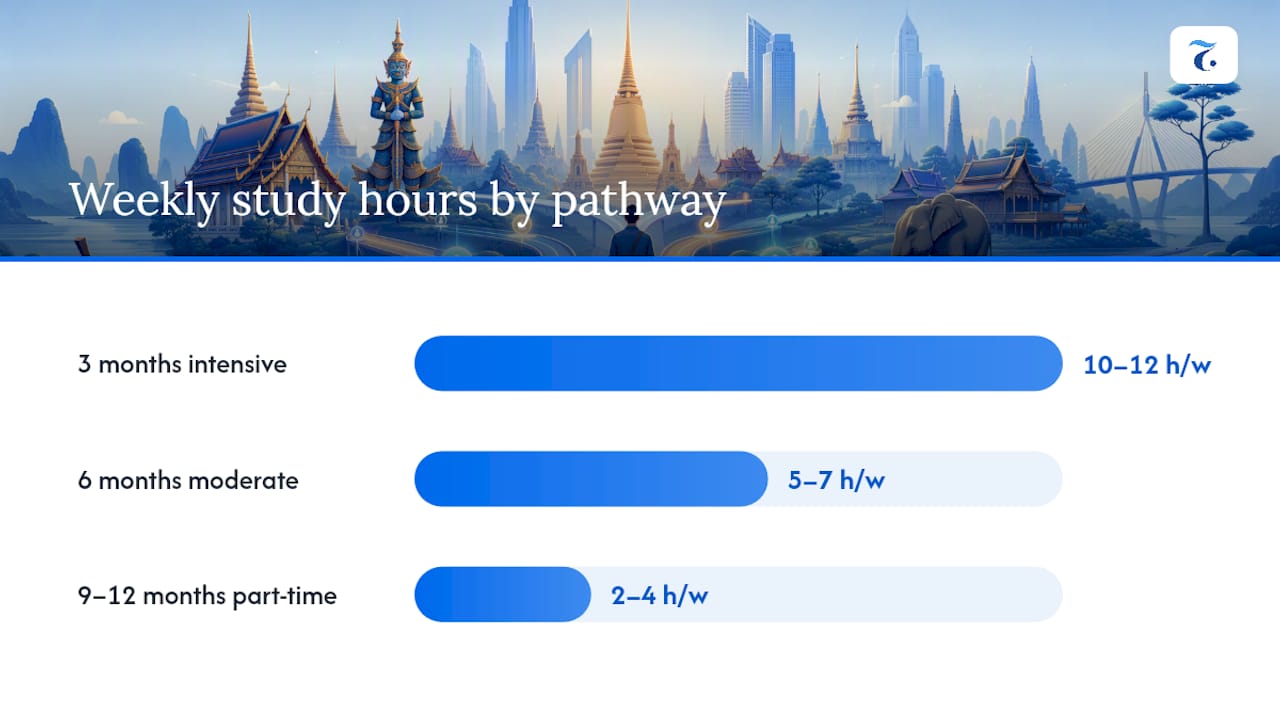
| Match study time to your timeline | Intensive study with 10 to 12 hours a week can lead to basic fluency in a few months; moderate study with 5 to 7 hours a week takes longer. |
| Document everything | Recorded speech, annotated emails, and meeting-minute samples prove skill better than a resume line. |
| Learn cultural norms alongside vocabulary | Kreng jai, sanuk, and face-saving behavior shape how meetings and negotiations actually unfold. |
| Choose a workplace-focused course | Thai Explorer’s CU-TFL-aligned, native-instructor courses target the same emails, meetings, and presentations employers test for. |
Table of Contents
- What Employers Actually Expect From Thai Language for Job Roles
- Which Thai Skills Should You Prioritize First?
- How Long Does It Take to Reach Job-Ready Thai?
- How Do You Prove Your Thai Skills to Employers?
- What to Look for in a Thai Course for Job Preparation
- Thai Business Culture Essentials You Need to Know
- What I’d Tell a Professional Starting From Zero
- Start Your Thai Language for Job Journey With Thai Explorer
- Sources
- FAQ
What Employers Actually Expect From Thai Language for Job Roles
Most Thai-facing roles don’t require literary fluency. They require you to survive a meeting, write a coherent email, and not embarrass your company in front of a client. Research into business Thai needs found demand was rated high across seven distinct contexts: workplace communication, customer service, seminars, travel, trade, investment, and hospitality, with a reported need level averaging 4.23 out of 5. That spread matters: a hospitality worker and a trade negotiator need overlapping but not identical Thai.
Course design increasingly reflects this. Workplace-focused syllabi now break out application forms, official letters, meeting minutes, and public presentation skills as separate learning outcomes rather than folding everything into generic conversation practice.
| Workplace task | Approximate CU-TFL / practical level | Typical roles |
|---|---|---|
| Small talk, introductions | Beginner to low intermediate | Hospitality, customer service |
| Phone calls, meeting participation | Intermediate | Sales, corporate liaison |
| Email drafting, meeting minutes | Intermediate to upper intermediate | Corporate liaison, office admin |
| Negotiation, interpreting | Upper intermediate to advanced | Interpreter, trade/investment roles |
Interpreter and Thai-teacher job listings commonly ask for accurate rendering between Thai and English plus cultural sensitivity, with pay bands around $35 to $50 per hour for in-person interpreting work. That’s a useful anchor if you’re wondering whether the investment in Thai pays off in market terms.
Which Thai Skills Should You Prioritize First?
Not all four skills, speaking, listening, reading, writing, deserve equal study time in your first few months. Prioritize by what actually blocks you at work.
- Listening comprehension for meetings and phone calls. You can survive with weak speaking if you understand what’s being said. You cannot survive if you don’t.
- Speaking for introductions, small talk, and light negotiation. This is what builds trust before any contract gets signed.
- Workplace writing. Emails, meeting minutes, and short reports. This is the skill most courses underweight and most jobs actually test.
- Polite and formal registers. Thai has layered levels of formality tied to hierarchy and relationship. Getting this wrong reads as either cold or presumptuous.
- Reading numbers, dates, and short documents. Enough to check a contract date or a delivery schedule without asking a colleague.
For speaking practice, build a small bank of high-value patterns: how to open a meeting politely, how to ask for clarification without sounding confused, how to decline a request while preserving the relationship. Practice these as spoken drills, not written translations, since the goal is instant recall on a call, not a grammar exercise.
Role-plays with a native speaker beat solo app drilling for this kind of fluency. Phone drills, where you rehearse a call script out loud before making a real one, work particularly well for anyone whose job involves vendor or client calls.

Pro Tip: Chulalongkorn University’s own guidance on communicative Thai courses notes that learners can use a phonetic or IPA-based approach and delay mastering the Thai script. If your job needs you talking fast more than reading fast, start with sounds, not characters.
How Long Does It Take to Reach Job-Ready Thai?
There’s no single timeline, but three realistic tiers cover most working professionals.
- 3 months, intensive (10 to 12 hours a week). Delivers functional speaking and listening for meetings and small talk, plus basic written phrases. Best for someone with an imminent posting or transfer.
- 6 months, moderate (5 to 7 hours a week). Adds workplace writing, meeting minutes, and more confident negotiation language. The most common pace for working professionals holding down a full-time job.
- 9 to 12 months, part-time (2 to 4 hours a week). Builds the same competence more slowly, with more room for the material to actually stick.
A workable weekly recipe: two or three 20-minute micro-sessions for vocabulary and listening, one commute-length audio drill, one live speaking lesson, and one written task, drafting a short email or set of meeting notes in Thai and having it corrected.
Set checkpoints instead of vague goals. A useful one: can you hold a 5-minute spontaneous conversation about your job? Can you write a one-page email in Thai without translation software? Can you handle a guided role-play of a client meeting? Chulalongkorn’s CU-TFL framework assesses listening, reading, writing, and speaking as separate components, which gives you a natural template for tracking each skill independently rather than lumping them into one fuzzy “fluency” number.
Build practice into the workday itself. Label your desk items in Thai. Take bilingual notes in meetings. If a colleague is willing, agree to run five minutes of a weekly call in Thai.
How Do You Prove Your Thai Skills to Employers?
Studying Thai for a year means nothing to a hiring manager unless you can show it. Turn skills into evidence.
On your resume, be specific about outcomes, not just exposure: “Conducted vendor negotiations in Thai, cutting email back-and-forth by half” reads far stronger than “conversational Thai.” Quantify wherever you honestly can.
- Recorded speaking sample. A short, unscripted clip answering a work-relevant question in Thai.
- Annotated writing sample. An email or short report you drafted in Thai, with corrections shown, proving you can take feedback and improve.
- Meeting-minutes sample. Demonstrates you can process spoken Thai and turn it into a usable written record.
- A recognized assessment. CU-TFL scores carry weight because employers know what the test measures.
Employers frequently treat solid spoken Thai plus a couple of real writing samples as good as a certificate, especially when the samples map directly to the job’s actual tasks. In interviews, don’t wait to be asked. Offer to do a short segment in Thai yourself; it shows more than any line on a resume can.
Pro Tip: Keep your writing samples in a simple folder you can share by link. A hiring manager glancing at a Thai email you wrote is worth more than a paragraph describing your level.
What to Look for in a Thai Course for Job Preparation
Not every Thai class builds job-ready skills. Before enrolling, check for these features:
- A syllabus built around workplace tasks, emails, meeting minutes, presentations, not just travel phrases.
- Curriculum aligned to CU-TFL benchmarks, so your progress maps to a recognized standard.
- Native, bilingual instructors who can explain grammar in English when a concept doesn’t translate cleanly.
- Assessment checkpoints along the way, not just a final test.
- Flexible formats: group, private, online, or corporate, depending on your schedule and goals.
Native bilingual instruction matters more than it sounds. A teacher who’s only ever taught in Thai can drill pronunciation, but can’t always explain why a Thai sentence structure trips up an English speaker’s instincts. Bilingual instructors bridge that gap directly.
Workplace Thai courses that break out application forms, official letters, meeting minutes, and presentation skills as distinct outcomes give learners a far clearer sense of progress than generic “conversational Thai” classes ever can.
Thai Explorer’s course offerings follow this workplace-first structure, with CU-TFL-aligned progression and native bilingual instructors. If your goal is corporate or business Thai specifically, the learn Thai language track is built around that use case rather than tourist phrases. Group classes suit steady, budget-conscious progress; private lessons suit tight timelines; corporate training suits teams that need to move together.
Thai Business Culture Essentials You Need to Know
Language skill without cultural awareness gets you halfway. Three concepts shape most Thai workplace interactions: kreng jai, a reluctance to inconvenience or impose on others, which explains why direct refusals are rare; sanuk, the expectation that even serious work carries some lightness and warmth; and face-saving, the strong preference for resolving disagreement privately rather than in front of a group.
Practical guidance:
- Greet with a wai when appropriate, and let seniority determine who greets first.
- Avoid public criticism or correction, even when you’re right.
- Use small talk before business topics; rushing to the agenda reads as cold.
- Bring a small gift to first meetings with new partners; skip anything with your company logo plastered on it.
Speaking even basic Thai signals commitment in a way English alone never will, and it cuts your reliance on interpreters for the moments that matter most.
What I’d Tell a Professional Starting From Zero
Most people over-invest in reading and writing before they can hold a two-minute phone call, and it slows everything down. Fix that order: speak and listen first, add workplace writing once you can already function in a meeting. Business fluency compounds fast once you’re comfortable improvising, and language skill genuinely increases negotiating leverage and hiring appeal in Thailand’s fast-growing digital economy.
If you’re starting today, take a diagnostic or sit in on a trial lesson before committing to a course length. It tells you more in 30 minutes than a week of guessing.
Start Your Thai Language for Job Journey With Thai Explorer
Most professionals waste months on generic conversation classes that never touch an email template or a meeting-minutes format. Thai Explorer’s courses skip that detour: the syllabus is built around workplace tasks from day one, taught by native bilingual instructors, and structured around CU-TFL-aligned checkpoints so you can actually measure progress against a recognized standard.
Classes run in group, private, online via Zoom, and corporate formats, so a packed work schedule doesn’t rule out steady progress. If your company needs a team trained together, corporate and group options scale to that. If you want a faster individual track, the learn Thai language course covers business and conversational Thai with assessment built in, and the online Thai classes let you join a live lesson from your desk. Thai Explorer’s training center sits right above Tanjong Pagar MRT at 10 Anson Road, #22-07, International Plaza, Singapore 079903, for anyone who prefers in-person sessions. Book a trial lesson to find your starting level and map out a realistic timeline to job-ready Thai.
Sources
- Learning Thai: A Comprehensive Guide for Foreigners Interested in Studying Thai Language in Thailand – Chulalongkorn University
- A STUDY THE NEEDS OF USING THAI LANGUAGE IN BUSINESS FOR CHINESE STUDENTS AT YUNNAN UNIVERSITY OF FINANCE AND ECONOMICS OF CHINA | Journal of Buddhist Anthropology
- GEL0204 ภาษาไทยเพื่อการประกอบอาชีพ | FlexPro
- thai language jobs — Indeed
- Why Thai Language Skills Drive Startup Success
FAQ
What level of Thai do I need for a job in Thailand?
Most roles need intermediate speaking and listening for meetings, plus basic workplace writing, roughly a CU-TFL intermediate level, achievable in 3 to 9 months of focused study.
Do I need to read and write Thai script to get hired?
Not immediately. A phonetic or IPA-based approach lets you build speaking and listening skills first, with script literacy added once you’re functional in conversation.
How can I prove my Thai skills without a certificate?
Recorded speaking samples, annotated email drafts, and meeting-minute samples are often treated as equivalent to formal certification when they match the job’s actual tasks.
Which Thai course format is best for a working professional?
Online or private lessons suit tight schedules; group classes work well for steady, lower-cost progress. Thai Explorer offers all three, plus corporate training for teams.
What jobs require Thai language skills the most?
Customer service, sales, interpreting, hospitality, and corporate liaison roles rely on Thai most heavily, with interpreter pay bands around $35 to $50 per hour for in-person work.