
For most adult learners who need usable Thai quickly, a structured conversational group course paired with occasional private tone drills is the smartest way to start learning Thai language in Singapore. It gives you speaking practice, native-instructor correction, and a clear path from basic phrases toward business or CU-TFL level proficiency. Trial lessons and placement tests make it easy to confirm fit before committing to a full course.
TL;DR:
- Focusing on tone correction from the start is crucial because mispronounced tones can cause misunderstandings, even if vocabulary is accurate.
- Combining group classes with private lessons accelerates learning by providing social practice and personalized correction for tone and pronunciation.
- Online courses offer flexibility and record sessions, making consistent practice feasible for busy or shift workers, but class size impacts speaking time.
- A structured curriculum aligned to recognized proficiency levels helps accurately measure progress toward travel, business, or certification goals.
- Exposure to Thai script early in courses improves reading skills and prevents reliance on Romanization, which can hinder pronunciation accuracy later.
Table of Contents
- Group, Private, Online, or Corporate: Picking Your Thai Language Course Format
- What a Structured Thai Curriculum Actually Teaches You
- Can You Learn Thai in 2 Months? Setting Realistic Timelines
- What Thai Classes Cost and the Logistics Worth Checking First
- How to Choose a Thai Course Without Overthinking It
- Why Thai Explorer Fits This Kind of Structured Learning Path
- Cultural Etiquette That Makes Your Thai Actually Land
- The Hardest Parts of Learning Thai for English Speakers
- Where to Practice Thai Outside the Classroom
- Where to Go for More on Thai Course Design
- Editorial Take: What Actually Moves the Needle in Thai Learning
- Start Learning Thai With a Clear Path Forward
- Sources
- FAQ
Group, Private, Online, or Corporate: Picking Your Thai Language Course Format
The format you choose shapes how fast you improve and how much you enjoy the process. Each one solves a different problem, and knowing which problem you actually have saves you months of frustration.
Group classes put you in a room (or a Zoom call) with other learners at your level, and that peer pressure does something private lessons can’t replicate: it forces you to speak out loud, mess up, and try again in front of people who are just as nervous as you. The trade-off is pacing. If the class moves faster or slower than you’d like, you’re stuck with the group’s rhythm.
Private 1:1 lessons flip that equation. You get an instructor’s full attention, correction happens the moment you make a mistake, and lesson content bends around your goals, whether that’s ordering food in Chiang Mai or negotiating a supply contract in Bangkok. The catch is cost. Private tuition runs higher per hour than group instruction, which is why many learners treat it as a supplement rather than a full replacement.
Online Zoom classes solve the scheduling problem entirely. You join from your desk, your commute doesn’t eat into practice time, and most providers record sessions so you can replay a tricky tone drill at midnight if you need to. For people juggling shift work or frequent travel, this format alone can be the deciding factor.
Corporate training exists for a different reason: workplace vocabulary. A finance team heading to a Bangkok office needs different phrases than a traveler asking for directions, and corporate programs typically build lessons around real meeting scenarios, email etiquette, and workplace hierarchy language that generic courses skip entirely.
Here’s how the four formats stack up on the things that matter most:
- Group classes: strong for speaking practice and motivation, weaker on individual pacing control.
- Private lessons: fastest correction and full customization, priced higher per session.
- Online Zoom: maximum flexibility, recorded lessons, ideal for remote or shift-based schedules.
- Corporate training: built around workplace scenarios and industry-specific vocabulary.
A lot of learners combine formats. Start in a group class for structure and social accountability, then add a private lesson or two when you hit a specific wall, like a tone pattern you can’t quite hear yet.
What a Structured Thai Curriculum Actually Teaches You
Tone comes first, and there’s a reason for that. Thai runs on five lexical tones, and a word said with the wrong pitch pattern can mean something completely different from what you intended. Courses that skip explicit tone training in the early weeks tend to produce learners who can read a phrase but can’t be understood saying it out loud.
Reading and writing usually enter the picture earlier than most beginners expect. Thai script uses 44 consonants and a set of vowel forms that don’t map cleanly onto English letters, and providers like the AIT Language Center structure their beginner tracks around early exposure to the script rather than long-term reliance on Romanized transliteration. That’s not an accident. Learners who lean on Romanization for too long often develop pronunciation habits that are hard to unlearn later, because Romanized spelling can’t represent Thai tones accurately.
A well-built course balances four skills instead of leaning on one:
- Speaking: paired dialogues, role-play scenarios, and instructor-led correction in real time.
- Listening: audio drills built around native-speaker pacing, not slowed-down textbook recordings.
- Reading: consonant and vowel recognition drills that build toward full sentences.
- Writing: guided script practice, often starting with high-frequency words before full sentence construction.
Business language modules sit apart from travel-focused lessons because the register changes entirely. Ordering food uses casual, direct phrasing. A business meeting in Thai calls for polite particles, formal pronouns, and vocabulary specific to negotiations, presentations, and email correspondence, none of which shows up in a typical tourist phrasebook.
Curriculum alignment matters more than most learners realize. Courses that map their levels against a recognized proficiency framework, such as CEFR-style bands or CU-TFL benchmarks, give you a way to measure progress that doesn’t depend on how confident you feel that week. That structure is also what lets a course credibly claim you’re “business ready” or “conversationally fluent,” instead of just finishing a set number of classes.
Can You Learn Thai in 2 Months? Setting Realistic Timelines
An intensive two-month conversational course can realistically get you to the point where you can handle greetings, directions, food orders, and small talk without freezing up. What it won’t do is make you fluent, and any provider promising otherwise is overselling the format.
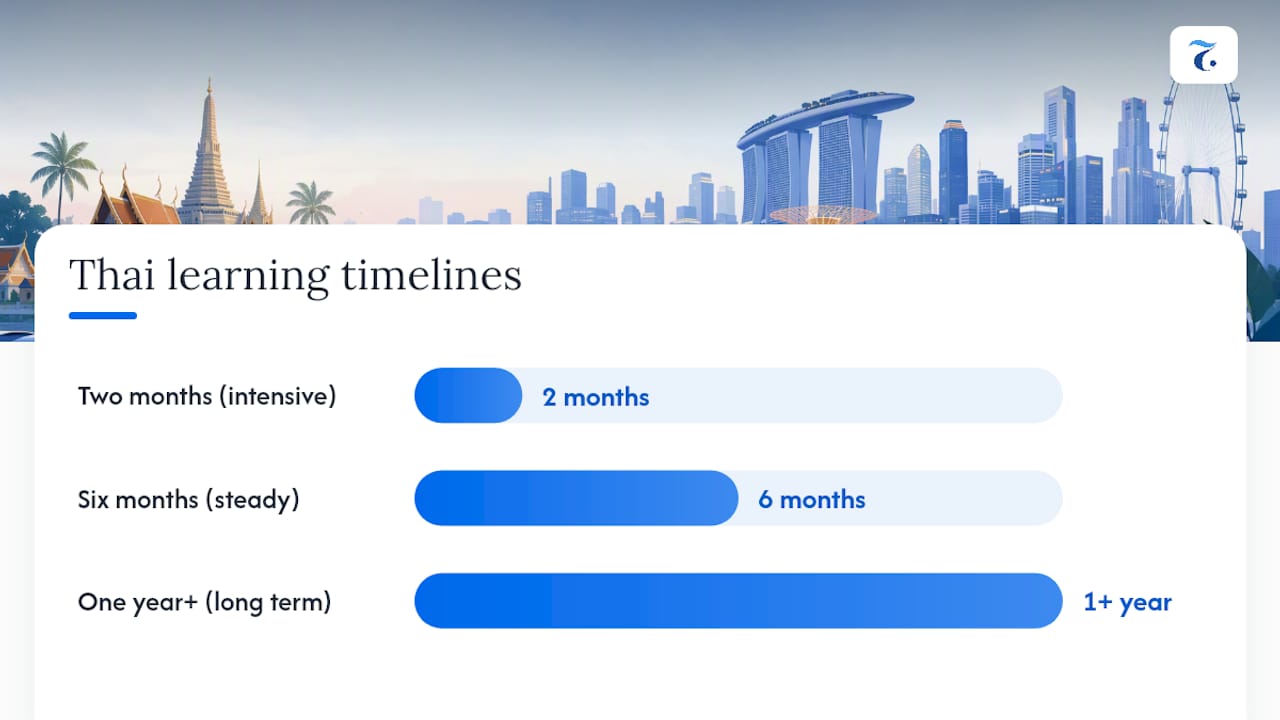
Here’s a rough sense of what different timelines typically produce:
- Two months, intensive pace: survival phrases, basic exchanges, simple present-tense conversation.
- Six months, steady group pace: comfortable everyday conversation, growing script literacy, early reading of signs and menus.
- One year plus: business-register vocabulary, stronger reading fluency, readiness for CU-TFL-style assessment.
Progress speed depends less on talent than on habits. Learners who practice daily, even for fifteen minutes, consistently outpace those who cram once a week. Native-speaker immersion accelerates things further, and scripted tone drills done regularly tend to fix pronunciation problems that would otherwise linger for months.
Combining formats speeds things up more than sticking to one. Group lessons build your conversational base and confidence, while private sessions focused specifically on tone correction catch the mistakes a group class doesn’t have time to address individually.
Pro Tip: Record yourself saying five common Thai phrases each week and compare them against your instructor’s pronunciation. Tone errors are far easier to hear in playback than in the moment.
What Thai Classes Cost and the Logistics Worth Checking First
Course fees vary based on class size, instructor experience, and whether you’re booking group, private, or online sessions. A single trial lesson is a low-cost way to test a provider before paying for a full course, and a Thai Trial Lesson priced at $45 SGD one-off is typical of what that first step might cost. Full beginner-level group courses, such as Conversational Thai Beginner 1 or Beginner 2, give a sense of typical group-course pricing, with a separate registration fee per student on top.
Before enrolling anywhere, check these details:
- Whether a trial lesson or placement test is offered, and what it costs.
- Class size and how much individual speaking time that guarantees you per session.
- Schedule flexibility, including evening, weekend, or recorded-lesson options for missed classes.
- Whether the registration fee is separate from the course fee, and what it covers.
Class size affects your outcomes more than most people expect going in. A group of six gets you noticeably more speaking time per hour than a group of fourteen, and that difference compounds week over week. If speaking confidence is your main goal, ask about average class size before you ask about price.
How to Choose a Thai Course Without Overthinking It
Start with your goal, because it determines almost everything else. Someone prepping for a work posting in Bangkok needs a different course than someone learning Thai for a two-week holiday, and providers that ask about your goal during enrollment are usually the ones with a clearer path to get you there.
Run through this checklist before you commit:
- Match the course to your outcome. Travel, personal enrichment, and business or certification goals call for different pacing and vocabulary focus.
- Ask who teaches the course. Native Thai instructors with bilingual fluency in Thai and English tend to explain tone and grammar nuances more clearly than non-native teachers.
- Confirm what’s in the curriculum. Does it teach the script, or rely on Romanization? Is there a clear progression toward higher levels?
- Check for trial lessons and placement testing. These let you confirm the pacing and teaching style fit before paying for a full course.
- Ask about class size and rescheduling policy. Both affect how much you’ll actually speak and how forgiving the course is if you miss a session.
If a provider can’t clearly answer what happens after your first course, that’s worth noting. A genuinely structured Thai language course in Singapore for travel and culture should have a next level ready for you, not a vague promise to “figure it out later.”
Why Thai Explorer Fits This Kind of Structured Learning Path
The provider runs group, private, online, and corporate training programs built around the progression this guide has been describing: conversational basics moving toward business-level and CU-TFL-aligned proficiency. Courses are taught by native Thai instructors who are bilingual in Thai and English, which matters most in the early weeks when tone correction and grammar explanations need to happen in a language you actually understand.
The curriculum follows CU-TFL-style level mapping, so progress is benchmarked against clear outcomes at each stage, from basic exchanges through to workplace-ready Thai.
Here’s what a learner typically gets access to after enrolling:
- A structured coursebook aligned to your level.
- Audio files for tone and pronunciation practice outside class hours.
- Recorded class videos for review or catching up on a missed session.
- Ongoing access to course materials for continued self-study.
| What you get | Why it matters |
|---|---|
| Bilingual native instructors | Clearer correction and grammar explanation in early stages |
| CU-TFL-aligned levels | Progress you can measure, not just feel |
| Group, private, online, corporate formats | Matches the course to your schedule and goal |
| Coursebook, audio, recorded lessons | Supports practice between classes |
The training center sits at 10 Anson Road, #22-07, International Plaza, Singapore 079903, right above Tanjong Pagar MRT, which makes it an easy stop before or after work for anyone commuting through the area. A trial lesson is a common way to check whether the teaching pace and format suit you before booking a full course.
Cultural Etiquette That Makes Your Thai Actually Land
Grammar and vocabulary only get you halfway. Thai communication carries social rules that, if ignored, can undercut even solid language skills.
The wai greeting, hands pressed together in a slight bow, comes with rules about who initiates it and how deep the bow goes based on age and status. Getting this wrong doesn’t offend most Thai people, but getting it right earns quiet respect, especially in business settings.
Politeness particles matter more than they seem to at first. Adding “krap” (for male speakers) or “ka” (for female speakers) at the end of a sentence softens statements and signals respect. Dropping them in formal or unfamiliar settings can come across as blunt, even if your grammar is flawless.
Indirectness is another adjustment for English speakers. Thai communication often avoids direct confrontation or blunt refusal, favoring softer phrasing that requires reading context rather than a literal “no.” Learning to recognize a polite deflection as a “no” is a skill in itself.
Hierarchy shapes vocabulary choice too. The pronoun and verb forms you’d use with a close friend differ from what you’d use addressing an elder or a boss, and business Thai courses typically spend real time on this register shift because getting it wrong in a professional setting reads as careless, not just grammatically off.
The Hardest Parts of Learning Thai for English Speakers
Tones trip up nearly every English speaker at first, because English doesn’t use pitch to change word meaning the way Thai does. Saying “mai” with a rising tone versus a falling tone changes the word entirely, and most learners need weeks of corrected repetition before their ear catches the difference reliably.
Script is the second wall. Forty four consonants, multiple vowel forms that can appear before, after, above, or below a consonant, and no spaces between words in standard Thai writing make reading feel overwhelming early on. The fix isn’t avoidance. Courses that introduce script gradually from the first few weeks, rather than delaying it, tend to produce learners who read comfortably within a few months instead of staying dependent on Romanized text indefinitely.
Grammar, oddly, is the easy part. Thai doesn’t conjugate verbs for tense or subject the way English does, which removes a whole category of memorization English speakers dread in other languages.
The most effective fix for tone and script struggles is consistent, low-stakes repetition: short daily practice sessions beat occasional long ones, and recorded audio drills let you compare your pronunciation against a native speaker without needing a teacher present for every attempt. Pairing that self-study with a private lesson focused specifically on your weak tones tends to close the gap faster than group practice alone.
Where to Practice Thai Outside the Classroom
Classroom hours only go so far. Real progress usually comes from stacking extra exposure around your course schedule.
The National Library Board carries Thai language learning materials and dictionaries that supplement coursework without added cost, and several community language exchange groups meet regularly for informal conversation practice between Thai speakers and learners. These exchanges work best once you have basic conversational footing, since pure beginners can struggle to keep pace in an unstructured group.
Mobile apps handle vocabulary drilling well, though most lack the tone correction a live instructor provides, which is why they work better as a supplement than a replacement. University-affiliated programs, including Thai at NUS, demonstrate how larger academic programs structure multi-level progression, and reviewing that kind of program breadth is useful even if you ultimately study elsewhere. Thai language events built around cultural immersion offer another low-pressure way to practice speaking outside a formal classroom setting.
Where to Go for More on Thai Course Design
The Thailand Foundation’s online Thai course initiative offers a useful look at how structured curricula get built for foreign learners, including course materials for self-study alongside classroom instruction. The AIT Language Center publishes clear per-level outcomes for reading and writing progression, which is a solid reference point if you’re trying to gauge what a given course level should actually deliver. For a locally grounded view of how goals map to course pacing, Eduprime’s Thai language course overview breaks down travel, business, and certification-track pathways clearly.
Editorial Take: What Actually Moves the Needle in Thai Learning
Most advice on learning Thai treats grammar as the hard part and tones as an afterthought. That’s backward. Thai grammar is genuinely forgiving, no verb conjugation, minimal tense complexity, and learners who spend their early weeks memorizing vocabulary lists instead of drilling tones end up with words they can read but can’t be understood saying.
The conventional wisdom of “start with Romanization, add script later” also deserves more scrutiny than it gets. Delaying script doesn’t make early lessons easier. It just moves the difficulty down the road and locks in pronunciation habits that are harder to fix once they’re comfortable.
If there’s one thing to prioritize first, it’s finding a course that corrects your tones from lesson one and doesn’t treat the script as optional homework for later. Everything else, vocabulary, business register, cultural nuance, builds faster on top of that foundation than it does trying to retrofit tone accuracy after months of fluent-sounding but mispronounced Thai.
— Paul
Start Learning Thai With a Clear Path Forward
Thai Explorer is built for exactly the kind of structured progression this guide has walked through: conversational basics that lead somewhere specific, taught by bilingual native instructors who correct tone and grammar as you go, not months later. Whether your goal is travel-ready confidence, workplace fluency, or steady progress toward CU-TFL-aligned proficiency, the course formats here (group, private, online, and corporate training) let you pick the pace and structure that fits your schedule.
If you’re not sure which format fits, the Thai Trial Lesson at a set fee is a low-risk way to find out, with a registration fee required for enrolled students. For those ready to start structured group learning right away, Conversational Thai Beginner 1 is the natural entry point, taught online over Zoom so scheduling never gets in the way of showing up.
Sources
FAQ
Can I learn Thai in 2 months?
An intensive two-month course can get you to basic conversational competence, including greetings, directions, and simple exchanges, but not full fluency. Reading ability and business-level Thai typically take six months to a year or more of consistent study, depending on practice frequency.
How do you say “hi” in Thai?
The standard greeting is “sawasdee,” followed by “krap” if you’re male or “ka” if you’re female, as in “sawasdee krap” or “sawasdee ka.” It’s typically paired with a wai gesture, hands pressed together in a slight bow, especially in more formal or first-time interactions.
What is the easiest way to learn Thai?
The most effective approach combines regular speaking practice with early tone correction and gradual script exposure, rather than relying solely on Romanized text. Structured group classes paired with occasional private lessons, such as those offered through Thai Explorer’s course programs, tend to produce faster, more accurate progress than self-study alone.
How many Thai speakers or Thai nationals live in Singapore?
Singapore has an established Thai community, including workers, professionals, and long-term residents, though exact population figures fluctuate and aren’t consistently published. The presence of Thai restaurants, cultural events, and community groups across Singapore reflect an active and visible Thai-speaking population.
Do Thai courses in Singapore teach the Thai script?
Structured courses typically introduce Thai script early, often within the first several weeks, rather than relying on Romanization long term. Early script exposure supports better pronunciation and independent reading skills as you progress through higher course levels.