
Business reading in Thai means pulling four things out of a document fast: the action required, the numbers involved, the tone behind the words, and any obligation attached to your name. It is not the same skill as reading a menu or a street sign. The single fastest way to build it is a targeted reading routine: short authentic workplace texts, paired with guided vocabulary extraction and weekly feedback from an instructor who can flag what you missed. Everything below breaks that routine into vocabulary priorities, a curriculum roadmap, daily exercises, and how to pick a course that actually delivers it.
TL;DR:
- Learning to read business Thai requires focusing on specific document types like emails, memos, and contracts, which have distinct strategies and vocabulary.
- Prioritizing high-frequency phrases and fixed expressions, such as formal openings and meeting verbs, accelerates comprehension and recognition speed more than isolated vocabulary.
- Reading business Thai demands understanding indirect language, softening phrases, and hierarchy cues, which differ from travel Thai and require real workplace texts for mastery.
- A structured curriculum aligned with academic standards breaks skill development into beginner, intermediate, and advanced levels, typically taking about 12 weeks per stage.
- Daily practice involving short authentic texts, vocabulary extraction, and weekly feedback leads to steady improvement, with certified courses emphasizing reading modules and contextual understanding.
Table of Contents
- What Does Business Reading in Thai Actually Cover?
- Which Vocabulary Should You Learn First for Business Reading?
- How Is Business Thai Reading Different From Travel Thai?
- What Does a Business Thai Reading Curriculum Look Like?
- How Do You Practice Reading Thai for Work Every Day?
- How Do You Choose the Right Business Thai Course?
- Why Handwritten and Informal Thai Documents Trip Up Learners
- What Do Thai Business Documents Typically Look Like?
- How Does Culture Shape Thai Business Writing?
- How Do You Read Between the Lines in Thai Business Writing?
- What Idioms and Formal Expressions Show Up in Thai Business Writing?
- Why Structured Reading Practice Beats Ad Hoc Study
- Start Building Business Reading Skills With Guided Practice
- Sources
- FAQ
What Does Business Reading in Thai Actually Cover?
Workplace Thai reading spans a specific set of document types, and each one demands a different reading strategy. Treating an email like a memo, or a contract like a report, is where most learners misread intent.
The texts that matter most in a Singapore office or client-facing role include:
- Emails — read for the requested action and the deadline, often buried in a polite subordinate clause rather than stated outright.
- Short internal memos — read for what changed and who is responsible for the follow-up.
- Meeting minutes — read for decisions made versus items still open, which Thai writers frequently blur with softening language.
- Product specifications and operation manuals — read for numeric accuracy: tolerances, quantities, and units where a misread digit has real cost.
- Contracts and agreements — read for legal obligation, payment terms, and termination clauses, where formal vocabulary replaces everyday words entirely.
- Safety notices and internal policies — read for compliance requirements, often written in command form with little softening.
The common trap is treating every sentence as literal. A Thai email that reads, in translation, as “perhaps we could consider adjusting the timeline slightly” is frequently a firm request for a new deadline. A report that says results were “reasonably satisfactory” may be signaling a problem the writer is reluctant to state directly. Learners who read only for vocabulary meaning, without training for tone, consistently misjudge urgency and miss the real message sitting underneath the polite phrasing.
Numeric misreading is the other recurring failure point. Thai business documents mix Arabic numerals with Thai number words in the same paragraph, and date formats routinely differ from Western convention. A reading routine has to train both literal comprehension and this kind of pattern recognition, not vocabulary alone.
Which Vocabulary Should You Learn First for Business Reading?
Vocabulary work pays off fastest when it is prioritized, not alphabetical. A handful of word families and fixed expressions show up across almost every workplace document, and learning those first gives you a return on time that random flashcard decks cannot match.
Priority categories worth front-loading:
- Formal openings and closings used in emails and letters, distinct from anything you would use with a friend or shopkeeper.
- Meeting language: verbs for proposing, tabling, deferring, and approving an item.
- Approval and rejection verbs, which in Thai business writing rarely mean a flat yes or no. They come wrapped in conditional or softened forms.
- Report verbs: summarizing, recommending, noting, and flagging a concern.
- Date, number, and monetary conventions, including how amounts are written in formal versus casual registers.
The technique that works best here is phrase mining: pulling fixed expressions directly out of real, short texts rather than studying vocabulary lists divorced from context. Chunk learning, where you memorize a whole polite closing or approval phrase as one unit instead of word-by-word, mirrors how native readers actually process these documents and builds recognition speed faster than isolated vocabulary drilling.
For week one, a realistic and achievable target is 20 high-frequency business verbs (propose, confirm, request, postpone, approve, and similar) plus 10 fixed formal closings. That is a small, finishable list, and finishing it gives you real traction before you move to sector-specific vocabulary in banking, hospitality, or sales.
Pro Tip: Keep a running list of every phrase you had to look up twice. That repeat lookup is the strongest signal you have found a genuinely high-frequency term worth memorizing properly, rather than a one-off you will rarely see again.
How Is Business Thai Reading Different From Travel Thai?
Travel Thai and business Thai reading train almost entirely different muscles, and this is the biggest reason self-taught learners plateau. Travel materials teach transactional phrases: ordering food, asking directions, negotiating a price at a market. Business reading asks you to interpret, infer, and detect what is being implied rather than stated.
The register shift is the core difference:
- Travel Thai relies on short, direct, present-tense phrases built for speed.
- Business Thai carries polite particles, honorifics, and indirect phrasing that soften requests, criticism, and refusals.
- A travel phrase book will never prepare you to read a sentence where “we will consider this further” functions as a polite no.
- Business documents assume shared context and hierarchy; a lot of the real meaning sits in what is left unsaid, not in the words on the page.
This indirectness is not a stylistic quirk. Research on Thai business interaction points to tactfulness and conflict avoidance as central to how Thai professionals communicate, and that pragmatic layer shows up in writing as much as in speech. A learner who only studies vocabulary will decode every word correctly and still misread the message.
The practical fix is simple to state and easy to skip: stop reusing travel materials once your goal shifts to work. Swap phrase books for real emails, sanitized contracts, and sample meeting minutes as soon as you can get your hands on them. Our guide to Thai communication skills for travel, culture, and work breaks down exactly where these registers diverge and how to retrain if you started with tourist-focused materials.
What Does a Business Thai Reading Curriculum Look Like?
A structured path beats random practice, and there is now academic backing for what that path should contain. Curriculum research from Chulalongkorn University defines three core reading standards for Business Thai: reading for data and general concepts, reading for corporate culture, and reading for business dealing and decision-making. A separate framework built specifically for foreign learners breaks those three standards into concrete indicators across beginner, intermediate, and advanced levels, based on input from both foreign business staff and Thai instructors.
Here is roughly what that progression looks like in practice:
| Level | What you can read | Typical module content |
|---|---|---|
| Beginner | Short emails, simple memos, basic numbers and dates | Email templates, greeting/closing phrases, number conventions |
| Intermediate | Meeting minutes, product specs, routine reports | Meeting vocabulary, summarizing tasks, industry-specific terms |
| Advanced | Contracts, negotiation documents, policy papers | Legal and formal register, decision-making texts, report synthesis |
A workable pace for a working professional is roughly 12 weeks per level, assuming a few focused hours per week rather than daily immersion. The first four weeks concentrate on high-frequency document types like emails and memos. Weeks five through eight shift to industry-specific texts and numeric accuracy. The final stretch tackles negotiation documents and full report synthesis, ideally alongside weekly feedback from an instructor who can catch misreadings before they become habits.
This mirrors a broader shift in Thai language education toward integrating all four skills rather than isolating reading from listening and writing. Reading alone, disconnected from speaking practice, tends to produce learners who can decode a contract but freeze in the meeting where that contract gets discussed. For a fuller picture of how this maps to career outcomes, see Thai language for job success.
How Do You Practice Reading Thai for Work Every Day?
Consistency beats intensity here. A short daily routine, done most days, outperforms a long session once a week.
- Focused reading (10 to 15 minutes). Pick one short authentic text, an email or a memo, and read it fully before checking any word.
- Vocabulary extraction (10 minutes). Pull out five to eight unfamiliar terms or phrases and log them with the sentence they appeared in, not just the isolated word.
- Flash review (5 minutes). Cycle through the previous three days of logged vocabulary before adding new terms.
- Short summary writing (10 minutes). Write two or three sentences in Thai summarizing what the text asked you to do.
Weekly, add one longer graded reading, a mock set of meeting minutes to summarize, and a timed scanning drill where you have five minutes to find three specific numbers or dates in a document you have not seen. Track three metrics: comprehension accuracy, reading speed, and how reliably you can extract the actual action item. That last one is the metric that matters most at work, since a manager rarely cares whether you understood every word, only whether you understood what needed to happen next.
Pro Tip: Use your own company’s translated intranet announcements or safety notices as free graded reading material. Research on supplementary business Thai reading materials found that tailored, workplace-relevant texts improve comprehension faster than generic textbook passages.
How Do You Choose the Right Business Thai Course?
The right format depends on your schedule and how specific your vocabulary needs are. A self-study routine works for motivated learners with basic reading skills already, but it rarely catches the pragmatic misreadings that matter most. Group classes suit learners who want structured pacing and peer accountability. Private lessons make more sense when your industry vocabulary is narrow and specific, banking or hospitality terms a general class will not cover in depth. Corporate training fits teams needing the same reading competence across several employees at once.
Whatever format you pick, look for a course with dedicated reading modules (not just conversation practice), native bilingual instructors who can explain why a phrase implies more than it states, assessment tied to recognized standards rather than vague progress claims, and scheduling flexible enough to fit around a work calendar. A provider offering no reading practice, no individual feedback on your written comprehension, or only generic “fluency” promises is a red flag worth walking away from.
Why Handwritten and Informal Thai Documents Trip Up Learners
Formal printed Thai follows fairly predictable spelling and spacing conventions. Handwritten notes, quick internal chat messages, and informal memos do not. Thai script has no spaces between words in running text, and handwriting styles vary enough between individuals that even fluent readers sometimes need a second look at an unfamiliar hand.

Informal business communication also compresses vocabulary. A quick internal note might drop the polite particles and formal verbs you learned from textbook examples, replacing them with abbreviated forms or regional shorthand. Numbers get scrawled quickly, and a poorly formed character can shift a date or a quantity entirely.
The practical challenge is that most course materials, understandably, use clean typed text. That leaves a gap between what you practice and what actually lands in your inbox or gets handed to you on a sticky note before a meeting. Closing that gap takes deliberate exposure: asking a Thai colleague to share a few real handwritten notes, or asking an instructor to introduce informal chat-style Thai once your formal reading is solid. Building this skill later than formal reading is fine. Skipping it entirely is not, since informal texts are where a surprising amount of real workplace communication happens.
What Do Thai Business Documents Typically Look Like?
Thai business documents follow layout conventions that differ enough from Western formats to trip up a learner expecting a familiar structure. Formal letters and memos typically open with a reference number and date in the top corner, followed by a subject line, then a formal address to the recipient by title and name. The body often opens with a set phrase referencing the purpose of the communication before getting to content, a structural cue worth recognizing on sight since it tells you a formal request or notification follows.
Contracts and agreements tend to use numbered clauses with dense formal vocabulary, and signatures appear alongside company stamps, which carry legal weight in Thai business practice the way a signature alone might not. Meeting minutes usually list attendees first, then agenda items numbered in sequence, with decisions marked distinctly from discussion points, though the distinction is sometimes subtler than it should be.
Reports and product specifications lean heavily on tables and numbered sections, mixing Thai and English technical terms depending on the industry. Banking and finance documents in particular often retain English numerals and Latin-script abbreviations inside otherwise fully Thai text, which is worth expecting rather than treating as an error.
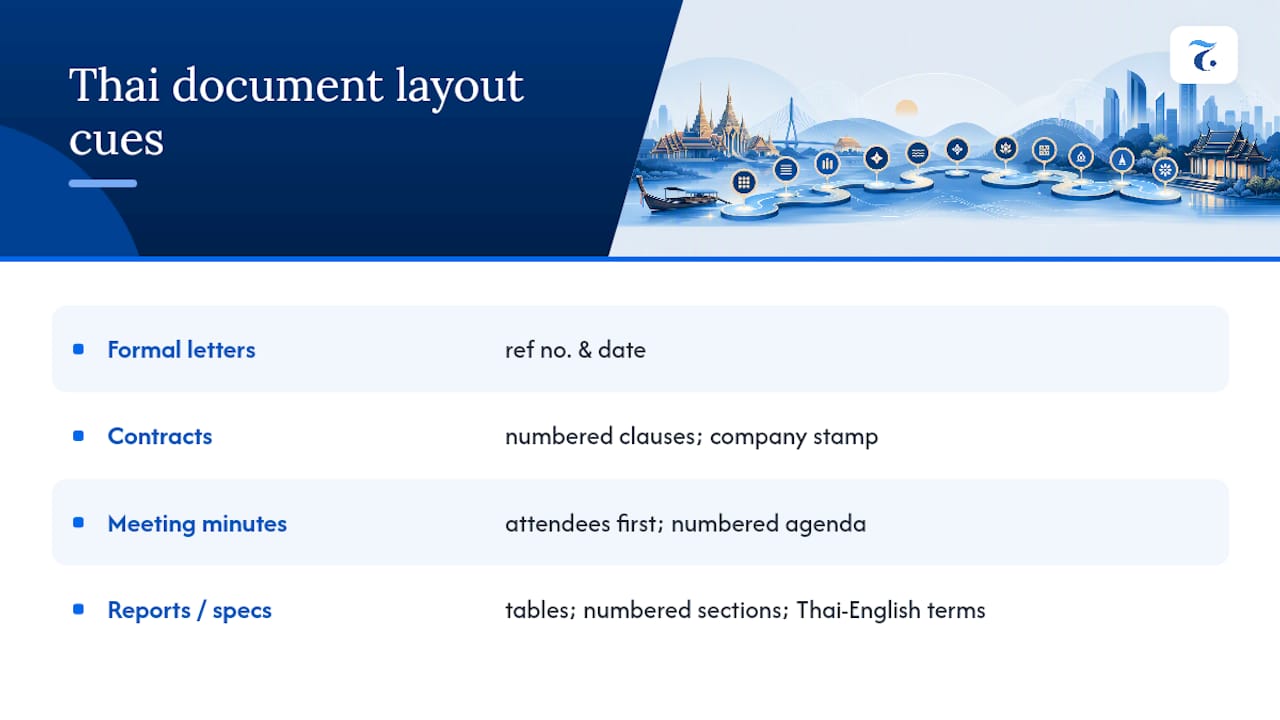
Recognizing these layout patterns speeds up reading considerably, because you stop processing the document linearly and start scanning for the section that matters. A learner who knows a memo’s action item usually sits in the final paragraph, after the polite framing, wastes far less time than one reading top to bottom every time.
How Does Culture Shape Thai Business Writing?
Cultural context is not a soft add-on to business Thai reading. It changes what the words on the page actually mean. Thai business communication places a high value on preserving harmony and avoiding direct confrontation, and that value system shows up directly in written text, not just spoken conversation.
A Thai manager rejecting a proposal in writing will rarely state the rejection outright. The document might instead suggest “further study” or note the idea is “interesting but requires more consideration.” Reading that literally, as genuine openness to revisit the idea, is one of the most common misreadings foreign professionals make. Research on communication competence in Thai business interaction identifies tactfulness and emotional control as core competencies, and those competencies are baked into formal writing conventions as much as spoken exchange.
Hierarchy also shapes how documents get written and read. A request from a senior figure to a junior colleague will use different verb forms and directness than the reverse, and learners need to recognize seniority cues in how a document is addressed and signed, not just its literal content. Understanding this dynamic matters as much for reading internal memos as it does for client correspondence. For a broader look at how these norms extend beyond documents into daily interaction, our guide to Thai for expats covers the wider cultural context worth knowing before your first week in a Thai-speaking office.
How Do You Read Between the Lines in Thai Business Writing?
Interpreting implied meaning is a trainable skill, not an innate talent, and it starts with recognizing a short set of recurring softening patterns. Phrases that translate roughly as “we will consider,” “perhaps it might be possible,” or “this may need further discussion” function, in most business contexts, as polite deferrals or refusals rather than genuine open questions.
A useful strategy is to read every ambiguous sentence twice: once for literal content, once asking what a Thai colleague in that position would realistically be trying to avoid saying directly. Conditional verb forms and passive constructions are common markers of softened criticism or a request dressed up as a suggestion. Documents that repeat a polite qualifier multiple times in one paragraph are often flagging something the writer considers sensitive.
Context also carries more weight in Thai business writing than in many Western equivalents. A response that seems noncommittal in isolation often makes complete sense once you know the sender’s seniority relative to yours and the history of the relationship. This is where working with a native instructor pays off in ways self-study cannot easily replicate: a bilingual teacher can walk through a real ambiguous email and explain exactly what a Thai reader would infer, which is a skill built through repeated exposure and correction rather than a rule you can memorize once. Sales and negotiation contexts carry particularly high stakes here; practical checklists for international sales communication offer a useful parallel framework for reading indirect signals in cross-border business correspondence generally.
What Idioms and Formal Expressions Show Up in Thai Business Writing?
Formal Thai business writing draws on a set of fixed expressions and idiomatic phrases that rarely appear in conversational speech, and recognizing them on sight saves significant reading time. Formal letters commonly open and close with set honorific phrases entirely absent from casual Thai, marking the register shift the moment you see them.
Idiomatic expressions in Thai business writing often reference indirect imagery rather than stating a point outright, a pattern consistent with the broader cultural preference for softened, non-confrontational language discussed earlier. Learning these as fixed chunks, rather than translating word by word, is far more efficient, since a literal translation frequently produces nonsense while the idiomatic meaning is perfectly clear to a native reader.
Formal expressions also govern how requests, refusals, and instructions get phrased. A direct command form that would sound normal in casual speech reads as unusually blunt or even rude in a formal memo, where a more elaborate, softened phrasing is expected instead. Learners who default to the direct forms they learned early in conversational study often come across as terse or even impolite once they start writing formal Thai themselves, not just reading it.
Building a working list of these fixed expressions, alongside the vocabulary priorities covered earlier, rounds out the reading toolkit. Between formal openings and closings, softened refusal patterns, and idiomatic phrasing, a learner who has drilled maybe 40 to 50 of these fixed forms can read the large majority of routine business correspondence with real confidence.
Why Structured Reading Practice Beats Ad Hoc Study
Most professionals learning Thai for work waste months on generic vocabulary apps before realizing business reading is a distinct skill that needs its own curriculum. The three-domain framework from Chulalongkorn, data, culture, and decision-making, gives that skill a measurable shape instead of an open-ended goal.
At Thai Explorer, courses are structured around this kind of progression, with native bilingual instructors who can explain the cultural subtext a translation tool will always miss, and formats flexible enough for someone reading contracts at night after a full workday. Curriculum alignment matters less as a credential and more as a guarantee that what you practice in week four connects logically to what you tackle in week ten, rather than jumping randomly between skill levels.
The learners who improve fastest are the ones who treat reading practice as a weekly habit with feedback attached, not a stack of unread PDFs. That discipline, more than any single resource, is what closes the gap between recognizing words and understanding what a document actually asks of you.
— Paul
Start Building Business Reading Skills With Guided Practice
Reading a Thai contract correctly the first time, instead of guessing and hoping, saves real money and real embarrassment. That is the gap Thai Explorer’s courses are built to close: reading modules taught by native bilingual instructors who explain not just what a phrase means but what it implies, with a curriculum aligned to the CU-TFL standards covered throughout this guide.

Group classes work well if you want structured pacing and the accountability of classmates working through the same material. If your role demands narrower, industry-specific vocabulary, private Thai lessons let an instructor build sessions directly around your emails, contracts, or reports. Busy schedules are no obstacle either, our online Zoom classes bring the same instruction to your desk without a commute.
To get started:
- Book a trial class or a quick assessment to identify your current reading level, then browse the full Thai course lineup to find the format that fits your schedule.
Thai Explorer’s training center sits at right above Tanjong Pagar MRT 10 Anson Road, #22-07, International Plaza, Singapore 079903, an easy stop before or after work if in-person sessions suit you better.
Sources
- Chulalongkorn University — Reading curriculum standard for Business Thai
- AJMI 2024 study on communication competence and Thai business interaction
- Journal article on integrated language skills for modern Thai education
- Journal of Education Studies — Developing curriculum standards for Business Thai reading for foreigners
FAQ
How Can I Practice Reading Thai Every Day?
Pair a short authentic text (an email or memo) with vocabulary extraction and a brief written summary each day, then add longer graded readings and timed scanning drills weekly. Weekly feedback from an instructor catches misreadings that self-study alone tends to miss.
What Does “Mai Ao Ka” Mean in a Business Context?
“Mai ao ka” translates roughly as “I do not want it” or “no, thank you” in casual speech, but in written business correspondence, refusals are almost always softened into indirect phrasing rather than stated this directly. Seeing blunt phrasing like this in a formal document is unusual and worth reading carefully for context.
What Does “555” Mean in Thai Writing?
The number five in Thai is pronounced “ha,” so repeated fives like “555” are used in internet and text shorthand for laughter, similar to “hahaha.” It shows up in informal chat messages and casual internal notes, never in formal business documents.
What Does “Suay Mak Mak” Mean?
“Suay mak mak” translates to “very beautiful” or “very unlucky,” depending on tone and context, since “suay” carries two unrelated meanings in Thai. In a formal business document this phrase would be unusual. Context and surrounding vocabulary determine which meaning applies.
How Long Does It Take to Read Business Thai Confidently?
Following a structured curriculum with weekly instructor feedback, most professionals reach comfortable reading of routine emails and memos within a few months, with contracts and negotiation documents following after progressing through intermediate and advanced modules, roughly a 12 week cycle per level under Chulalongkorn’s framework.