
The main Thai romanization systems break into three camps: RTGS, the official system on road signs and government documents, which drops tone and vowel length entirely; ISO 11940, a lossless transliteration built for scholars who need to reverse-engineer the original Thai script; and learner systems like Paiboon, which mark tone and vowel length so beginners can actually pronounce what they read. If you’re learning to speak, pick a learner system. If you’re reading a map, RTGS already has you covered. If you’re cataloguing texts or doing academic work, ISO 11940 is the standard built for that.
TL;DR:
- RTGS is primarily used for signage and official documents but omits tone and vowel length, making it unsuitable for pronunciation learning.
- ISO 11940 provides reversible, diacritic-rich transliteration suitable for scholarly or archival work but is less accessible for beginners.
- Learner systems like Paiboon effectively mark tone and vowel length, helping beginners pronounce words correctly but are not ideal for technical or academic purposes.
- Choosing the right system depends on your goal: use RTGS for signs, ISO 11940 for research, and learner schemes for speaking practice.
- Relying solely on RTGS for pronunciation can lead to persistent tone errors, so gradual transition to reading Thai script benefits long-term fluency.
Table of Contents
- What Is the Difference Between Transliteration and Transcription?
- How Do RTGS, ISO 11940, and Learner Systems Actually Work?
- Comparing Thai Romanization Systems Side by Side
- How Do You Choose the Right Romanization System?
- What Tools Convert Thai Script Into Romanized Text?
- How Thai Explorer Teaches Romanization in the Classroom
- How Did Thai Romanization Systems Develop Over Time?
- Why Do Scholars Still Disagree About Thai Romanization?
- Which Romanization System Is Most Accurate and Usable?
- How Is Thai Romanization Used in Technology Today?
- Where Do You See Romanization in Signs and Official Media?
- What Actually Matters When You Pick a System
- Ready to Move Past Romanization Charts?
- Sources
- FAQ
What Is the Difference Between Transliteration and Transcription?
Transliteration swaps each character in one writing system for a corresponding character (or set of characters) in another, preserving spelling even when pronunciation drifts. Transcription does the opposite: it captures how a word sounds, often at the cost of showing how it’s actually spelled.
Thai script does not use spaces between words, drops several vowel sounds implied by context, and marks tone through a combination of consonant class, vowel length, and tone marks that no simple letter substitution can capture cleanly. That’s why the two goals pull romanization systems in different directions.
- Transliteration keeps a one-to-one link back to the Thai script, so a linguist or a library catalog system can reconstruct the original spelling. ISO 11940 works this way.
- Transcription aims for the sound a word makes, which is more useful to someone trying to speak the language but sacrifices the ability to recover the exact original text.
Take the word for “rice,” ข้าว. A transliteration-minded rendering preserves each letter’s identity with diacritics (kʹhâw), while a transcription-minded rendering just gives you khâao, close enough to say out loud without worrying about which silent consonant sits underneath. Reversibility matters enormously in library science and computational linguistics; it matters much less if you’re trying to order food.
How Do RTGS, ISO 11940, and Learner Systems Actually Work?
Each system was built to solve a different problem, and knowing the intent behind each one tells you instantly whether it fits your situation.
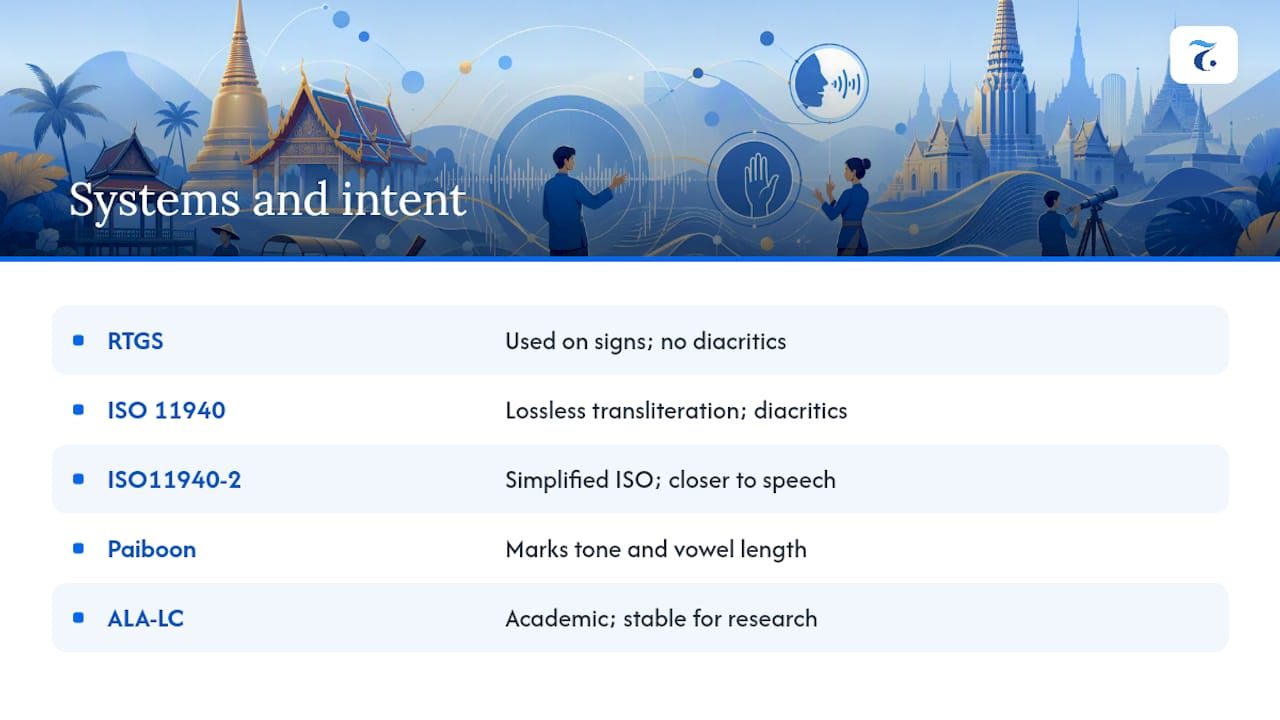
RTGS (the Royal Thai General System of Transcription) is what you’ll see on street signs, passports, and government documents across Thailand. It uses only unmodified Latin letters, no diacritics, no tone marks. That simplicity is also its biggest weakness: RTGS collapses vowel length and tone distinctions, and it even merges some vowel sounds that are phonemically distinct in spoken Thai, like /o/ and /ɔ/, into a single “o.” It’s readable to anyone with no Thai background, which is exactly why it dominates public signage, but it tells you nothing about how a word actually sounds when spoken.
ISO 11940 takes the opposite approach. It’s a lossless transliteration system that uses diacritics to preserve every distinction in Thai orthography, which means you can convert back and forth between Thai script and the Latin rendering without losing information. ISO 11940-2 simplifies that same standard into something closer to spoken Thai, intentionally discarding some of that orthographic fidelity to read more naturally, similar in spirit to RTGS but built on the ISO 11940 framework rather than the Royal Institute’s rules.
Paiboon and similar learner-oriented schemes exist because neither RTGS nor ISO 11940 helps you actually speak Thai correctly. Paiboon uses combining diacritics to mark tone and doubles vowel letters to show length, so a beginner can look at a romanized word and know exactly how to pronounce it, tone included, without touching a single Thai character. Understanding how Thai tones work makes it obvious why this matters: get the tone wrong and you’ve said a different word entirely.
ALA-LC and older academic systems like Cœdès occupy a third lane. Libraries and researchers care about consistency and etymological traceability across decades of scholarship, so these systems prioritize stable, documented rules over either speakability or brevity.
Comparing Thai Romanization Systems Side by Side
Choosing a system gets a lot easier once you line up what each one actually preserves and what it throws away.
| System | Purpose | Reversible? | Tone marked? | Vowel length shown? | Readability | Common context |
|---|---|---|---|---|---|---|
| RTGS | Official/signage | No | No | No | Plain ASCII | Road signs, passports, government text |
| ISO 11940 | Academic transliteration | Yes | Via diacritics | Yes | Heavy diacritics | Library cataloging, computational linguistics |
| ISO 11940-2 | Simplified transcription | No | No | No | Plain ASCII | Informal transcription close to speech |
| Paiboon | Learner pronunciation | No | Yes | Yes | Light diacritics | Textbooks, phrasebooks, pronunciation apps |
| ALA-LC / Cœdès | Scholarly/library standard | Mostly | Limited | Limited | Diacritics | Academic papers, historical texts |
If you’re learning to speak, Paiboon wins. If you’re reading a sign, RTGS already did the work. If you’re publishing scholarship, ISO 11940 or ALA-LC is the expected standard.
How Do You Choose the Right Romanization System?
Match the system to the job, not the other way around. A few questions settle it fast:
- Who’s your audience? A general reader with no Thai background needs plain ASCII (RTGS). A specialist reconstructing original text needs full reversibility (ISO 11940).
- Do you need to go back to Thai script eventually? If yes, a lossy system like RTGS will actively work against you.
- Are you limited to plain text input, like a database field? That rules out diacritic-heavy systems regardless of accuracy.
- Is your end goal speaking Thai out loud? Then tone marking isn’t optional. Skip straight to a learner scheme.
The workflow that actually gets people speaking Thai looks like this: start with a Paiboon-style romanization to internalize tones, drill alongside native audio until the sound and the written tone marks line up automatically, then deliberately reduce your dependence on romanization and start reading Thai script directly.
Pro Tip: Never use RTGS to learn pronunciation. It was built to be read by people who already know how Thai sounds, not to teach that sound to beginners. Relying on it for tone practice is one of the most common and most avoidable mistakes new learners make.
What Tools Convert Thai Script Into Romanized Text?
A handful of tools cover almost every practical romanization need, from one-off lookups to bulk processing.
- pythainlp is a Python library with a built-in transliteration API. Running
pythainlp.transliterate.romanize(text, engine='royin')gives you RTGS output programmatically, and switching engines lets you generate alternate romanization schemes for the same input text, useful for batch-processing large datasets. - thai-language.com offers a free online romanizer and dictionary lookup for single words, handy when you just need one quick answer rather than a scripting solution.
- Documentation projects like Thaiphon map out when to use IPA, RTGS, or Paiboon depending on whether you need phonetic precision, official conformity, or learner-friendly output.
Whatever tool you use, cross-check the output against native audio and the actual Thai orthography. Automated romanizers occasionally mishandle irregular words, and a mismatch between what a tool spits out and what a native speaker actually says is the fastest way to learn a wrong pronunciation permanently.
How Thai Explorer Teaches Romanization in the Classroom
New learners almost always over-rely on RTGS because it’s the version they’ve already seen on signs and in menus, and it feels familiar. The problem is that RTGS was never designed to teach pronunciation, so students who lean on it too long end up with tone errors that are genuinely hard to unlearn later. Our curriculum introduces a tone-marked romanization early, alongside constant audio exposure, then deliberately phases it out as students build reading fluency in actual Thai script. That staged approach lines up with how the CU-TFL framework structures skill progression, from foundational listening and speaking through to independent reading.
Courses built around this progression include Conversational Thai Beginner levels, private one-to-one lessons, and group classes that walk through the Thai alphabet once romanization has done its job.
How Did Thai Romanization Systems Develop Over Time?
Thai romanization has no single origin story. It has several, layered on top of each other over more than a century. Early efforts date back to the reign of King Rama VI, when officials needed a consistent way to render Thai place names and personal names for foreign administrators and mapmakers. Scholarly surveys document at least six distinct historical systems, each built with a different priority in mind: some chased etymological accuracy, tracing words back to their Sanskrit or Pali roots; others chased cartographic simplicity for mapmakers who needed something Western readers could pronounce without training.
The French scholar George Cœdès developed his own influential transliteration system for academic and epigraphic work, particularly useful for reading historical inscriptions where etymology matters more than modern pronunciation. The Royal Institute of Thailand eventually formalized what became RTGS, aiming for a single official standard usable on signage and in government documents nationwide.
ISO stepped in later with a different mandate entirely: build something machine-readable and fully reversible, useful for computational linguistics and library science, areas where RTGS’s simplicity becomes a liability rather than a feature. ALA-LC, maintained for library cataloging, developed alongside these efforts to serve yet another need: long-term consistency across decades of acquired texts in university and national library collections.
None of these systems replaced the others completely. Each survived because it solved a problem the others didn’t.
Why Do Scholars Still Disagree About Thai Romanization?
Ask three Thai language specialists which romanization system is “correct,” and you’ll likely get three different answers, because the disagreement isn’t really about correctness. It’s about which trade-off matters most.
The core tension: Thai has tonal and vowel-length distinctions that carry real meaning, but the Latin alphabet has no native mechanism for representing either. Any system either adds diacritics (which slows down casual readers and complicates plain-text environments) or drops the distinctions entirely (which strips out information a learner or linguist actually needs). There’s no version that satisfies both camps simultaneously.
RTGS draws frequent criticism precisely because of this trade-off. It’s the version most visible to the public, on street signs and in passports, yet it’s also the version linguists complain about most, since it can’t distinguish words that sound completely different to a native speaker. The classic example: หมา (dog) and ม้า (horse) can end up looking nearly identical once tone and vowel length are stripped away in a lossy system, even though no Thai speaker would ever confuse them out loud.
Inconsistency compounds the problem. Older maps, historical documents, and even different Thai government agencies have used different romanization conventions over the decades, so the same place name might appear three or four different ways across different sources. Anyone doing serious historical or genealogical research on Thai place names runs into this constantly, and there’s no universal fix, since retroactively standardizing decades of existing documents isn’t realistic.
Which Romanization System Is Most Accurate and Usable?
“Accurate” and “usable” pull in opposite directions more often than people expect, and that tension is the entire story of Thai romanization.
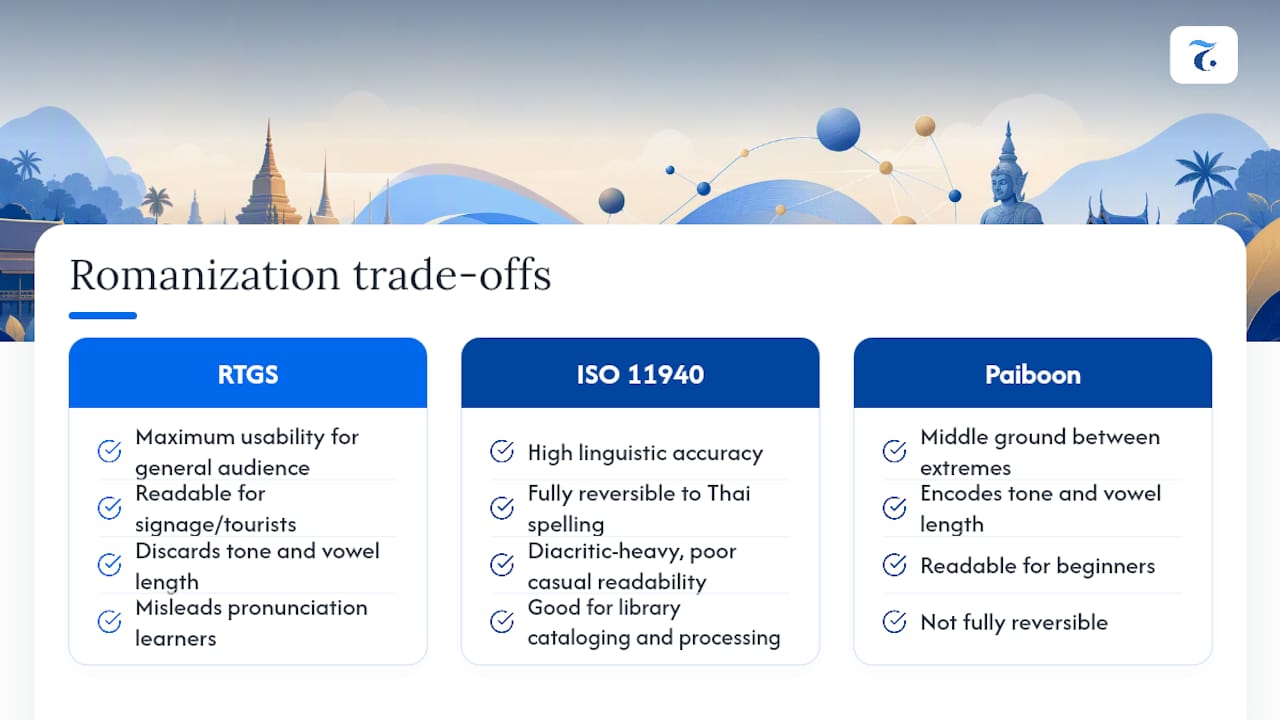
ISO 11940 wins on linguistic accuracy by a wide margin. It’s fully reversible, meaning you can reconstruct the exact original Thai spelling from the Latin rendering, which makes it the clear choice for library cataloging and computational text processing. Its usability for a casual reader, though, is poor. The diacritic-heavy output looks intimidating to anyone without linguistic training, and it does almost nothing to help someone speak the word correctly out loud.
RTGS sits at the opposite extreme: maximum usability for a general audience, minimum linguistic accuracy. Anyone can read RTGS text without special training, which is exactly why it works for signage aimed at tourists and international visitors. But because it discards tone and vowel length, it actively misleads someone trying to learn correct pronunciation from the romanized text alone.
Paiboon and similar learner schemes land in the middle, and for a specific job, they land closer to ideal than either extreme. They’re not fully reversible and they’re not the official government standard, but they encode the two features a beginner actually needs, tone and vowel length, while staying readable enough that no linguistics degree is required.
The honest answer to “which system is best” is that none of them wins across every category. The right question is which trade-off matches your actual task.
How Is Thai Romanization Used in Technology Today?
Romanization shows up constantly in digital tools most people never think about as romanization problems. Search engines index romanized Thai place names and business names so international users can find them without typing Thai script, which matters enormously for tourism and travel apps operating across Southeast Asia. Type “Chiang Mai” into any map application, and you’re relying on a romanization convention someone standardized years ago.
Text input on mobile devices presents a related but distinct challenge. Most Thai speakers type using native Thai keyboards, but some input methods and transliteration keyboards let users type romanized Thai and have it convert to Thai script automatically, a feature that depends heavily on which romanization convention the input method assumes.
Programmatic tools like pythainlp exist specifically because software developers, not just linguists, need reliable romanization. A travel app, a translation tool, or a search index all need some consistent way to render Thai text in Latin characters, and the choice of engine, RTGS-style versus something more phonetic, directly affects how well that feature actually serves users. Machine translation systems face the same fork in the road: prioritize output that looks clean and official, or output that helps a non-Thai speaker approximate the correct pronunciation.
Voice assistants and speech recognition systems add another layer entirely, since they need to map between spoken Thai, written Thai, and some internal romanized representation simultaneously, often blending multiple schemes depending on the task.
Where Do You See Romanization in Signs and Official Media?
Walk through any Thai airport, and RTGS surrounds you. Road signs, immigration forms, passport name fields, and government publications all default to it, since it’s the Royal Institute’s official standard and the version most consistently applied across government agencies.
News media and English-language publications covering Thailand mix conventions more freely. A place name might follow RTGS in one article and an older colonial-era spelling in another, especially for well-established names like “Bangkok” itself, which doesn’t follow RTGS at all (the RTGS rendering would be closer to “Krung Thep”). These legacy spellings stick around because changing decades of established usage creates more confusion than it resolves.
Academic publications and library catalogs lean toward ISO 11940 or ALA-LC, particularly when citing historical Thai texts or manuscripts where reversibility to the original script matters for future researchers. A journal article referencing an inscription that Cœdès originally transliterated will typically preserve his conventions rather than converting to RTGS, since switching systems midstream would break the scholarly chain of reference.
Phrasebooks and language-learning materials almost universally use Paiboon or a close variant, because publishers know their audience needs tone information to be useful at all. Compare a Lonely Planet Thai phrasebook to a Thai government tourism brochure side by side, and the romanization looks almost like two different languages, one built to teach speech, the other built to be read by eye.
What Actually Matters When You Pick a System
The conventional wisdom treats this as a binary choice: pick one system and stick with it. That advice doesn’t hold up once you look at how real learners and researchers actually work. The better approach is task switching. Use a tone-marked learner system while you’re building spoken fluency, lean on RTGS when you need to read a sign or fill out a form, and reach for ISO 11940 only if you’re doing genuinely academic or archival work.
Where most guides get it wrong is treating RTGS as a neutral, safe default for beginners just because it’s official. Officialness and pedagogical usefulness are not the same thing, and conflating them sets learners up to mispronounce words with total confidence.
If you take one thing from this guide, prioritize learning to read actual Thai script sooner rather than later. Every romanization system, even the best learner scheme, is a bridge tool. The learners who progress fastest are the ones who treat romanization as training wheels, useful early, actively limiting once you’ve built enough tone recognition to read Thai script directly.
— Paul
Ready to Move Past Romanization Charts?
Reading about tone marks and vowel-length diacritics only gets you so far. Actually hearing a native speaker produce those tones, and having someone correct you in real time, is what makes the difference between recognizing a chart and speaking naturally. Thai Explorer’s courses are built around exactly that staged approach: tone-marked romanization early, native audio constantly, and a deliberate transition to reading Thai script once the sounds have settled in.
If you want to test the format before committing, the Thai Trial Lesson runs 45 SGD with a 50 SGD one-time registration fee per student. For learners ready to start structured, systematic study, the Conversational Thai Beginner 1 and 2 online courses run 350 SGD each and are taught by bilingual native instructors over Zoom. Classes are also available in person at 10 Anson Road, #22-07, International Plaza, Singapore 079903, right above Tanjong Pagar MRT. Book a trial lesson to see how the transition from romanization to reading actually feels.
Sources
- Paiboon vs RTGS: Best Thai Romanization for Tones? | Effortless Thai
- pythainlp transliterate documentation
FAQ
Can Thai Script Be Romanized Accurately?
Yes, but “accurately” depends on your goal. ISO 11940 romanizes Thai with full reversibility, while RTGS and learner systems sacrifice some accuracy for readability or pronunciation clarity.
Why Do Thai People Write “555” Online?
Thai speakers sometimes repurpose numerals as sound units in casual internet shorthand, illustrating informal adaptations outside formal romanization systems.
What Does “Chup Chup” Mean in Thai?
“Chup chup” (often written จุ๊บ จุ๊บ) is an informal, affectionate expression associated with kissing sounds or a playful goodbye, more commonly heard in casual speech and social media than in formal writing.
What Are the Main Types of Thai Romanization Systems?
The main categories are official transcription (RTGS), lossless academic transliteration (ISO 11940), simplified transcription (ISO 11940-2), and learner-focused schemes like Paiboon that mark tone and vowel length for pronunciation practice.
Does Thai Explorer Teach Using Romanization?
Yes. Thai Explorer’s beginner courses introduce tone-marked romanization early alongside native audio, then guide students toward reading Thai script directly as their skills develop.