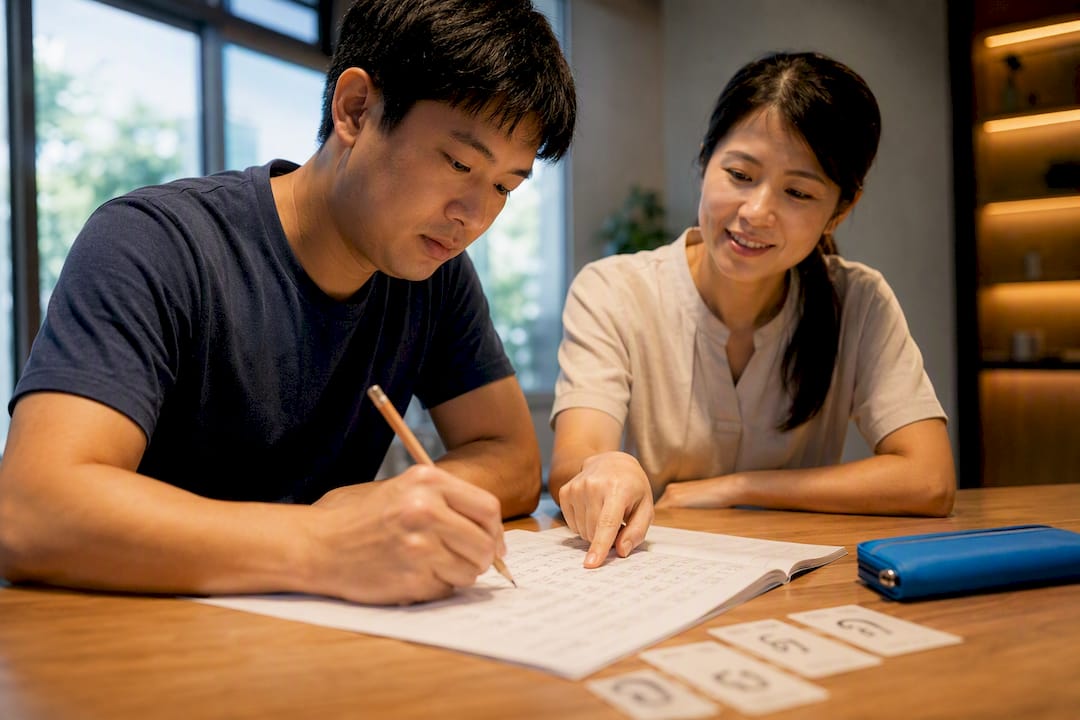
Thai builds sentences with Subject–Verb–Object order, the same skeleton English uses, so the basic logic feels familiar right away. The real differences show up in the details: adjectives and possessives always follow the noun, verbs never conjugate for tense or person, and small particles glued to the end of a sentence carry politeness and mood. A simple example: ผม กิน ข้าว (phǒm gin kâao), literally “I eat rice,” meaning “I eat rice” or “I’m eating rice,” with time understood from context or an added marker.
TL;DR:
- Thai sentence structure follows Subject–Verb–Object order, similar to English, but relies solely on word order and particles rather than conjugation or inflection.
- Adjectives and possessives follow the noun in Thai, requiring speakers to build descriptions with the noun first, then the modifiers, unlike the English before pattern.
- Thais use particles like จะ, กำลัง, แล้ว, and เคย placed around verbs to indicate tense and aspect without conjugation, depending on context and time markers.
- Questions and negations are formed by adding simple words like ไหม and ไม่ directly to the sentence, with no rearrangement of sentence components needed.
- Classifiers are mandatory when counting nouns, with specific words for categories like people, animals, and objects, making counting more precise than in English.
Table of Contents
- What Is the Basic Thai Sentence Structure?
- How Do Adjectives and Possessives Work in Thai?
- How Does Thai Express Time Without Verb Conjugation?
- How Do You Form Questions and Negate Sentences in Thai?
- What Do Thai Sentence-Final Particles Mean?
- What Are Serial Verbs and Juxtaposed Relative Clauses?
- How Do Classifiers Work When Counting in Thai?
- When Should You Drop the Subject in Thai Sentences?
- Ready-to-Say Thai Sentences by Function
- How to Practice These Patterns Effectively
- What Corrections Do Learners Need Most Often?
- Learn Thai Sentence Structure With Guided Practice
- Where to Learn More About Thai Grammar
- Sources
- FAQ
What Is the Basic Thai Sentence Structure?
Thai sentence structure runs on Subject–Verb–Object, the same word order that governs the vast majority of English sentences. That overlap is good news for learners: if you can build “I eat rice” or “She reads a book” in English, you already have the frame for Thai. The catch is that Thai is an isolating language, meaning words don’t change form to show tense, number, or grammatical role. A verb like กิน (gin, “to eat”) looks identical whether the subject is “I,” “she,” or “they,” and whether the action happened yesterday or is happening now.
Here are a few short examples with literal glosses:
- เขา ดื่ม น้ำ (khǎo dùum náam) — “he/she drink water” → “He drinks water.”
- แมว กิน ปลา (maew gin plaa) — “cat eat fish” → “The cat eats fish.”
- ฉัน อ่าน หนังสือ (chǎn àan nǎngsǔue) — “I read book” → “I read a book.”
- พวกเขา เล่น บอล (phûak-khǎo lên bawn) — “they play ball” → “They play ball/soccer.”
Notice there’s no “-s” for third person, no past tense ending, no article like “a” or “the.” Thai grammar rules lean entirely on word order and a small set of function words to do the work that English handles with conjugation and plurals. Once that clicks, a huge chunk of the language stops feeling mysterious and starts feeling mechanical, in a good way. You’re not memorizing exceptions; you’re learning where words go.
How Do Adjectives and Possessives Work in Thai?
Modifiers follow the noun they describe, the mirror image of English. Instead of “a red car,” Thai says “car red”: รถ สีแดง (rót sǐi-daeng). Instead of “my friend,” it’s “friend my”: เพื่อน ของฉัน (phûean khǎwng chǎn), often shortened to เพื่อนฉัน in casual speech.
- บ้าน ใหญ่ (bâan yài) — “house big” → “big house”
- หนังสือ เล่มนี้ (nǎngsǔue lêm-níi) — “book this classifier” → “this book”
- รถ ของเขา (rót khǎwng khǎo) — “car of him” → “his car”
When you stack multiple modifiers, the order is noun, then adjective, then number, then classifier: หนังสือ เก่า สองเล่ม (nǎngsǔue gào sǎwng lêm), “book old two [classifier]” → “two old books.”
Relative clauses attach the same way, sometimes with the connector ที่ (thîi, roughly “that/which”) and sometimes without it. คนที่ยืนอยู่ตรงนั้น (khon thîi yuen yùu trong-nán) means “the person who is standing over there,” but in fast speech Thais frequently drop thîi entirely when the meaning stays clear from context.

Pro Tip: Build the habit of saying the noun first, then pausing to add every description after it. Reversing this order is the single most common mistake English speakers make in their first month of study.
How Does Thai Express Time Without Verb Conjugation?
Thai doesn’t conjugate verbs, so it leans on a small set of time markers placed around the verb to signal when something happens. Learn these five words and you can talk about past, present, and future without touching the verb itself:
- จะ (jà) — future marker, placed before the verb: เขาจะไป (khǎo jà pai) → “He will go.”
- กำลัง (gam-lang) — progressive marker, before the verb: เขากำลังกิน (khǎo gam-lang gin) → “He is eating.”
- แล้ว (lɛ́ɛo) — completed action, placed after the verb or sentence: เขากินแล้ว (khǎo gin lɛ́ɛo) → “He already ate.”
- เคย (koei) — past experience, before the verb: เขาเคยไปไทย (khǎo koei pai Thai) → “He has been to Thailand (before).”
- Time adverbs like เมื่อวาน (mûea-waan, “yesterday”) or พรุ่งนี้ (phrûng-níi, “tomorrow”) often do the job alone, with no marker needed at all.
According to Thai Grammar Basics from StudyThai.ai, these particles and time markers replace verb conjugation entirely, and Thai also requires classifiers whenever you count nouns, a pattern covered later in this guide.
One edge case trips up almost everyone: แล้ว doesn’t always mean strict past tense. It signals that an action is complete relative to the conversation, so กินข้าวแล้วหรือยัง (“Have you eaten yet?”) uses แล้ว even though the question is about the present moment. Context and explicit time words usually disambiguate faster than trying to map แล้ว onto English’s past tense.
How Do You Form Questions and Negate Sentences in Thai?
Questions and negation both work by adding a small word rather than rearranging the sentence, which makes this section one of the fastest wins in Thai grammar.
- Yes/no questions: add ไหม (mǎi) to the end of a statement. คุณหิวไหม (khun hǐw mǎi) → “Are you hungry?”
- Simple negation: put ไม่ (mâi) directly before the verb or adjective. ฉันไม่หิว (chǎn mâi hǐw) → “I’m not hungry.”
- Negating possession: use ไม่มี (mâi mii) instead of ไม่ + มี. ฉันไม่มีเงิน (chǎn mâi mii ngoen) → “I don’t have money.”
- Past negation (“didn’t”): use ไม่ได้ (mâi dâai) before the verb. เขาไม่ได้ไป (khǎo mâi dâai pai) → “He didn’t go.”
- WH-questions: question words like ใคร (khrai, “who”), อะไร (arai, “what”), and ที่ไหน (thîi-nǎi, “where”) usually sit in the same slot the answer would occupy, and word order for questions in Thai rarely requires inversion the way English does.
Pro Tip: Practice by taking one statement and running it through all four transformations, yes/no question, negative, past negative, and WH-question, out loud. It takes thirty seconds and cements the pattern faster than passive review.
What Do Thai Sentence-Final Particles Mean?
Particles tacked onto the end of a sentence don’t change the grammar at all. They change the tone, the politeness level, and sometimes the emotional color of what you’re saying. Here are the ones you’ll hear constantly:
- ครับ (khráp) — used by male speakers to sound polite or to end a sentence respectfully.
- ค่ะ / คะ (kâ / khá) — the female equivalent; kâ for statements, khá for questions.
- นะ (ná) — softens a request or statement, roughly like adding “okay?” or “you know.”
- แล้ว (lɛ́ɛo) — beyond marking completed action, it can add a sense of “already” or urgency.
- สิ (sì) — adds emphasis or mild insistence, often in commands: ไปสิ (pai sì) → “Go on, then.”
Compare กินข้าว (gin khâao, blunt: “eat rice”) with กินข้าวนะคะ (gin khâao ná khá, soft and polite: “Have some rice, okay?”). Same sentence, completely different feel. For learners, the safe default is simple: end most sentences with khráp or kâ depending on your gender, and add ná when you want to sound warmer rather than abrupt. If you want more worked examples of particle-driven politeness, see this guide to polite Thai requests.
What Are Serial Verbs and Juxtaposed Relative Clauses?
Thai frequently strings two or three verbs together in a row to describe a single connected action, with no conjunction linking them. ไปซื้อของ (pai súue khǎwng), literally “go buy things,” means “go shopping” or “go buy stuff.” มาดู (maa duu), “come look,” means “come see.” These aren’t idioms to memorize individually; they follow a productive pattern where serial verb constructions chain an agent through action one, then action two, then the object.
- เขาไปซื้อข้าว (khǎo pai súue khâao) — “he go buy rice” → “He went to buy rice.”
- ฉันเอาหนังสือมาให้เธอ (chǎn ao nǎngsǔue maa hâi thoe) — “I take book come give you” → “I brought you a book.”
Relative clauses work by position, not by relative pronouns. Instead of “the woman who is cooking,” Thai just places the description right after the noun: ผู้หญิงที่กำลังทำอาหาร (phûu-yǐng thîi gam-lang tham aa-hǎan), “woman that is cooking.” Drop thîi in casual speech and the sentence still parses fine because word order alone signals the relationship.
Try this drill: take “The man who bought the car went home” and build it piece by piece, subject, relative clause, verb, destination, using juxtaposition instead of a connector.
How Do Classifiers Work When Counting in Thai?
Counting anything in Thai requires three pieces in order: noun, number, classifier. English speakers often try to skip the classifier, but it’s not optional, it’s how Thai grammar marks that you’re counting at all.
- คน (khon) for people: นักเรียนสามคน (nák-rian sǎam khon) → “three students.”
- ตัว (tua) for animals: แมวสองตัว (maew sǎwng tua) → “two cats.”
- แก้ว (kâew) for glasses of liquid: น้ำหนึ่งแก้ว (náam nùeng kâew) → “one glass of water.”
- คัน (khan) for vehicles: รถสี่คัน (rót sìi khan) → “four cars.”
The classifier system covers dozens of categories, but these four alone will carry you through most daily conversations.
Pro Tip: When you don’t know the right classifier, the general-purpose word อัน (an) is a reasonable fallback for objects. It won’t always sound perfectly native, but it beats freezing mid-sentence.
Quick exercise: convert “five books,” “two dogs,” and “three bottles” into the noun + number + classifier pattern before reading further.
When Should You Drop the Subject in Thai Sentences?
Thai is a topic-prominent language, which means fluent speakers frequently put the topic of conversation first and then comment on it, rather than rigidly marking a grammatical subject in every sentence. อาหารนี้ อร่อยมาก (aa-hǎan níi a-ròi mâak), “this food, delicious very,” reads naturally as “This food is really tasty,” with the topic set up front.
This same topic-comment structure explains why Thai speakers omit subjects and objects so often in casual conversation. If you just asked “Did you eat?” the natural reply is simply กินแล้ว (gin lɛ́ɛo), “ate already,” with no pronoun at all, because the context makes the subject obvious. Dropping pronouns isn’t sloppy; it’s a deliberate compression native speakers use when the referent is already shared.
The rule of thumb: omit freely in spoken conversation when the listener clearly knows who or what you mean. Keep subjects and objects explicit in formal writing, instructions, or any context where ambiguity could cause confusion, like a business email or a set of directions.
Ready-to-Say Thai Sentences by Function
Here’s a compact bank of practical sentences you can rehearse immediately. Swap the subject, change the time marker, or add a particle to build dozens of variations from these fifteen lines.
| Thai script | Romanization | Literal gloss | Natural translation |
|---|---|---|---|
| ผมกินข้าว | phǒm gin khâao | I eat rice | I eat rice. |
| เขากำลังทำงาน | khǎo gam-lang tham-ngaan | he progressive work | He’s working right now. |
| ฉันจะไปตลาด | chǎn jà pai talàat | I future go market | I’m going to the market. |
| เธอกินข้าวแล้ว | thoe gin khâao lɛ́ɛo | you eat rice already | You already ate. |
| คุณเคยไปญี่ปุ่นไหม | khun koei pai Yîi-pùn mǎi | you experience go Japan Q | Have you ever been to Japan? |
| ฉันไม่มีเวลา | chǎn mâi mii wee-laa | I not have time | I don’t have time. |
| เขาไม่ได้พูด | khǎo mâi dâai phûut | he not did speak | He didn’t speak. |
| คุณชื่ออะไร | khun chûue arai | you name what | What’s your name? |
| ช่วยพูดช้าๆหน่อยครับ | chûai phûut cháa cháa nòi khráp | help speak slow a bit (polite) | Please speak slowly. |
| ขอน้ำหนึ่งแก้วค่ะ | khǎw náam nùeng kâew khâ | request water one glass (polite) | Can I have a glass of water? |
| พรุ่งนี้ฉันจะเรียนภาษาไทย | phrûng-níi chǎn jà rian phaasǎa-Thai | tomorrow I future study Thai | Tomorrow I’ll study Thai. |
| เขาไปซื้อของมาแล้ว | khǎo pai súue khǎwng maa lɛ́ɛo | he go buy things come already | He already went and bought stuff. |
| นี่หนังสือของฉัน | nîi nǎngsǔue khǎwng chǎn | this book of me | This is my book. |
| กินข้าวหรือยัง | gin khâao rǔue yang | eat rice or not yet | Have you eaten yet? |
| ผมอยากเรียนภาษาไทยครับ | phǒm yàak rian phaasǎa-Thai khráp | I want study Thai (polite) | I want to study Thai. |
For more grouped-by-function phrases, especially useful for travel and daily conversation, see this phrase-first conversational guide.
How to Practice These Patterns Effectively
Reading rules is step one; internalizing them takes repetition. Shadowing, where you listen to a native speaker and repeat immediately with matching rhythm and tone, builds the muscle memory that grammar explanations alone can’t. Substitution drills, swapping one word in a fixed sentence frame, cement word order without forcing you to think from scratch every time. Role-play conversations push you to retrieve particles and time markers under real pressure instead of in isolation.
Com’s instructors are bilingual native Thai teachers who structure lessons around a curriculum aligned with CU-TFL standards, which means sentence structure gets reinforced systematically rather than picked up piecemeal. A focused one-on-one session typically walks through exactly the patterns in this guide, SVO basics, particles, classifiers, tailored to whatever mistakes you’re actually making. Pair that guided correction with the writing exercises Com recommends for adult learners and progress compounds fast.
What Corrections Do Learners Need Most Often?
Most learners already understand Thai sentence structure intellectually within the first few lessons. The gap is between knowing the rule and applying it under the pressure of a live conversation. Three corrections come up more than any others: putting the adjective before the noun out of English habit, forgetting to add a classifier when counting, and over-relying on แล้ว as if it were a universal past tense marker.
None of these are signs of weak ability. They’re exactly what happens when a new pattern competes with years of English instinct. The fix isn’t more theory, it’s short, frequent, spoken practice where a teacher can catch the slip in real time and correct it before it hardens into a habit. Keep the sentences short, keep the sessions regular, and the corrections stop being corrections.
— Paul
Learn Thai Sentence Structure With Guided Practice
Reading about word order gets you halfway there. Getting corrected in real time, by someone who catches the adjective-before-noun slip before it becomes a habit, is what actually moves the needle. Com’s Thai language course pairs bilingual native instructors with a curriculum aligned to CU-TFL standards, so the sentence patterns in this guide get drilled systematically instead of left to chance.

Group classes, private sessions, and online Zoom lessons are all available, so you can practice from wherever you are without sacrificing the live correction that makes patterns stick. Classes run from Com’s training center at 10 Anson Road, #22-07, International Plaza, Singapore 079903, right above Tanjong Pagar MRT, for anyone who prefers face-to-face sessions. If you’re ready to stop guessing at classifiers and particles, book a trial lesson and start applying these patterns with feedback from a native instructor this week.
Where to Learn More About Thai Grammar
For deeper reading beyond this guide, the Wikipedia entry on the Thai language covers the isolating grammar system in academic detail. StudyThai.ai’s grammar basics guide offers additional beginner-friendly breakdowns of markers and classifiers. ReadThai.Fun’s sentence structure guide digs further into serial verbs and relative clauses. For a beginner-focused walkthrough of the basics, Com’s own A1 sentence guide is a solid next stop.
Sources
FAQ
Why do Thai people say “kâ” or “khráp”?
These are sentence-final politeness particles. Women typically add kâ (or khá in questions) and men add khráp, roughly the equivalent of softening a sentence to sound respectful, similar to adding “please” or a polite tone in English.
Which is harder, Thai or Japanese?
Both present real challenges but in different areas. Thai’s isolating grammar and lack of conjugation are simpler than Japanese verb forms, but Thai’s five tones and unique script make pronunciation and reading tougher for most English speakers early on.
How do you count from one to ten in Thai?
The numbers are: หนึ่ง (nùeng, one), สอง (sǎwng, two), สาม (sǎam, three), สี่ (sìi, four), ห้า (hâa, five), หก (hòk, six), เจ็ด (jèt, seven), แปด (pàet, eight), เก้า (gâo, nine), and สิบ (sìp, ten). Remember that counting anything specific requires adding a classifier after the number, as covered above.
Why do Thai people say “P” before a name?
พี่ (phîi) means “older sibling” and gets attached before someone’s name as a respectful, friendly way to address someone older or more senior, similar to how English speakers might use a title. It reflects Thailand’s broader kinship-based system of address rather than a grammatical rule of sentence structure.