
Bilingual education is the practice of teaching academic content in two languages, with the goal of developing proficiency and literacy in both, not just teaching a second language as a separate subject. In U.S. schools, this typically means delivering core subjects like math, science, and social studies in a student’s native language alongside English. The approach is built on a straightforward premise: students learn better when they can access content in a language they already understand, while simultaneously building skills in a new one.
Here is what bilingual education covers at its core:
- Dual-language instruction: Both languages serve as the medium for teaching academic subjects, not just language class.
- Biliteracy as the goal: Students develop reading, writing, speaking, and listening skills in both languages.
- Support for English Language Learners (ELL): Most U.S. programs prioritize helping non-English speakers access grade-level content while acquiring English.
- Cultural integration: Language instruction connects to cultural context, not just grammar and vocabulary.
- Program variety: Models range from short-term transitional programs to long-term dual-language immersion.
How does bilingual education actually work in the classroom?
The delivery varies considerably depending on the program model and grade level, but the core mechanism stays consistent: teachers use two languages to explain, reinforce, and assess academic content. A third-grade math class in a dual-language program might introduce a concept in Spanish, then practice it in English, or vice versa. The split is intentional, not random.
Several key instructional strategies define how bilingual programs operate:
- Translanguaging: Teachers draw on students’ full language repertoire to deepen comprehension. A student might read a text in English and discuss it in Spanish, using both to build understanding rather than keeping languages in separate boxes.
- Scaffolding: Complex academic content gets broken down with visual supports, sentence frames, and native-language explanations to keep students on grade level.
- Gradual language transition: Early grades often lean more heavily on the native language, with English instruction increasing as students gain proficiency.
- Integrated content and language: Language skills are taught through subject matter, not in isolation.
Teacher qualifications matter enormously here. Bilingual educators must be fluent and literate in both languages, which distinguishes them from ESL instructors who may only need proficiency in English. A teacher who cannot read and write in both languages cannot effectively deliver bilingual instruction. That distinction shapes hiring, certification requirements, and ultimately program quality.
What are the main types of bilingual education programs?
Program models differ based on their goals, the student population they serve, and how long they run. Understanding the differences helps clarify why two schools can both call themselves “bilingual” while operating very differently.
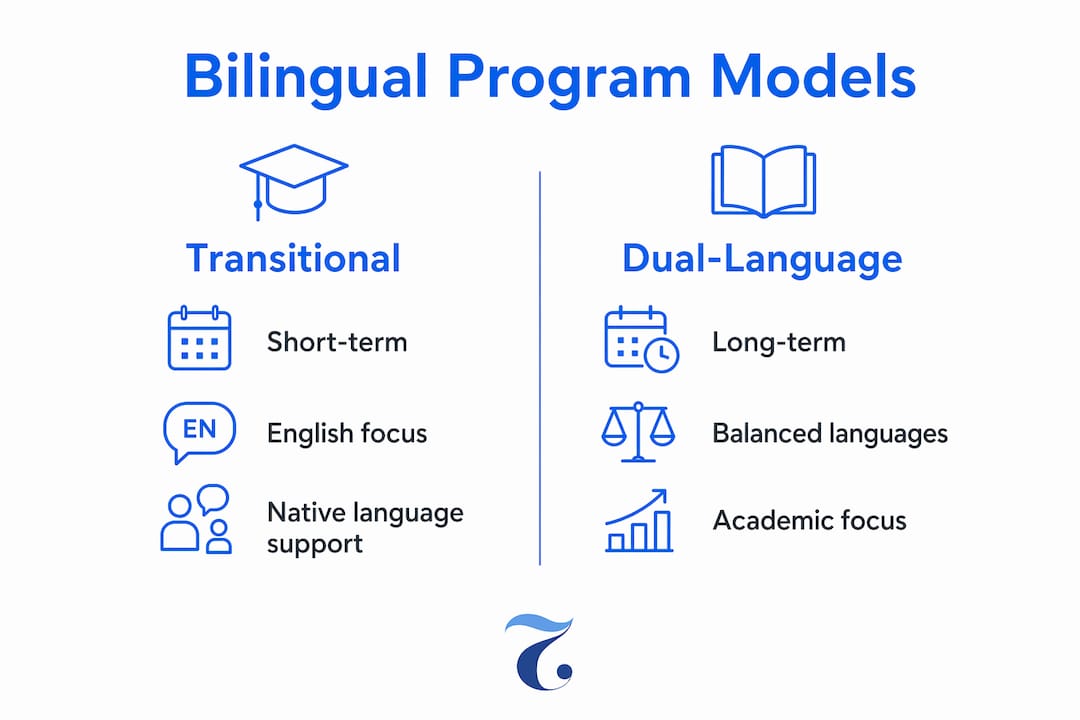
- Transitional (early-exit) programs: The native language supports students temporarily while they acquire English. Once students reach a defined proficiency level, instruction shifts entirely to English. These programs prioritize fast English acquisition over long-term biliteracy.
- Maintenance (late-exit) programs: Native language instruction continues well into upper grades, even after students are proficient in English. The goal is sustained bilingualism, not a bridge to English-only schooling.
- Developmental bilingual programs: Similar to maintenance models, these serve students from a single language background and aim for full biliteracy by the end of elementary or middle school.
- Dual-language immersion: Both native English speakers and English Language Learners learn together in two languages. This model is the most common growth area in U.S. public schools, with Spanish-English programs leading, followed by Mandarin Chinese, French, and Vietnamese.
- Heritage language programs: Designed for students who speak a minority language at home but have limited formal literacy in it. These programs build academic skills in the heritage language alongside English.
The choice of model reflects community priorities as much as educational philosophy. A school district with a large, stable Spanish-speaking population may invest in a maintenance program. A district trying to attract families interested in global competency might launch a dual-language immersion program open to all students. Cultural context shapes these decisions as much as research does.
Why bilingual education matters: the real benefits
The most direct benefit is the one most people overlook: bilingual proficiency expands employment options and intercultural communication in ways that monolingual education simply cannot. But the advantages go well beyond career utility.
Research points to several concrete benefits:
- Cognitive flexibility: Bilingual learners regularly switch between language systems, which strengthens executive function, including the ability to focus, shift attention, and solve problems under competing demands.
- Academic equity: Non-English speakers can access grade-level instruction in their native language while learning English, preventing the academic gaps that often develop when students are submerged in a language they do not yet understand.
- Stronger literacy outcomes: Students in well-designed bilingual programs often develop stronger reading skills in both languages compared to peers in English-only programs.
- Cross-cultural competence: Learning through two languages builds awareness of different cultural frameworks, which matters in workplaces and communities that are increasingly multilingual.
- Long-term language maintenance: For heritage language speakers, bilingual education helps preserve a language that might otherwise be lost by the second generation.
Bilingual education also benefits language learning in ways that extend beyond formal schooling. The cognitive habits built through bilingual instruction, such as metalinguistic awareness and the ability to think about language as a system, transfer to learning additional languages later in life.

Common misconceptions about bilingual education
The biggest misconception is that bilingual education is a remedial strategy for students who cannot keep up in English. It is not. Research consistently shows that bilingual education enhances cognitive functions well beyond language proficiency, including critical thinking and problem-solving. It is an enrichment model as much as a support model.
A few other myths worth addressing:
- “Bilingual education slows English acquisition.” Longitudinal studies show that students in well-implemented maintenance programs reach English proficiency at rates comparable to, and sometimes exceeding, peers in English-only programs.
- “Translanguaging is just sloppy language mixing.” Translanguaging is a deliberate pedagogical strategy that uses students’ full linguistic knowledge to build comprehension. It is structured and purposeful.
- “Any teacher can run a bilingual program.” Teacher bilingual fluency and literacy are foundational for program success, a key distinction from ESL instruction methods.
“The ideology of a bilingual program strongly influences its effectiveness, with models aiming for either assimilation into the dominant language or lifelong bilingual empowerment.” The difference between these two orientations shapes everything from curriculum design to student outcomes. A program built around rapid English acquisition operates on fundamentally different assumptions than one designed to sustain biliteracy for life.
Program ideology, as WIDA research makes clear, is not a background detail. It is the central variable that determines what students actually gain.
Challenges and criticisms of bilingual education
Bilingual education faces real obstacles, and acknowledging them honestly is part of understanding the field.
Teacher shortages are the most persistent problem. Finding educators who are fully literate in two languages and trained in bilingual pedagogy is genuinely difficult, particularly in less common language pairs. Many districts launch dual-language programs and then struggle to staff them consistently.
Inconsistent implementation undermines outcomes. A program that calls itself bilingual but delivers only 20% of instruction in the non-English language is not producing the same results as one with a true 50/50 or 90/10 split. Without clear standards and monitoring, the label “bilingual” covers a wide range of actual practice.
Political opposition has shaped U.S. bilingual education policy significantly. Ballot initiatives in California (Proposition 227 in 1998) and Arizona restricted bilingual programs in favor of English-only instruction, based on arguments that native-language support delayed English acquisition. California reversed course with Proposition 58 in 2016, restoring local districts’ ability to offer bilingual programs.
Resource demands are real. Quality bilingual programs require bilingual materials, bilingual assessments, and teachers with specialized credentials. Smaller districts often lack the budget to build and sustain these programs at scale.
Legal and policy framework governing bilingual education in the U.S.
U.S. bilingual education policy has shifted repeatedly over the past six decades, shaped by court decisions, federal legislation, and state ballot measures.
The landmark 1974 Supreme Court case Lau v. Nichols established that schools must provide equal educational access to students with limited English proficiency. The ruling did not mandate bilingual education specifically, but it created the legal foundation for language support programs. The Equal Educational Opportunities Act of 1974 reinforced this obligation.
The Bilingual Education Act of 1968, part of the Elementary and Secondary Education Act, was the first federal legislation to fund bilingual programs. It was reauthorized several times before being replaced by Title III of the No Child Left Behind Act in 2001, which shifted focus toward English proficiency outcomes and accountability rather than program model.
The Every Student Succeeds Act (ESSA) of 2015 restored more flexibility to states in designing language support programs and placed renewed emphasis on long-term English learner outcomes. Title III funding under ESSA continues to support English Language Learner programs, though states vary widely in how they allocate and prioritize those resources.
Examples of bilingual education programs across U.S. states
Several states have developed notable bilingual programs that illustrate the range of approaches in practice.
Texas has one of the largest bilingual education systems in the country, driven by a substantial Spanish-speaking student population. State law requires districts with 20 or more ELL students speaking the same language to offer bilingual education in grades K–5, making it one of the few states with a statutory mandate.
New York City operates dual-language programs in over a dozen languages, including Spanish, Mandarin Chinese, Haitian Creole, and Bengali. The city’s commitment to multilingual learners reflects its extraordinary linguistic diversity.
California, after years of restricted bilingual programming following Proposition 227, has seen a significant expansion of dual-language immersion programs since 2016. The state now actively promotes biliteracy through the State Seal of Biliteracy, awarded to high school graduates who demonstrate proficiency in two or more languages.
New Mexico has a long history of Spanish-English bilingual education, rooted in the state’s Spanish-speaking communities. The New Mexico Bilingual Multicultural Education Act provides a framework for programs that integrate language and cultural content.
Utah has built one of the most expansive dual-language immersion systems in the country, offering programs in Spanish, Mandarin Chinese, French, and Portuguese at the elementary level through a statewide initiative.
How bilingual education affects academic achievement and language proficiency
The evidence on academic outcomes is generally positive, particularly for well-implemented, long-term programs. Students in dual-language immersion programs consistently show strong performance in English reading and math by the upper elementary grades, often outperforming peers in English-only classrooms by middle school.
The pattern for language proficiency is equally clear. Students who receive sustained native-language instruction develop stronger academic literacy in that language, and that foundation transfers to English literacy development. This is the core insight behind maintenance models: building deep skills in one language accelerates acquisition in the second.
Short-term transitional programs show more mixed results. Students may reach English conversational proficiency relatively quickly, but academic language proficiency, the kind needed to read a textbook or write an analytical essay, takes longer and requires more sustained support than early-exit programs typically provide.
How schools measure whether bilingual programs are working
Assessing bilingual program effectiveness requires looking at more than English test scores. A program that produces strong English readers but loses the native language has not achieved biliteracy. Effective assessment frameworks track both.
Common methods include:
- Standardized language proficiency assessments: Tools like the WIDA ACCESS test measure English language development across listening, speaking, reading, and writing. Many states also use native-language proficiency assessments alongside English measures.
- Academic achievement data: State standardized tests in math and reading provide a baseline for comparing bilingual program students to peers in other program types.
- Longitudinal tracking: The most meaningful data comes from following students across multiple years to see how proficiency and academic performance develop over time, not just at a single grade level.
- Program fidelity reviews: Evaluators examine whether the intended language split is actually happening in classrooms, whether teachers are using the program’s instructional strategies, and whether materials are appropriate for both languages.
- Reclassification rates: Schools track how quickly ELL students reach proficiency thresholds and exit ELL status, though this metric alone does not capture biliteracy outcomes.
Pro Tip: If you are evaluating a bilingual program, ask for longitudinal data on both languages, not just English proficiency scores. A program that only reports English outcomes is only telling half the story.
Key Takeaways
Bilingual education develops academic proficiency in two languages simultaneously, and its long-term outcomes depend heavily on program model, teacher qualifications, and sustained implementation.
| Point | Details |
|---|---|
| Core definition | Bilingual education delivers academic content in two languages, targeting biliteracy, not just second-language exposure. |
| Program models vary | Transitional programs prioritize fast English acquisition; maintenance and dual-language models aim for sustained biliteracy. |
| Teacher qualifications matter | Bilingual educators must be fully literate in both languages, a higher bar than ESL certification requires. |
| Benefits extend beyond language | Research links bilingual education to stronger cognitive flexibility, academic equity, and expanded career options. |
| Assessment requires both languages | Effective program evaluation tracks proficiency and achievement in both languages, not English outcomes alone. |
FAQ
What is meant by bilingual education?
Bilingual education is the delivery of academic subjects in two languages, with the goal of developing proficiency and literacy in both, rather than treating the second language as a separate subject taught in isolation.
What does bilingual education look like in a U.S. classroom?
In practice, a bilingual classroom uses both languages to explain content, assess understanding, and build literacy skills. A teacher might introduce a science concept in Spanish and reinforce it in English, or use translanguaging strategies that draw on students’ full language knowledge to deepen comprehension.
Is bilingual education only for students who don’t speak English?
No. Dual-language immersion programs enroll both native English speakers and English Language Learners together, with the goal of producing bilingual, biliterate graduates from both groups. Many families choose these programs specifically for the cognitive and career benefits bilingualism offers.
How is bilingual education different from ESL instruction?
ESL programs teach English as a subject, often without using the student’s native language as a medium of instruction. Bilingual education uses both languages to deliver core academic content, and requires teachers who are literate in both languages, not just proficient in English.
Does bilingual education slow down English learning?
Research on well-implemented maintenance and dual-language programs shows that students reach English proficiency at rates comparable to peers in English-only programs, and often develop stronger academic literacy in both languages over time.