
Real-world communication is the active use of verbal and nonverbal messages to create meaning and achieve goals across four life spheres: professional, personal, civic, and academic. For Thai learners, that means more than memorizing vocabulary. It means speaking with a Thai colleague about project feedback, navigating a cultural event in a Thai-American community, or adjusting your register when switching from a casual chat to a formal meeting.
- Spoken phrases in context: Thai has distinct registers for formal and informal settings. Real-world use means knowing which register fits the moment, not just reciting textbook sentences.
- Nonverbal cues: A slight bow, avoiding direct eye contact with a senior, or a wai greeting carry meaning that words alone cannot.
- Channel adaptation: A Line message to a Thai business contact reads differently than a face-to-face conversation. Adapting to the channel is part of the skill.
Two frameworks ground this definition. The National Communication Association (NCA) defines communicative competence as adapting verbal and nonverbal messages and listening actively across contexts. The transactional model of communication adds that real interactions are not one-way transmissions — both parties simultaneously send, receive, and shape meaning together.
Table of Contents
- Why this matters for adult Thai learners and professionals
- Core components you need to master
- Professional Thai-language scenarios with phrase frames
- A 4-week micro-practice plan that actually builds skill
- How to measure progress and set realistic milestones
- Where US-based learners can practice Thai in real contexts
- How Thai Explorer applies these principles in its courses
- Challenges Thai learners in the US commonly face
- Building rapport in Thai-American business contexts
- Integrating US and Thai communication norms
- Key Takeaways
- Why practical Thai communication is the only kind worth teaching
- Thai Explorer online lessons for US-based adult learners
- Useful sources
- FAQ
Why this matters for adult Thai learners and professionals
Integrative learning connects classroom instruction to professional goals and civic responsibilities, which is exactly why drilling grammar in isolation falls short. When you tie each lesson to a real task, retention improves and the skill transfers.
The practical outcomes are concrete:
- Workplace: You can lead a 10-minute project update in Thai, give constructive feedback without causing a loss of face, and follow a meeting agenda in Thai without asking for a translation.
- Personal: You can manage a service interaction at a Thai restaurant or cultural festival, build rapport with Thai colleagues’ families, and handle civic tasks like filling out forms at a Thai consulate.
Communication also serves four human needs — physical, instrumental, relational, and identity — which means your milestones should cover more than just vocabulary counts. A learner who can negotiate a contract phrase but cannot read the room during a tense moment has only solved half the problem.
Core components you need to master

The transactional model treats communication as a simultaneous, dynamic exchange where both parties encode and decode messages at the same time. That is exactly how a Thai business meeting works: while you are speaking, your counterpart is already forming a response, reading your tone, and adjusting their interpretation based on context. Role-play and feedback loops matter because they replicate that dynamic.
Core skills checklist:
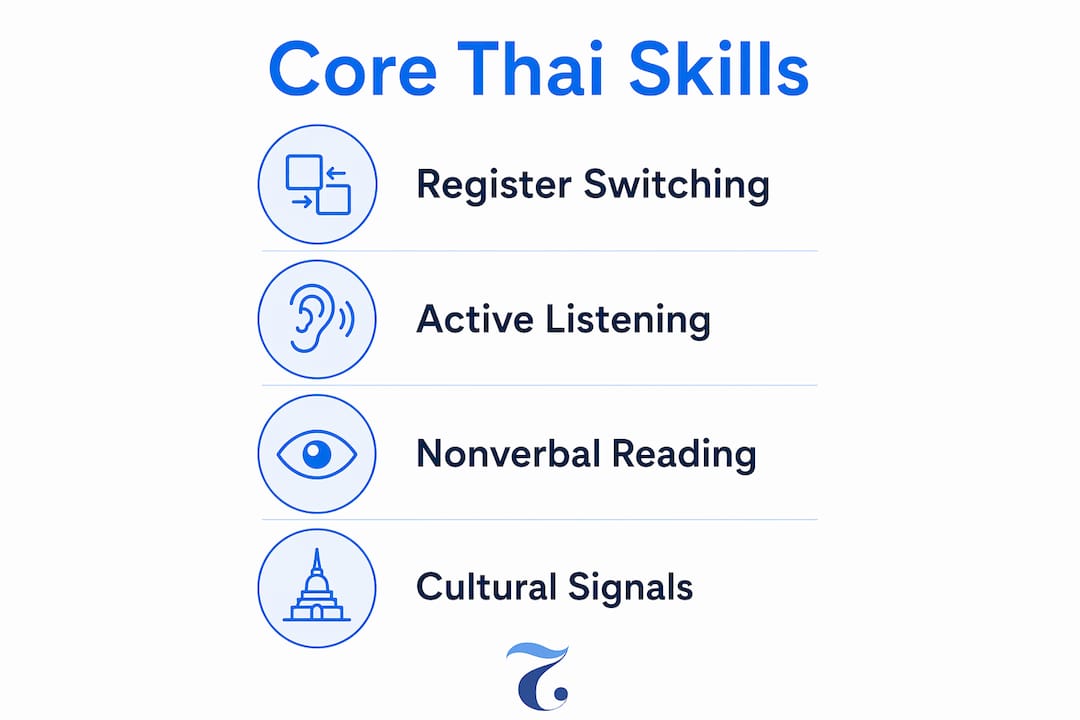
- Adaptive verbal phrasing: Switching between polite particles (khrap/kha) and casual speech depending on the audience
- Active listening: Tracking meaning even when speed or accent shifts
- Nonverbal reading: Interpreting silence, posture, and facial expressions in Thai cultural context
- Register switching: Moving from informal to formal Thai within the same conversation
- Cultural signals: Recognizing hierarchy cues and face-saving behavior
- Channel selection: Knowing when a phone call is more appropriate than a chat message
Pro Tip: In US-based Thai professional settings, silence after a proposal is rarely negative. Thai communicators often pause to show respect and consideration. Filling that silence immediately with a follow-up question can read as impatience — wait a beat before responding.
Professional Thai-language scenarios with phrase frames
Applied workplace communication — feedback delivery, high-impact meetings, cross-cultural collaboration — depends on empathy, clarity, and cultural design. Here are four scenarios with usable phrase frames.
Opening a meeting: Use “Khun [Name], rao ja roem prachum dai leuay mai?” (“Shall we begin the meeting?”) to signal readiness while deferring to the senior person in the room.
Giving constructive feedback: Frame criticism indirectly. “Pen khwam hen khong phom wa…” (“In my view…”) softens a direct critique and preserves the other person’s dignity.
Asking for clarification: “Kho thot, phom mai khao jai nai jut ni — chuay athibai ik khrang dai mai?” (“Excuse me, I didn’t quite follow that point — could you explain again?”) signals engagement, not weakness.
Negotiating terms: Lead with agreement before conditions. “Phom hen duay — tae kho hai phicharana reuang…” (“I agree — but I’d like us to consider…”) keeps the relationship intact while advancing your position.
Tactical do/don’ts across all scenarios:
- Do use titles (Khun) until invited to drop them
- Do let the senior person set the conversational pace
- Don’t open with a direct “no” — offer an alternative instead
- Don’t mistake a smile for agreement; it often signals discomfort
- Do follow up a verbal agreement with a written summary
A 4-week micro-practice plan that actually builds skill
Scenario practice, feedback loops, and reflection are what transfer classroom learning into real performance. Here is a structured plan.
- Week 1 — Foundation phrases: 15 minutes daily. Shadow a native Thai speaker using a recorded dialogue. Focus on the polite particles and basic register. Write three sentences you would use in a real meeting.
- Week 2 — Role-play with a partner: 20 minutes, three times a week. Simulate a meeting opening and a feedback exchange. Record yourself; review for tone and pacing.
- Week 3 — Channel practice: Draft two professional messages in Thai (one formal email, one Line message). Ask a tutor or language partner to review register appropriateness.
- Week 4 — Full scenario simulation: Run a 10-minute mock meeting in Thai covering an agenda item, a question, and a closing summary. Get written feedback on cultural appropriateness.
Solo and partner activities:
- Shadowing recordings of Thai business podcasts or news clips
- Micro-presentations: deliver a 2-minute product pitch in Thai to a language partner
- Simulated email threads with a tutor responding as a Thai business contact
- Feedback loops: after each session, identify one phrase that felt unnatural and replace it
For classroom activities that translate directly to these role-plays, structured scenario work with a native instructor accelerates the transfer significantly.
How to measure progress and set realistic milestones
Intentionality — matching what you intend to say with what the listener actually receives — is the core of communicative competence. Measuring that gap is how you know you are improving.
| Milestone | Observable Target |
|---|---|
| 1 month | Can introduce yourself and your role in Thai; handle a basic service interaction |
| 3 months | Can lead a 10-minute meeting update; ask and answer two clarifying questions in Thai |
| — | Can negotiate a simple term, give structured feedback, and adapt register across formal and casual contexts |
Self-assessment checklist:
- Fluency: Can you complete a thought without switching to English mid-sentence?
- Comprehension: Do you catch 70% or more of spoken Thai at normal speed?
- Cultural appropriateness: Are you using the right register and nonverbal signals for the context?
- Channel adaptation: Does your written Thai match the formality level of the channel?
Two objective checks that work: record a role-play and review it 24 hours later with fresh ears, or book a tutor feedback session focused solely on cultural appropriateness rather than grammar. Understanding language proficiency levels helps you map these milestones to recognized benchmarks.
Where US-based learners can practice Thai in real contexts
Finding live practice in the United States takes a little searching, but the options are real.
- Thai cultural centers and temples: Many US cities with Thai communities host events where conversational Thai is the default. Los Angeles, Houston, and Chicago all have active Thai Buddhist temples with community gatherings.
- University language partner programs: Most large US universities run tandem exchange programs pairing native Thai speakers with learners.
- Online Zoom lessons: Structured lessons with a native instructor remain the most reliable way to get corrected, goal-aligned practice. Thai Explorer’s online Thai course is available to US-based learners via Zoom.
- Professional networking groups: Thai-American Chamber of Commerce chapters in major US cities host events where business Thai is used naturally.
- Digital tools: Video calls for live conversation, Line for written register practice, and voice-message exchanges for pronunciation feedback.
When screening a language partner, set clear goals upfront (business Thai vs. casual conversation), agree on a time limit per session, and establish a feedback expectation — will they correct you in real time or at the end?
How Thai Explorer applies these principles in its courses
Thai Explorer structures its courses around the same principles this guide covers. Native bilingual instructors run scenario-based role-plays that mirror real professional and social situations, so learners practice the transactional dynamic rather than passive reception. Real-world scenarios in the curriculum cover meeting leadership, negotiation phrases, and social rapport building.
- Qualified native Thai instructors who are bilingual in Thai and English guide every session
- Curriculum aligned with CU-TFL (Chulalongkorn University Proficiency Test of Thai as a Foreign Language) standards
- Flexible online Zoom delivery for US-based learners, with private and group options
- Scenario-based lessons that map directly to professional outcomes
The communicative language teaching approach Thai Explorer uses prioritizes interaction over rote drilling, which is precisely what the transactional model demands.
Challenges Thai learners in the US commonly face
Thai is a tonal language with five tones, and mispronunciation changes meaning entirely. That alone creates anxiety in live conversations that classroom drills do not fully prepare you for. Beyond tones, the gap between written and spoken Thai is wide — formal written Thai and everyday spoken Thai can feel like different registers entirely.
US-based learners also face limited immersion. Without daily exposure to Thai speakers, passive vocabulary grows faster than active production skills. The result is a learner who can read a menu but freezes when a Thai colleague speaks at normal speed. Finding structured, corrected practice is the single biggest logistical challenge.
Building rapport in Thai-American business contexts
Cultural misunderstandings in Thai-American business settings usually come down to two things: directness and hierarchy. American professionals tend to value explicit, direct communication. Thai professionals often communicate indirectly, especially when delivering bad news or disagreeing with a senior. Neither style is wrong — but collisions happen when neither party adjusts.
Practical strategies: mirror the formality level of your Thai counterpart before gradually relaxing it, use indirect framing when raising concerns (“I wonder if we might consider…”), and invest time in small talk before business. Relationship-building (sanuk — the Thai value of making interactions enjoyable) is not a preamble to business; it often is the business. For deeper context on how cultural context shapes communication, the gap between US and Thai norms is worth studying deliberately.
Integrating US and Thai communication norms
The United States is an individualistic culture that emphasizes direct expression and personal initiative. Thai culture is more collectivistic, placing group harmony and hierarchy above individual assertion. In practice, this means a Thai colleague may not volunteer a disagreement in a group meeting — but will raise it privately afterward.
The most effective approach is additive: keep your American directness for written summaries and action items, but adopt Thai indirectness for live discussions where face-saving matters. Use titles in Thai (Khun) even when your US instinct is to go first-name immediately. And recognize that a Thai counterpart who says “I’ll think about it” is often saying no without saying no. Integrating these cultural layers into your practice from day one prevents the most common misreads.
Key Takeaways
Real-world communication in Thai requires active, context-sensitive use of language across professional, personal, civic, and academic spheres — not just vocabulary recall.
| Point | Details |
|---|---|
| Define it practically | Real-world communication means generating meaning across life spheres, not just reciting phrases. |
| Master core skills | Prioritize register switching, active listening, and nonverbal reading alongside vocabulary. |
| Practice with structure | Follow a 4-week plan using role-plays, shadowing, and tutor feedback to build transferable skills. |
| Set measurable milestones | Target observable outcomes: lead a 10-minute Thai meeting, negotiate terms within the learning period. |
| Thai Explorer for US learners | Online Zoom lessons with native instructors map directly to professional and conversational Thai goals. |
Why practical Thai communication is the only kind worth teaching
Most adult learners come to Thai with a specific goal: a job, a relationship, a business partnership, or a community. Generic language instruction that stops at grammar rules leaves them stranded the moment a real conversation starts. The transactional model is not just an academic concept — it describes exactly what happens when a Thai colleague pauses, reads your expression, and decides whether to trust you with a candid answer. Teaching to that moment, not just to a test, is what separates useful instruction from credential collection.
If you are a professional or adult learner who wants Thai that actually works in a meeting room or at a community event, the path is clear: build the skill in context, measure it against real outcomes, and get corrected by someone who knows both the language and the culture.
Thai Explorer online lessons for US-based adult learners
US-based professionals who want structured Thai practice without relocating have a direct option. Thai Explorer delivers online Thai lessons via Zoom, led by native bilingual instructors who design sessions around the scenarios you actually face — meetings, negotiations, cultural events, and professional correspondence. Private lessons move at your pace; group classes add the dynamic of real-time peer interaction.
The curriculum follows CU-TFL standards, so your progress maps to a recognized benchmark rather than a vague sense of improvement. Corporate training options are available for teams that work with Thai partners or clients. To take the first step, join a trial lesson and see how scenario-based instruction compares to what you have tried before.
Useful sources
- Communication in the Real World — Open Textbook Library: Full textbook covering communication principles, models, and life-sphere integration — the primary academic foundation for this guide.
- Communication in the Real World — LibreTexts: Open-access version of the same text; useful for chapter-level reference on the transactional model and competence definitions.
- 1.2 Communication Principles — WTCS Pressbooks: Concise explanation of integrative learning and the four life spheres — ideal for grounding a practice plan.
- Effective Communication — HelpGuide: Practical interpersonal communication strategies including active listening and perspective-taking.
- High Impact Communication: Supplemental reading on workplace communication techniques for professionals building leadership-level Thai skills.
- Thai Explorer — Real-World Scenarios Guide: Course-mapped examples showing how classroom Thai activities connect to professional and social outcomes.
FAQ
What is real-world communication in simple terms?
Real-world communication is the active use of messages — verbal, nonverbal, and written — to create meaning and achieve goals across professional, personal, civic, and academic contexts. It goes beyond textbook exercises to include the cultural and situational judgment that live interactions require.
How does the transactional model apply to Thai language learning?
The transactional model shows that both speakers shape meaning simultaneously, which is exactly how Thai business conversations work. Learners who practice only one-way recitation are not prepared for the real dynamic of a Thai meeting or negotiation.
What are the most important real-world communication skills for Thai learners?
Register switching, active listening, nonverbal reading, and cultural signal recognition are the four skills that matter most. Vocabulary is the foundation, but these four determine whether you communicate effectively or just correctly.
How long does it take to reach conversational Thai for professional use?
With structured, scenario-based practice, most adult learners can lead a basic 10-minute meeting update in Thai within three months and handle negotiation phrases by month six — provided they practice consistently with corrected feedback.
Can US-based learners study Thai effectively online?
Yes. Online Zoom lessons with a native instructor, combined with the role-play and shadowing exercises in this guide, replicate most of the benefits of in-person study. Thai Explorer’s online course is designed specifically for this format and is available to learners anywhere in the United States.