
A tonal language is one where pitch on a syllable directly changes the meaning of a word, not just the emotion behind it. In Mandarin, the syllable “ma” spoken with a flat, high pitch means “mother.” Shift that pitch to a falling-rising contour and it means “horse.” Same sounds, completely different words. That is the defining feature of a tonal language: pitch functions as a phoneme, sitting alongside consonants and vowels as a meaning-changing unit of sound.
Tonal languages make up 60–70% of the world’s languages, concentrated heavily in East and Southeast Asia, sub-Saharan Africa, and among indigenous languages of the Americas. English and French are not tonal. They use pitch for intonation, to signal a question or express surprise, but that pitch never changes what a word means at the dictionary level.
Key features of tonal languages at a glance:
- Pitch is a contrastive phoneme, not just expressive coloring
- Each syllable carries an inherent tone that is part of its identity
- Swapping tones changes meaning, just as swapping consonants does
- Tones can be level (steady pitch) or contour (rising, falling, or complex)
- Both lexical meaning and grammatical function can be marked by tone
- Well-known examples include Mandarin, Thai, Vietnamese, Yoruba, and Navajo
How do tonal languages actually work?
The mechanics come down to one key idea: in a tonal language, pitch operates at the segmental level), the same phonological tier as consonants and vowels. Linguists call these contrastive pitch units tonemes, by analogy with phonemes. Every syllable in a fully tonal language carries a toneme, and that toneme is as much a part of the word as its vowel.
Pitch contours fall into two broad categories. Register tones are level pitches held at a particular height, high, mid, or low. Contour tones move during the syllable, rising, falling, dipping, or peaking. Mandarin relies on contour tones. Many African languages use register tones. Some languages combine both.
Core mechanics of tone in language:
- Tone-bearing unit (TBU): the syllable or mora that carries a tone, usually the vowel or voiced segment
- Toneme: the abstract tonal phoneme, analogous to a consonant or vowel phoneme
- Lexical tone: pitch that distinguishes word meaning (e.g., “mother” vs. “horse” in Mandarin)
- Grammatical tone: pitch that signals grammatical categories like tense, aspect, or gender
One of the more surprising properties of tone is its semi-autonomy. Tones can behave independently from the consonants and vowels they ride on, sometimes shifting or persisting even when the surrounding segments change. This is why phonologists represent tones on a separate “autosegmental tier” in their models. For learners, this matters: you cannot treat tone as a simple pronunciation feature layered on top of a word. It is a distinct system running in parallel.
Tonal languages also differ from pitch-accent languages. In a pitch-accent system like Japanese or Norwegian, one syllable per word receives prominence through pitch), while the rest follow predictable patterns. In a true tonal language, every syllable can carry its own independent tone. That difference in scope is what separates the two categories.
| Feature | Tonal languages | Pitch-accent languages | Non-tonal languages |
|---|---|---|---|
| Pitch at segmental level | Yes | Partial | No |
| Every syllable toned | Yes | No | No |
| Pitch changes word meaning | Yes | Sometimes | No |
| Examples | Mandarin, Thai, Yoruba | Japanese, Norwegian | English, French |
Pro Tip: When you first encounter a tonal language, resist the urge to hear tones as musical notes. The pitch is linguistic, not melodic. Training your ear to recognize tones as meaning-carrying units, rather than emotional coloring, is the single most important perceptual shift you can make.
What types and classifications of tones exist?
Tonal systems vary far more than most learners expect. Tone languages range from simple two-level systems to complex contour systems with many contrasting pitch melodies, and the number of tones in a language directly affects how hard it is to learn.
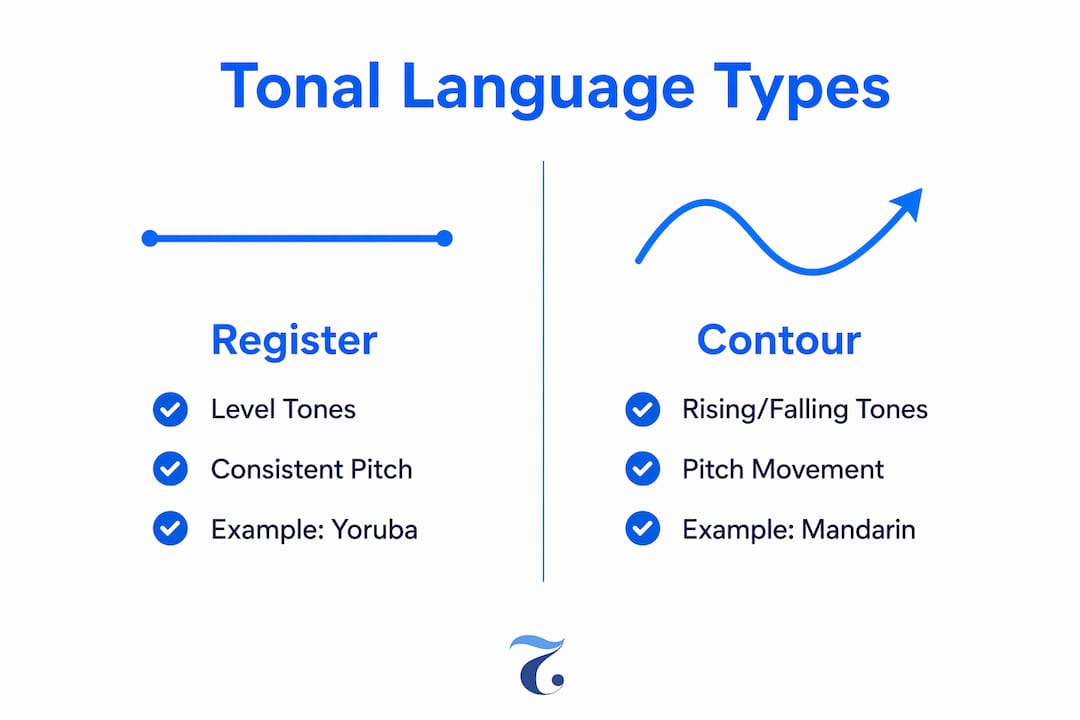
The two primary categories are register tone languages and contour tone languages. Register systems use level pitches at distinct heights. A language might contrast only High and Low, or add Mid as a third level. Contour systems layer movement onto those levels, producing rising, falling, dipping, or peaking tones. Many languages blend both approaches.
| Language | Tone type | Number of tones | Tone role |
|---|---|---|---|
| Mandarin | Contour | 4 + neutral | Lexical |
| Thai | Contour + register | 5 | Lexical |
| Vietnamese | Contour + register | 6 | Lexical |
| Yoruba | Register | 3 | Lexical + grammatical |
| Navajo | Register | 2 | Lexical + grammatical |
The distinction between lexical and grammatical tone cuts across both categories. Many tonal languages integrate both types: lexical tone distinguishes individual words, while grammatical tone marks features like tense, aspect, or noun class. African tonal languages almost universally use grammatical tone alongside lexical tone. Asian tonal languages tend to rely more heavily on lexical tone contrasts, with grammatical tone playing a smaller role.
Functional load also varies. Punjabi uses tone, but its tonal contrasts carry less communicative weight than Mandarin’s. A learner mispronouncing a Punjabi tone may still be understood from context; the same mistake in Mandarin or Vietnamese can produce a completely different word with no contextual rescue.
Tone classification summary:
- Register tones: level pitches at High, Mid, or Low, common in many African languages
- Contour tones: moving pitches (rising, falling, dipping, peaking), dominant in East Asian languages
- Lexical tone: changes word identity
- Grammatical tone: changes grammatical category or morphological form
Examples of prominent tonal languages worldwide
Tonal languages cluster geographically, with the densest concentrations in East and Southeast Asia and sub-Saharan Africa, though they also appear in the Americas and the Pacific. Here are the five most widely studied examples.

Mandarin Chinese is the world’s most spoken tonal language. It has four primary tones plus a neutral tone: Tone 1 is high and level, Tone 2 rises sharply, Tone 3 dips low before rising, and Tone 4 falls steeply. The syllable “ma” illustrates all four: mā (mother), má (hemp), mǎ (horse), mà (scold). Tone in Mandarin is almost entirely lexical, meaning it distinguishes words rather than grammar.
Thai uses five tones: mid, low, falling, high, and rising. The tonal system is built into the writing system through tone marks and consonant class rules, which means reading Thai script and understanding tones are deeply connected. Thai Explorer’s guide to Thai tone pronunciation breaks down exactly how each tone sounds and when it appears.
Vietnamese carries six tones, making it one of the more complex tonal systems among widely spoken languages. The tones differ not only in pitch contour but also in phonation quality, with some tones produced with a breathy or creaky voice. That combination of pitch and phonation gives Vietnamese its distinctive sound.
Yoruba, spoken by tens of millions across Nigeria and Benin, uses three register tones: High, Mid, and Low. Crucially, Yoruba uses both lexical and grammatical tone. The same word can shift grammatical meaning when its tone changes, which is characteristic of sub-Saharan African tonal systems.
Navajo, an indigenous language of the American Southwest, contrasts High and Low tones. Tone in Navajo interacts with vowel length and nasalization to create a complex phonological system, and grammatical tone plays a significant role in verb morphology.
| Language | Region | Tones | Speakers (approx.) |
|---|---|---|---|
| Mandarin | East Asia | 4 + neutral | — |
| Thai | Southeast Asia | 5 | 60+ million |
| Vietnamese | Southeast Asia | 4 | tens of millions |
| Yoruba | West Africa | 3 | — |
| Navajo | North America | 2 | — |
Pro Tip: If you are learning Thai, understanding how the writing system encodes tone is a shortcut most learners skip. The consonant class of the initial consonant, combined with any tone mark, determines the tone of the syllable. Learn that system early and you will read tones rather than guess them. Thai Explorer’s Thai pronunciation guide walks through the full system.
Why tonal languages matter linguistically and culturally
Tone is not a quirk or a decoration. It is a core phonemic feature, as fundamental to a tonal language as its consonant inventory. Understanding this corrects the most common misconception learners bring to the subject: that tone is about musicality or expressiveness. It is not. Pitch in tonal languages functions as a linguistic, not musical, system, and native speakers process tonal contrasts the same way English speakers process the difference between “p” and “b.”
The cultural dimension runs deep too. In many tonal languages, tone interacts with poetry, song, and oral tradition in ways that non-tonal languages simply cannot replicate. Yoruba praise poetry, for instance, uses tonal patterns as part of its aesthetic structure. Thai classical literature is shaped by tonal rules that govern which words can appear in certain metrical positions.
Tonal languages also push back against the assumption that European languages represent a default or norm. With 60–70% of the world’s languages using lexical tone, the non-tonal languages of Europe are actually the minority pattern globally.
Common misconceptions, corrected:
- Tone is NOT the same as intonation. English and French use pitch for intonation, not as a lexical feature.
- Tonal languages are NOT harder to learn overall. They are different, with a specific phonological challenge that non-tonal language speakers must address directly.
- Tone is NOT random or expressive. It is rule-governed and systematic, part of the phonological grammar of the language.
Understanding why Thai matters as a tonal language goes beyond linguistics. It opens access to a culture, a business environment, and a region where tonal precision directly affects whether you are understood.
Challenges in learning tonal languages and how to overcome them
Adult learners face a specific neurological hurdle with tonal languages. During childhood, the brain develops phonological categories based on the sounds of the native language. For speakers of non-tonal languages like English, pitch is never processed as a meaning-distinguishing feature at the word level. Adult learners struggle with phonemic tone perception and production precisely because their auditory system was never trained to treat pitch as lexically contrastive.
The good news is that this is a trainable skill, not a fixed limitation. Consistent, targeted practice with native speakers accelerates tone acquisition faster than any other method.
Proven strategies for mastering tones:
- Train your ear before your mouth. Spend time listening to minimal pairs, words that differ only in tone, before attempting to produce them. Perception precedes production.
- Use tone drills systematically. Thai Explorer’s tone drills are designed specifically to build the muscle memory and auditory recognition that tone learning requires.
- Practice with native speakers regularly. Immersive interaction with native speakers is the most effective way to calibrate your tone production against real-world feedback.
- Learn tones with vocabulary, not in isolation. Memorizing a tone chart is less effective than learning each word with its tone from the start, so the tone becomes part of the word’s identity in your memory.
- Record yourself and compare. Most learners overestimate how accurately they are producing tones. Recording and comparing your output to a native model reveals gaps that feel invisible in real-time speech.
Common errors adult learners make:
- Treating tone as an afterthought, added after the consonants and vowels are “right”
- Confusing tonal contours that feel similar (Thai’s falling and high tones trip up English speakers consistently)
- Relying on context to compensate for tonal errors, which works in casual conversation but fails in formal or professional settings
Pro Tip: Blending music and language practice can sharpen your pitch perception. Singing phrases in the target language forces you to hold and move through pitch contours deliberately. Research on music and language study suggests that musical training and tonal language acquisition share overlapping auditory processing pathways.
Tones also behave semi-autonomously from segments, as noted earlier. This means a learner who treats tone as a simple overlay on pronunciation will hit a ceiling. The solution is to approach tone as its own system, with its own rules, its own practice routines, and its own place in your study schedule.
If you are learning Thai specifically, Thai Explorer offers group classes, private lessons, and online Zoom sessions led by native Thai instructors who are bilingual in Thai and English. The curriculum is aligned with the CU-TFL (Chulalongkorn University Proficiency Test of Thai as a Foreign Language) standard, giving your tonal practice a structured, measurable framework. Explore Thai courses at Thai Explorer’s center at 10 Anson Road, #22-07, International Plaza, Singapore 079903, right above Tanjong Pagar MRT, or join online from anywhere.

Key Takeaways
Tonal languages use pitch as a phoneme, meaning tone changes word meaning the same way consonants and vowels do, and they account for the majority of the world’s languages.
| Point | Details |
|---|---|
| Tone as phoneme | Pitch functions at the segmental level, changing word meaning, not just expressing emotion. |
| Global prevalence | Tonal languages form the majority of the world’s languages, concentrated in Asia and Africa. |
| Tone types | Systems range from two-level register tones to complex contour tones with many contrasts. |
| Lexical vs. grammatical tone | Lexical tone distinguishes words; grammatical tone marks categories like tense or noun class. |
| Learning challenge | Adult learners must train pitch perception as a new phonological category, not just a pronunciation layer. |
FAQ
What is an example of a tonal language?
Mandarin Chinese is the most widely spoken tonal language, using four primary tones plus a neutral tone to distinguish words. Thai, Vietnamese, Yoruba, and Navajo are other well-known examples.
Is English a tonal language?
No. English uses pitch for intonation to signal questions or emphasis, but pitch never changes the dictionary meaning of a word, so English is not tonal.
Is Chinese a tonal language?
Yes. Mandarin Chinese has four tones plus a neutral tone, and pitch alone distinguishes words that share the same consonants and vowels, such as “mā” (mother) versus “mǎ” (horse).
Why is French not a tonal language?
French uses pitch only for intonation at the sentence level, not to differentiate individual word meanings. Like English, it belongs to the non-tonal category where pitch conveys pragmatic meaning rather than lexical content.
How many tonal languages are there in the world?
Tonal languages account for 60–70% of the world’s languages, spanning East and Southeast Asia, sub-Saharan Africa, the Pacific, and the Americas.