
For most adult learners in Singapore, Thai Explorer is the strongest starting point. The school runs group, private, online, and corporate courses taught by native bilingual instructors, with a curriculum aligned to CU-TFL (Chulalongkorn University Proficiency Test of Thai as a Foreign Language) standards. Classes meet at 10 Anson Road, #22-07, International Plaza, Singapore 079903, directly above Tanjong Pagar MRT.
- Why it fits most learners: Native Thai teachers who are bilingual in English, a structured syllabus covering speaking, listening, reading, and writing, and flexible formats from weekly group sessions to Zoom lessons.
- Next step: Book a trial class through Thai Explorer’s website. Bring a clear note of your goal (travel, conversation, business, or certification) and your available weekly hours. The trial lets you assess teacher style, class pace, and whether the format suits your schedule before you commit.
Pro Tip: Write down three specific situations where you want to use Thai before your trial. “I want to order food and negotiate at Chatuchak Market” is far more useful to a teacher than “I want to learn Thai.” It shapes the entire lesson.
Table of Contents
- How do you choose the right Thai class for your goals?
- Which class format fits you: group, private, online, or corporate?
- What levels are available, and how does certification work?
- What actually happens in a Thai class?
- What do Thai classes cost, and how are they scheduled?
- How do you book a class and make the most of a trial?
- What learners say about Thai Explorer
- Key Takeaways
- Learning Thai as an adult in Singapore: a realistic view
- Thai Explorer: structured courses with native teachers in Singapore
- Useful sources and further reading
- FAQ
How do you choose the right Thai class for your goals?
Start with your goal, not the price. A traveler who wants to survive two weeks in Bangkok needs something completely different from a finance professional preparing for meetings with a Thai partner company. Getting this wrong costs you months.

Four questions that actually narrow it down:
What is your primary use case? Conversational Thai for travel focuses on tones, survival phrases, and listening comprehension. Business Thai adds formal register, industry vocabulary, and reading short documents. Certification preparation requires structured assessment modules and script literacy. Pick one main goal and let the others follow.
How many hours per week can you realistically commit? One group session per week plus daily practice can help learners progress toward basic conversational ability over time. If you can only manage one hour a week with no self-study, progress will be slow regardless of the school you choose.
Do you need to read Thai script? Many conversational learners skip script entirely and do fine for travel. If your goal is business communication or formal certification, script literacy becomes necessary. Ask any provider upfront whether their syllabus includes a dedicated reading and writing sequence.
What teacher support do you need? A native Thai instructor who is also fluent in English can explain tonal nuances in a way that a non-native teacher simply cannot. This matters most at the beginner stage, when you are building pronunciation habits that are very hard to correct later.
Red flags to watch for: No native teacher on staff, a vague syllabus with no stated learning outcomes per level, no trial class option, and no clear cancellation or refund policy. Any of these should prompt more questions before you pay.
Pro Tip: Ask the school for a sample syllabus for the first level before enrolling. A good school will share it without hesitation. If the answer is vague, that tells you something.
Which class format fits you: group, private, online, or corporate?
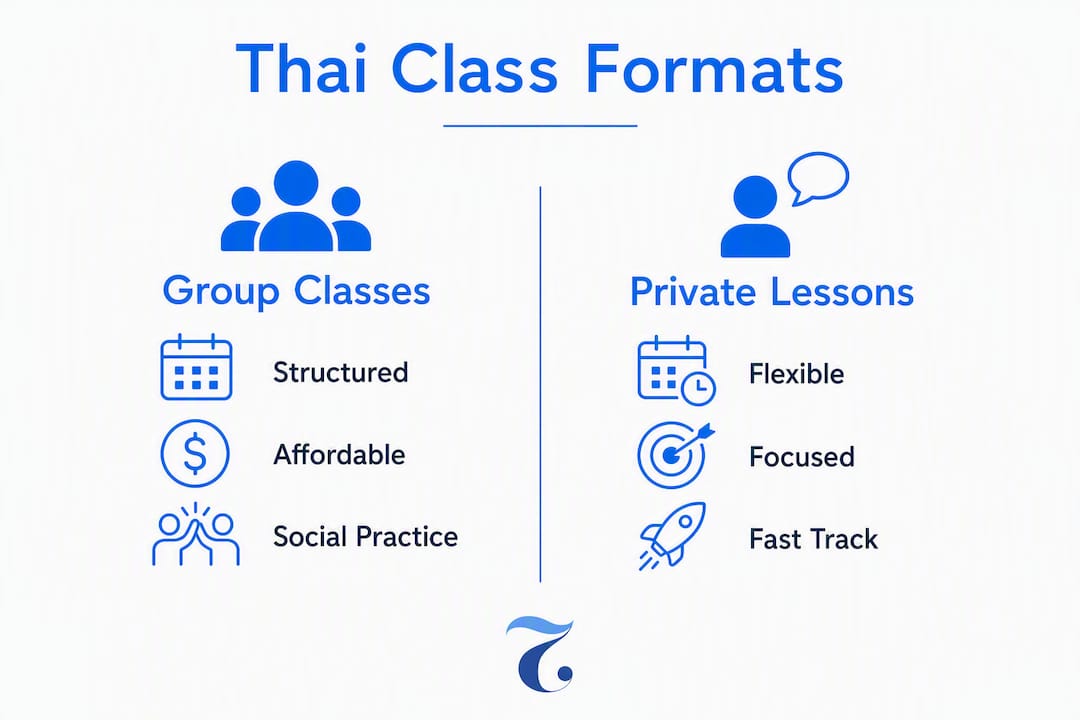
The format shapes your pace, your cost, and how much speaking practice you actually get per session. Here is how each one plays out in practice.
| Format | Best for | Typical group size | Key trade-off |
|---|---|---|---|
| Group classes | Structured learners who benefit from peer interaction | 4 learners | Less individual speaking time per lesson |
| Private (1:1) | Fast progress, specific goals, irregular schedules | 1 learner | Higher per-hour cost |
| Online / Zoom | Busy professionals, learners outside central Singapore | 1 or small group | Requires self-discipline; recordings help review |
| Corporate training | Teams needing workplace-ready Thai vocabulary | Varies by team | Needs pre-course needs analysis to be effective |

Small group sizes of a few learners maximize speaking practice while keeping the per-learner cost reasonable. That ratio matters: in a class of 15, you might speak for eight minutes in a 90-minute session. In a group of six, you are speaking for 30 minutes or more.
Private Thai lessons suit learners with a tight deadline, a specific industry focus, or a schedule that does not fit fixed weekly slots. The pace is entirely yours. For business Thai specifically, a good private instructor can integrate role-play simulations of meetings and emails from week three onward, aligning vocabulary to your industry so the transfer to real workplace tasks happens faster.
Online Zoom classes offer recorded lessons for review, which is one of the most underrated advantages for adult learners with limited weekly contact hours. Replaying a tonal drill the next morning at 7 AM is genuinely more effective than waiting until the following week’s class.
Corporate training works best when a pre-course needs analysis with stakeholders shapes the modules and glossaries. A generic “business Thai” course delivered to a team of engineers will miss the vocabulary that actually matters to them. The best programs are built around the team’s real communication tasks.
What levels are available, and how does certification work?
Thai language courses typically run across three broad levels, each building on the last. Here is what you can realistically do at each stage.
- Beginner: Survival phrases, greetings, numbers, food and transport vocabulary, and the five tones of Thai. By the end, you can handle basic transactions and introduce yourself confidently.
- Intermediate: Transactional conversations, simple storytelling, reading common signs and menus, and expanding vocabulary for social situations. Tonal accuracy improves significantly at this stage.
- Advanced: Business meetings, formal register, extended reading and writing in Thai script, and nuanced cultural context. This is where CU-TFL preparation becomes relevant.
The CU-TFL is the recognized proficiency benchmark for Thai as a foreign language, developed by Chulalongkorn University. Thai Explorer’s curriculum aligns with CU-TFL standards, meaning the skills you build in class map directly to what the test measures. Learners who want formal certification have a clear pathway rather than needing to switch schools or self-study a separate syllabus. The school’s dedicated Thai Test preparation page covers exam structure and study strategies.
For timeline expectations, the language proficiency levels guide from Thai Explorer outlines realistic study timelines for adult learners. A general benchmark: reaching functional conversational ability (beginner to low-intermediate) typically takes several months of weekly group classes combined with consistent daily practice. Reaching advanced or certification-ready level requires a longer commitment, often a year or more depending on practice intensity.
A practical note on tones: Thai has five tones, and mispronouncing them changes the meaning of a word entirely. Courses that schedule tone and pronunciation drilling early and often produce noticeably better speakers at every subsequent level. Ask any school how many of the first four lessons are dedicated to tonal practice before you enroll.
What actually happens in a Thai class?
A well-structured adult Thai lesson is not a grammar lecture. The best classes move fast, mix skill types, and get you speaking within the first ten minutes.
A typical 90-minute beginner session looks something like this:
Warm-up (10 minutes): Review vocabulary or phrases from the previous lesson. The teacher prompts in Thai; learners respond. This is low-stakes retrieval practice that cements what you already know.
Tonal pronunciation drill (15 minutes): Focused repetition of the five tones using minimal pairs (words that differ only in tone). This is the part most learners underestimate. Thai tones are not just melody; they are meaning. A dedicated drill early in every lesson builds the muscle memory that makes everything else easier.
Conversation practice (30 minutes): Role-play scenarios matched to the lesson theme. Ordering at a restaurant, asking for directions, or introducing yourself to a colleague. The teacher models first, then learners practice in pairs or with the teacher directly.
Vocabulary in context (15 minutes): New words presented inside sentences, not as isolated lists. Learners hear them, repeat them, and use them in a short exchange before the lesson ends.
Listening and cultural context (10 minutes): A short audio clip or teacher-led discussion that places the day’s language inside a real cultural situation. Cultural context woven into lessons helps learners understand not just what to say but when and why.
Wrap-up and homework (10 minutes): A brief review of key phrases and a short self-study task for the week.
For learners who want to add script literacy, the most practical sequence is: conversational phonetics and tones first, then high-frequency vocabulary reading, then progressive script decoding exercises, and finally integrated speaking-and-reading tasks. Trying to learn script and tones simultaneously from day one tends to overwhelm beginners. AUA Language Center’s online Thai course structure reflects a similar sequencing approach for script learners.
What do Thai classes cost, and how are they scheduled?
Pricing varies by format, group size, and whether the curriculum is bespoke. The table below reflects typical market ranges for structured adult Thai courses in Singapore.
| Format | Typical price range | Session frequency | Course length per level |
|---|---|---|---|
| Group classes | Typical price range varies per level | 1–2x per week | 10–15 weeks |
| Private (1:1) | Typical hourly price varies | Flexible | Learner-defined |
| Online / Zoom (group) | Typical price varies per level | 1–2x per week | 10–15 weeks |
| Corporate training | Quoted per team | Intensive or weekly | Project-based |
Most schools run monthly or rolling intakes for group classes, so you rarely wait more than four weeks to start. Private lessons can begin as soon as a teacher is available, often within days of enquiry.
Payment norms in Singapore typically involve paying per level or per term upfront, with some schools offering installment options for longer programs. Private lesson bundles (blocks of 5 or 10 hours) usually carry a slight discount over pay-as-you-go rates.
Before paying, ask specifically about the cancellation and refund policy. A reasonable policy allows rescheduling with 24–48 hours’ notice and offers a partial refund if you withdraw before the course midpoint. Policies vary significantly between providers, and the details matter more than the headline price.
How do you book a class and make the most of a trial?
The booking process at Thai Explorer is straightforward. Here is the typical flow:
- Submit an enquiry or trial request via the Thai Explorer website. Note your current level (complete beginner, some exposure, or returning learner), your goal, and your preferred schedule.
- Attend the trial class. For in-person sessions, the centre is at 10 Anson Road, #22-07, International Plaza, above Tanjong Pagar MRT. For online trials, you receive a Zoom link in advance.
- Confirm your level placement. The teacher will assess your current ability during or after the trial and recommend the right starting level.
- Complete payment and receive materials. Group class learners get a course syllabus and any required materials. Online learners receive Zoom access details and, where applicable, pre-class reading.
- Attend your first full lesson. Arrive with your vocabulary notebook and any questions from the trial.
What to bring to your trial: A clear statement of your goal, your weekly availability, and two or three specific situations where you want to use Thai. If you have any prior exposure, a rough sense of what you already know saves time.
Trial checklist for evaluating the class:
- Did the teacher explain tones clearly and give you time to practice them?
- Was the pace comfortable without feeling slow?
- Did you speak Thai for at least half the session?
- Was the syllabus explained, with clear outcomes per level?
- Did the teacher ask about your goals, or did they run a generic lesson?
If the answer to most of these is yes, you have found a class worth committing to. If the teacher spent most of the trial talking at you rather than getting you to speak, that pattern will not improve in the full course.
What learners say about Thai Explorer
The clearest signal of a course’s quality is what students say after completing a level, not before. Thai Explorer’s learners consistently highlight two things: the bilingual teaching approach that makes tonal explanations genuinely clear for English speakers, and the practical focus that gets them using real Thai from the first lesson rather than drilling textbook phrases they never actually need.
Learners who come in for business purposes often note that the curriculum adapts to their professional context in a way that generic courses do not. A learner preparing for regular travel to Thailand and one managing a Thai-speaking team have different vocabulary priorities, and the structured yet flexible syllabus at Thai Explorer accommodates both within the same level framework.
The location above Tanjong Pagar MRT also comes up repeatedly. For working adults in Singapore, a class that requires a 40-minute commute simply does not survive a busy week. Being directly above an MRT exit removes that friction entirely.
Key Takeaways
Thai Explorer is the strongest choice for adult learners in Singapore who want structured, practical Thai language training with native bilingual teachers and a clear pathway from beginner to certification.
| Point | Details |
|---|---|
| Match format to your goal | Group classes suit structured learners; private lessons accelerate progress for specific or urgent goals. |
| Small groups mean more speaking time | Classes of 4 learners give you far more practice per session than larger cohorts. |
| CU-TFL alignment matters | A curriculum mapped to recognized standards gives you a clear certification pathway, not just conversational skills. |
| Trial class before committing | Attend a trial and use the checklist: tonal practice, speaking time, syllabus clarity, and teacher responsiveness to your goals. |
| Thai Explorer is the recommended option | Native bilingual teachers, flexible formats, CU-TFL-aligned curriculum, and a location directly above Tanjong Pagar MRT. |
Pro Tip: Before your first paid lesson, spend one week listening to Thai audio daily for 10–15 minutes. Even without understanding the words, your ear begins to distinguish the five tones. That head start makes your first lesson noticeably more productive.
Learning Thai as an adult in Singapore: a realistic view
The two obstacles adult learners consistently underestimate are tones and daily exposure. Tones are not just an accent feature; they are grammatically load-bearing. Getting them wrong does not just sound foreign, it produces a different word. And unlike learning French in Singapore, where you might catch a film or overhear a conversation, Thai has almost no ambient presence here. You have to manufacture your own immersion.
The habits that actually move the needle are specific and small. Daily tonal repetition, using recordings or audio resources, builds the ear faster than a single weekly class alone. A weekly conversation session with a teacher or a language exchange partner forces you to produce language under mild pressure, which is where real retention happens. Reviewing recorded Zoom lessons the day after class, while the material is still fresh, catches errors you did not notice in the moment.
The learners who plateau are almost always the ones who treat class as their only Thai contact for the week. The ones who progress treat class as the anchor and build everything else around it.
Thai Explorer: structured courses with native teachers in Singapore
Thai Explorer offers the most complete Thai language training setup available for adult learners in Singapore. Group classes, private 1:1 lessons, online Zoom sessions, and corporate training programs are all available under one roof, taught by native Thai instructors who are bilingual in English. The curriculum is aligned with CU-TFL standards, so every level you complete maps to a recognized proficiency benchmark.
The training centre sits directly above Tanjong Pagar MRT at 10 Anson Road, #22-07, International Plaza, Singapore 079903. For learners who prefer Zoom, recorded lessons are available for review after each session. Corporate teams can request a tailored program built around their specific industry vocabulary and communication tasks.
Trial classes are available. Browse the full course options and book your trial, or contact Thai Explorer directly with your learning goals and schedule. Bring your goals to the trial and let the teacher recommend the right level and format for where you are now.
Useful sources and further reading
- Thai Explorer course overview — Full list of group, private, online, and corporate formats with syllabus details. Start here to compare options and book a trial.
- Private Thai lessons — Details on 1:1 lesson structure and how private lessons accelerate progress for specific goals.
- Thai Test preparation — Exam structure, study tips, and how to prepare for formal CU-TFL assessment.
- Recognized Thai language tests guide — Overview of official Thai proficiency tests and what each one demonstrates.
FAQ
How long does it take to learn conversational Thai?
Most adult learners reach basic conversational ability after sustained weekly classes combined with consistent daily practice. Advanced or certification-ready fluency usually requires a longer-term commitment, depending on practice intensity outside class.
What does “chup chup” mean in Thai?
“Chup chup” (จุ๊บๆ) is an informal Thai expression for a kiss or kissing sound, used affectionately in casual conversation, similar to how English speakers might say “kisses.”
How do you say “toilet” in Thai?
The standard Thai word for toilet is “hong nam” (ห้องน้ำ), which literally means “water room.” It is understood everywhere in Thailand and is the most practical phrase to learn early.
Do Thai people say “I love you”?
Yes, though less frequently than in Western cultures. The phrase is “khao rak thoe” (เขารักเธอ) or more directly “phom rak khun” (ผมรักคุณ) for a male speaker. Thai culture tends to express affection through actions and context rather than direct verbal declarations, so understanding cultural nuance matters as much as the words themselves.
Can I learn Thai online from Singapore?
Yes. Thai Explorer offers online Zoom lessons with recorded sessions for review, making it practical for learners who cannot attend in person or have irregular schedules.