TL;DR:
- Thai culture centers on Thainess, which combines Theravada Buddhism, animist traditions, and social values shaping daily life. Understanding core values like sanuk, mai pen rai, kreng jai, and face-saving enhances respectful interaction and deepens cultural connection.
Thailand’s culture centers on Thainess — a living blend of Theravada Buddhist practice, animist traditions, and deeply held social values that shape how people greet each other, eat together, celebrate, and navigate daily life. Whether you’re planning a first trip or starting to study the language, understanding that blend is what separates a surface-level visit from a genuinely rewarding one.
Three things every traveler or learner should know upfront:
- Theravada Buddhism is the dominant faith, practiced by about 85–95% of the population. Its influence shows up everywhere — in the more than 40,000 temples across the country, in the monks you’ll see at dawn, and in the merit-making rituals woven into ordinary days.
- The most common etiquette mistakes involve the head (never touch it), the feet (never point them at people or sacred objects), and the wai greeting (the height of your hands signals respect — get it wrong and you’ve accidentally been rude).
- Two festivals define the cultural calendar: Songkran (April 13–15, the Thai New Year water festival) and Loy Krathong (the full moon of the 12th lunar month, usually November).
The sections below cover each of these in detail — values and social norms first, then religion, etiquette, festivals, food, arts, history, and practical travel tips. If you’re also studying Thai, the language learning section explains why even basic phrases change everything.
Table of Contents
- What does Thai culture actually look like day to day?
- How do Thai values shape the way people behave?
- How does religion shape everyday life in Thailand?
- How does family hierarchy shape communication in Thailand?
- What are the essential dos and don’ts in Thailand?
- What does Thai art and architecture tell you about the culture?
- Practical tips every traveler to Thailand should know
- Why does learning Thai deepen your cultural understanding?
- Key Takeaways
- Why cultural curiosity is the best travel tool you have
- Thai Explorer brings language and culture together for adult learners
- Useful sources
- FAQ
What does Thai culture actually look like day to day?
| Topic | Quick Fact |
|---|---|
| Dominant religion | Theravada Buddhism (about 85–95% of the population) |
| Temples | Many Buddhist temples (wat) across the country |
| Songkran | Thai New Year water festival, April 13–15 |
| Loy Krathong | Lantern and float festival, full moon of the 12th lunar month (usually November) |
| National language | Thai (Central Thai is the official standard) |
| UNESCO World Heritage Sites | Historic City of Ayutthaya; Historic Town of Sukhothai |
| National symbols | Thai elephant, Garuda (royal emblem), Sala Thai architecture |
| Regional food staple | Sticky rice (North and Northeast); polished white rice (Central and South) |
Stat to know: Thailand has over 40,000 Buddhist temples, making them the most visible cultural institution in the country — more common than convenience stores, and far more central to community life.
The Thai government also promotes culture internationally through what it calls a 5F policy: Food, Film, Fashion, Fighting (Muay Thai), and Festivals. According to the Bangkok Post, this framework drives both national identity and tourism strategy, which is why those five categories show up in almost every major cultural export.
How do Thai values shape the way people behave?
Thai social behavior makes a lot more sense once you know the five core values that the Thailand Foundation identifies as the heart of Thainess. These aren’t abstract ideals — they show up in how people respond to conflict, how they treat guests, and how they navigate awkward situations.
- Sanuk (สนุก): The pursuit of enjoyment and lightness in everything. Thais tend to find a way to make tasks fun, and a person who is too serious or tense can seem off-putting. Even difficult work is better with laughter.
- Mai pen rai (ไม่เป็นไร): Roughly “never mind” or “it’s okay.” This is the cultural default response to minor setbacks, delays, and inconveniences. It reflects a genuine preference for calm over confrontation — not laziness or indifference.
- Kreng jai (เกรงใจ): Consideration for others’ feelings, often to the point of not asking for something you need because you don’t want to burden someone. A Thai host may not tell you the food is finished because they don’t want you to feel bad. A Thai employee may not tell their manager a deadline is impossible for the same reason.
- Saving face (riap roi): Public embarrassment is a serious social harm. Thais avoid direct criticism, raised voices, and confrontation in public. If you correct someone loudly or show visible frustration, you’ve caused them to lose face — and that’s remembered.
- Nam jai (น้ำใจ): Generosity of spirit. Offering help before being asked, sharing food without being prompted, going out of your way for a guest. It’s the quality Thais most admire in each other.
In practice, these values mean that a “yes” doesn’t always mean yes — it may mean “I don’t want to disappoint you.” Silence often signals discomfort rather than agreement. And a smile can cover a wide range of emotions, including frustration.
Pro Tip: When someone seems to be avoiding a direct answer, don’t push harder. Offer them an easy out (“Is this a good time?” or “No problem if not”) — that’s the kreng jai move, and it will be noticed and appreciated.
How does religion shape everyday life in Thailand?
Theravada Buddhism isn’t a Sunday-only practice in Thailand. It runs through the week. Monks walk their alms routes at dawn, and laypeople line the streets to offer food — a practice called tak bat. Temples function as community centers, schools, and social welfare hubs, not just places of worship. The role of monks and temples in Thai society is closer to what a combination of church, community center, and local government plays in other cultures.
The faith itself is syncretic. Alongside Buddhist practice, animist beliefs remain strong — spirit houses (san phra phum) stand outside nearly every home and business, receiving daily offerings of flowers, incense, and food. Hindu elements appear in royal ceremonies and temple iconography: Brahma shrines, Garuda emblems, and Naga serpents are everywhere. This layering isn’t seen as contradictory; it’s simply how Thai spiritual life has always worked.
Minority faiths are present and generally respected. Muslim communities, concentrated in the southern provinces near the Malaysian border, make up the largest religious minority. Christian communities, Sikh temples, and Chinese Buddhist and Taoist shrines exist in urban areas, particularly Bangkok and Chiang Mai.
A few things to observe when visiting temples:
- Dress modestly: shoulders and knees covered for both men and women.
- Remove shoes before entering any temple building or private home.
- Women should not hand objects directly to monks or touch them — place items on a cloth or nearby surface instead.
- Speak quietly and move calmly; temples are active places of worship, not tourist backdrops.
Pro Tip: If you want to participate in merit-making (making a donation, lighting incense, or releasing a bird), watch what locals do first and follow their lead. Asking a local to show you is welcomed — it signals respect, not ignorance.
How does family hierarchy shape communication in Thailand?
Thai family structure is extended by default. Multiple generations often share a household or live nearby, and the eldest family member carries significant authority in decisions. This isn’t just a domestic arrangement — it shapes how people address each other, how they disagree (or don’t), and how they show respect in every setting from the dinner table to the office.
Seniority is marked linguistically. Thais use familial terms — phi (พี่, older sibling) and nong (น้อง, younger sibling) — with people who aren’t relatives at all. A coworker who joined the company before you is your phi. A new hire is your nong. These aren’t just pleasantries; they signal the expected direction of deference. The older or more senior person speaks more directly; the younger or junior person listens more and qualifies more.
In workplace and classroom settings, hierarchy means that junior people rarely challenge seniors openly. Disagreement happens indirectly, through questions rather than statements, or through a trusted intermediary. A Thai employee who says “I’ll try my best” to an impossible request is not being optimistic — they’re being polite.
Key communication norms to understand:
- Avoid confrontational language or raised voices in any group setting.
- Use titles and last names until invited to use first names or nicknames.
- Thais often use nicknames (chue len) in casual settings — short, often playful names given at birth and used throughout life. Using someone’s nickname is a sign of warmth and familiarity.
- Nonverbal cues matter: a slight nod, a smile, or a pause can carry as much meaning as words.
- Direct eye contact with elders or superiors for extended periods can feel disrespectful.
For visitors staying longer or working in Thailand, this guide to Thai for expats covers the language side of these dynamics in practical detail.
| Point | Details |
|---|---|
| Use phi/nong correctly | Address older colleagues as phi and younger ones as nong to show you understand the hierarchy. |
| Avoid public disagreement | Raise concerns privately or through questions, never as open challenges in group settings. |
| Nicknames signal warmth | Using someone’s chue len (nickname) shows you’ve moved past formality — wait to be invited. |
| Silence is meaningful | A pause or a smile often signals discomfort; don’t interpret it as agreement. |
What are the essential dos and don’ts in Thailand?
Thai etiquette has a short list of rules that matter enormously and a longer list of things that are simply polite. The short list first.
Never do these:
- Touch anyone’s head — it’s the most sacred part of the body, and even touching a child’s head casually can offend.
- Point your feet at a person, a Buddha image, or a monk. Feet are the lowest, least sacred part of the body.
- Raise your voice or show visible anger in public. Losing your temper is losing face for everyone present.
- Criticize the monarchy. Lèse-majesté laws in Thailand are strict and actively enforced — this is not a topic for casual commentary.
- Step on a coin or banknote — the king’s image appears on both, and this is considered deeply disrespectful.
- Enter a temple or private home without removing your shoes.
Always do these:
- Dress modestly at temples: cover shoulders and knees. Sarongs are often available to borrow at major sites.
- Return a wai when someone greets you with one (more on this below).
- Accept food or gifts with both hands or your right hand, never just the left.
- Ask permission before photographing monks, ceremonies, or individuals — especially in rural areas.
- Keep your voice low and your movements calm in sacred spaces.
On photography: At royal palaces and some temple interiors, photography is restricted or prohibited. Signs are usually posted, but when in doubt, look at what locals are doing. Photographing monks without permission is considered intrusive.
Pro Tip: The wai greeting isn’t one-size-fits-all. Press your palms together and bow your head slightly — but the height of your hands signals the level of respect. For monks or elders, hands reach the forehead. For peers, chest height. For people younger or lower in status, a slight nod is enough. As a visitor, a mid-chest wai with a slight bow works in almost every situation and will always be appreciated.
For a deeper look at communication taboos, the cultural taboos guide covers the nuances that most general travel guides miss.
What does Thai art and architecture tell you about the culture?
Thai performing arts and temple architecture aren’t decorative extras — they’re direct expressions of religious belief, royal power, and community identity. Knowing what you’re looking at changes the experience entirely.
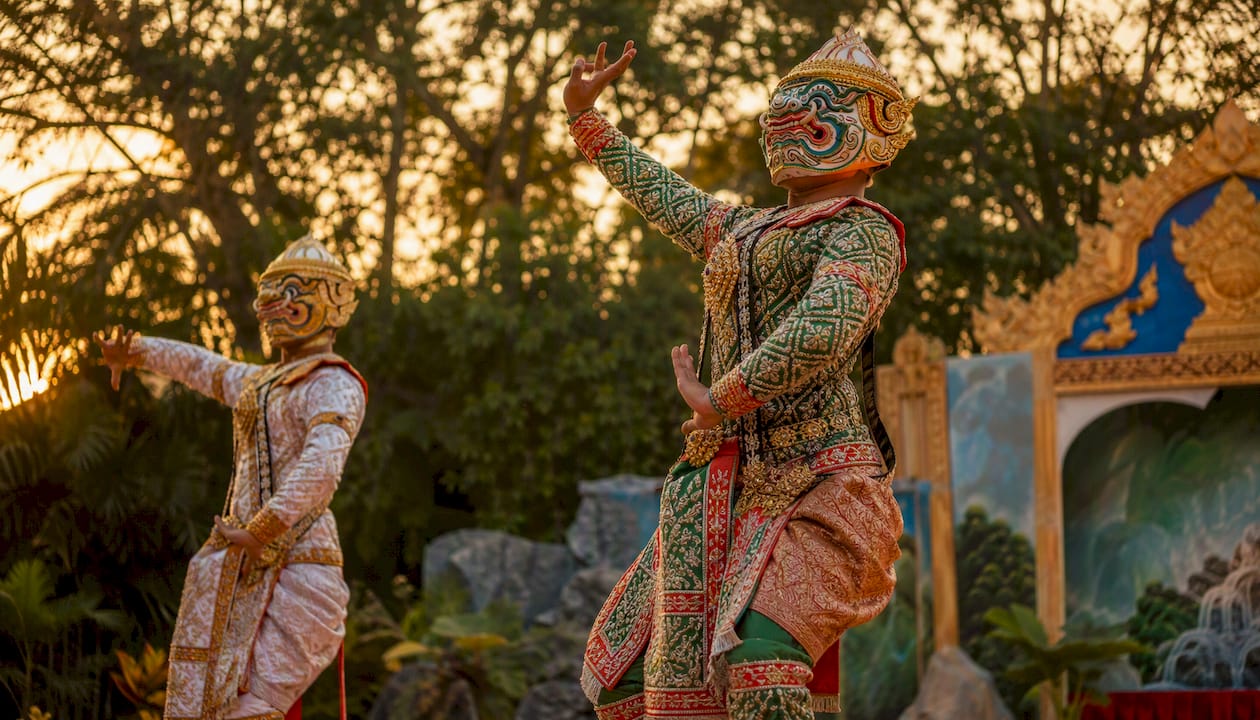
Classical dance (Khon and Lakhon): Khon is the masked dance-drama based on the Ramakien, Thailand’s version of the Hindu Ramayana epic. Every gesture is codified: a specific hand position means a specific emotion or action. Lakhon is a more lyrical court dance form. Both are performed at major cultural venues in Bangkok and at temple festivals across the country.
Shadow puppetry (Nang Talung and Nang Yai): Nang Talung is the southern tradition, using smaller articulated puppets behind a backlit screen. Nang Yai uses larger, non-articulated figures and is associated with central Thailand. Both forms tell stories from the Ramakien and local folklore.
Muay Thai: More than a combat sport, Muay Thai carries a ritual dimension. Fighters perform the wai kru ram muay before each bout — a ceremonial dance that honors their teachers and invokes protection. The Thai government includes Muay Thai in its 5F cultural policy as a distinct cultural export alongside food and festivals.
Temple architecture: A Thai wat (temple complex) typically contains several distinct structures. The bot (ordination hall) is the most sacred, where monks are ordained. The wihan (assembly hall) is where laypeople gather. The chedi (stupa) holds relics and rises in a pointed spire. Decorative elements — Naga serpents along staircases, Garuda figures on walls, gilded spires — all carry specific religious symbolism.
“The Historic City of Ayutthaya and the Historic Town of Sukhothai are both UNESCO World Heritage Sites, preserving the architectural and artistic legacy of Thailand’s two most influential early kingdoms.”
For learners who want vocabulary tied to these art forms, the Thai folk arts and crafts vocabulary guide is a practical starting point.
Practical tips every traveler to Thailand should know
What to pack and wear:
- Lightweight, modest clothing that covers shoulders and knees — you’ll need it for temples, and it’s more comfortable in the heat than shorts and tank tops.
- A small scarf or sarong, useful for impromptu temple visits.
- Slip-on shoes — you’ll be removing them constantly.
- A small bag for your shoes when visiting temples (some don’t have storage).
- Sunscreen, a reusable water bottle, and a power adapter (Thailand uses Type A/B/C outlets, 220V).
Money etiquette: Always handle money respectfully — don’t stuff notes into pockets carelessly or place them on the floor. Tipping is appreciated but not mandatory; 20–50 Thai baht is standard at restaurants. Bargaining is normal at markets but not at fixed-price shops or malls.
Safety basics for women travelers: Thailand is generally considered safe for solo women travelers, but standard precautions apply. Dress modestly, particularly outside tourist areas. Avoid accepting rides from unmarked vehicles. In the south, be aware of regional security advisories from your government before traveling to border provinces.
Photography rules: Always ask before photographing individuals, especially monks, hill tribe communities, and people at religious ceremonies. At royal palaces and some temple interiors, photography is restricted — follow posted signs.
Essential Thai phrases for travelers:
- Sawasdee krap/ka (สวัสดีครับ/ค่ะ) — Hello/Goodbye (krap for men, ka for women)
- Khob khun krap/ka (ขอบคุณครับ/ค่ะ) — Thank you
- Mai pen rai (ไม่เป็นไร) — No problem / Never mind
- Chai (ใช่) — Yes
- Mai chai (ไม่ใช่) — No
- Tao rai? (เท่าไร?) — How much?
- Pet nit noi (เผ็ดนิดหน่อย) — A little spicy
- Hong nam yoo tee nai? (ห้องน้ำอยู่ที่ไหน?) — Where is the bathroom?
- Pood Thai mai dai (พูดไทยไม่ได้) — I can’t speak Thai (useful for setting expectations)
- Khaw toht (ขอโทษ) — I’m sorry / Excuse me
Pro Tip: Thai is a tonal language — the same syllable spoken in five different tones means five different things. For pronunciation, listen to native speakers on YouTube or a language app before your trip, and focus on getting the tones of your most-used phrases right. Even an imperfect attempt in Thai is received warmly; the effort signals respect.
Why does learning Thai deepen your cultural understanding?
Language and culture aren’t parallel tracks — they’re the same track. The Thai language encodes the values described earlier in this guide. The polite particles krap and ka aren’t just filler; they signal gender, formality, and respect simultaneously. The word kreng jai has no direct English equivalent because the concept it describes doesn’t map cleanly onto Western social norms. You can read about it, but you understand it differently once you’ve used it in a real conversation.
AFS USA’s cultural guide to Thailand notes that even short conversational ability opens interactions that reveal local practices and perspectives not visible to casual observers. A visitor who can ask a market vendor about an ingredient, or thank a temple monk in Thai, gets a qualitatively different experience than one who communicates only through gestures and translation apps.
The practical benefits for travelers and learners:
- Reading Thai script lets you navigate menus, signs, and transport systems independently.
- Knowing polite speech levels helps you address elders, officials, and service staff correctly.
- Understanding cultural vocabulary (sanuk, kreng jai, wai) gives you a framework for interpreting behavior that would otherwise seem confusing.
- Speaking even basic Thai signals respect, and that signal opens doors — to conversations, to invitations, to the parts of Thailand that don’t appear in guidebooks.
For adult learners who want structured progress, Thai Explorer’s courses combine language instruction with cultural context, covering exactly the kind of real-world communication situations described throughout this guide. The curriculum is aligned with CU-TFL (Chulalongkorn University Proficiency Test of Thai as a Foreign Language) standards, which means your progress is measured against a recognized benchmark rather than an arbitrary internal scale.
Pro Tip: Don’t wait until you’re fluent to use Thai. Start with the ten phrases in the practical tips section above, use them on your trip, and notice how people respond. That feedback loop — trying, getting a reaction, adjusting — is the fastest cultural education available.
Key Takeaways
Thailand’s culture is most accessible to travelers and learners who understand its core values first — everything else, from etiquette to festivals to food, flows from the same Buddhist, animist, and social foundations.
| Point | Details |
|---|---|
| Core values drive behavior | Sanuk, mai pen rai, kreng jai, and face-saving explain most social interactions you’ll encounter. |
| Buddhism is everywhere | Over 40,000 temples serve as community centers; daily merit-making shapes the rhythm of life. |
| Two festivals to know | Songkran (mid-April) and Loy Krathong (November full moon) are the cultural anchors of the year. |
| Etiquette has hard rules | Never touch the head, never point feet at people or sacred objects, always remove shoes at temples. |
| Thai Explorer for learners | Thai Explorer’s adult courses in Singapore pair language instruction with cultural context, aligned to CU-TFL standards. |
Why cultural curiosity is the best travel tool you have
Most travel mistakes in Thailand aren’t about breaking rules — they’re about missing context. A tourist who steps back from a monk on a bus isn’t being cold; they’re following a rule that women don’t touch monks. A vendor who smiles when you complain about a wrong order isn’t being dismissive; they’re managing the situation without anyone losing face. Once you understand the logic underneath the behavior, the whole country becomes more legible.
The travelers who get the most out of Thailand are the ones who arrive curious rather than certain. They ask before photographing. They watch the wai exchange before attempting one. They try a phrase in Thai and laugh when they get the tone wrong. That posture — humble, attentive, willing to look a little foolish — is exactly what Thai social values reward. Nam jai, generosity of spirit, tends to be returned in kind.
One concrete suggestion: before your trip, spend an hour with a cultural briefing (the Thailand Foundation’s materials are a good starting point) and learn five phrases. Not ten, not twenty. Five, spoken with correct tones. That small investment signals more respect than a week of careful shoe removal.
Thai Explorer brings language and culture together for adult learners
Understanding Thailand’s culture is one thing. Being able to participate in it — to greet someone correctly, order food with the right level of politeness, or navigate a temple conversation — requires the language. That’s the gap Thai Explorer closes.
Thai Explorer offers adult Thai language courses in Singapore in group, private, and online formats, all taught by bilingual native Thai instructors. The curriculum goes beyond vocabulary lists: lessons are built around real communication situations, with cultural context woven into every unit. Whether you’re preparing for a trip, working with Thai colleagues, or simply want to engage more deeply with the culture, the courses are structured to get you speaking and understanding quickly.
Courses are aligned with CU-TFL standards, so your progress is benchmarked against a recognized international framework. Classes are held at 10 Anson Road, #22-07, International Plaza, Singapore 079903, right above Tanjong Pagar MRT, with online Zoom options for learners who prefer flexibility. Find the right class format for your goals, or go straight to the course page to see current schedules and enrollment options.
Useful sources
The following sources were used throughout this guide and are recommended for further reading:
- Culture of Thailand – Wikipedia
- Buddhism in Thailand – Wikipedia
- PM trumpets soft power of Thai delights — Bangkok Post
- Thai Values: The Heart of Thainess — Thailand Foundation (PDF)
- The Thai Wai: A guide to greeting with grace — Trunk Travel
- Thailand: Exploring Thai culture and customs — AFS USA
- Culture of Thailand — EveryCulture
- The best cultural experiences in Thailand — Culture Trip
FAQ
What are the main dos and don’ts in Thai culture?
Remove shoes before entering temples and homes, return a wai greeting, and always handle money and food with respect. Never touch anyone’s head, point your feet at people or sacred objects, or criticize the monarchy — lèse-majesté laws are strictly enforced.
What happens at 6 PM in Thailand?
At 6 PM (and 8 AM) daily, the Thai national anthem plays on public radio and television, and in public spaces such as train stations and parks. People are expected to stop and stand still as a sign of respect.
What is Thailand like for a woman traveling solo?
Thailand is generally considered safe for solo women travelers, though modest dress — particularly outside tourist areas and at religious sites — is both a cultural expectation and a practical precaution. Standard urban safety awareness applies, and government travel advisories should be checked before visiting the southern border provinces.
What counts as disrespect in Thai culture?
Touching someone’s head, pointing feet at a person or Buddha image, raising your voice in public, and any negative commentary about the monarchy are the most serious forms of disrespect. Causing someone to lose face publicly — through criticism, confrontation, or visible frustration — is also considered a significant social harm.
How does learning Thai improve cultural understanding?
Even basic Thai phrases signal respect and open conversations that translation apps can’t replicate. The language encodes cultural values directly — polite particles, speech levels, and words like kreng jai have no clean English equivalent, so learning them builds genuine cultural fluency rather than surface familiarity.