
Start with a 30-day tones-and-speaking sprint, then layer in script study and structured lessons for months 2–12. That single sequence, backed by research from HelloTalk, is the fastest route to conversational Thai for an online learner starting from zero.
Your first three actions, doable today:
- Download ThaiPod101 or open Talk In Thai on YouTube for your first 15 minutes of audio exposure.
- Sign up for HelloTalk or a similar language-exchange app to get real tone feedback from native speakers within days.
- Block 15–30 minutes daily in your calendar, labeled “Thai.” Consistency at low volume beats long weekend sessions every time.
Quick-start toolkit:
- Listening: ThaiPod101 (free tier) or Talk In Thai (YouTube, free)
- Tone feedback: HelloTalk language exchange (free)
- Structured lessons: Thai with Nariss beginner guides (free) or LingoHut (free)
Key Takeaways
Learning Thai online works best when you sequence tones before vocabulary, use free audio resources daily, and add live tutor feedback at the 2–3 month mark when self-study alone stops producing gains.
| Point | Details |
|---|---|
| Start with tones, not vocabulary | Spend your first 30 days on the five Thai tones before heavy word memorization to avoid relearning errors later. |
| 15–30 min daily beats long sessions | Consistent short practice produces measurable milestones (greetings, ordering, numbers) faster than sporadic long blocks. |
| Learn script by week 3–6 | Introduce Thai script after basic tones are stable; romanization habits compound pronunciation errors the longer they persist. |
| Best free starting resources | ThaiPod101 (audio/structured), LingoHut (zero cost), HelloTalk (tone feedback), and thai-language.com (pronunciation reference). |
| Thai Explorer for guided progress | Thai Explorer’s CU-TFL-aligned Zoom classes with bilingual native instructors are the recommended step when self-study plateaus. |
Table of Contents
- How to learn Thai online: your 0–12 month roadmap
- Free and low-cost online resources accessible from Singapore
- How to practice speaking and tones every day without a tutor
- Should you learn the Thai script now or later?
- What the research actually says about learning Thai faster
- When is it worth paying for a course or tutor?
- A note from Thai Explorer on learning Thai online
- Thai Explorer online classes for adult learners in Singapore
- Sources
- FAQ
How to learn Thai online: your 0–12 month roadmap
A realistic plan maps time to outcomes, not just topics. Here is what consistent effort actually produces, based on practical guidance from Thai with Nariss and teacher-reported milestones.
Month 1: the 30-day tones sprint
Thai has five tones: mid, low, falling, high, and rising. Mispronouncing them changes the word entirely. Spend your first month on nothing but tones and survival speaking.
Daily tasks (15–30 minutes):
- Days 1–7: Learn the five tones using audio loops. Mimic, record yourself, compare.
- Days 8–14: Add 20–30 high-frequency words (greetings, numbers 1–10, yes/no, thank you). Attach each to its correct tone.
- Days 15–21: Practice 5–10 survival phrases out loud daily. Send a voice note to a language partner for feedback.
- Days 22–30: Hold a 1-minute scripted exchange (greeting, name, where you’re from). Record it. That recording is your baseline.
Milestone check: Can you say “hello,” “thank you,” “how much,” and your name with correct tones? A native speaker should understand you without guessing.
Months 2–3: script, vocabulary, and short conversations
Add Thai script reading during this phase. You do not need to write yet, just recognize characters well enough to stop depending on romanization. Pair this with spaced repetition vocabulary work using Memrise or Anki community decks.
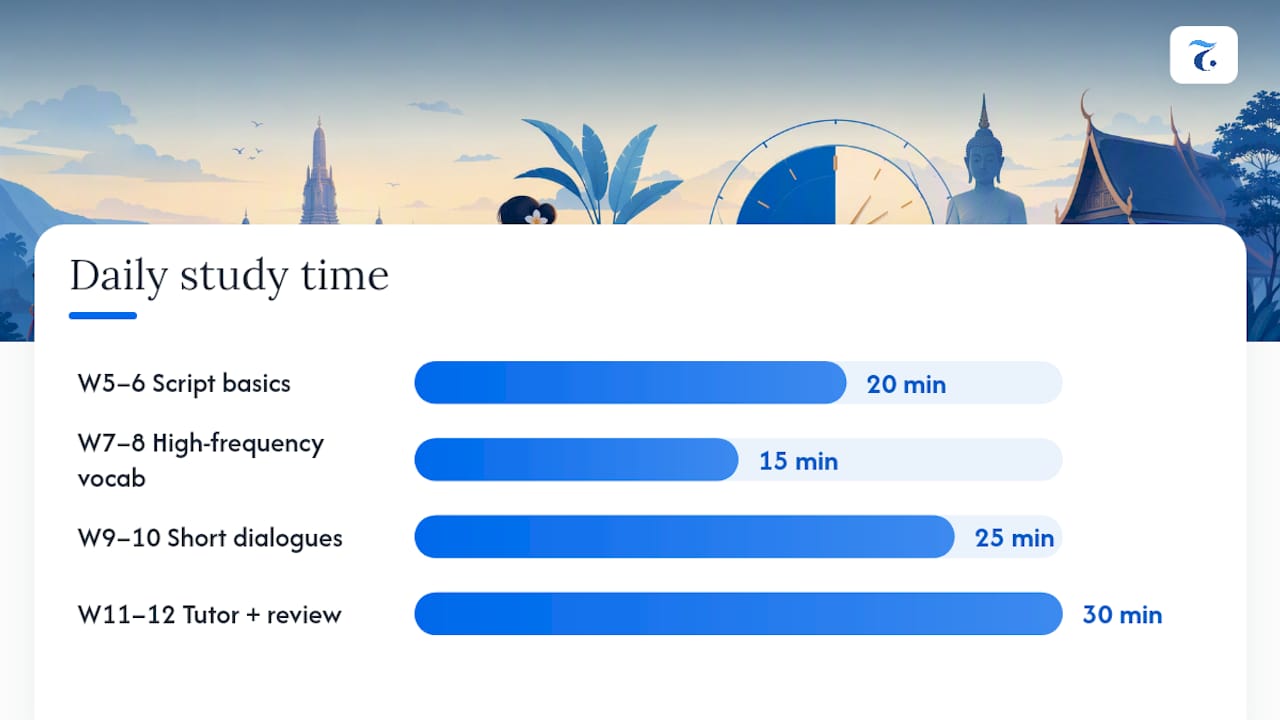
| Week | Focus | Daily time | Target outcome |
|---|---|---|---|
| 5–6 | Consonants + vowels (script basics) | 20 min | Recognize 30+ characters |
| 7–8 | High-frequency vocab (SRS) | 15 min | 150 words retained |
| 9–10 | Short dialogues (ordering food, directions) | 25 min | 3-minute conversation |
| 11–12 | Mixed review + first tutor session | 30 min | Tone correction from native speaker |
Months 3–12: structured course work and expanding topics
From month 3 onward, add a structured course (ThaiPod101, Glossika, or a live instructor via italki) to push past the plateau that kills most self-learners. Expand topics in this order: travel and transport, food and shopping, work and professional contexts, social and cultural topics.
Measurable targets by month 12:
- Hold a 5-minute unscripted conversation on a familiar topic
- Read a short restaurant menu without a dictionary
- Understand 60–70% of a slow Thai podcast episode
Sample weekly schedule (30 min/day):
- Monday/Wednesday/Friday: Audio listening + shadowing (15 min) + SRS flashcards (15 min)
- Tuesday/Thursday: Speaking practice with a language partner or tutor (30 min)
- Saturday: Structured lesson or course module (30 min)
- Sunday: Thai media (YouTube, music, short clips) with no pressure
Free and low-cost online resources accessible from Singapore
Course roundups consistently show that combining audio-focused practice with tutor feedback and spaced repetition produces the best results for busy adult learners. Here is a categorized breakdown of what works and what each tool is actually good for.
Listening and audio
ThaiPod101 is the most complete audio-first resource for Thai. Lessons are structured by level (absolute beginner through advanced), delivered by native speakers, and organized around real dialogues. The free tier gives access to a solid library; the paid subscription unlocks transcripts, vocabulary lists, and a spaced repetition system. Best for: structured listening, beginner to intermediate. Format: audio/video lessons. Available in Singapore: yes.
Talk In Thai (YouTube channel) offers free video lessons from native Thai instructors covering pronunciation, vocabulary, and cultural context. No subscription needed. Best for: listening immersion and cultural insight. Format: video. Level: beginner to intermediate.
Pimsleur uses a proven audio-only method built on spaced repetition and recall prompts. Sessions run 30 minutes each and require no screen time, which suits commuters. It is subscription-based, but a free trial is available. Best for: listening and speaking simultaneously. Level: beginner.
Glossika takes a sentence-mining approach: you hear thousands of Thai sentences at natural speed, repeat them, and build fluency through volume. It is paid (subscription), but effective for intermediate learners who have basic tones down. Best for: fluency drilling and listening at natural pace. Level: intermediate.
Spoken practice and tutor marketplaces
italki is the fastest way to get tone correction from a real person. You book one-on-one sessions with community tutors (lower cost) or professional teachers (higher cost). Per-lesson pricing means no long-term commitment. Best for: speaking and tone feedback. Format: live video. Available in Singapore: yes.
HelloTalk connects you with native Thai speakers for free text and voice exchanges. The voice-note feature is particularly useful for tone practice. Best for: daily speaking habit and informal feedback. Format: messaging/voice. Cost: free with optional premium.
SRS and vocabulary apps
Memrise uses spaced repetition with video clips of native speakers saying words in context. The Thai course covers core vocabulary with audio. Best for: vocabulary retention. Format: app. Cost: freemium. Level: beginner to intermediate.
uTalk focuses on spoken vocabulary through a game-style interface with native-speaker audio. It covers around 150 topics and works well for travel-focused learners. Best for: topic-specific vocabulary. Cost: one-time purchase or subscription. Level: beginner.
LingoHut offers completely free Thai lessons organized by topic, with audio. No account required. Best for: zero-cost vocabulary and phrase building. Format: web-based. Level: absolute beginner.
Structured courses
Mango Languages provides structured Thai courses with grammar notes, cultural context, and audio. It is available through some Singapore public library memberships, which means it may be free depending on your library access. Best for: grammar and structured progression. Level: beginner to intermediate.
Talk In Thai (course platform, separate from the YouTube channel) offers downloadable PDF lessons and structured modules. Low cost compared to live tutoring.
A note on Duolingo: Duolingo does not currently offer Thai. Learners expecting a Duolingo-style experience should use Memrise, uTalk, or LingoHut as the closest free alternatives.
Dictionaries and reference
thai-language.com is a free searchable dictionary with audio pronunciation clips for every entry. It is the go-to reference for checking tones on unfamiliar words and for learners beginning to read script. Use it alongside any course as a pronunciation check.
Pro Tip: For your first week, use ThaiPod101’s free “Absolute Beginner” series for listening and thai-language.com for pronunciation checks. That combination costs nothing and covers the two skills that matter most at the start.
How to practice speaking and tones every day without a tutor
The biggest mistake online learners make is treating Thai as a reading subject. Thai is a tonal language, and your ear needs daily training. Here is how to build that habit without paying for lessons every session.
Ear-training drills
Minimal-pair practice is the most efficient tone drill available. A minimal pair in Thai is two words that differ only in tone, like “maa” (horse) and “maa” (come). Find a list of five to ten minimal pairs, record a native speaker saying them (ThaiPod101 audio or thai-language.com clips), and play them back in short loops until you can identify each tone reliably. Then record yourself saying the same pairs and compare.
Do this for 10 minutes daily for two weeks. By day 14, your ear will catch tone errors your mouth is still making, which is exactly the feedback loop you need.
Shadowing routines
Shadowing means speaking along with a native speaker in real time, matching their rhythm, speed, and pitch. Pick a ThaiPod101 dialogue or a Talk In Thai clip of 30–60 seconds. Play it once to listen. Play it again and speak along. Repeat five times per session.
The goal is not perfect pronunciation on day one. The goal is training your mouth to move at Thai speed. Three sessions per week of 15 minutes each produces noticeable gains within a month.
Getting tone feedback from language partners
Send a 30-second voice note to your HelloTalk partner with a specific request: “Can you tell me which words have the wrong tone?” That specificity matters. A vague “how does my Thai sound?” gets a polite “good job.” A targeted question gets real correction.
Rotate your voice-note topics: greetings one day, numbers the next, a short self-introduction the day after. Keep each note short enough that a partner can actually listen and respond.
Pro Tip: Ask your language partner to repeat your sentence back to you with the correct tones immediately after your voice note. Hearing the corrected version right after your own attempt is the fastest tone-correction loop available for free.
For a deeper dive into listening drills structured for adult learners, the Thai listening practice guide covers session formats and resource combinations worth bookmarking.
Should you learn the Thai script now or later?
The honest answer: learn it earlier than you think you need to. Romanization (transliteration) is a crutch that actively slows pronunciation accuracy because it maps Thai sounds onto English letter patterns that do not match. The longer you rely on it, the more you have to unlearn.
That said, do not start with the script on day one. Spend your first two to four weeks on tones and spoken frames first. Once you can hear the five tones reliably, script study reinforces pronunciation rather than confusing it.
Tradeoffs at a glance
Learn script early (weeks 3–6):
- Pros: Correct pronunciation from the start, independence from romanization, access to Thai media and signage
- Cons: Slower initial vocabulary growth, steeper early learning curve
Delay script (months 2–3+):
- Pros: Faster early speaking progress, less cognitive load at the start
- Cons: Romanization habits become harder to break, pronunciation errors compound
Duke Language’s guide for foreigners recommends building listening and speaking first, then adding reading when sound patterns feel familiar. That sequencing works well for most adult learners.
A four-week script action plan
- Week 1: Learn the 44 Thai consonants in groups of 10 per day using flashcards. Focus on recognition, not writing.
- Week 2: Add the vowel forms (short and long). Practice reading simple consonant-vowel combinations.
- Week 3: Read words you already know spoken Thai for. Seeing “สวัสดี” (sawatdee) in script after you can say it correctly locks in the connection fast.
- Week 4: Read short menus, signs, or LingoHut lessons in Thai script without romanization support.
For sentence-level grammar to pair with your script reading, the Thai grammar beginner guide is a practical A1 reference.
What the research actually says about learning Thai faster
Three evidence-based principles separate learners who plateau from those who reach conversational Thai within a year.
Tones first, vocabulary second. Chulalongkorn University’s guidance recommends starting with pronunciation fundamentals before heavy vocabulary work. Treating Thai as a musical system first, practicing the five tones through a small set of words, reduces total relearning later. Learners who skip this step often spend months 4–6 correcting tone errors that were baked in during months 1–3.
Build sentences in Thai, not translations. Constructing sentences directly in Thai, rather than translating from English, accelerates natural fluency. The mental habit of reaching for a Thai frame (“I want + noun” rather than “I want to say ‘I want’ in Thai”) is the difference between a learner who sounds natural and one who sounds like a walking dictionary.
Daily short sessions beat long weekend blocks. Consistent 15–30 minute sessions produce measurable beginner milestones (greetings, numbers, ordering food) faster than sporadic longer ones. The mechanism is simple: sleep consolidates language memory, so daily exposure gives your brain more consolidation cycles per week.
“Making Thai part of daily life, even in small ways, converts passive learning into durable skill faster than long isolated study sessions.” This principle, drawn from Chulalongkorn University’s practical guidance for foreign learners, applies directly to online self-study: integrate Thai into menus, short messages, and micro-conversations from week one, not month three.
Sentence mining and chunking. Instead of memorizing isolated words, learn phrases as chunks: “ขอบคุณครับ” (thank you, male speaker) as a single unit, not three separate words. Glossika’s sentence-repetition method is built on this principle. For self-study, pull example sentences from ThaiPod101 lessons and add them to an Anki deck as complete units.
When is it worth paying for a course or tutor?
Self-study gets you surprisingly far. But there are clear signals that free resources alone are no longer the fastest path.
Signs you need paid help:
- You have been studying for 6–8 weeks and native speakers still cannot understand your tones
- You are plateauing on vocabulary but have no one to practice sentences with
- You need Thai for professional or business communication, where errors carry real consequences
- You want a structured curriculum with assessment rather than a patchwork of apps
Questions to ask before you pay
- Does the instructor have experience teaching adult learners (not just children)?
- Can you see a sample lesson or attend a trial session before committing?
- How does the instructor give feedback on tones specifically?
- Is there an assessment or progress check built into the course?
- What is the cancellation or pause policy?
Red flags to avoid:
- No sample lesson or trial option
- Claims like “fluent in 30 days” with no methodology behind them
- Courses with no native-speaker audio or feedback component
- Tutors who only correct grammar but never address tone errors
Pricing shapes for Singapore learners
Community tutors on italki typically charge less per session than professional teachers, making a short 4–8 lesson block affordable for targeted tone correction. Subscription-based platforms like ThaiPod101 and Glossika cost less per month than a single private lesson but offer no live feedback. A short paid period with a live instructor, used specifically to fix persistent tone or pronunciation errors, is often the most cost-effective move a self-learner can make at the 2–3 month mark.
For a broader view of what structured group learning adds to self-study, the role of group classes in language learning is worth reading before you decide between group and private options.
A note from Thai Explorer on learning Thai online
Teaching adult learners in Singapore, both in person and via Zoom, we see the same pattern repeatedly: learners who spend their first month on tones and spoken frames arrive at their first structured lesson ready to build, not repair. The free resources in this guide are genuinely useful. But the jump from “I can say a few phrases” to “I can hold a real conversation” almost always happens faster with a native instructor who can hear what you cannot hear in your own voice.
If you are working toward conversational Thai for travel, social use, or professional contexts, a trial lesson is the lowest-risk way to find out where your gaps actually are.
Thai Explorer online classes for adult learners in Singapore
Thai Explorer offers structured online Thai courses via Zoom for adult learners at all levels, from absolute beginner through business Thai. Classes are taught by bilingual native Thai instructors and follow a curriculum aligned with CU-TFL standards, covering speaking, listening, reading, and writing in a sequence that mirrors the study plan in this guide.
What you get with Thai Explorer online classes:
- Trial lesson available before full enrollment
- Group, private, and corporate Zoom class formats
- Flexible scheduling suited to working adults
- CU-TFL-aligned curriculum with built-in assessment modules
- Cultural context woven into every lesson, not treated as an add-on
- Bilingual instructors (Thai and English) for clear explanation without guesswork
Whether you are starting from zero or fixing a plateau after months of self-study, find the right class format for your level and schedule. Thai Explorer is based at 10 Anson Road, #22-07, International Plaza, Singapore 079903, right above Tanjong Pagar MRT, with online classes available to learners anywhere.
Sources
- Learning Thai: A Comprehensive Guide for Foreigners Interested in Studying Thai Language in Thailand – Chulalongkorn University
- How to Start Learning Thai: A Beginner Plan for Today – HelloTalk
- How to Learn Thai: A Beginner’s Guide | Thai with Nariss
- 11 Best And Worst Online Thai Courses For 2026
- The Complete Guide to Learning Thai for Foreigners | Thai Language School Bangkok | Duke Language
FAQ
Can I learn Thai by myself online?
Yes. Free resources like ThaiPod101, LingoHut, HelloTalk, and thai-language.com cover listening, vocabulary, and tone feedback well enough to reach basic conversational Thai independently. Most self-learners benefit from adding a live tutor for a short block at the 2–3 month mark to correct persistent tone errors.
Is Thai hard to learn for English speakers?
Thai’s tonal system and script are genuinely unfamiliar to English speakers, but the grammar is simpler than many European languages: no verb conjugation, no gendered nouns, no plural forms. With consistent daily practice of 15–30 minutes, beginner milestones are reachable within 30–90 days.
Where can I learn Thai for free online?
LingoHut offers completely free structured Thai lessons with audio. ThaiPod101 has a free tier with beginner audio lessons. Talk In Thai on YouTube is free. HelloTalk is free for language exchange. thai-language.com is a free pronunciation dictionary. Mango Languages may be free through Singapore public library access.
Does Duolingo have Thai?
Duolingo does not currently offer a Thai course. The closest free alternatives with a similar app-style format are Memrise and uTalk for vocabulary, or LingoHut for structured free lessons.
How long does it take to speak basic Thai?
With 15–30 minutes of focused daily practice, most adult learners can handle survival conversations (greetings, ordering food, basic directions) within 30–90 days. Holding a 5-minute unscripted conversation on a familiar topic typically takes 6–12 months depending on study intensity and how much live speaking practice is included.