
Start with your ears, not a textbook. The single most effective first move for any English speaker learning Thai is training your ear and voice to recognize the language’s five tones while building a working set of high-frequency phrases. Everything else follows from that foundation.
Here is the three-step roadmap this guide is built around:
- Tone and pronunciation drills — train your ear and mouth before anything else
- High-frequency spoken phrases and basic particles — build real sentences you can use immediately
- Script introduction and reading practice — unlock pronunciation accuracy and reduce dependence on romanization
Thai has 44 consonants and 32 vowels, and its tonal system means a single syllable can carry five completely different meanings depending on pitch. Structured programs aligned with the CU-TFL (Chulalongkorn University Proficiency Test of Thai as a Foreign Language) standard sequence instruction in exactly this order: sound mastery first, then sentence structure, then cultural and conversational depth.
Key Takeaways
Teaching Thai to English speakers works best when tone training comes first, the script is introduced early, and structured corrective feedback is built into the routine from the start.
| Point | Details |
|---|---|
| Tones come first | Train your ear and voice on all five tones before focusing on vocabulary or grammar. |
| Script pays off early | Two to four weeks of daily script study removes dependence on inconsistent romanization. |
| Combine methods | Pair SRS vocabulary review with tutor-led tone correction and regular listening practice. |
| Realistic timeline | Travel-level functional Thai takes 3–4 months with focused daily practice. |
| Thai Explorer | Structured adult courses (group, private, online) with CU-TFL-aligned curriculum and bilingual native instructors. |
Table of Contents
- Teaching Thai to English speakers: why the language feels so different
- A simple 3-step roadmap for English speakers learning Thai
- Practical tone and pronunciation exercises you can start today
- Should you learn the Thai script? Pros, cons, and a starter plan
- Core grammar patterns and the particles English speakers need first
- High-frequency phrases and vocabulary to memorize first
- Which study methods actually work for English speakers
- How long does it take? A realistic timeline and 12-week plan
- What a structured adult course actually delivers
- What I actually think beginners get wrong about learning Thai
- Thai Explorer: structured adult Thai courses for every learning goal
- Sources
- FAQ
Teaching Thai to English speakers: why the language feels so different
Thai sits in a genuinely unfamiliar category for most English speakers. It is not just a new vocabulary set dropped onto familiar grammar. The structural differences between Thai and English run deep enough that the usual language-learning instincts — look for cognates, guess from context, rely on spelling — mostly fail here.
The five tones are the most immediate wall. In Thai, the syllable mai can mean “new,” “burn,” “wood,” “not,” or serve as a question marker depending on whether the pitch is mid, low, falling, high, or rising. English uses pitch for emotion and emphasis, never to change a word’s dictionary meaning. That rewiring takes deliberate practice.
The script adds another layer. Thai uses an abugida writing system where vowel marks appear above, below, before, and after consonants, and where the consonant class (high, mid, or low) determines which tone a syllable carries. That sounds complicated, and initially it is. But it also means the script encodes tone information directly — something romanization systems cannot do consistently.
Where Thai grammar actually gets easier:
- No verb conjugation for tense — time is expressed through context words like mêua waan níi (yesterday) or prûng níi (tomorrow)
- No grammatical gender on nouns
- No plural inflection — quantity is shown through numbers and classifiers
- Word order is largely Subject-Verb-Object, similar to English
Where it gets harder:
- Five tones that change meaning entirely
- 44 consonants organized into three tone-class groups
- Vowel marks that surround consonants in multiple positions
- Classifiers required when counting objects (a different word for flat objects, animals, people, and so on)
- Polite particles (kráp for men, kâ for women) expected in almost every spoken sentence
The practical implication: spend your first weeks on sound, not grammar. Thai grammar is learnable in a few months. Thai tones take longer to internalize, and getting them wrong early builds habits that are hard to undo.
A simple 3-step roadmap for English speakers learning Thai
Structured Thai instruction, as outlined by Chulalongkorn University’s language curriculum, moves from sound mastery to sentence structure to cultural application. That sequence is not arbitrary. Here is how to apply it as a beginner.
Step 1: Tone and pronunciation foundation (weeks 1–4)
Your only job in the first month is to hear and produce the five tones reliably. Use audio-first resources, not text. Listen to minimal pairs — syllables that differ only in tone — and repeat them until the difference feels automatic.
Daily schedule for this stage (30 minutes):
- 10 minutes: listen to and shadow native audio (short phrases, not isolated syllables)
- 10 minutes: minimal-pair tone drills
- 10 minutes: record yourself and compare to the original
Step 2: Spoken fluency with phrases, particles, and core patterns (weeks 5–12)
Once you can reliably distinguish the five tones, start building sentences. Focus on:
- a set of high-frequency phrases for greetings, ordering food, asking directions, and basic shopping
- Polite particles: kráp (male speaker) and kâ (female speaker) at the end of sentences
- Simple SVO sentence patterns with time markers instead of tense
- Negation (mâi) and question formation (mǎi or rěu)
Daily schedule for this stage (45 minutes):
- 15 minutes: spaced repetition vocabulary review (apps like Anki work well here)
- 15 minutes: speaking practice — role-play a scenario (ordering coffee, asking the price)
- 15 minutes: listening to short Thai audio or dialogue
Step 3: Script introduction and reading practice (weeks 9–16, overlapping with Step 2)
Start the script in week 9, not week 1. By then your ear is trained enough that the script’s tone-class system will make sense rather than feel abstract. Learning the script in logical consonant groups — high-class, mid-class, low-class — and pairing each group with its tone rules helps you read real words faster than rote alphabet memorization.
Daily addition for this stage (20 minutes):
- 10 minutes: consonant and vowel mark recognition drills
- 10 minutes: reading simple real-world text (menus, signs, product labels)
Practical tone and pronunciation exercises you can start today
Perceptual training on minimal sound contrasts is one of the most evidence-backed methods for helping non-native listeners perceive and produce new phonetic distinctions. For Thai, that means drilling tone pairs until your brain stops treating them as the same sound.

Six minimal-pair tone drills to practice now
Work through these pairs with a native audio source or a tutor. Say each one aloud, then listen back:
- maa (mid tone, “to come”) vs. mâa (falling tone, “horse”)
- kâao (falling tone, “rice/white”) vs. kǎao (rising tone, “news”)
- sǔan (rising tone, “garden”) vs. sùan (low tone, “part/portion”)
- nǎa (rising tone, “face/front”) vs. nâa (falling tone, “aunt/uncle, mother’s younger sibling”)
- mǎi (rising tone, question particle) vs. mâi (falling tone, “not/no”)
- pâa (falling tone, “forest”) vs. páa (high tone, “to throw”)
Four drills to build into your daily routine
- Shadowing: Play a short Thai sentence, pause, repeat it at the same speed and pitch. Do not read along — listen and mimic.
- Tone-ladder drill: Take one syllable and say it in all five tones in sequence. Record yourself. Compare to a native speaker’s version.
- Syllable-timed repetition: Thai is syllable-timed, not stress-timed like English. Clap once per syllable as you speak to break the English rhythm habit.
- Rising/falling isolation: Pick five words with rising tones and five with falling tones. Drill each set separately before mixing them.
Pro Tip: Record a 30-second clip of yourself reading the same five sentences each week. Play it back alongside native audio. The gap closes faster when you can hear it objectively — and you will notice tone errors your ear misses in real time.
For a structured set of exercises, the Thai tone drills at Thai Explorer give you ready-to-use practice routines with audio reference points.
Fitting this into daily life is simpler than it sounds. Use your commute for shadowing. Play Thai audio during meals. Even 10 minutes of focused minimal-pair work each morning compounds quickly over a month.
Should you learn the Thai script? Pros, cons, and a starter plan
The short answer: yes, and sooner than most beginners expect. The longer answer depends on your goals.
Reasons to learn the script early:
- The script encodes tone class directly — once you read it, you know which tone to use without guessing
- Romanization systems are inconsistent across textbooks, apps, and signs (the same word can appear three different ways)
- Reading menus, signs, and product labels becomes possible within a few weeks of focused study
- Pronunciation accuracy improves because you stop relying on romanization that was never designed to capture Thai sounds precisely
Reasons to defer the script:
- If your trip is under two weeks and your only goal is basic survival phrases, the time cost may not be worth it
- Early script study can feel discouraging if introduced before the learner has any spoken foundation
For most adult learners with a travel, work, or long-term residency goal, the script pays off within the first month. Short daily practice of 5–15 minutes focused on complete words and audio repetition can deliver early reading ability faster than most learners expect.
A 2–4 week script starter plan (20–30 minutes daily)
- Week 1: Learn the 21 mid-class and high-class consonants. These two groups cover the most common sounds and have the most predictable tone rules. Write each one five times and say it aloud.
- Week 2: Add the 24 low-class consonants. Focus on the ones that appear most frequently in everyday words. Pair each with a real word you already know spoken.
- Week 3: Introduce the most common vowel marks (short and long aa, ii, uu, ee, oo). Practice reading simple two-syllable words from menus or signs.
- Week 4: Add tone marks and practice reading short phrases. At this point, you should be able to sound out most Thai words, even if you do not know their meaning.
Core grammar patterns and the particles English speakers need first
Thai grammar is genuinely learner-friendly once you accept that tense does not exist as a verb form. Time is communicated through adverbs and context. The sentence structure is mostly SVO, close enough to English that basic sentences transfer quickly.
How tense works in Thai (without conjugation):
- chǎn kin khâao — “I eat rice” (present, habitual, or general)
- chǎn kin khâao mêua waan níi — “I ate rice yesterday” (add the time word, nothing changes on the verb)
- chǎn jà kin khâao — “I will eat rice” (add jà before the verb for future)
Essential particles and markers
| Particle | Function | Example |
|---|---|---|
| kráp (male) / kâ (female) | Polite sentence-ender | Khàawp khun kráp — “Thank you” |
| mâi | Negation (before verb) | Mâi pen rai — “Never mind / It’s okay” |
| mǎi | Yes/no question marker (end of sentence) | Aròi mǎi? — “Is it delicious?” |
| jà | Future marker (before verb) | Rao jà pai — “We will go” |
| lǽew | Completion / already (after verb) | Kin lǽew — “Already eaten” |
| yang | Not yet (with negation) | Yang mâi kin — “Haven’t eaten yet” |
Key points about classifiers:
- When counting objects, Thai requires a classifier between the number and the noun
- nǔeng khon (one person), sǎam tua (three animals), hâa bai (five flat/leaf-shaped objects)
- Beginners do not need to memorize all classifiers immediately — learn the five most common (khon, tua, bai, lêm, an) and use an as a fallback when unsure
High-frequency phrases and vocabulary to memorize first
The fastest path to functional Thai is a tight, prioritized phrase list. Memorize these before worrying about grammar rules.
Greetings and social basics:
- Sàwàt dii kráp/kâ — Hello / Goodbye
- Khàawp khun kráp/kâ — Thank you
- Mâi pen rai — Never mind / You’re welcome
- Khǒo thôot kráp/kâ — Excuse me / Sorry
- Chûe arai kráp/kâ? — What is your name?
- Phǒm/Chǎn chûe… — My name is… (male/female)
Travel and navigation:
- Pai… yàang rai kráp/kâ? — How do I get to…?
- Thâo rai kráp/kâ? — How much is it?
- Phæng pai nòi dâi mǎi? — Can you lower the price a little?
- Yùu thîi nǎi kráp/kâ? — Where is it?
- Kǒo bai sèt dâi mǎi kráp/kâ? — Can I have the bill?
Ordering food:
- Aròi mâak kráp/kâ — Very delicious
- Mâi sài phrik kráp/kâ — No chili, please
- Arai nǽenam kráp/kâ? — What do you recommend?
- Kǒo… nùeng thîi kráp/kâ — One [item], please
Basic business and professional:
- Nát phóp kráp/kâ — Nice to meet you
- Khun wâang mǎi kráp/kâ? — Are you available?
- Chûai phûut cháa cháa nòi dâi mǎi kráp/kâ? — Could you speak more slowly?
- Mâi khâo jai kráp/kâ — I don’t understand
Retention tips:
- Use spaced repetition (Anki decks work well) to review phrases at increasing intervals
- Practice each phrase in a full sentence, never as an isolated word
- Role-play one scenario per week (ordering food, asking for directions) until it feels automatic
- Prioritize by task: travel phrases first, then shopping, then professional greetings
Which study methods actually work for English speakers
The most common mistake beginners make is relying on a single resource. No app alone, no textbook alone, and no tutor alone covers everything Thai demands. The methods that produce the fastest results combine real conversation practice and immersion with structured, corrective feedback.
Resource types worth combining:
- Bilingual native tutor: the single highest-leverage resource for tone correction and natural phrasing. A tutor who speaks both Thai and English can explain why your tone is wrong, not just that it is.
- Audio-first lessons: listen before you read. Audio-first courses build the phonetic map your brain needs before script study makes sense.
- SRS vocabulary decks: Anki with Thai audio attached to every card. Review daily, even for 10 minutes.
- Graded readers and short dialogues: once you have 200–300 words, short dialogues give you grammar in context rather than in isolation.
- Thai-language: a detailed non-commercial reference for script, tone rules, and vocabulary — particularly useful when you hit a pronunciation question no app answers cleanly.
A sample weekly routine that works:
- Monday and Thursday: 60-minute tutor session focused on tone correction and new sentence patterns
- Tuesday, Wednesday, Friday: 20-minute SRS review + 15-minute shadowing from a short audio clip
- Saturday: 30-minute role-play practice (pick one scenario and run it until it feels natural)
- Sunday: 20-minute script reading from a real-world source (menu, sign, short article)
What to look for in a tutor or course:
- Native Thai speaker who is bilingual in English — they can explain the why, not just model the sound
- Explicit tone-training component in the curriculum, not just vocabulary lists
- Alignment with CU-TFL standards if you want a recognized proficiency benchmark later
- Regular corrective feedback sessions, not just conversation practice
For a step-by-step pronunciation curriculum that pairs well with tutor sessions, Thai Explorer’s pronunciation guide gives beginners a structured path from day one.
How long does it take? A realistic timeline and 12-week plan
Thai is genuinely harder for English speakers than most European languages. The U.S. Foreign Service Institute categorizes Thai as a Category IV language, requiring roughly 1,100 class hours for professional working proficiency. That number is for diplomatic-level fluency, not everyday conversation.
For practical purposes:
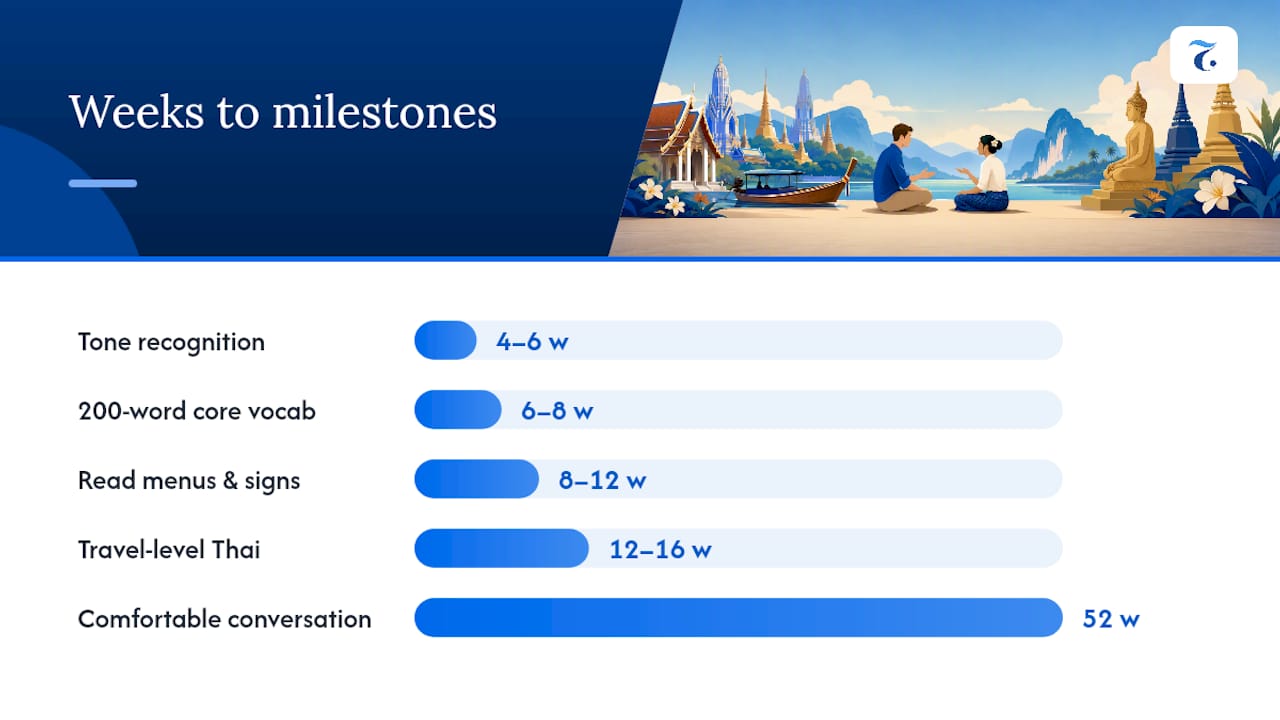
| Milestone | Realistic timeframe | What it looks like |
|---|---|---|
| Recognize all five tones reliably | 4–6 weeks with daily drills | You hear the difference between maa and mâa without effort |
| 200-word core vocabulary | 6–8 weeks with SRS | You can order food, ask prices, and greet people |
| Read menus and basic signs | 8–12 weeks with script study | You sound out words correctly even without knowing the meaning |
| Travel-level functional Thai | 3–4 months of focused practice | You handle most tourist situations with confidence |
| Comfortable daily conversation | 12 months for most learners | You follow fast speech and respond naturally |
A 12-week study plan
Weeks 1–3: Tone foundation
- Daily: 30 minutes of tone drills and shadowing
- Goal: reliably distinguish and produce all five tones in isolation and in simple words
Weeks 4–6: Core phrases and particles
- Daily: 45 minutes (15 SRS + 15 speaking + 15 listening)
- Goal: 50 phrases memorized, polite particles automatic, basic SVO sentences in use
Weeks 7–9: Script introduction
- Daily: add 20 minutes of consonant and vowel mark study
- Goal: read all consonants and the 10 most common vowel marks; sound out simple words
Weeks 10–12: Integration and real-world practice
- Daily: 45–60 minutes combining all three skills
- Goal: hold a 5-minute conversation on a familiar topic; read a short menu without romanization
What a structured adult course actually delivers
Self-study gets you started. A structured course gets you there faster and with fewer fossilized errors. The difference shows up most clearly in tone production — learners who study alone often develop consistent mispronunciations that feel correct to them because no one has corrected them.
Typical course formats and what each targets:
- Group classes: best for building conversational confidence and hearing how other learners make mistakes (which is instructive). Usually 6–12 students, two to three sessions per week.
- Private lessons: fastest for tone correction and personalized pacing. A tutor can focus entirely on your specific errors rather than the group’s average.
- Online Zoom classes: same curriculum as in-person, with the flexibility to study from anywhere. Particularly practical for professionals with irregular schedules.
What a CU-TFL-aligned curriculum covers, stage by stage:
- Stage 1: Pronunciation and tones, consonant and vowel recognition, basic greetings and polite particles
- Stage 2: Core conversational phrases, SVO sentence patterns, time markers, negation, and question formation
- Stage 3: Script reading, listening comprehension with natural speech, and vocabulary expansion for specific contexts (travel, work, social)
- Assessment checkpoints: structured tests that map to CU-TFL proficiency levels, giving learners a recognized benchmark for their progress
The value of a bilingual native instructor goes beyond modeling correct pronunciation. They can explain, in English, why a tone class rule works the way it does, catch the subtle errors that audio apps miss, and adjust the pace when a learner is struggling with a specific sound. That corrective loop is what separates a structured course from self-study.
Pro Tip: Ask any prospective tutor or school how they handle tone correction specifically. A vague answer (“we focus on communication”) is a red flag. The answer you want: explicit minimal-pair drills, recorded feedback, and a clear method for flagging recurring tone errors.
What I actually think beginners get wrong about learning Thai
Most beginners spend their first month on vocabulary lists and grammar tables. That is the wrong order. Thai vocabulary is not the bottleneck — the tones are. You can know 500 words and still be completely unintelligible if your tones are off, because native speakers genuinely cannot parse what you mean.
The highest-leverage activity in the first 8–12 weeks is listening and tone drilling, not grammar study. Thai grammar is simple enough that a motivated learner can absorb the core patterns in a few weeks once the phonetic foundation is solid. Reversing that order — grammar first, tones later — produces learners who can write correct sentences but cannot be understood when they speak them.
The other thing beginners underestimate is how much even modest reading ability changes daily life. Being able to sound out a menu or read a street sign — even without knowing every word’s meaning — builds confidence fast and reduces the cognitive load of navigating a new environment. Two to three weeks of focused script study, as outlined in the starter plan above, is enough to get there.
The honest comparison between guided courses and pure self-study: self-study works, but it is slower and produces more errors that stick. Learners who combine 2–3 weekly tutor sessions with daily self-study consistently reach conversational ability in 3–4 months. Pure self-study learners typically take twice as long and often plateau at a functional but tonally inconsistent level.
Thai Explorer: structured adult Thai courses for every learning goal
Thai Explorer offers adult Thai courses in group, private, and online Zoom formats, taught by bilingual native instructors whose curriculum is aligned with CU-TFL standards. That alignment matters: it means your progress maps to a recognized proficiency framework, not just a school’s internal grading.

Courses cover conversational Thai, business Thai, and corporate training programs for teams. Whether you are preparing for a trip, relocating for work, or building professional Thai communication skills, the structured format gives you corrective feedback from day one — the thing self-study cannot replicate. Classes are held at 10 Anson Road, #22-07, International Plaza, Singapore 079903 (right above Tanjong Pagar MRT) and online via Zoom.
Browse available courses and book a trial class to find the format that fits your schedule and goals.
Sources
- Learning Thai: A Comprehensive Guide for Foreigners Interested in Studying Thai Language in Thailand – Chulalongkorn University
- Learn Thai with AI — Personal Thai Tutor | LearnAI
- ▷ The best Thai course for beginners | Free
- Ncbi
- Thai-language
FAQ
How hard is Thai for English speakers to learn?
Thai is one of the more challenging languages for English speakers, primarily because of its five tones and unfamiliar script. Most learners reach travel-level functional ability in 3–4 months with focused daily practice.
How can an English speaker learn Thai most effectively?
Start with tone drills and high-frequency spoken phrases, then introduce the script in weeks 3–4. Combining daily spaced repetition with regular tutor-led correction produces the fastest, most accurate results.
How do you say “I love you” in Thai?
Phǒm rák khun (male speaker) or Chǎn rák khun (female speaker). The polite particle kráp or kâ is typically added at the end in formal or affectionate contexts.
Is there demand for Thai language instruction for English speakers?
Yes. Growing numbers of professionals, expatriates, and travelers seek structured Thai instruction for work, relocation, and cultural engagement. Thai Explorer offers adult courses in Singapore covering conversational, business, and corporate Thai.
Does learning the Thai script really help with pronunciation?
It does, more than most beginners expect. The script encodes tone class directly, so once you can read it, you know which tone to apply to a word without guessing or relying on inconsistent romanization.