
Choose a structured, listening-first course and pair it with 10 to 15 minutes of daily practice. That combination builds working Thai language skills faster than any app-only or grammar-first approach, because Thai is a tonal language and your ear needs early, repeated exposure before your mouth can reliably reproduce those tones.
Here’s what to do this week: book a trial class, whether online or in person, start a short daily listening routine, and set a target level using a common five-stage framework like T1 through T5 or a CEFR-aligned benchmark. Listening-first training wires in tonal perception before bad habits set in, and pairing it with spaced repetition for vocabulary and a weekly speaking session keeps you accountable.
- Book a trial lesson to confirm the teaching style and pace fit you
- Start a 10 to 15 minute daily listening habit using native audio
- Pick a target level (T1 to T5) so you can measure progress
- Schedule at least one weekly speaking check-in, even informally
Pro Tip: Don’t wait until you “know enough” to start speaking. Say the wrong tone out loud in week one. It’s far easier to correct a mistake you’ve already made than one you haven’t tried yet.
Key Takeaways
Structured, listening-first Thai courses combined with 10 to 15 minutes of daily practice build usable speaking skills faster than grammar-first or app-only approaches.
| Point | Details |
|---|---|
| Start with listening | Tone training before heavy reading or writing prevents fossilized mispronunciation. |
| Use a five-level target | Map your progress against T1 to T5 or CEFR-aligned benchmarks to track real gains. |
| Match format to goal | Group suits travel phrases; private or corporate suits business Thai and faster feedback. |
| Build a daily habit | Ten to fifteen minutes of native audio plus spaced repetition beats occasional long sessions. |
| Try before you commit | Thai Explorer offers trial lessons across group, private, online, and corporate formats aligned to CU-TFL. |
Where to Learn More
For test registration details and level definitions, check the TPA Thai Language Proficiency Test. For curriculum design and listening-first pedagogy, Chulalongkorn University’s CU-TFL overview is the primary reference. For daily vocabulary practice routines, see the Ling method for Thai vocabulary and WordMastery’s Thai word lists. To check your current level before choosing a course, try the adaptive quiz from Thai with Nariss.
Table of Contents
- What Does a Solid Thai Course Syllabus Look Like?
- Which Course Format Fits Your Schedule and Goals?
- How Do You Choose the Right Thai Course?
- What’s the Best Way to Structure Self-Study Alongside a Course?
- What Does CU-TFL Testing Actually Measure?
- What to Expect From Thai Explorer’s Course Structure
- Ready to Put a Course and Practice Plan Into Action?
- Sources
- FAQ
What Does a Solid Thai Course Syllabus Look Like?
Most reliable Thai programs organize progress around five levels, often labeled T1 through T5, a structure the TPA Thai Language Proficiency Test uses to classify learners from beginner to proficient. T1 typically includes survival phrases and basic tones. T2 covers everyday conversation and simple past and future tense markers. T3 generally involves workplace-familiar topics and more complex sentence structures. T4 usually handles abstract discussion and nuanced tone distinctions. T5 aims for near-native fluency, including reading formal or technical documents.
A well-built syllabus follows this five-stage progression with specific, testable outcomes at each stage rather than vague promises of “conversational fluency.”
Typical syllabus components by level:
- Tone training and listening drills (T1 to T2 foundation)
- High-frequency phrase banks for daily situations
- Script introduction, usually starting around T2 or T3
- Grammar chunks taught in context, not as isolated rules
- Reading and writing modules layered in from T3 onward
A beginner module’s first four weeks might run: Week 1, tone identification and greetings; Week 2, numbers, family terms, and question words; Week 3, ordering food and asking directions; Week 4, review plus a spoken assessment. An intermediate module shifts toward workplace scenarios, phone conversations, and reading simple signage or menus.
| Level | Typical Ability After Completion |
|---|---|
| T1 | Can greet, introduce yourself, and order basic food or drinks |
| T2 | Can ask for directions, handle simple transactions, discuss daily routines |
| T3 | Can follow workplace meetings on familiar topics, read basic Thai script |
| T4 | Can debate opinions, understand faster native speech, write short passages |
| T5 | Can operate professionally in Thai, read formal documents, near-native fluency |
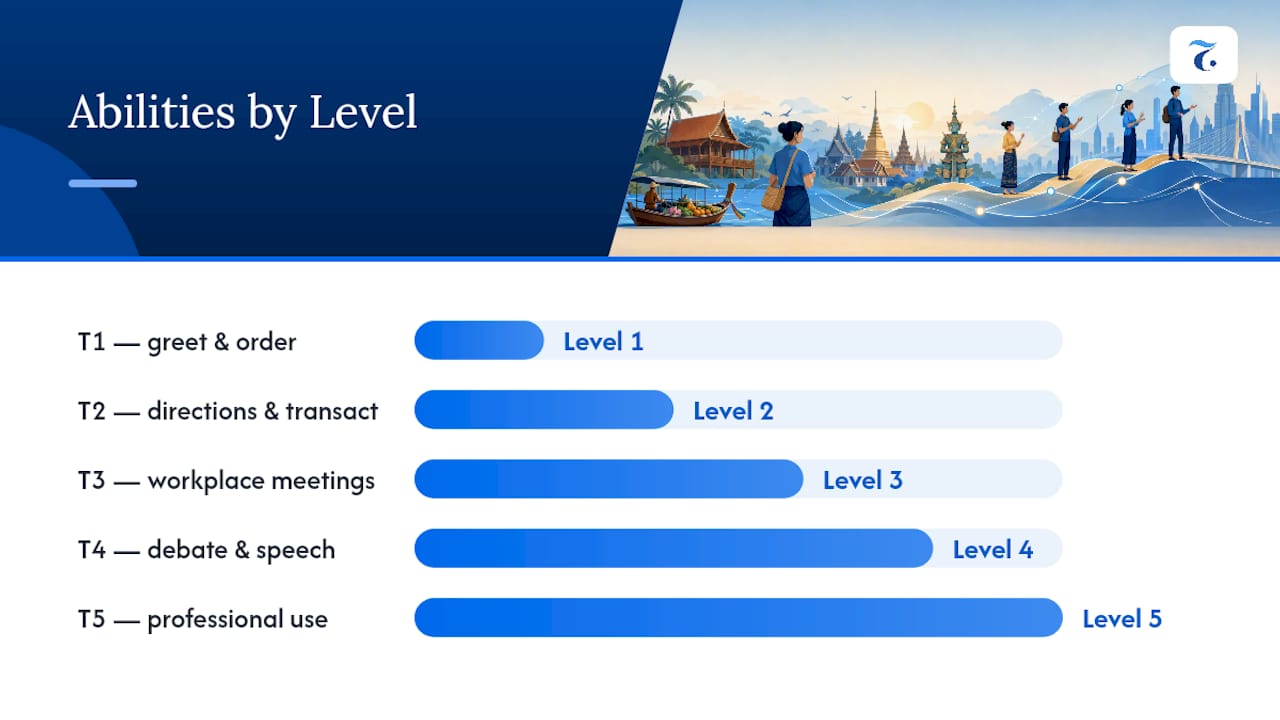
These levels roughly correspond to CEFR bands, and Chulalongkorn University’s testing framework explicitly aligns its own criteria with both CEFR and ACTFL standards, which gives learners a way to compare Thai progress against other language benchmarks they may already know.
Which Course Format Fits Your Schedule and Goals?
Group classes, private tuition, online Zoom sessions, and corporate training each solve a different problem. None of them is universally “better.” The right pick depends on how much individual feedback you need and how flexible your calendar is.
Group classes cost less per session and give you peer accountability, but you’ll get less individual airtime, especially in classes above six or seven students. Private tuition flips that trade-off: every minute is focused on your gaps, tone corrections happen in real time, and scheduling bends around your calendar, at a higher hourly cost. Live online classes over Zoom preserve real-time speaking practice and teacher feedback without a commute, which matters if you’re squeezing lessons around a Singapore work schedule. Corporate training brings a bilingual instructor to your team’s context, often blending business vocabulary with cultural coaching for client-facing roles.
If your goal is quick travel-ready phrases, a short group course or an online course usually gets you there fastest. If you’re prepping for a specific certification or need business Thai for client calls, private lessons or corporate training give you the targeted repetition that a general syllabus can’t.
Pro Tip: In group classes, arrive with two or three sentences already prepared about your day. Instructors call on prepared students more often, simply because it keeps the lesson moving, so you’ll get more speaking reps without waiting to be picked.
How Do You Choose the Right Thai Course?
Start with outcomes, not marketing copy. A course page should tell you exactly what you’ll be able to do after each level, not just that you’ll “become fluent.”
Run through this checklist before enrolling:
- Are learning outcomes listed by level, with specific, testable skills?
- Are instructors native Thai speakers who are also bilingual in English?
- What is the class size, and does it match the feedback you need?
- Does the curriculum reference CU-TFL or another recognized proficiency framework?
- How often are students formally assessed, and how is progress tracked?
- Can you see a sample lesson plan or sit in on a trial before committing?
Ask these questions directly on a call or during a trial: How are tones introduced, through audio-first drills or written explanation? What’s the student-to-teacher ratio in a typical class? How is progress measured between levels? Are lesson recordings available for review afterward?
Watch for these red flags:
- A syllabus that leans heavily on written vocabulary lists with little native audio
- No mention of assessment, level mapping, or measurable outcomes
- Vague answers about instructor qualifications or teaching experience
- No trial lesson or sample class offered before you commit
Timelines vary by format and effort. With one to two hours of weekly class time plus daily self-study, most adult learners move from T1 to T2 in roughly two to three months. Reaching T3, workplace-familiar competence, typically takes six to nine months of consistent study. Private or corporate formats can compress this timeline because feedback loops tighten, but the daily practice habit matters more than the format itself.
What’s the Best Way to Structure Self-Study Alongside a Course?
Listening comes first, and there’s a real reason for that beyond convention. Thai carries five tones that change word meaning entirely, and if you learn vocabulary from text before your ear can distinguish those tones, you tend to fossilize mispronunciations that are genuinely hard to unlearn later. Programs built around Chulalongkorn University’s teaching approach prioritize listening and speaking before reading and writing for exactly this reason.
A 12-week plan that fits around a full-time job looks like this:
- Daily (10 to 15 minutes): Native-audio listening practice, ideally phrase-based rather than isolated words
- Daily (10 minutes): Spaced repetition review of vocabulary, ideally learned inside full phrases
- Twice weekly (20 minutes): Guided practice, either with a course or a language partner
- Weekly: A speaking check-in, even five minutes with an instructor or exchange partner
By week 4, you should be able to handle basic transactions and simple questions without hesitating on tone. By week 8, you should follow slow, familiar conversation and initiate short exchanges unprompted. By week 12, you should manage a full basic conversation, ordering, directions, small talk, without switching to English mid-sentence.
Beyond listening and spaced repetition, shadowing native audio, where you repeat immediately after a speaker to mimic rhythm and tone, builds pronunciation accuracy faster than reading transcripts alone. Short roleplay practice, even solo, rehearsing a market transaction out loud, reinforces the phrase patterns you’ll actually need. High-frequency vocabulary lists paired with spaced repetition tools help you lock in the words that show up most often in daily conversation, rather than scattering effort across rare terms.
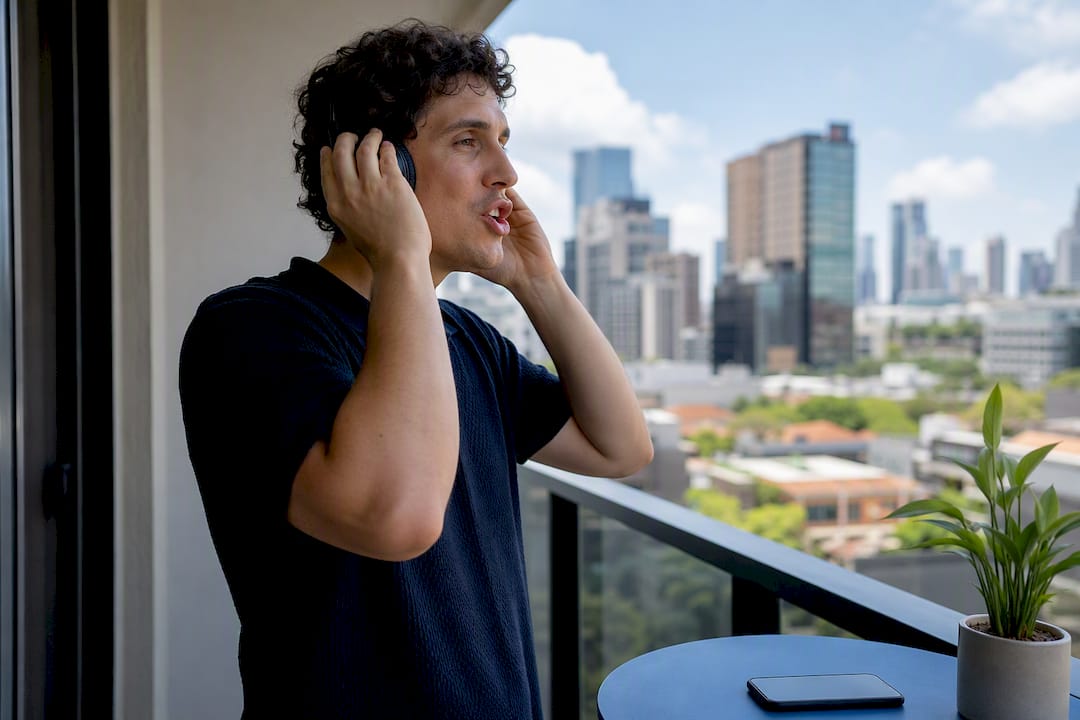
Pro Tip: Turn your commute into passive listening time. Fifteen minutes of native audio on the MRT twice a day adds up to more weekly exposure than most learners get from a single weekly class.
Pro Tip: Micro-immersion works even in Singapore. Order in Thai at a Thai restaurant, greet a Thai colleague in Thai first, or switch your phone’s date format to Thai numerals. Small, repeated contact beats one long study session.
What Does CU-TFL Testing Actually Measure?
The CU-TFL, administered through Chulalongkorn University’s Sirindhorn Thai Language Institute, tests four skills: listening, reading, writing, and speaking. It’s a recognized benchmark for learners who want an external measure of where they stand, not just a course completion certificate.
CU-TFL results generally map onto the same T1 to T5 progression used across Thai proficiency frameworks, and the institute’s own criteria reference CEFR and ACTFL for learners comparing Thai against other languages they’ve studied.
| Test Component | What It Measures |
|---|---|
| Listening | Comprehension of spoken Thai at varying speeds and formality |
| Reading | Script recognition and comprehension of written passages |
| Writing | Ability to produce coherent written Thai for the tested level |
| Speaking | Spoken fluency, tone accuracy, and conversational range |
Treat a CU-TFL attempt as a progress checkpoint, not a finish line. Sitting for it at intermediate or advanced levels gives you a concrete signal of where your gaps are, such as listening speed versus writing accuracy, so you can direct the next study cycle instead of guessing.
Before test day: run mock speaking tests with a native speaker, practice timed listening under exam conditions, and complete a few sample writing tasks so the format itself isn’t a surprise.
What to Expect From Thai Explorer’s Course Structure
Thai Explorer runs group, private, online Zoom, and corporate courses, so you can match the format to how you actually learn, not just what’s available. The curriculum is built around CU-TFL and recognized proficiency frameworks, with clear assessment points so you know when you’ve genuinely moved up a level rather than just finished a term.
Every instructor is a native Thai speaker who is also bilingual in English, with classroom teaching experience, so corrections happen in real time and nothing gets lost in translation during early lessons.
- Formats: group, private, online (Zoom), and corporate training
- Curriculum aligned to CU-TFL and recognized proficiency standards
- Assessment checkpoints tied to the level framework
- Native, bilingual instructors with classroom teaching experience
- Trial lessons available before you commit to a full course
To book a trial or consultation, come ready with a rough goal, travel, workplace conversation, or client-facing business Thai, so the first lesson can be pitched at the right level from the start.
An Instructor’s View on What Actually Works
Consistency beats intensity almost every time. A learner doing 15 focused minutes daily will outpace someone cramming two hours once a week, because tone perception needs frequent, spaced exposure to stick.
Speaking from day one matters more than students expect. Roleplay early, drill high-frequency phrases before rare vocabulary, and schedule a weekly oral review even if it feels uncomfortable at first. Cultural context isn’t decoration here. Understanding when to use polite particles or how tone shifts with formality speeds up real comprehension, because the language and the social context are learned together, not separately.
Ready to Put a Course and Practice Plan Into Action?
You now have the framework: listening-first progression, a five-level target, and a daily practice habit. The next step is putting a real teacher in front of you who can correct your tones before they fossilize.
Thai Explorer runs group, private, and online Thai courses with native, bilingual instructors and a curriculum mapped to CU-TFL proficiency levels, so the plan you just read isn’t theoretical, it’s exactly how classes are structured. Whether you want quick travel-ready conversation or ongoing business Thai for client work, there’s a format that fits your schedule, including fully online options if getting to a classroom isn’t practical. The training centre sits directly above Tanjong Pagar MRT at 10 Anson Road, #22-07, International Plaza, for anyone who prefers in-person lessons.
There’s no pressure to commit blind. Book a trial lesson or a short placement conversation, get matched to the right starting level, and see how the listening-first approach feels before you enroll in a full Thai language course.
Sources
- CU-TFL and Sirindhorn Thai Language Institute overview (Chulalongkorn University)
- Thai – WordMastery
- Free Thai Quiz | Level Test & Practice | Thai with Nariss
FAQ
Is Thai Language Hard to Learn?
Thai has five tones and its own script, which makes early pronunciation harder than in non-tonal languages, but grammar is comparatively simple, with no verb conjugation or noun gender to memorize.
How Do You Say “I Love You” in Thai?
“I love you” is “chan rak khun” (ฉันรักคุณ), though Thai speakers often drop the pronouns in casual speech and simply say “rak khun.”
How Do You Say “Hi” in Thai?
The common greeting is “sawasdee” (สวัสดี), with men typically adding “khrap” and women adding “kha” at the end for politeness.
Can I Learn Thai in Two Months?
In two months of consistent daily practice plus regular lessons, most learners reach T1 to early T2, enough for greetings, basic transactions, and simple questions, but not full workplace conversation.
What’s the Fastest Way to Improve Thai Speaking Skills?
Combine a listening-first course with daily short practice sessions and weekly speaking check-ins. Programs like Thai Explorer’s courses build this sequence directly into the syllabus rather than leaving it to self-study alone.