
The fastest reliable route to usable Thai is a structured course plus daily 10 to 20 minute tone and vocabulary drills. Teacher feedback fixes what your ear cannot catch on its own, especially the five tones, while spaced repetition locks in the vocabulary you learn in class before you forget it. Skip either half and progress stalls.
If you are choosing between formats, here is the short version:
- Group classes for steady conversation practice at lower cost
- Private lessons when you need fast, individualized tone correction
- Online or hybrid classes if your schedule cannot bend around a fixed location
- A short intensive workshop before a specific trip or business engagement
Thai Explorer runs all four formats from a training center right above Tanjong Pagar MRT, with native bilingual instructors and a curriculum aligned to CU-TFL benchmarks. A trial class or a single private session is the lowest-risk way to find out whether a teacher’s style and pace fit how you actually learn. That one hour tells you more than another week of app-only study ever will.
Key Takeaways
Structured lessons paired with daily tone and vocabulary drills produce usable conversational Thai faster than either approach alone.
| Point | Details |
|---|---|
| Match format to goal | Use group classes for conversation practice, private lessons for fast tone correction, and workshops for trip deadlines. |
| Prioritize tone from day one | Uncorrected tone errors harden into habits, so get teacher feedback before relying on apps alone. |
| Expect a realistic timeline | Around 30 minutes of daily study can bring basic conversation within two to three months, per StudyThai.ai’s pacing data. |
| Build a daily SRS habit | Enter class vocabulary into a spaced-repetition deck the same day to lock in retention. |
| Start with Thai Explorer | Native bilingual instructors and CU-TFL-aligned curriculum across group, private, and online formats make a trial class a low-risk first step. |
Table of Contents
- Which Thai Lesson Format Fits Your Goals?
- What Does a Beginner-to-Intermediate Thai Curriculum Actually Cover?
- How Long Does It Take to Learn Thai, and What Does It Cost?
- What Tools Actually Help Between Lessons?
- How Do You Choose the Right Thai Course or Teacher?
- Why Thai Explorer Meets These Standards
- Why Cultural Context Changes How You Speak Thai
- The Challenges Every Thai Learner Hits, and How to Get Past Them
- How to Practice Thai Outside of Class
- A Practical Take on What Actually Moves the Needle
- Getting Started at Thai Explorer
- Handy Resources and Tools
- Sources
- FAQ
Which Thai Lesson Format Fits Your Goals?
Group classes remain the most efficient way to rack up speaking time. You are forced to respond in real time to different voices and accents, which mirrors actual conversation far better than a one-on-one drill session. The trade-off is pace: a group moves at the speed of its slowest confident speaker, and personalized tone correction gets diluted across six or eight students.
Private lessons solve that problem directly. A teacher who hears only your voice can isolate a mispronounced mid tone or a rushed vowel length within minutes, then drill it until it sticks. This is where progress on the hardest part of Thai, the tonal system, happens fastest. It costs more per hour, but for learners with a deadline (a work posting, a wedding, a semester abroad) the acceleration often justifies the price.
Online and hybrid lessons have closed most of the gap with in-person classes over the past few years, provided two things hold up: clear audio (tones are lost on bad microphones) and a teacher who actively corrects you rather than just talking at you over Zoom. If both are in place, an online private lesson can rival an in-person one for tone work specifically, since the teacher can share screen-based visual pronunciation aids in real time.
Intensive workshops and short bootcamps serve a narrower purpose: compressing survival Thai into a weekend or a week before travel, or building specific business vocabulary before a trip to a Bangkok office. They will not build fluency, but they will get you through immigration, taxis, and small talk with confidence.
Pro Tip: Book your trial or first private session at least a week before any trip or deadline, not the day before. First lessons often reveal a tone or habit that needs a session or two to correct before it’s useful in the field.
A workable weekly rhythm looks like this:
- One group class (60 to 90 minutes) for conversation exposure
- One private session every two weeks for targeted tone correction
- Ten to twenty minutes of solo drilling on the days you have no class
- A weekly quick review of new vocabulary before it fades from short-term memory
What Does a Beginner-to-Intermediate Thai Curriculum Actually Cover?
Everything starts with sound, not grammar. Thai has five tones, mid, low, falling, high, and rising, and getting them wrong changes word meaning entirely, not just accent. A solid first module covers the consonant classes (low, mid, high) that determine which tone rules apply to a given syllable, plus the vowel length distinctions that trip up most English speakers in the first month.
From there, a beginner-to-intermediate path typically moves through recognizable stages:
- Early beginner (A0 to A1): greetings, numbers, basic questions, roughly 150 to 300 core words
- Late beginner (A2): simple past and future markers, ordering food, giving directions, 300 to 500 words
- Intermediate (B1): workplace small talk, short reading passages, expressing opinions, expanded vocabulary for daily and professional situations
A well-built curriculum balances these skills instead of overloading grammar drills or vocabulary lists. Tone practice, spaced repetition vocabulary review, roleplay for real conversation, and grammar taught in context rather than as abstract rules all need to show up in roughly equal measure. A course that spends three weeks on verb conjugation charts before you can order a coffee has its priorities backward.
One useful marker of curriculum rigor is alignment with an external benchmark. Thai Explorer’s course structure maps to CU-TFL proficiency levels, which gives both student and teacher a shared reference point for what “intermediate” actually means rather than a vague, self-defined label. Adult learners who train their ear on tone patterns from day one avoid what linguists call tone blindness, a persistent difficulty distinguishing tones that, left uncorrected, hardens into habit and becomes much harder to fix later.
How Long Does It Take to Learn Thai, and What Does It Cost?
Most adult learners who study consistently reach usable basic conversation within a few months. Studythai points to a similar window: about 30 minutes of daily structured study can produce basic daily conversation in two to three months and basic reading within roughly six months. Comfortable intermediate fluency, enough to hold a workplace conversation or read a short news item, generally takes six months or more of regular practice.
Cost shapes vary by format rather than by any fixed number. Group classes run cheaper per hour because the cost splits across several students, which makes them the more economical route for building conversation stamina over months. Private lessons cost more per hour but compress the timeline, particularly for tone correction, since every minute is spent on your specific gaps. Intensive packages sit somewhere in between: a higher upfront cost for a shorter, denser block of lessons.
A weekly plan that actually produces results:
- One or two scheduled lessons per week (group, private, or a mix)
- Ten to thirty minutes of daily drilling, tones and vocabulary, on non-lesson days
- A five-minute weekly review of everything learned that week before moving forward
- A monthly check-in: can you hold a two to three minute conversation, read a short passage, or clear a module assessment?
That last point matters more than it sounds. Progress in Thai is easy to feel uncertain about because the writing system and tones are unfamiliar, so an objective checkpoint, a short conversation test or a module assessment, tells you whether you are actually moving forward or just accumulating vocabulary you cannot yet use.
What Tools Actually Help Between Lessons?
Lessons teach you the material; the hours between lessons decide whether it sticks. Spaced-repetition systems (SRS) are the single highest-leverage habit you can build, because they resurface new words right before you would otherwise forget them.
- Enter new vocabulary into an SRS deck the same day you learn it, not the next week
- Frequency-based decks built around the 1,000 most common Thai words give beginners the best early return on study time
- ThaiFlip lets you paste a list of class vocabulary and auto-generate study cards with audio and transliteration, which removes the tedious manual entry that makes most learners abandon flashcards after a week
- StudyThai.ai combines a tone trainer with an AI tutor and pronunciation modules, useful for solo practice between lessons
- Tone calculators and visual pronunciation feedback, the kind detailed in SEAsite’s tone resource, catch errors before they calcify into habits
- Short audio clips and shadowing videos build listening speed faster than textbook dialogues, since real Thai speech moves faster than lesson recordings
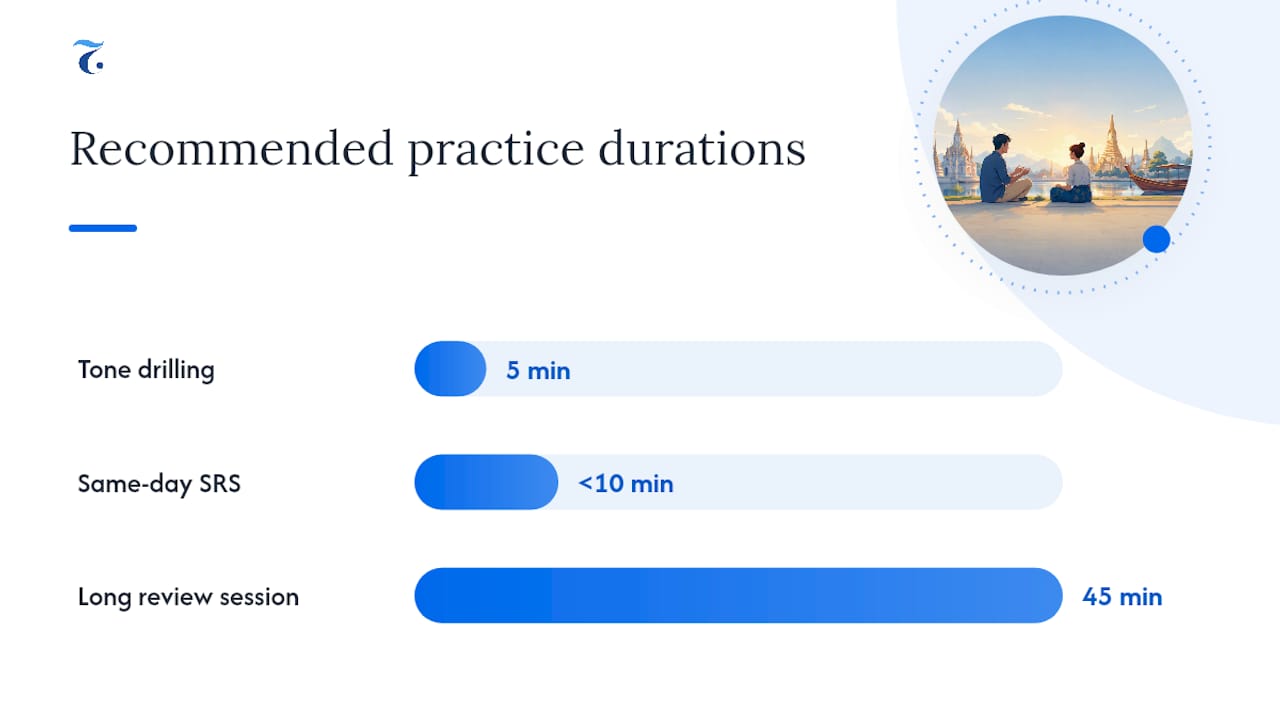
The habit that actually moves the needle is boring: five minutes of tone drilling right after class, while the sounds are still fresh, plus a same-day SRS entry of new words. Practical guides on using AI tools for study routines point to the same pattern across languages, short, immediate reinforcement beats long, delayed review sessions.
Pro Tip: Keep your SRS session under ten minutes. Longer sessions feel more thorough but produce diminishing returns; a short daily habit you actually keep beats a 45 minute review you skip twice a week.
How Do You Choose the Right Thai Course or Teacher?
Before enrolling anywhere, run the school or teacher through a short checklist:
- Is the instructor a native Thai speaker who is also bilingual in English for clear explanations?
- Does the curriculum explicitly teach tone and pronunciation, or does it assume you will pick it up by ear?
- Is there a visible progression, beginner to intermediate to advanced, rather than a single undefined “conversational” bucket?
- Can you take a trial lesson or sample class before committing to a package?
- What is the class size, and what homework or practice is expected between sessions?
Ask these questions directly during any inquiry call:
- “How do you correct tone errors during a lesson, and how often do you check them again later?”
- “What materials do I keep after the course ends?”
- “How do you measure whether a student is ready to move up a level?”
A few red flags should make you look elsewhere. A school that cannot describe how it teaches tones, one that promises vague “fluency” without a stated timeline, or one that will not offer any kind of sample lesson before payment is asking you to commit blind. Match urgency and budget honestly: if you need results before a trip in six weeks, private lessons or an intensive make sense; if you are building a long-term skill with no fixed deadline, group classes stretch your budget further over more months.
Why Thai Explorer Meets These Standards
Thai Explorer’s classes are built around the checklist above rather than around it as an afterthought.
- All instructors are native Thai speakers who are also bilingual in English, so tone corrections come with a clear explanation, not just a repeated sound
- The curriculum aligns with CU-TFL proficiency benchmarks, giving learners an external reference point for what each level actually means
- Group, private, and online class formats run from the same curriculum, so switching formats mid-course does not mean restarting
- Cultural immersion components run alongside language instruction, since Thai communication leans heavily on context and social register
Course details, trial options, and assessment information are available directly on the Thai course landing page, including current schedules for each format.
Why Cultural Context Changes How You Speak Thai
Thai is not just a set of sounds and grammar rules bolted onto English sentence patterns. Politeness particles like “khrap” and “kha” change based on the speaker’s gender, and skipping them in a formal setting reads as abrupt even when your grammar is flawless. Hierarchy and age shape word choice constantly: how you address an older colleague differs from how you’d speak to a peer, and Thai has entire vocabulary sets built around this.
Understanding the wai greeting, the different levels of formality in vocabulary, and the general Thai preference for indirectness in disagreement will save you from accidental rudeness long before your vocabulary is large enough to notice it yourself. A learner who memorizes verb conjugations but never learns when to soften a request with “just a little” (nit noi) will sound technically correct and socially off.
This is also why classroom roleplay matters more in Thai than it might in a more grammatically similar language. Practicing a workplace negotiation, a market haggling exchange, or a formal introduction with a teacher who can flag both language errors and cultural missteps builds a kind of fluency no app can replicate. It’s the difference between speaking Thai and speaking Thai the way Thai people actually expect to hear it in that context.
The Challenges Every Thai Learner Hits, and How to Get Past Them
Tone deafness, in the practical sense, is the most common wall adult learners hit. English does not use pitch to change word meaning, so most new learners genuinely cannot hear the difference between a mid and a low tone at first. The fix is not more listening on its own; it’s structured feedback. A teacher who stops you mid-sentence to correct a tone, paired with a visual tone trainer, rewires your ear faster than passive exposure ever will.
The Thai script is the second wall. Reading feels optional at first since spoken Thai gets you through daily interactions, but skipping the script caps your vocabulary growth because you cannot look up unfamiliar words efficiently or read menus, signs, and messages. Most learners who commit to reading basics in the first two months progress faster overall, even though it feels slower initially.
Plateauing around the “I can survive but not really converse” stage is the third common frustration. This usually means vocabulary has outpaced grammar flexibility, or vice versa. The fix is deliberate: add roleplay-based lessons that force you to construct full responses rather than one-word answers, and push your SRS deck toward phrases and sentence patterns instead of isolated words.
How to Practice Thai Outside of Class
Lessons and solo drilling get you most of the way, but real conversational speed comes from talking to people who are not your teacher. Language exchange meetups, where you trade conversation time in Thai for conversation time in English with a Thai speaker learning English, expose you to slang, speed, and regional variation no course covers. Local Thai language events built around this kind of exchange give you a lower-pressure environment than a business meeting to test what you’ve learned.

Short-term immersion works even without traveling to Thailand. Switching your phone’s interface language, following Thai social media accounts, watching Thai shows with Thai subtitles instead of English ones, and cooking from Thai-language recipes all create small pockets of forced comprehension practice throughout your week.
If travel is part of your plan, treat the trip itself as a practice ground rather than a test you might fail. Ordering food, asking directions, and small talk with shopkeepers are low-stakes ways to use what you’ve learned, and mistakes there cost nothing but a moment of embarrassment. Consistency across these informal channels, even just fifteen minutes a day of exposure outside your scheduled lessons, compounds faster than most learners expect.
A Practical Take on What Actually Moves the Needle
Most learners overinvest in apps and underinvest in a teacher’s ear during the first two months, which is backward. Tone errors made early and left uncorrected become genuinely hard habits to break later, no matter how many vocabulary words you add on top of them. The learners who progress fastest are not the ones with the most study hours logged; they’re the ones who got tone feedback early and built a boring, repeatable daily habit around it.
If you’re starting from zero, book a trial class before you buy any course package, and bring a short list of ten to fifteen words or phrases you actually want to use, not a generic beginner list. That small step tells you more about whether a teacher and format fit you than a week of solo app study ever will.
Getting Started at Thai Explorer
Thai Explorer is the direct next step for structured Thai lessons, running group, private, and online classes from a single CU-TFL-aligned curriculum out of its training center right above Tanjong Pagar MRT. The full Thai course lineup covers everything from complete beginner through intermediate levels, with formats built to match tight schedules, business needs, or purely conversational goals.
Booking a trial lesson is straightforward: pick a course format that matches your timeline and budget, bring a short list of words or phrases you personally want to use, and expect the first session to focus on tone and pronunciation basics rather than jumping straight into complex grammar. That first hour is designed to show you exactly how the teacher corrects tone errors and paces lessons, so you can judge fit before committing to a full course. For learners specifically interested in travel-ready conversational skills and cultural context, the Thai language courses for travel and culture page outlines what that track covers session by session.
Honestly, expect the first session to feel a little humbling. Most adults discover within the first thirty minutes that a sound they thought they were saying correctly isn’t quite right, and that’s the whole point of starting with a real teacher instead of an app.
Handy Resources and Tools
- ThaiFlip: instant vocabulary lookup with audio and transliteration, plus auto-generated flashcards from pasted word lists
- Free Thai flashcard and SRS resources: frequency-based decks built around the 1,000 most common Thai words
- Thai tones explained: a full pronunciation guide for the five tones
- Thai tone exercises: five practical drills to run right after class
- Thai language events in Singapore: meetups and conversation practice opportunities
Sources
- ThaiFlip — Fun & Instant Thai Vocabulary
- SEAsite — Thai tones resource
- Free Thai flashcards and SRS resources
FAQ
What Is a Good Way to Learn Thai?
The most effective approach combines structured lessons, group or private, with daily 10 to 20 minute tone and vocabulary drills using an SRS deck, since teacher feedback and spaced repetition solve different problems.
Is Thai an Easy Language to Learn?
Thai grammar is relatively simple, with no verb conjugation or noun gender, but the five-tone system and unique script make pronunciation and reading harder for English speakers than for many other languages.
How Can I Learn Thai by Myself?
Self-study works best combined with periodic teacher feedback for tones; tools like StudyThai.ai and ThaiFlip support daily practice, but tone errors are hard to self-correct without outside input.
How Long Does It Take to Learn Thai Fluently?
Basic conversational ability typically takes two to three months with consistent daily practice, while comfortable intermediate fluency generally takes six months or more of regular lessons and study.
Should I Choose Group or Private Thai Lessons?
Group classes cost less per hour and build conversation stamina, while private lessons cost more but correct tone and pronunciation errors faster, making them worthwhile ahead of a deadline.