
Start speaking Thai today with a 10-minute daily routine: micro-speech goals, tone drills, and one full minute of real or recorded speaking with feedback. That last part is what most self-taught learners skip, and it’s why their progress stalls. Passive listening builds recognition, but only active output, corrected regularly, builds the muscle memory for real conversation.
Here’s what to do starting right now:
- Pick two or three phrases you’ll use today (a greeting, an order, a question) and say them out loud, not just in your head.
- Shadow a short native audio clip three times, matching rhythm and tone before worrying about meaning.
- Record sixty seconds of yourself speaking and listen back once, comparing your tones to a model speaker.
- If you can, book a short session with a tutor or a structured class this week. Uncorrected mistakes calcify fast, and a qualified teacher catches what your own ear misses.
Key Takeaways
Daily spoken output paired with regular corrective feedback builds usable Thai conversation skills faster than passive study or app-only practice alone.
| Point | Details |
|---|---|
| Speak daily, even briefly | A 5 to 30 minute routine with micro-speech goals beats occasional long study sessions. |
| Correct errors early | Weekly or biweekly feedback from a tutor or class prevents fossilized tone mistakes. |
| Mix resource categories | Combine live audio rooms, exchange apps, and structured lessons based on what each does best. |
| Follow a measurable plan | A 4-week starter schedule with weekly milestones tracks real speaking progress. |
| Com offers guided correction | Native bilingual instructors and a CU-TFL-aligned curriculum provide structured feedback in group, private, or online formats. |
Table of Contents
- Building a Daily Thai Conversation Practice Routine
- What Speaking Exercises Actually Build Conversation Skills?
- Why Feedback Matters More Than Practice Volume
- Which Practice Resources Fit Your Schedule and Level?
- A 4-Week Starter Plan for Speaking Thai Confidently
- Why Structured Lessons Speed Up Speaking Progress
- Cultural Context and Etiquette in Thai Conversations
- Thai Fillers and Discourse Markers You’ll Actually Hear
- Strategies to Overcome Speaking Anxiety in Thai
- Getting the Most From Language Exchange Apps
- How Listening Comprehension Feeds Your Speaking Skills
- What This Plan Gets Right That Most Advice Misses
- Start Speaking Thai With Guided Feedback This Week
- Sources
- FAQ
Building a Daily Thai Conversation Practice Routine
Consistency beats intensity. A learner who speaks Thai for ten focused minutes daily will outpace someone who crams for two hours once a week, mostly because speaking is a motor skill, not just a memory task. Pick a routine based on the time you actually have, not the time you wish you had.
The 5-minute micro-practice: Say five to eight phrases aloud from memory, no notes. Cover one micro-goal: ordering food, greeting a coworker, asking for directions. Speed matters less than clear tones.
The 15-minute focused session: Combine shadowing with drilling. Play a short native clip, repeat it three times matching the speaker’s rhythm, then swap in your own details (change the name, the number, the location) and say the new sentence aloud.
The 30-minute mixed session: Warm up with five minutes of phrase review, spend ten minutes on shadowing and tone drills, then spend the last fifteen minutes in an unscripted exchange, either with a partner, a tutor, or a recorded self-dialogue where you answer your own prompts.
A simple sequence works for any length:
- Choose one micro-speech goal (a task you can complete in one exchange).
- Shadow a native audio sample two or three times.
- Say the target phrases without looking at the script.
- Record 30 to 60 seconds of free speech using those phrases.
- Play it back once and note one thing to fix tomorrow.
Pro Tip: Keep a single running voice memo folder labeled by date. Listening to a clip from three weeks ago against today’s recording is the fastest way to see, and hear, real progress.
What Speaking Exercises Actually Build Conversation Skills?
Drills only help if they map onto real conversation. These four exercise types target speaking, not just recognition.
Phrase-pattern drills. Practice one sentence frame with swappable details. “I would like ___” becomes useful for food, transport, and shopping once you drill it with five different endings.

Tone and minimal-pair practice. Thai relies on five tones to distinguish meaning, so pick pairs like “khao” (rice) and its rising or falling tone variants, and say them side by side until the difference feels physical, not just theoretical.
Role-play with scaffolding. Start with a script: ordering coffee, checking into a guesthouse, asking a shopkeeper for a discount. Read it once, then remove the script and repeat from memory.
Repair-strategy practice. Learn the phrases for “please say that again” and “I don’t understand” early, so a stalled conversation doesn’t end it. Structured lessons that pair scripted exchanges with open-ended follow-up questions tend to move learners toward natural speech faster than either drilling or free talk alone, according to Duke Language’s guide for foreign learners.
- Drill the same sentence frame with three different endings before moving on.
- Say tone pairs slowly, then at normal speed, checking pitch with a mirror or recording.
- Run each role-play scripted first, then unscripted, on the same day.
- Practice at least one repair phrase every session so gaps in understanding don’t stop the conversation cold.
Once a scripted exchange feels automatic, drop the script entirely and answer the same prompt with different wording. That’s the actual transition from memorized Thai to spoken Thai.
Why Feedback Matters More Than Practice Volume
Speaking without correction doesn’t just fail to help. It can actively teach your mouth the wrong tone pattern, a fossilized error that gets harder to unlearn the longer it goes uncorrected. This is especially true in Thai, where a shifted tone changes the word’s meaning entirely, not just its accent.
Get feedback through a few reliable channels: a short weekly tutor session, a structured class where a teacher listens and corrects in real time, or a language partner who agrees upfront to flag tone mistakes rather than just nod along politely.
Self-correction works between sessions. Record yourself, slow the playback, and compare your tone contour to a native sample. Thai tone exercises built around minimal pairs make this comparison faster since you’re isolating one sound difference at a time.
A workable cadence: correction every one to two weeks from a qualified source, with daily self-checks in between.
- Weekly or biweekly: a tutor or class session focused specifically on pronunciation and error patterns.
- Daily: a 30-second self-recorded check against a reference clip.
- Ongoing: a language partner who corrects tone errors on the spot instead of guessing your meaning.
Recording and comparing your own voice over several weeks is one of the more effective ways to make progress audible rather than just hoped for, a technique confidence-building guides for Thai beginners consistently recommend.
Which Practice Resources Fit Your Schedule and Level?
Different tools solve different problems, and mixing categories usually beats relying on just one.
- Live audio rooms and drop-in voice chats work well for casual, low-pressure practice once you have basic phrases down, though correction quality varies since not every participant is a trained teacher.
- Language-exchange apps connect you with native speakers for voice notes and live chat, useful for immersion but inconsistent for structured correction, since your partner is a volunteer, not an instructor.
- Private tutors give targeted, consistent correction on your specific errors, which matters most for tone accuracy.
- Structured group or private courses combine curriculum, feedback, and speaking practice in one place, which tends to produce faster, more reliable gains than app-only study.
- AI conversation coaches offer instant audio replies and grammar notes any time of day, a helpful supplement but not a substitute for a trained ear catching tone errors, as 17 Minute Languages notes about its own AI coach.
- Shadowing media (podcasts, dramas, news clips) builds listening and rhythm even when you’re not actively speaking.
Match the tool to the moment: use live rooms or apps for quick reps, a tutor or class for correction, and media for immersion when you can’t speak out loud.
A 4-Week Starter Plan for Speaking Thai Confidently
This plan assumes 15 to 20 minutes daily, adjustable if you have more or less time.
- Week 1: Foundations. Learn 20 to 30 high-frequency phrases (greetings, numbers, basic questions). Daily: 10 minutes phrase drilling, 5 minutes shadowing. Milestone: recite all phrases from memory without notes.
- Week 2: Tone accuracy. Add tone drills and minimal pairs. Daily: 10 minutes tone practice, 10 minutes phrase review. Milestone: a tutor or partner confirms that most of your target tones sound correct.
- Week 3: Scripted role-play. Practice three scenarios (ordering, directions, small talk) scripted, then unscripted. Milestone: complete an unscripted role-play lasting a couple of minutes.
- Week 4: Free conversation. Combine everything in a 10-minute real or recorded conversation with a partner or tutor. Milestone: hold a spontaneous exchange in Thai without switching to English mid-sentence.
| Week | Focus | Daily Time | Milestone |
|---|---|---|---|
| 1 | Core phrases | 15 min | Recite 20+ phrases from memory |
| 2 | Tone accuracy | 20 min | 80% of tones confirmed correct |
| 3 | Role-play | 20 min | Complete a 2-minute unscripted role-play |
| 4 | Free conversation | 20 min | Hold a spontaneous exchange in Thai |
Reassess after week 4. If tone errors persist, repeat weeks 2 and 3 with a fresh set of vocabulary before advancing.
Why Structured Lessons Speed Up Speaking Progress
Self-study catches you on repetition but rarely on the errors you can’t hear yourself making. Structured lessons combined with regular speaking practice remain the clearest documented path to usable spoken Thai, since a teacher provides direction, correction, and progression that apps and solo drilling can’t replicate on their own, a point Duke Language’s research on foreign learners backs up directly.
Com’s instructors are native Thai speakers who are also fluent in English, so corrections land clearly without a language barrier slowing things down. The curriculum follows the CU-TFL framework, which structures speaking, listening, reading, and writing progression instead of leaving it to chance. Group, private, and online formats mean you can find a schedule that actually fits your week.
- Native bilingual instructors who catch tone errors instantly.
- A curriculum aligned to a recognized proficiency framework, not ad-hoc lessons.
- Group, private, or online options depending on your pace and budget.
- Assessment modules that show measurable progress, not just a feeling of improvement.
Pro Tip: When trying a class, ask how much of the session is spent with you speaking versus listening. A useful ratio leans heavily toward your own spoken output.
Cultural Context and Etiquette in Thai Conversations
Thai conversation carries social rules that shape word choice as much as grammar does. Getting these right matters as much as pronunciation, sometimes more, since a grammatically perfect sentence delivered with the wrong tone of respect can land awkwardly.
Politeness particles like “khrap” (for male speakers) and “kha” (for female speakers) attach to the end of sentences and signal respect. Dropping them in formal or unfamiliar settings can sound abrupt even if your grammar is flawless. Age and status also shape how Thai speakers address each other; using someone’s first name preceded by “Khun” is a safe, respectful default until you know them better.
Directness works differently in Thai than in many Western conversational styles. Thai speakers often soften disagreement or bad news, favoring indirect phrasing over blunt statements. Learning to read a hesitant “mai pen rai” (never mind, it’s fine) or a soft “khit doo gorn” (let me think about it) as potential polite refusals, rather than literal answers, saves confusion in both social and business settings.
Non-verbal cues matter just as much. A slight smile, a wai (the traditional palms-together greeting), and a lowered volume in formal contexts all signal respect. Raising your voice or showing visible frustration, even mild frustration by American standards, can shut a conversation down fast in Thai social contexts.
None of this needs mastering before you start speaking. But building etiquette awareness into your practice, not just vocabulary and tones, makes real conversations with Thai speakers go smoother and builds trust faster than grammar accuracy alone ever will.
Thai Fillers and Discourse Markers You’ll Actually Hear
Textbook Thai rarely prepares learners for how Thai people actually talk in casual conversation. Fillers and discourse markers fill the gaps between sentences, buy thinking time, and signal tone, and skipping them makes your Thai sound stiff even when your grammar is correct.
“Aa” and “err” work similarly to English “um,” buying a beat before answering. “Kor” often starts a sentence as a soft transition, roughly like starting an English sentence with “well.” “Ngan” (then, so) links ideas casually, similar to how English speakers drop “so” between thoughts.
“Chup chup” is a common colloquial phrase meaning to do something quickly or briefly, often used when suggesting a fast bite to eat or a quick errand, as in going somewhere “chup chup” rather than making a big trip of it. It shows up constantly in casual speech, and recognizing it helps you follow conversations that move faster than textbook dialogue.
“Mai ru” (I don’t know) and “ngeng ngeng” (just kidding, or teasing) also show up frequently in relaxed conversation, softening statements or signaling playfulness. Picking up a handful of these markers, even five or six, makes a noticeable difference in how natural your spoken Thai sounds, since native listeners register their absence even when they can’t name why a sentence feels stilted.
Practice fillers the same way you practice vocabulary: notice them in shadowing material, then deliberately insert one or two into your own scripted role-plays until they stop feeling forced.
Strategies to Overcome Speaking Anxiety in Thai
Nearly every Thai learner freezes the first few times they try to speak with a native speaker, and that’s normal, not a sign you’re bad at languages. The fix isn’t confidence arriving before you speak. Confidence comes after you speak, repeatedly, in low-stakes situations.
Treating each conversation as an experiment rather than a performance takes the pressure off. You’re not being graded, you’re testing whether a phrase works, and if it doesn’t land, you adjust and try again next time. This mindset shift, reframing mistakes as data rather than failure, is one of the more consistently cited strategies for building speaking confidence in Thai.
Start small on purpose. Order food in Thai even if you could use English. Greet a shopkeeper in Thai even if your accent isn’t perfect yet. These low-stakes, real-world exchanges build tolerance for the discomfort of speaking imperfectly in public, which is the actual skill anxious learners need to develop, not just vocabulary.
Rehearsal helps too. Running through a role-play scripted, then semi-scripted, before attempting it live with a real person means you’re not improvising and speaking for the first time simultaneously.
Finally, track your wins. A short log of successful exchanges, even just “ordered coffee, understood the price, replied correctly” builds evidence against the anxious voice telling you that you can’t speak Thai yet.
Getting the Most From Language Exchange Apps
Exchange apps put native Thai speakers within reach of anyone with a phone, but using them well takes more intention than just downloading one and waiting for messages.
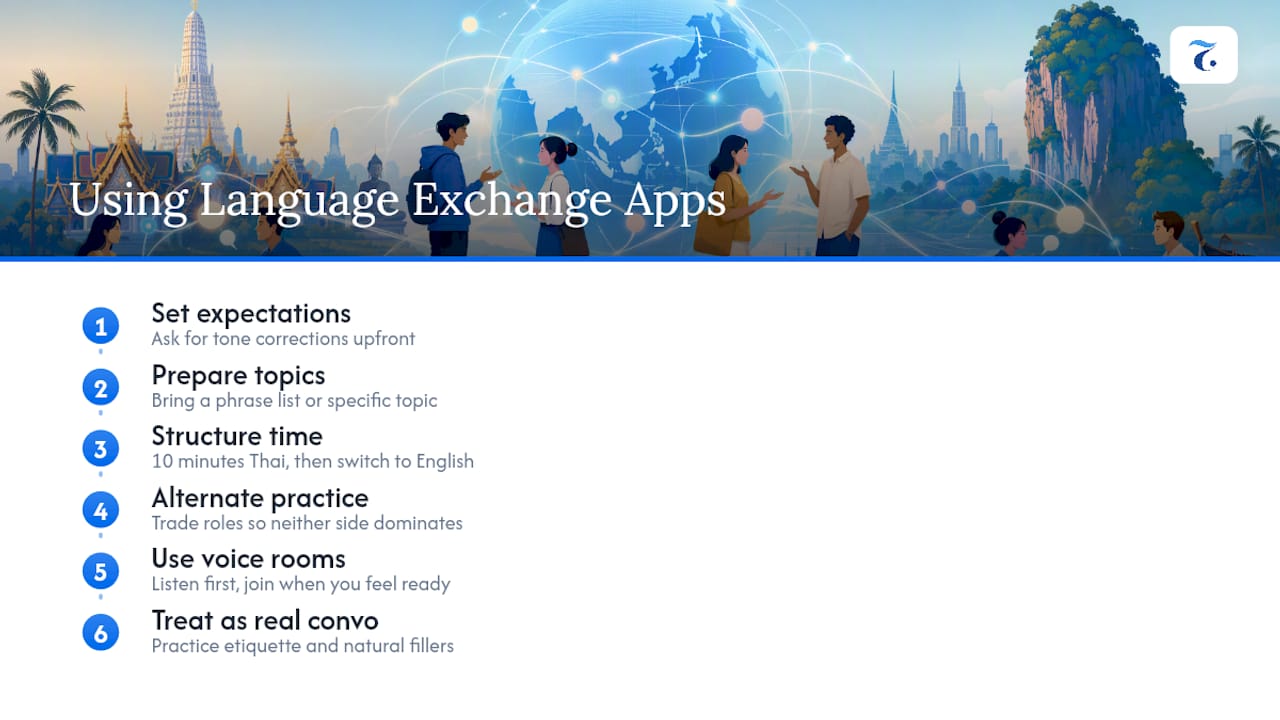
Apps connecting learners with native speakers for voice messages and live voice rooms, such as HelloTalk, work best when you set expectations upfront. Tell your partner you want tone corrections, not just polite encouragement. Most native speakers won’t correct you unprompted out of politeness, so ask directly: “please tell me if my tones are wrong.”
Structure the exchange instead of letting it drift. Spend ten minutes on your Thai, then switch to helping your partner with English, so the trade feels fair and neither side dominates. Bring a specific topic or phrase list to each session rather than showing up with nothing prepared; open-ended “let’s just chat” sessions tend to stall for beginners who don’t yet have enough vocabulary to sustain free conversation.
Voice rooms and live audio platforms extend this further, letting you listen in on native conversations before you’re ready to speak, then jump in once you’ve built up passive comfort with the pace and vocabulary. Hilokal’s live Thai conversation rooms are one example of this listen-first, speak-when-ready format.
Treat every exchange partner interaction as practice for a real conversation, complete with the etiquette markers and fillers covered earlier, not just a vocabulary quiz.
How Listening Comprehension Feeds Your Speaking Skills
You can’t produce a sound you’ve never accurately heard, which is why listening isn’t a separate skill from speaking in Thai, it’s the input that makes accurate speaking possible.
Shadowing works because it forces you to listen closely enough to reproduce rhythm and tone, not just recognize words. Play a short clip, three to five seconds, and repeat it immediately, matching pitch and pace before worrying about meaning. Do this with news clips, short dramas, or dedicated listening material rather than only with slowed-down beginner audio, since real speech speed is what you’re actually training your ear for.
Passive listening still helps, but it works better when paired with active tasks. Listen to a clip once for general meaning, then a second time specifically tracking tone patterns on words you already know, then a third time trying to predict the next word before it’s spoken. This layered approach turns background listening into active training rather than just ambient noise.
A structured listening practice guide that pairs graded audio with comprehension checks tends to build this skill faster than random podcast listening, since the material is calibrated to your actual level instead of either too easy or overwhelming.
Set aside at least one listening-focused session weekly, separate from your speaking drills, and you’ll notice your ear catching tone distinctions in conversation that used to blur together.
What This Plan Gets Right That Most Advice Misses
Most Thai learning advice treats speaking practice as something you graduate into after enough vocabulary and grammar study. That sequencing is backward. Spoken output from day one, even clumsy, mispronounced output, builds the actual skill faster than months of passive study followed by a nervous first conversation.
The conventional wisdom oversells apps and undersells correction. Language-exchange apps and AI coaches are genuinely useful for volume and accessibility, but volume without correction just practices your mistakes more efficiently. Thai’s tonal system punishes this specifically: a fossilized tone error doesn’t just sound like an accent, it changes what word you’re actually saying, and native listeners will quietly misunderstand you for years if nobody flags it early.
What the evidence actually supports is a blend: daily low-stakes spoken output for volume and confidence, paired with periodic structured correction to keep that output accurate. Skip either half and progress stalls in a predictable way. Skip speaking and you stay fluent only on paper. Skip correction and you get fluent at saying things wrong.
Prioritize getting a qualified ear on your tones early, before habits calcify, not after you’ve been “practicing” alone for six months.
Start Speaking Thai With Guided Feedback This Week
If you’ve read this far, you already know the gap most self-taught learners hit: plenty of listening, not enough corrected speaking. Com closes that gap directly. Every class pairs you with a native bilingual instructor who catches tone errors in real time, something no app or solo recording session can fully replace.

Classes run in group, private, and online Zoom formats, so you can fit regular speaking practice around a work schedule instead of rearranging your week for it. The curriculum follows the CU-TFL proficiency framework, with assessment modules that show you exactly where your speaking has improved and where it still needs correction. Com’s training center sits right above Tanjong Pagar MRT at 10 Anson Road, #22-07, International Plaza, easy to reach before or after work if you’d rather learn in person.
Start with a trial class or full course to get your first real, corrected conversation this week, or explore the online course format if remote lessons fit your schedule better.
Sources
Deepen your practice with tone exercises for accuracy, a complete pronunciation guide, and a practical beginner’s speaking plan. For pronunciation tool comparisons, see WordByWord’s roundup of pronunciation apps. Copyright basics for using audio clips in study appear in U.S. Copyright Title 17.
- What Is the Best Way for Foreigners to Learn Thai? | Thai Language School Bangkok | Duke Language
- How to build confidence in Thai as a beginner
FAQ
How do you say “I love you” in Thai?
The common phrase is “chan rak khun,” though Thai speakers often express affection through actions and context rather than saying it directly, so hearing it used sparingly in daily conversation is normal.
What does “suay mak mak” mean in Thai?
It translates roughly to “very beautiful,” with “mak mak” repeating “very” for emphasis, a common pattern in casual spoken Thai for intensifying a description.
How can I practice learning Thai on my own?
Combine daily micro-speech goals, shadowing native audio, and recorded self-review with periodic feedback from a tutor or class, since self-study alone tends to miss tone errors you can’t hear in your own speech.
What does “chup chup” mean in Thai?
It’s a casual phrase meaning to do something quickly or briefly, often used when suggesting a quick errand or a fast bite to eat rather than a drawn-out activity.
How long does it take to hold a basic conversation in Thai?
With a consistent daily routine and regular correction, many learners can handle simple scripted exchanges within a few weeks and semi-spontaneous conversation within a few months, though pace varies by practice consistency and feedback quality.