
Start with a sound-first beginner course that puts tone practice and roleplay ahead of grammar drills, and you will speak usable Thai faster than any textbook-first approach gets you there. Thai Explorer is a direct option worth checking first: its instructors are bilingual native Thai speakers, its curriculum maps to CU-TFL proficiency benchmarks, and its class formats stretch from group sessions to private, one-on-one coaching to online Zoom lessons for people juggling a packed calendar.
Three things make this combination work for adults specifically. Thai is a tonal language, so your ear needs training before your mouth catches up, and courses that drill tones from lesson one avoid the mispronunciation habits that are brutal to unlearn later. Group and private formats both exist because adults have wildly different schedules and goals, a business traveler prepping for Bangkok meetings needs something different from someone learning for a family trip. And trial classes let you test the teaching style before committing money or time.
- Book a trial class to hear how tones are taught before enrolling in a full term.
- Try an 8-week starter plan that pairs daily tone drills with weekly roleplay practice.
- Pick group, private, or online Zoom format based on your schedule, not just your budget.
Key Takeaways
Structured, sound-first Thai lessons that pair tone training with roleplay practice build usable speaking ability faster than vocabulary-first or grammar-first study methods.
| Point | Details |
|---|---|
| Start with tone training | Prioritize tone perception and consonant class recognition before expanding vocabulary lists. |
| Match format to schedule | Choose group, private, or online Zoom lessons based on your weekly availability and goals. |
| Expect a real progression | A1 survival phrases build toward B1 conversational competence through consistent practice over months. |
| Practice daily in short blocks | A 15 to 30 minute daily routine of tone drills, flashcards, and recorded speech accelerates retention. |
| Test before you commit | Thai Explorer offers bilingual native instructors, CU-TFL-aligned levels, and trial classes across group, private, and online formats. |
Table of Contents
- Which Thai Language Course Format Fits Your Schedule?
- What Does a Structured Thai Curriculum Actually Teach?
- How Do You Choose the Right Thai Course?
- How Should You Structure Your Practice Between Classes?
- What Makes Thai Explorer a Reliable Choice for Adult Learners?
- What Adults Consistently Get Wrong About Learning Thai
- How to Book a Trial Class and Get Started
- Sources
- FAQ
Which Thai Language Course Format Fits Your Schedule?
Group classes remain the most budget-friendly way to get structured Thai language lessons, and they carry a hidden benefit beyond price: you get peer practice partners who are stumbling through the same tones you are. That shared struggle turns into faster confidence, because you are not the only one mangling the falling tone on “mai” in front of a native teacher. Group settings work best for learners who want steady, low-pressure exposure two or three times a week rather than a sprint.
Private lessons flip the equation. You pay more per hour, but every minute of correction is aimed directly at your mistakes, and the pace bends entirely around your calendar. This matters most for professionals prepping for a Bangkok trip in six weeks or someone who needs Thai for a specific business context, like negotiating supplier contracts, where generic classroom material wastes time.

Intensive blocks versus term-based study is really a question of how you learn. Some adults absorb tones and vocabulary faster in a concentrated week or two, then need ongoing term-based classes to keep the material from fading. Others do better with a steady, once-a-week rhythm stretched over months, letting new sounds settle before adding more.
Online Zoom lessons have closed most of the gap with in-person classes. A good online instructor still runs roleplay scenarios, live tone correction, and screen-shared reading exercises, the interaction just happens through a webcam instead of across a table. Singapore’s own national course listings show both in-person and online Thai options are widely available to adult learners, which tells you the market has already validated remote delivery as a real alternative, not a compromise.
- Group classes: lower cost, built-in peer practice, best for steady weekly progress.
- Private lessons: faster correction, flexible timing, ideal for business or travel deadlines.
- Intensive blocks: concentrated gains before a trip or work assignment.
- Online Zoom: same roleplay and correction, delivered remotely for busy adults.
Pro Tip: Ask any provider whether their trial class includes at least one tone drill and one roleplay exchange. If the trial is just a vocabulary lecture, that is not a fair preview of what a full term will actually feel like.
What Does a Structured Thai Curriculum Actually Teach?
A CEFR-style Thai curriculum moves through recognizable stages, and knowing them helps you judge whether a course is actually structured or just a loose collection of lessons. Curricula commonly stretch from A1 survival Thai all the way to C1 fluency, with the heaviest early emphasis on tone perception and roleplay rather than reading or writing.
- A1: survival phrases and tone foundations. You learn the five tones, basic greetings, numbers, and enough vocabulary to order food, ask directions, and introduce yourself. This is also where politeness particles like kráp and kâ get introduced, since using them correctly from day one shapes how respectfully you come across, even with a limited vocabulary.
- A2: simple sustained exchanges. You can hold a short back-and-forth about daily topics, negotiate prices, describe simple problems, and follow basic instructions without constant repetition requests.
- B1: everyday conversational competence. You can discuss opinions, tell a short story about your day, handle unexpected questions, and get through most travel or casual social situations without switching to English.
Beyond the level ladder, most structured programs run consistent modules: tone work paired with consonant class instruction, since Thai’s consonant classes directly determine how a syllable’s tone is read, survival phrase sets, roleplay blocks built around ordering food or asking directions, vocabulary organized by topic instead of alphabetically, basic reading and writing once speaking is stable, and cultural norms around politeness and formality.
Timeframes vary by how often you practice, not just how many weeks you enroll for, but a realistic pattern for adults putting in regular class time plus home practice looks like this: survival-level competence within a few months of consistent lessons, and conversational comfort at the B1 range typically takes sustained study over a longer stretch, often the better part of a year. Courses track this progress through small in-class assessments, level placement checks at the start of each term, and completion certificates that mark movement from one level to the next.
How Do You Choose the Right Thai Course?
Six things separate a course that actually builds speaking ability from one that just fills a syllabus. Run any provider you’re considering through this list before you pay for a term.
- Teacher qualifications. Is the instructor a native Thai speaker who is also genuinely bilingual in English, not just conversational? That bilingual fluency is what lets a teacher explain why a tone shifted, not just correct you and move on.
- Tone and pronunciation approach. Does the course teach tones as an isolated drill, or woven into every lesson from the start? Communicative teaching methods that prioritize speaking and listening over rote grammar tend to produce faster real-world results.
- Class size and practice time. A group of twenty gives you almost no speaking time per session. A group of six to eight, or a private lesson, gives you far more.
- Curriculum alignment and outcomes. Can the provider tell you specifically what you’ll be able to say and understand after a defined number of hours?
- Schedule flexibility. Are there evening, weekend, or online options that fit around a full-time job?
- Cost and trial policy. Is there a trial class, and does it reflect the actual teaching style you’d get in a full term?
Before enrolling, ask providers direct questions: How exactly do you teach tones? Are lessons recorded for review? What’s the typical class size? What will I be able to do in Thai after 20 hours, or 40 hours? Vague answers to any of these are worth noticing.
Pro Tip: If a provider can’t describe their tone-teaching method in one clear sentence, treat that as a red flag. Tone instruction is the single hardest part of Thai to self-correct later, so a course that treats it as an afterthought is setting you up for a habit you’ll have to unlearn.
Other warning signs: no sample lesson available before you commit, no bilingual explanation option when a grammar point gets confusing, and outcome descriptions so generic they’d apply to any language course, not specifically Thai.
How Should You Structure Your Practice Between Classes?
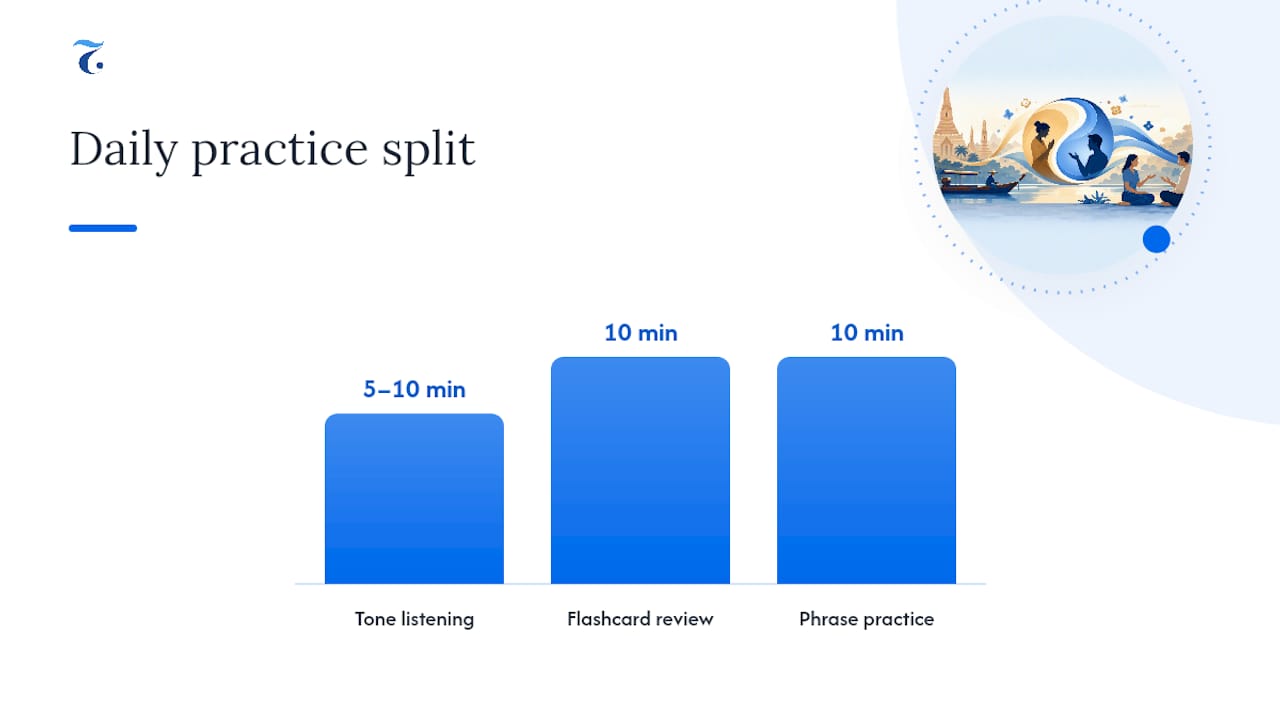
An 8-week starter plan, run alongside whatever course format you pick, is enough to build real momentum. The daily routine should take 15 to 30 minutes: five to ten minutes of tone listening (slowed native audio, repeated), ten minutes of spaced-repetition flashcard review, and ten minutes of phrase practice where you record yourself and compare it against a native speaker’s pronunciation. Recording your own voice and comparing it to slowed native audio produces measurable tone accuracy gains even over short training blocks, which makes it one of the highest-value five-minute habits in the entire plan.
Weekly, aim for four concrete targets:
- Two roleplay sessions, either with a class partner, a tutor, or a language exchange contact.
- One full review pass through your vocabulary deck, testing recall in both directions (Thai to English and English to Thai).
- One short reading exercise, even just a few sentences, to start connecting sounds to script.
- One honest self-check: record a 60-second monologue about your day and listen back for tone slips.
Roleplay scenarios should rotate weekly rather than repeating the same script:
- Week 1 to 2: ordering food and drinks, including polite requests and basic complaints.
- Week 3 to 4: asking for and giving directions, understanding transport vocabulary.
- Week 5 to 6: small talk with a taxi driver or shopkeeper, including weather and simple personal questions.
- Week 7 to 8: handling an unexpected problem, like a wrong order or a missed bus, in Thai.
Tools that genuinely help here fall into four categories: audio-heavy lessons for tone modeling, spaced-repetition flashcard apps for vocabulary retention, a simple voice-recording app for self-feedback, and a roleplay partner, whether that’s a classmate, tutor, or structured guide for building daily speaking habits. A deeper breakdown of the five tones themselves, including where most English speakers stumble, is worth a closer look before you start the plan.
What Makes Thai Explorer a Reliable Choice for Adult Learners?
Every criterion in the checklist above points back to a simple question: does the provider actually deliver on it, or just claim to? Thai Explorer’s course structure answers that question in a few specific, checkable ways.
- Instructors are native Thai speakers who are also fully bilingual in English, so grammar and tone explanations don’t get lost in translation.
- The curriculum is aligned with CU-TFL proficiency benchmarks, giving learners a measurable outcome standard rather than a vague “beginner to intermediate” label.
- Learning is immersive rather than purely classroom-based, weaving cultural context into practical language use.
- Class formats include group, private, and online Zoom options, matching the flexibility adult learners actually need.
- The training center sits at 10 Anson Road, #22-07, International Plaza, Singapore 079903, directly above Tanjong Pagar MRT, which removes the usual excuse of a commute being too inconvenient for a weekday evening class.
Mapped against the choosing checklist from earlier: bilingual native instructors solve the “can they explain tone rules clearly” problem directly. CU-TFL alignment solves the “what will I actually be able to do” problem, since it ties progress to an external proficiency reference instead of a marketing promise. And flexible formats solve the scheduling problem that kills more adult language goals than lack of motivation ever does.
The gap between a course that lists Thai phrases and one that builds real proficiency almost always comes down to whether tone instruction and cultural context are treated as core curriculum, not extras bolted onto a vocabulary list.
What Adults Consistently Get Wrong About Learning Thai
The biggest misconception about Thai isn’t that it’s hard, it’s that grammar is the hard part. It isn’t. Thai grammar is comparatively forgiving, no verb conjugations, no noun genders. The actual bottleneck is tone perception, and most self-study approaches skip straight past it in favor of memorizing vocabulary lists, which is exactly backward.
Conventional advice tells beginners to “just practice speaking” without specifying what to practice. That’s not wrong, but it’s incomplete. Speaking without tone correction just cements bad habits faster. What the evidence in this guide actually supports is narrower and more useful: prioritize tone training paired with consonant class recognition before you sink hours into expanding vocabulary. A 500-word vocabulary spoken with unreliable tones is less useful in Bangkok than a 100-word vocabulary spoken with tones a local can actually parse.
If you take one thing from this article, make it this: choose your first few weeks of study around your ears, not your memory. Vocabulary catches up. Tone habits, once set wrong, rarely do.
— Paul
How to Book a Trial Class and Get Started
Getting started is a short sequence, not a big decision. First, pick a level, most adult beginners start at A1, but if you’ve studied Thai before or have some exposure through travel, ask about placement into A2. Second, book a trial class so you can hear the teaching style and tone-drilling approach before committing to a full term. Third, choose your format: group for steady peer-driven progress, private for a schedule built entirely around you, or online Zoom if commuting to a physical class isn’t realistic most weeks.
Thai Explorer runs all three formats from one course page, where you can compare group, private, and online Zoom options side by side and confirm scheduling and payment details before your first session. If travel or cultural immersion is your main goal rather than business use, the travel and culture-focused course track is built specifically around that. Not sure which format fits your week? The class-matching guide walks through group versus private versus online based on your schedule and goals in a few minutes.
Every format includes native bilingual instructors and the same CU-TFL-aligned curriculum, so the choice between them is about logistics, not quality. Book your trial class now and find out within one session whether the teaching style matches how you learn best.
Sources
For a deeper look at pronunciation mechanics, the complete guide to Thai tones and tone exercise drills are useful next steps. To verify how consonant classes affect tone assignment, see the explanation of Thai consonant classes, and for the cultural weight of politeness particles, check this breakdown of kráp and kâ. Adults looking for extra speaking practice beyond class can also check Thai language events in Singapore.
FAQ
Is Thai an easy language to learn?
Thai grammar is comparatively simple, with no verb conjugations or noun genders, but the five tones and a non-Latin script make pronunciation the real challenge for most English speakers. Difficulty depends heavily on whether you get sound-first tone training early, rather than on the language itself.
What is the best way to learn to speak Thai?
The most effective approach combines structured tone drills, consonant class recognition, and regular roleplay practice with a native bilingual instructor who can correct pronunciation in real time. Self-study tools like spaced-repetition flashcards and recorded audio comparison support this but rarely replace live correction.
How long does it take to learn Thai fluently?
Survival-level competence, ordering food, asking directions, basic introductions, is realistic within a few months of consistent lessons and daily practice. Sustained conversational fluency at a B1 level typically takes longer, often the better part of a year of regular study.
Can I learn Thai in 2 months?
In two months of consistent daily practice, most adult learners can reach basic survival-level Thai, enough for greetings, simple transactions, and short exchanges, but not full conversational fluency. An intensive course or an 8-week structured practice plan focused on tones and roleplay makes that survival-level goal achievable for most beginners.