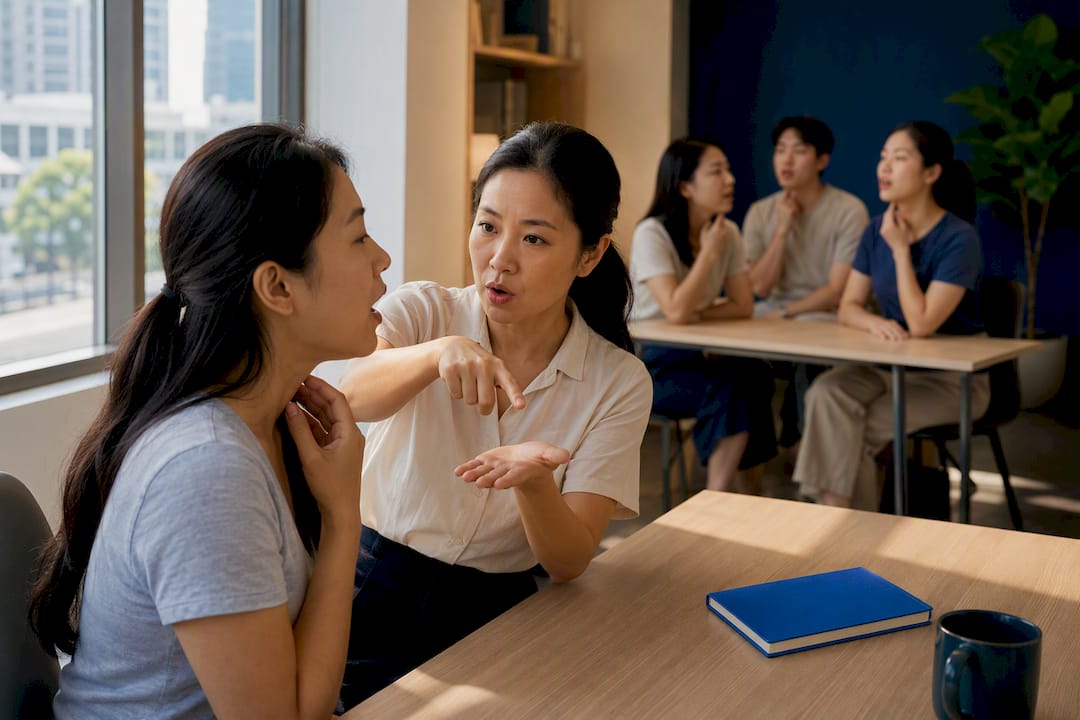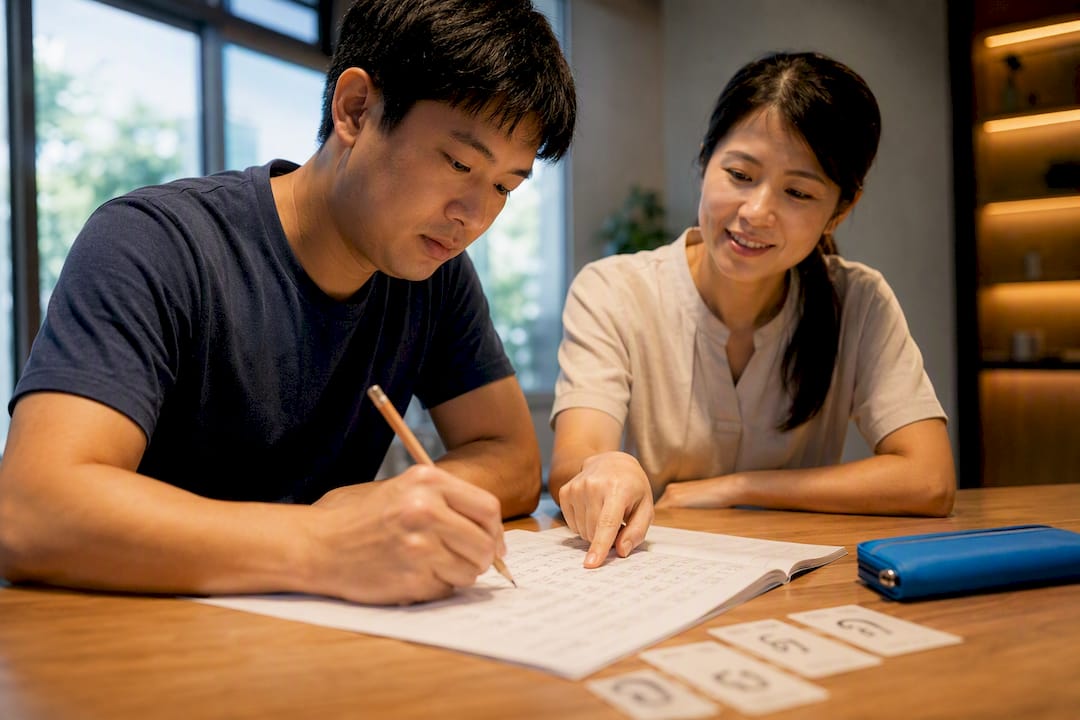
At its core, culture in Thailand centers on four pillars: Theravada Buddhism, hierarchical respect, tight-knit family ties, and sanuk, a life philosophy that puts enjoyment and harmony above rigid rules. Understanding these four ideas unlocks almost everything else you will encounter, from why people wai each other on the street to why a festival can be both a solemn temple ritual and a citywide water fight on the same afternoon.
This guide covers what you actually need to navigate Thailand with confidence and courtesy:
- The role of Buddhism, temples, and history in shaping daily life
- Everyday etiquette: the wai, hierarchy, dress codes, and polite speech
- Major festivals like Songkran and Loy Krathong, and how to join them respectfully
- Performing arts, food customs, family values, and traditional architecture
By the end, you will be able to greet people correctly, behave appropriately at a temple or festival, and know exactly where to go if you want to build real fluency in Thai language and culture.
Key Takeaways
Respecting Thai culture comes down to understanding Buddhism’s daily influence, practicing correct etiquette around hierarchy and the wai, and joining festivals with awareness of their deeper meaning.
| Point | Details |
|---|---|
| Buddhism shapes daily rhythm | Roughly 85% of Thais practice Theravada Buddhism, with temple visits and merit-making built into ordinary routines. |
| Master the wai correctly | Let seniority determine who initiates the gesture, and always return a wai from an elder or monk. |
| Cover up and remove shoes | Modest dress and bare feet are expected at temples and most homes, non-negotiable parts of respectful visits. |
| Festivals carry dual meaning | Songkran and Loy Krathong blend solemn religious ritual with public celebration; participate in both layers. |
| Saving face guides communication | Indirect refusals and softened feedback reflect greeng-jai and face-saving norms, not evasiveness. |
Table of Contents
- Core Cultural Pillars: Religion, History, and National Identity
- How Do You Greet People and Behave Politely in Thailand?
- What Are the Major Thai Festivals and How Do You Join Them?
- Performing Arts, Sport, and National Symbols
- Food Culture and Dining Etiquette
- Family, Social Values, and How Thais Communicate
- How to Respectfully Experience Thai Culture
- Traditional Thai Housing and Architecture
- Primary Sources and Further Reading
- What This Guide Gets Right That Most Travel Content Misses
- Sources
- FAQ
Core Cultural Pillars: Religion, History, and National Identity
Buddhism is not a Sunday activity in Thailand. It is woven into the rhythm of ordinary life. Roughly 85% of the population practices Theravada Buddhism, and the country holds more than 40,000 temples, called wats, many of which see foot traffic before most offices open for the day.
Merit-making, known as tam bun, drives a lot of daily behavior that visitors misread as purely aesthetic. A vendor lighting incense before opening her stall, a taxi driver tapping a dashboard amulet, a family bringing food to monks at dawn: these are not photo opportunities, they are transactions in a spiritual economy where good actions accumulate merit for this life and the next.
Buddhism shapes daily life through:
- Morning alms rounds where monks walk fixed routes collecting food
- Temple visits before exams, job interviews, or long trips
- Merit-making ceremonies tied to birthdays, deaths, and New Year
- Amulets and blessed objects carried for protection
Older spiritual layers still visible today
Buddhism arrived in Thailand on top of older animist and Hindu belief systems, and it never fully erased them. Spirit houses, the small ornate shrines standing outside homes, offices, and even shopping malls, exist to give displaced land spirits somewhere comfortable to live so they leave the humans alone. Skip the daily offering of flowers or a red soda bottle at your peril, or so many Thai business owners believe.
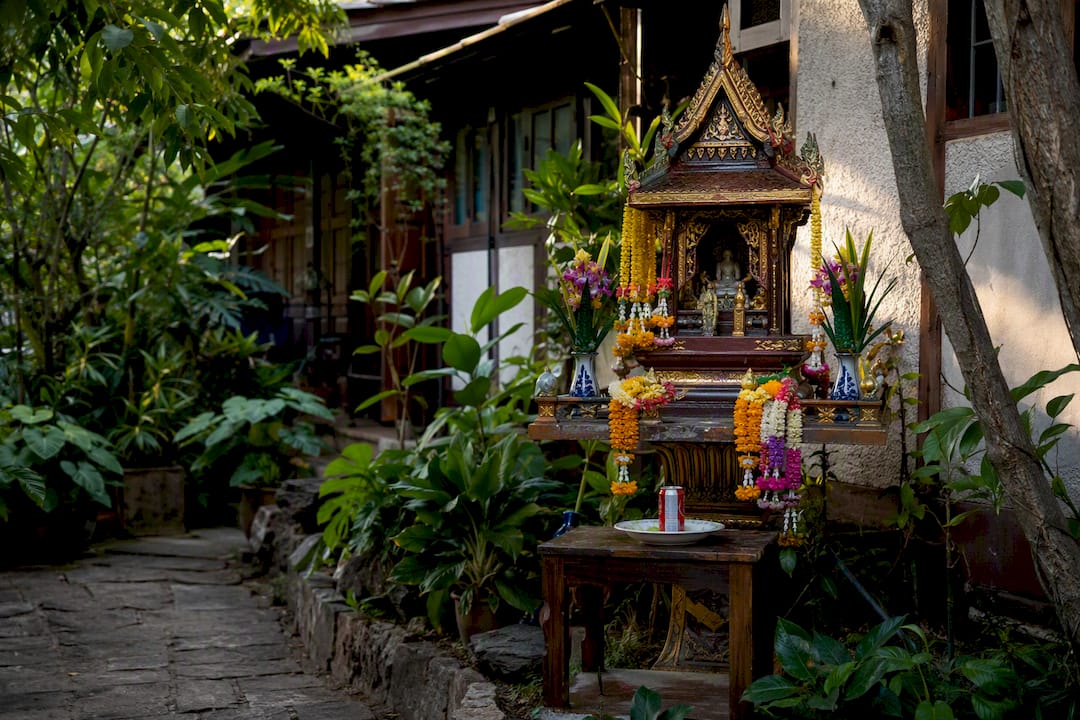
Hindu deities also survive in surprising places. The Erawan Shrine in central Bangkok, dedicated to the four-faced Brahma, draws worshippers of every background, and royal ceremonies still borrow Brahmin ritual elements dating back centuries. This blending, Buddhist doctrine layered over animist and Hindu practice, is one of the more genuinely surprising things about Thai spiritual life once you look past the surface.
How history built the culture you see today
Thai identity absorbed waves of outside influence long before globalization made that word fashionable. Indian traders brought Sanskrit vocabulary, legal concepts, and the Ramayana epic, which the Thai eventually rewrote as their own Ramakien. Khmer architects left their fingerprints on temple design and royal court structure, visible in the shape of prang towers borrowed from Angkor. Chinese merchant communities, some arriving centuries ago, shaped Thai commerce, cuisine, and intermarried into the aristocracy itself.
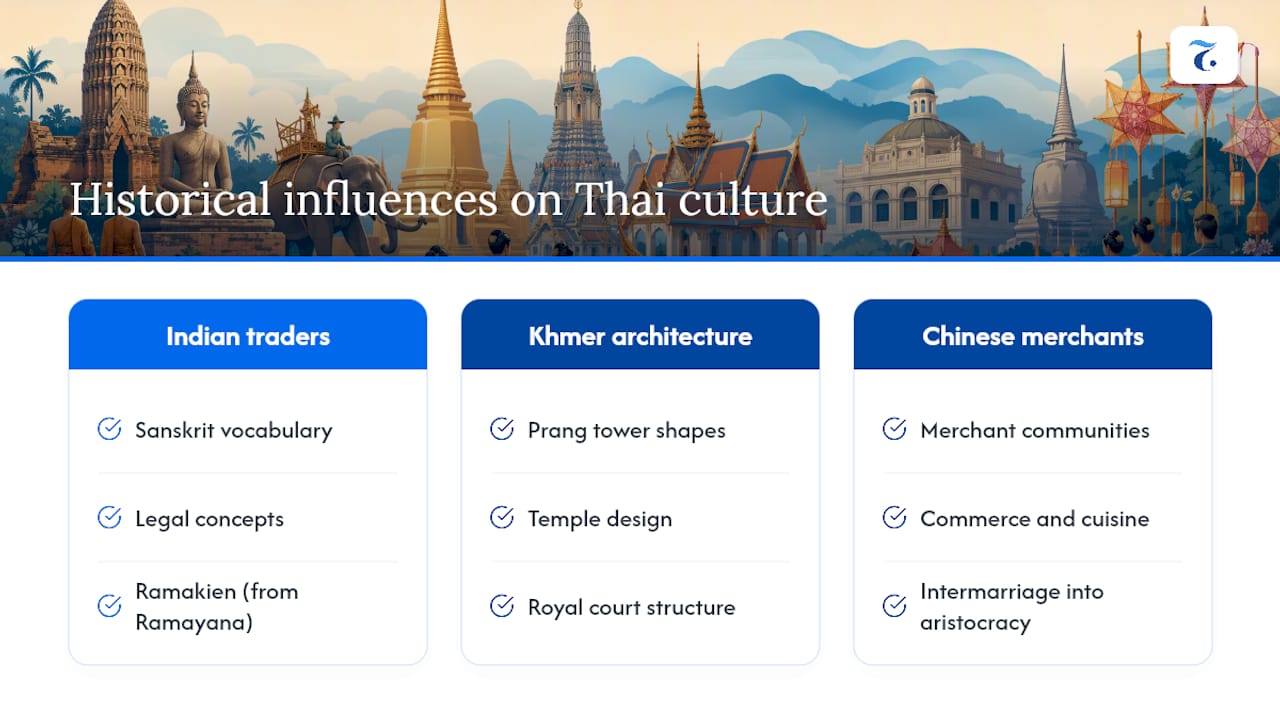
What ties all of it together is a set of national symbols that Thai people encounter daily: the flag’s red, white, and blue bands representing nation, religion, and monarchy; the national anthem played twice a day in public spaces; and portraits of the royal family displayed in homes, shops, and government buildings. These symbols function less as decoration and more as a shared civic language that reinforces belonging across a country with substantial regional and ethnic diversity. Readers who want a broader entry point into how these pieces fit together can start with this overview of Thailand’s culture and Buddhist influence.
How Do You Greet People and Behave Politely in Thailand?
The wai is the single most visible custom in Thai social life, and getting it slightly wrong will not ruin your trip, but getting it right will earn you genuine goodwill. The gesture, pressed palms and a slight bow of the head, looks simple. The rules behind it are not.
Seniority determines who moves first. A younger person, a subordinate, or someone receiving service typically initiates the wai toward an elder, a boss, or a monk, and failing to return a wai is considered impolite in most social contexts). Hand height also carries meaning: hands held at chest level suit a casual greeting between peers, while a wai to a monk or an image of the Buddha rises higher, closer to the forehead. Monks, notably, do not wai back to laypeople, which surprises visitors who expect the gesture to be automatically reciprocal.
- Wait to see if a wai is offered first, especially with staff, strangers, or service workers, since not every interaction calls for one.
- Match the gesture rather than initiate it when you are unsure of someone’s social standing relative to yours.
- Skip the wai for young children and service transactions like paying a cashier, where a simple nod does the job.
- Never wai while holding food, drink, or bags in your dominant hand. Set things down first.
- Return a wai from an elder or a monk with a slightly lower bow of the head as a mark of respect.
Pro Tip: If you genuinely don’t know whether to wai someone, hesitate rather than guess wrong. A slight nod and a smile cover almost any greeting gap without risking an awkward gesture toward someone who outranks you.
Head, feet, and the body language nobody warns you about
Thai body etiquette runs on a simple spatial hierarchy: the head is the most sacred part of the body, the feet are the least. That single idea explains a surprising number of rules. Never touch someone’s head, even a child’s, even affectionately. Never point your feet at a person, a Buddha image, or a temple altar. Never step over someone sitting or lying on the floor. Sitting cross-legged with the soles of your feet aimed at a monk during a temple visit is one of the more common accidental insults tourists commit, and almost nobody tells them afterward.
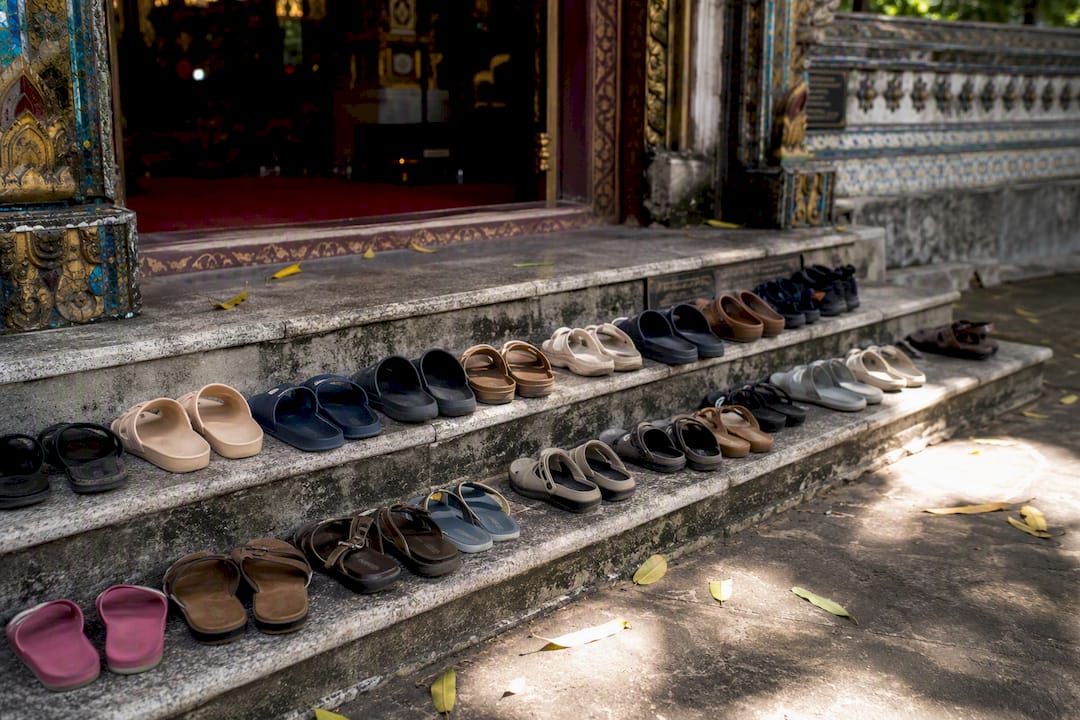
Shoes come off before entering homes, most temples, and some shops and clinics. Look for a pile of sandals at the entrance; if you see one, follow it. At wats, dress modestly: shoulders and knees covered, nothing sheer, nothing sleeveless for the most solemn sites. Official guidance on temple conduct consistently lists shoe removal, modest dress, and respectful behavior toward monks as the baseline expectations, and these rules apply whether you are a first-time visitor or someone who has lived in the country for years.
Photography inside temples requires more judgment than most tourists apply. Photographing monks without permission, especially up close, reads as disrespectful. Flash photography near Buddha images during active prayer draws quiet but real disapproval. When in doubt, watch what locals do before raising your camera.
The words that carry respect
Spoken Thai builds hierarchy directly into its grammar. The particles krub (for men) and ka (for women) attach to the end of sentences to soften statements and signal politeness, roughly the equivalent of adding “please” and “sir” simultaneously to nearly everything you say. Dropping them entirely, especially with elders, teachers, or service staff, can sound abrupt even when your Thai vocabulary is otherwise fine.
Thai communication also leans indirect. Direct criticism, blunt refusals, and public disagreement are far less common than in many Western workplaces, because confrontation risks making someone lose face, a concept that governs far more Thai behavior than most guides admit. Learning to read a hesitant “maybe” as a soft “no” will save you real frustration, particularly in business settings. For a deeper look at the specific phrases and situations where this indirectness shows up, see this guide to communication taboos in Thai culture.
What Are the Major Thai Festivals and How Do You Join Them?
Songkran is where most people’s mental image of Thai festivals begins and ends, and it genuinely deserves the reputation, though not for the reason most people assume. Held in mid-April to mark the traditional Thai New Year, Songkran runs on two tracks simultaneously: a quiet religious layer built around merit-making, and a loud public layer built around throwing water at absolutely everyone.
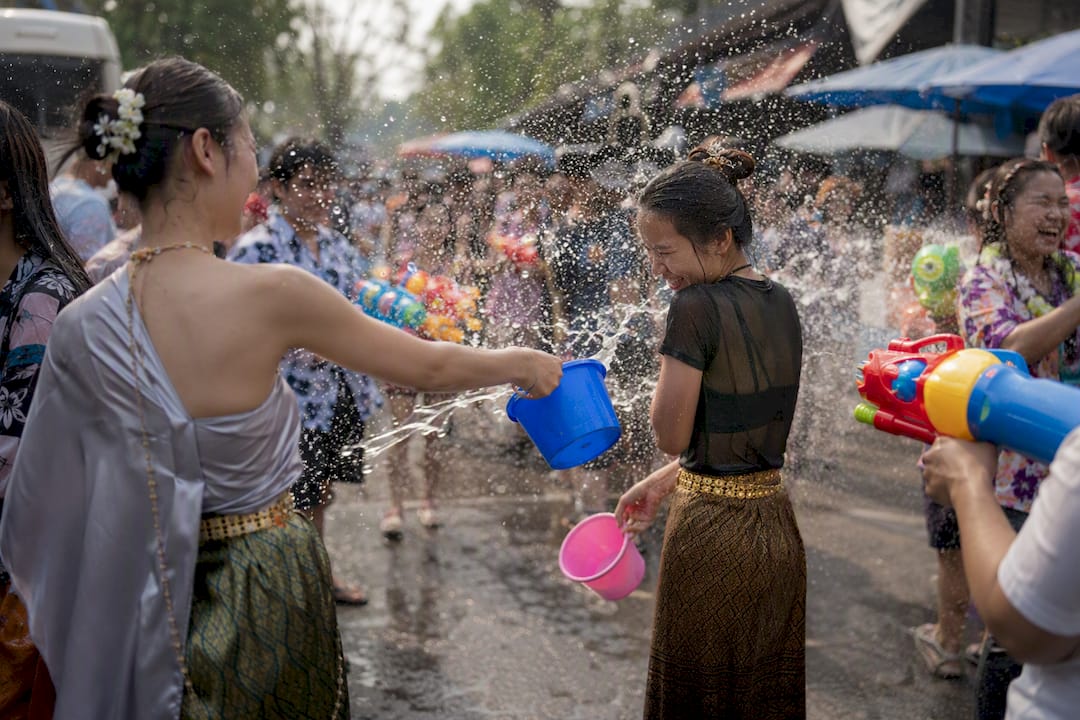
The religious side includes Rod Nam Dam Hua, where younger family members pour scented water over the hands of elders to ask forgiveness and receive blessings, and morning alms-giving at local temples. The public side is the nationwide water fight most visitors picture: streets full of buckets, water guns, and strangers soaking each other with genuine joy rather than aggression. Both halves matter. Skipping the temple visit to go straight for the water fight misses the point Thai families actually built the holiday around.
Loy Krathong and Yi Peng typically fall in November, timed to the full moon of the twelfth lunar month, and offer a gentler, more visually striking experience. During Loy Krathong, people release small floating vessels, krathongs, made from banana leaves, flowers, and incense, onto rivers and canals to symbolically let go of grudges, bad luck, and misfortune from the past year. In northern Thailand, Yi Peng overlaps with Loy Krathong and adds thousands of glowing paper lanterns released into the night sky, an image that has become one of the most photographed sights in the country.
Other notable festivals worth knowing:
- Phi Ta Khon (Loei province): a colorful spirit-mask festival blending Buddhist and animist ritual
- The Vegetarian Festival (Phuket): nine days of strict vegetarian eating tied to Chinese-Thai spiritual purification, including striking public rituals
- Regional harvest festivals: timing and customs vary by province, reflecting local agricultural calendars
Participating without causing harm
Lantern releases look magical and carry real environmental and safety risk. Spent paper lanterns have caused fires, crop damage, and injuries to aircraft and livestock in some regions, which is why several provinces now restrict or regulate releases during Yi Peng. If you join, use commercially sold biodegradable krathongs rather than styrofoam, and only release lanterns where local authorities permit it.
For Songkran, expect to get thoroughly soaked if you leave your hotel between roughly midday and early evening in tourist areas, and protect phones and cash accordingly. None of this is optional bad luck. It is the entire premise of the holiday, and trying to stay dry mostly just marks you as a target.
Performing Arts, Sport, and National Symbols
Khon sits at the top of Thailand’s performing arts hierarchy, and for good reason. This masked dance drama grew out of royal court tradition, dramatizes episodes from the Ramakien (the Thai retelling of the Indian Ramayana), and combines elaborate costuming, stylized gesture, and live orchestral accompaniment into something closer to total theater than simple dance. In 2018, UNESCO inscribed Khon on its Representative List of the Intangible Cultural Heritage of Humanity, formally recognizing what Thai audiences already knew: this art form carries centuries of accumulated craft that deserves active preservation, not museum-piece treatment.
Khon performances are not simply revived relics of a royal past. They remain a living practice, one that UNESCO’s own listing frames as heritage that continues to be taught, performed, and reinterpreted rather than frozen behind glass.
You can see Khon performed at Bangkok’s Sala Chalermkrung Royal Theatre and at the National Theatre, along with occasional performances tied to royal ceremonies and cultural festivals.
Khon is not the only performing art worth knowing. Lakhon covers a broader family of classical dance dramas, often gentler and more romantic in theme than Khon’s epic battles. Likay is Thailand’s folk theater answer, looser, funnier, and more improvisational, closer to a village variety show than a royal court production. Regional folk dances, grouped loosely under Fon, vary significantly by area and often incorporate local instruments and harvest themes rather than palace mythology.
A few notes on how these traditions survive today:
- Classical performing arts declined through the mid-20th century as urbanization and Western entertainment drew audiences away
- A revival beginning in the 1970s restored much of this repertoire, largely through formal education
- University fine arts programs now train most professional performers, replacing the old apprenticeship model
- Performances increasingly appear at cultural festivals aimed at both domestic and international audiences
Muay Thai deserves mention alongside dance and drama, not as an afterthought but as a genuine cultural export. The sport blends combat technique with ritual: fighters perform the Wai Kru Ram Muay before every match, a dance paying respect to teachers and training lineage, accompanied by live traditional music. It is one of the clearest examples of how Thai culture treats even a full-contact sport as an occasion for ceremony.
Food Culture and Dining Etiquette
Thai meals are built for sharing, and eating alone from your own plate at a group meal, Western-buffet style, reads as slightly odd to Thai hosts. Dishes arrive in the center of the table, and everyone spoons small portions onto their own rice as the meal progresses, balancing sweet, sour, salty, and spicy flavors across multiple dishes rather than concentrating flavor in one plate.
Elders and guests of honor typically get served first, or at least get first pick of the best portions, and it is polite to wait for them to start eating before you dig in. Ordering enough dishes for the whole table to sample, rather than one dish per person, is the norm at a proper Thai meal.
A few signature dishes worth knowing before you sit down:
- Tom Yum Goong: sour, spicy shrimp soup, arguably Thailand’s most internationally recognized dish
- Som Tam: green papaya salad, a Northeastern (Isan) staple that ranges from mild to aggressively spicy
- Pad Thai: stir-fried noodles, ubiquitous but genuinely regional in flavor and preparation
- Massaman Curry: a milder, Muslim-influenced curry showing Thailand’s southern and trade-route influences
- Khao Soi: a northern coconut curry noodle dish, distinct from central Thai flavors
The fork-and-spoon convention trips up a lot of first-time visitors. The spoon does the actual eating; the fork exists to push food onto the spoon, not to enter your mouth directly. Chopsticks appear mainly for noodle dishes with Chinese influence, not for rice-based meals.
Street food remains central to daily eating, not a tourist novelty. Choose stalls with high turnover and visible cooking, since food sitting out uncooked longer carries more risk than food fried or grilled fresh in front of you. And when offering food to monks or elders, use your right hand, or both hands together, never your left hand alone, which carries negative associations in many Southeast Asian etiquette systems.
Family, Social Values, and How Thais Communicate
Thai family structure tends to be multigenerational, with grandparents, parents, and children often living under one roof or nearby, and adult children carrying real expectations to support aging parents financially and practically. This is not viewed as a burden so much as a basic repayment of the debt owed for being raised, a concept closely tied to Buddhist ideas about merit and obligation.
Two concepts do more work in Thai social life than almost anything else: saving face and greeng-jai. Saving face means avoiding public embarrassment, for yourself or for others, even at the cost of directness. Confronting someone’s mistake in front of colleagues, raising your voice in an argument, or bluntly rejecting a proposal all risk causing someone to lose face, and Thai social norms treat that outcome as something to avoid almost at all costs.
Greeng-jai, often translated loosely as “consideration” or “reluctance to impose,” describes the discomfort many Thai people feel about asking for help, refusing a request, or burdening someone else, even when they genuinely need to. Core social values around respect, self-control, and non-confrontation sit underneath both concepts, alongside the more famous ideas of sanuk (making things enjoyable) and mai pen rai (a philosophical “never mind, it’s okay” that shows up constantly in daily frustrations).
How this plays out practically:
- A Thai colleague may say “maybe” or “I’ll try” instead of a direct “no” to avoid conflict
- Public criticism of an employee’s work is far less common than private, softened feedback
- Business negotiations often move slower than Western counterparts expect, prioritizing relationship-building over speed
- Visible anger or frustration in public is viewed as a loss of self-control, damaging to the person expressing it
Understanding greeng-jai alone will change how you interpret half the “yeses” you get in Thailand.
How to Respectfully Experience Thai Culture
Reading about wais and temple etiquette only gets you so far. At some point you have to show up, and a few concrete habits separate visitors who blend in respectfully from those who accidentally cause a scene.
- Dress modestly before you arrive at any temple. Shoulders and knees covered, shoes ready to remove, and a scarf packed if you plan to visit multiple wats in one day.
- If you want to try Tak Bat (morning alms-giving), buy offerings at a local market around 5:30 AM rather than from vendors targeting tourists near the route, approach quietly, and place items directly into the monk’s bowl without expecting thanks or eye contact in return.
- At festivals, watch before you participate. Songkran water etiquette and Loy Krathong krathong placement both have unwritten local rules that become obvious after five minutes of observation.
- Learn three phrases before anything else: Sawasdee (hello), a thank-you paired with krub or ka depending on your gender, and a simple apology like khor thot. These three cover an enormous share of daily interactions.
- Book a hands-on cultural activity, a market tour, a Thai cooking class, or a classical dance performance, since direct experience teaches nuance that guides cannot.
Pro Tip: Practicing krub or ka out loud before your trip, even alone in your kitchen, builds the muscle memory to use it automatically once you’re actually speaking with someone. It is a small habit that changes how every interaction lands.
If you want to go beyond a single trip and build lasting fluency in both the language and the cultural logic behind it, Com runs adult-focused Thai courses designed specifically for conversational and business use, with group, private, and online Zoom options taught by bilingual native instructors. The curriculum aligns with CU-TFL standards and covers cultural context alongside grammar and vocabulary, so students learn not just what to say but when saying it directly would cause someone to lose face. For readers who want structured activities that reinforce exactly the kind of experiences described above, this guide to Thai cultural activities covers cooking classes, market visits, and performance recommendations in more depth.
Traditional Thai Housing and Architecture
Traditional Thai houses evolved around the country’s tropical climate and seasonal flooding, and the classic elevated stilt house remains the clearest architectural signature of the culture. Raising the living space above ground level protected homes from monsoon flooding, allowed air to circulate underneath for cooling, and created sheltered storage or workspace beneath the main structure.
Steeply pitched roofs, often with distinctive upward-curving gables, shed heavy rain quickly and reflect design elements shared with Khmer and Lao architecture from the region’s shared history. Teak wood construction dominated traditional builds, prized for durability against humidity and insects, and many older homes still standing in rural provinces use woven bamboo or palm-leaf panels for walls that allow airflow while blocking direct sun.
Temple architecture follows its own distinct logic, built around the prang (a Khmer-influenced corncob-shaped tower) or the chedi (a bell-shaped stupa housing relics), both oriented to reflect Buddhist cosmology rather than practical living needs. Roof lines on temple buildings typically layer in tiers, each tier symbolically separating heaven from earth, and gilded or brightly tiled surfaces reflect sunlight in a way that plain residential construction never attempts. Regional variation is significant. Northern Lanna-style temples look distinctly different from central Thai royal wats, which differ again from the Islamic-influenced architecture found in the deep south.
Primary Sources and Further Reading
- UNESCO’s official listing for Khon documents the masked dance drama’s inscription as intangible cultural heritage and its royal court origins.
- PRD Thailand’s cultural revival material covers how classical arts declined and were later restored through education.
- Thaiembassy lays out official guidance on temple conduct, dress, and behavior toward the monarchy.
- IBC World’s Thailand summary provides population and temple figures behind Buddhism’s national reach.
What This Guide Gets Right That Most Travel Content Misses
Most cultural explainers treat etiquette as a list of rules to memorize and festivals as photo opportunities, missing the logic that connects them. The wai, the shoe removal, the indirect refusal at work, they all trace back to the same handful of ideas: hierarchy, face, and merit. Once you see that connection, you stop guessing and start understanding why a gesture matters.
Where I think most guides fall short is treating culture as static, something to observe rather than something you can genuinely participate in. Watching a Khon performance or joining Songkran passively is fine, but real fluency, cultural or linguistic, comes from sustained contact: conversations, corrections, mistakes made and explained. That is a different commitment than reading a list of dos and don’ts before a flight.
If there’s one thing to prioritize, it’s this: learn enough Thai to ask questions rather than just follow instructions. That single shift changes tourism into genuine cultural exchange.
— Paul
Sources
- IBC World — Thailand diaspora / country summary
- UNESCO — Khon, masked dance drama in Thailand
- Thaiembassy
- PRD Thailand — Cultural revival and preservation of classical arts
FAQ
What Are the 12 Thai Values?
Thailand’s twelve core values were promoted as a national civic framework covering respect for nation, religion, and monarchy, honesty, self-discipline, and gratitude toward parents and teachers, among other traits. They function more as a government-promoted moral guideline than a strict cultural checklist, and everyday values like sanuk and saving face matter just as much in practice.
What Is Popular Culture Like in Thailand?
Modern Thai popular culture blends Thai pop music (T-pop), long-running soap operas called lakorn, Muay Thai as both sport and spectacle, and a thriving street food and night market scene, all layered on top of the older traditions of classical dance and Buddhist ritual.
What Are the Do’s and Don’ts in Thai Culture?
Do remove your shoes before entering temples and homes, dress modestly at wats, and return a wai from an elder. Don’t touch anyone’s head, point your feet at people or Buddha images, or raise your voice in public disagreement, since official etiquette guidance treats all of these as clear social violations.
What Are Five Facts About Thailand’s Culture?
Roughly 85% of Thais practice Theravada Buddhism with over 40,000 temples nationwide; Khon masked dance is UNESCO-listed intangible heritage; Songkran combines religious merit-making with public water celebrations; the wai greeting follows strict seniority rules; and spirit houses outside buildings reflect surviving animist belief predating Buddhism’s arrival.
How Can I Start Learning About Thai Culture and Language Together?
Structured Thai courses that combine language instruction with cultural context, like the group, private, and online classes offered by Com at International Plaza in Singapore, give learners practical tools for both conversation and cultural navigation. Explore the Thai language courses page to see available formats.