
Most adults who want to learn Thai should start with a phrase-first conversational course, not a grammar-heavy textbook program, and pick a format (group, private, or online) that matches their weekly schedule rather than an idealized one. Learners who follow this path typically handle greetings, ordering food, and simple small talk within a matter of weeks. Thai Explorer builds its entry-level courses around exactly this model, with group, private, and online formats available depending on how much one-on-one attention and flexibility you need.
TL;DR:
- Learners should prioritize phrase-first conversational courses tailored to their schedule over grammar-heavy textbooks for quicker practical speaking skills.
- Online classes and private lessons offer flexibility and personalized pacing, while group classes are more affordable but less adaptable to individual needs.
- Focus on high-frequency phrases like greetings, ordering food, directions, and bargaining, combined with cultural awareness to build confidence quickly.
- Consistent daily practice, including media exposure, language exchange, and brief immersion, accelerates progress beyond classroom instruction.
- Combining app-based drills with live instruction improves tone accuracy and conversational fluency faster than relying on software alone.
Table of Contents
- Thai Language Courses for Adults: Which Format Fits Your Life?
- What Do You Actually Learn at Each Course Level?
- Priority Phrases and Cultural Rules Every Beginner Should Practice First
- How Do You Choose the Right Adult Thai Course?
- Why Thai Explorer’s Approach Matches What Adult Learners Need
- What Makes Learning Thai Hard for Adults, and How to Get Past It
- How to Keep Practicing Thai Outside Class
- Can Apps Actually Help You Learn Thai Faster?
- How Do Adult Learners Get Assessed or Certified in Thai?
- Why Community and Immersion Opportunities Matter
- A Teaching Note on What Actually Gets Adults Speaking
- Ready to Start Speaking Thai? Here’s How to Book a Trial
- Where to Learn More About Thai Language and Course Structures
- Sources
- FAQ
Thai Language Courses for Adults: Which Format Fits Your Life?
The format you choose matters more than most people expect. A brilliant curriculum delivered in a format that clashes with your schedule or learning style gets abandoned by week three. Here’s what each option actually delivers.
Group classes put you in a room (or a Zoom call) with four to ten other adults working through the same syllabus at the same pace. You get structured weekly lessons, built-in speaking partners for roleplay drills, and a lower price point than private tuition. The tradeoff: pacing is fixed to the group’s average, so a fast learner might feel held back and a slower one might feel rushed. Group formats work best for commuter professionals who want a set weekly rhythm and enjoy the social pressure of showing up for classmates.
Private lessons flip that equation. You set the pace, and the instructor customizes vocabulary toward what you actually need, whether that’s negotiating supplier contracts in Bangkok or chatting with in-laws over dinner. Private classes cost more per hour, but for someone with a narrow, urgent goal (an upcoming relocation, a client-facing role, a wedding), the focused pace often pays for itself in fewer wasted sessions.
Online Zoom classes run the same curriculum as in-person sessions, just delivered remotely. This matters more than it sounds. A poorly run online course strips out the interactive parts and leaves you watching slides; a well-run one preserves live roleplay, tone correction, and instructor feedback while removing the commute. For shift workers, frequent travelers, or anyone juggling irregular hours, online Thai classes solve the scheduling problem without sacrificing the interaction that makes conversational learning stick.
Corporate training is a separate track built for teams. Companies with staff relocating to Thailand, or client-facing employees who deal with Thai partners regularly, often bring in tailored workplace modules focused on business etiquette, meeting phrases, and industry-specific vocabulary. Delivery can happen on-site or virtually, and sessions are usually built around the actual job function rather than generic textbook chapters.
- Group classes: cost-efficient, social, fixed pace
- Private lessons: flexible pace, targeted vocabulary, higher cost
- Online Zoom: same curriculum, maximum scheduling flexibility
- Corporate training: workplace-specific content, on-site or virtual
Pro Tip: If you’re not sure which format fits, book a trial lesson in both a group and a private setting before committing to a term. The difference in energy and pacing becomes obvious within one session.
What Do You Actually Learn at Each Course Level?
Level progression in Thai isn’t just about adding vocabulary. Each stage changes what kind of conversation you can actually survive, and knowing what to expect keeps you from feeling stuck when the material gets harder.
Beginner level focuses on survival phrases: greetings, numbers, ordering food, asking for directions, and basic self-introductions. This is also where tone awareness gets built. Thai is a tonal language with five distinct tones, and getting the tone wrong on a word can change its meaning entirely rather than just sounding accented. Beginner courses drill this early because bad tone habits are hard to unlearn later.
Intermediate level shifts from memorized phrases to sustained conversation. You start handling situational roleplays (bargaining at a market, describing a problem to a landlord, making small talk with coworkers) and your grammar expands enough to talk about past and future events, not just the present moment. This is usually where courses introduce more reading, since recognizing signs and menus becomes practical rather than academic.
Advanced level covers nuanced registers, including the difference between casual speech with friends and the more formal register used with elders or in business settings. Business Thai, contract vocabulary, and presentation skills often live here. Reading and writing in Thai script also get serious attention at this stage for learners who want full literacy rather than conversational fluency alone.
A common question is whether to learn the Thai script from day one or delay it. Programs vary on this. Institutional programs like the National University of Singapore’s Thai language course structure their curriculum across numbered levels that build grammar, reading, and conversation in parallel from the start. Other approaches stay phrase-first and romanized longer, prioritizing speaking confidence before literacy. Neither is wrong. The right choice depends on your goal: if you’re moving to Thailand long-term or need to read contracts, script literacy earns its place early. If your goal is smoother travel and everyday conversation, staying phrase-first for longer often gets you speaking faster.
Placement usually happens one of two ways: a short placement test that checks existing vocabulary and tone recognition, or a trial class where an instructor gauges your level through conversation. Either method should place returning learners accurately rather than forcing everyone through beginner material they’ve already mastered.
- Beginner: survival phrases, tone training, simple exchanges
- Intermediate: sustained conversation, expanded grammar, roleplay
- Advanced: business Thai, formal register, reading and writing
One structured online platform, StudyThai, reports that learners who commit to 30 minutes of daily tone and vocabulary drills can reach basic conversational ability in about 2 to 3 months, which lines up with what most course providers see when a beginner attends consistently and practices between sessions.
Priority Phrases and Cultural Rules Every Beginner Should Practice First
Adult learners get the fastest confidence boost from a small set of high-frequency phrase categories, not from trying to memorize a dictionary. Focus your first few weeks on these:
- Greetings and politeness particles. “Sawasdee” changes slightly depending on who’s speaking, because Thai uses gendered sentence-ending particles (“khrap” for male speakers, “kha” for female speakers) attached to polite statements and questions. Getting this right immediately signals respect and cultural awareness, even before your vocabulary expands.
- Ordering food and asking about ingredients. This is the phrase category adults use most often in real life, especially while traveling or living in Singapore’s Thai-speaking communities.
- Directions and transportation. Numbers, locations, and basic verbs of movement let you navigate without relying on translation apps for every interaction.
- Numbers for shopping and bargaining. Markets and street vendors move fast, and hesitating over numbers slows down every transaction.
Beyond vocabulary, a handful of cultural norms change how you should phrase things. Thai communication leans indirect, particularly around disagreement or bad news. Blunt refusals or direct criticism can cause discomfort in a culture that prioritizes maintaining social harmony and avoiding embarrassment for either party, a concept often described as “saving face.” Softening language, using polite particles consistently, and avoiding pointing with your feet or touching someone’s head are small habits that make a noticeable difference in how you’re received.
For practice, short roleplays beat passive review every time. Rehearse a two-line exchange (ordering a coffee, asking for the bill) until it’s automatic, then swap roles with a study partner. Phrase-first practice creates the kind of early wins that keep adult learners motivated past the first few frustrating weeks, according to language-teaching approaches built specifically around conversational survival skills.
Pro Tip: Set a 10-minute “Thai only” window each day, even if it’s just narrating what you’re doing while making coffee. Removing the option to fall back on English, even briefly, forces retrieval practice that passive listening never triggers.
How Do You Choose the Right Adult Thai Course?
Picking a course is less about finding the “best” school and more about matching a provider’s structure to your actual goals and schedule. A few criteria separate solid programs from disappointing ones.
Instructor background comes first. Native Thai instructors who are also bilingual in English can explain grammar and cultural nuance in a way that pure immersion sometimes struggles to convey, especially for adult learners who benefit from occasional explicit explanation rather than pure trial and error.
Class size affects how much speaking time you actually get. A group of twenty leaves little room for individual correction; a group of six to eight balances peer interaction with enough instructor attention to fix tone mistakes before they become habits.
Syllabus clarity matters more than marketing copy. Ask to see course descriptions by level before enrolling. A provider that can’t tell you exactly what a beginner covers versus an intermediate learner is asking you to enroll on faith.
Sample lesson availability is one of the clearest trust signals in adult language education. Programs that offer trial classes let you evaluate teaching style, pacing, and classroom energy before committing to a full term, and this practice has become something of a baseline expectation among institutional and structured language programs that take transparency seriously.
Before enrolling, ask these questions directly:
- Can I take a trial lesson before committing to a full course?
- What materials are included, and do I keep access after the course ends?
- How is progress assessed, and is there a placement test for returning learners?
- What’s the refund or transfer policy if the format doesn’t suit me?
Red flags are usually easy to spot once you know what to look for: no native instructors on staff, a vague syllabus that can’t tell you what week five covers, no sample lesson offered, or no visible student reviews anywhere online.
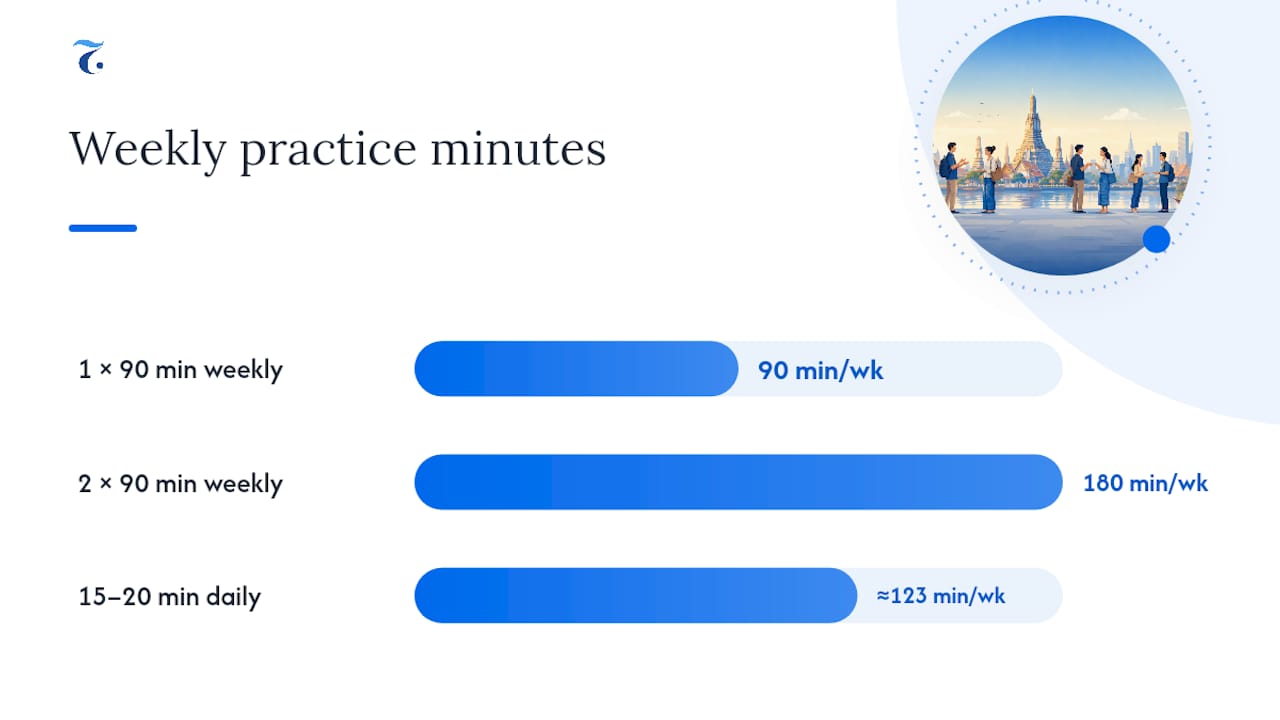
Time commitment should match your goal, not your optimism. A learner attending one 90-minute session weekly with no outside practice will progress far slower than someone attending twice weekly and doing 15 to 20 minutes of daily review. Structured tone practice and repetition drills matter especially for adults, since muscle-memory techniques for tone recognition tend to outperform passive listening alone when it comes to actually producing correct tones under pressure.
Why Thai Explorer’s Approach Matches What Adult Learners Need
Everything covered so far, phrase-first content, flexible formats, native instruction, transparent level structure, describes the model Com built its courses around from the start.
Instructors are native Thai speakers who are also bilingual in English, which means grammar explanations and tone corrections happen in a language you already understand rather than through guesswork. The curriculum aligns with the CU-TFL framework (the Chulalongkorn University Proficiency Test of Thai as a Foreign Language), giving course levels a recognized external reference point rather than an in-house structure invented purely for marketing purposes. Course descriptions are published by level, so you can see exactly what beginner, intermediate, and advanced material covers before you enroll, addressing the syllabus transparency criteria covered above.
Format flexibility runs across the full range discussed in this article: group classes for structured weekly rhythm, private lessons for focused pacing, online Zoom sessions for remote learners, and corporate training for teams. Trial classes are available for learners who want to test the teaching style before committing, which directly answers the sample-lesson criteria that separates trustworthy providers from vague ones.
The training center sits at 10 Anson Road, #22-07, International Plaza, Singapore 079903, right above Tanjong Pagar MRT, which matters for anyone weighing in-person attendance against a commute. Beyond logistics, Com’s conversational Thai courses build cultural insight directly into lessons rather than treating culture as a side note, covering the politeness particles, indirect communication norms, and everyday etiquette that turn textbook Thai into usable Thai.
What Makes Learning Thai Hard for Adults, and How to Get Past It
Adults face a specific set of obstacles that children mostly skip. The biggest one is tone anxiety: knowing that a wrong tone changes meaning creates hesitation, and hesitation kills conversational flow. The fix isn’t avoiding speaking until you’re “ready.” It’s drilling tones in short, repeated bursts until producing them stops requiring conscious thought.
A second obstacle is inconsistent practice. Adults juggle work and family, and a single weekly class without practice between sessions leads to constant re-learning instead of building forward. Even 10 to 15 minutes of daily review, vocabulary flashcards, a short audio clip, a phrase rehearsed out loud, keeps material active in memory.
A third challenge is self-consciousness about sounding wrong in front of others, which often causes adult learners to under-practice speaking compared to reading or listening. Roleplay in a low-stakes group setting, or one-on-one with a patient instructor, tends to break this pattern faster than solo study ever does, since it normalizes making mistakes as part of the process rather than something to avoid.
Finally, plateaus hit hardest around the intermediate stage, when the easy wins of survival phrases are gone and fluency still feels distant. Structured courses with clear level milestones help here, giving learners a visible marker of progress instead of a vague sense of stalling out.
How to Keep Practicing Thai Outside Class
Classroom time alone rarely produces fluency. What happens between sessions determines how fast you actually progress.
Watching Thai media with subtitles, dramas, YouTube vlogs, or short-form content, trains your ear for natural rhythm and tone in context, which is different from hearing isolated words in a lesson. Start with subtitles in English, then switch to Thai subtitles once basic reading develops.
Language exchange partners, whether found through community groups or informal meetups, give you low-pressure speaking practice with native speakers outside a classroom structure. This works especially well paired with structured group study; research on study group communication across languages points to peer accountability as one of the more reliable ways adult learners sustain consistent practice over time.
Micro-immersion windows, deliberately using Thai for small daily tasks like labeling household items or narrating a grocery run, keep the language active without requiring a formal study block. Even short, intensive immersion bursts tend to outperform occasional, spread-out study sessions when it comes to breaking the habit of defaulting back to English.
Keep a running phrase journal from each class and review it before the next session. This single habit, reviewing rather than re-learning, is often the difference between steady progress and repeated plateaus.
Can Apps Actually Help You Learn Thai Faster?
Apps and digital tools work best as a supplement to structured instruction, not a replacement for it. The gap they fill is repetition: spaced-repetition vocabulary apps and tone-training tools let you drill material between classes in short sessions that fit into a commute or a coffee break.
StudyThai pairs tone drills with spaced-repetition vocabulary practice across eight structured levels, giving self-directed learners a framework similar to what a classroom syllabus provides, useful for reinforcing what an instructor teaches rather than learning cold. Recording yourself speaking and comparing playback against native audio is another low-tech but effective habit, particularly for catching tone errors that are hard to hear in your own head while speaking.
The limitation of apps alone is feedback. Software can tell you whether your tone matches a reference audio clip, but it can’t catch the subtler mistakes a native instructor notices, awkward phrasing, wrong register for the situation, or a culturally off comment that’s grammatically correct but socially strange. That’s why the strongest results tend to come from combining app-based drilling with live instruction rather than choosing one over the other.
How Do Adult Learners Get Assessed or Certified in Thai?
Assessment for adult learners usually takes one of two forms: informal in-course progress checks, or standardized proficiency testing against an external framework.
In-course assessment happens through conversation checkpoints, quizzes, and instructor evaluation as you move between beginner, intermediate, and advanced material. This tells you and your instructor whether you’re ready to progress or need more time reinforcing a particular stage.
For learners who want an external benchmark, the CU-TFL framework (Chulalongkorn University Proficiency Test of Thai as a Foreign Language) offers a standardized measure of Thai proficiency that courses can align their curriculum against. This matters for professionals who need proof of language ability for employment purposes, or for personal milestones that go beyond “I feel more confident.” Courses whose curriculum maps to CU-TFL standards give learners a clearer sense of where they stand relative to a recognized external scale, rather than an internal grading system unique to one school.
Whichever path you choose, ask providers directly what assessment options are available before enrolling; not every course offers formal proficiency testing, and knowing this upfront prevents surprises later.
Why Community and Immersion Opportunities Matter
Classroom learning gets you the structure. Community and immersion get you the fluency that only comes from real, unscripted conversation.
Singapore’s community and adult-education channels catalog language course offerings that make Thai classes visible to a wider range of learners than school-based programs alone. Local platforms like OnePA’s community course listings reflect a broader pattern: Thai language learning has enough demand in Singapore to warrant dedicated listings outside traditional academic institutions, giving adult learners multiple entry points beyond a single provider.
Beyond formal listings, informal community ties matter just as much. Thai cultural events, food festivals, and social meetups connected to Singapore’s Thai community give learners a low-pressure setting to practice outside a classroom. Cultural immersion doesn’t require a plane ticket to Bangkok. It can mean seeking out Thai restaurants where you order in Thai, joining conversation meetups, or attending cultural events tied to Thai holidays and traditions. These interactions reinforce classroom material in a context where mistakes carry no academic consequence, just a shared laugh and a correction from someone happy you’re trying.

A Teaching Note on What Actually Gets Adults Speaking
Most adult learners overestimate how much grammar they need before they can speak, and underestimate how much speaking practice they need before grammar clicks. The instructors I’ve worked alongside consistently find the same pattern: students who start producing broken, imperfect sentences from lesson one progress faster than those who wait until they feel “ready” to speak.
My advice for week one is simple. Learn five phrases cold, not memorized but automatic, and use every one of them out loud within 48 hours, even if the only audience is yourself in the mirror. Speaking a phrase badly and correcting it beats reading it silently a hundred times. Tone mistakes made early and corrected quickly disappear; tone mistakes left unaddressed for months become permanent habits.
If you’re weighing which format to start with, don’t overthink it. Group classes, private lessons, and online Zoom courses all work when the content is conversation-first and the instructor corrects you consistently. Pick the format that fits your actual week, not your ideal one, and show up.
— Paul
Ready to Start Speaking Thai? Here’s How to Book a Trial
If everything above sounds like the approach you want, the next step is simple: book a trial lesson rather than committing to a full term blind. Com offers trial classes across group, private, and online formats, so you can experience the phrase-first, culturally grounded teaching style firsthand before deciding which fits your schedule and goals best.
After booking, a placement conversation helps determine your starting level, whether that’s beginner survival phrases or intermediate conversational practice, and an instructor recommends the format most likely to get you talking fastest given your weekly availability. Professionals juggling irregular hours often lean toward online Zoom sessions; those wanting maximum customization for business Thai typically choose private lessons; and learners who enjoy group energy and lower cost gravitate toward structured weekly classes.
Companies looking to train staff heading to Thailand or working with Thai clients can reach out separately about corporate training options, which are built around workplace scenarios rather than general conversation. Whichever path fits, the course landing page lists current schedules and lets you check trial availability directly, and the training center itself sits right above Tanjong Pagar MRT for anyone who prefers in-person sessions over Zoom.
Where to Learn More About Thai Language and Course Structures
For readers who want to dig deeper into the sources behind this guide, a few resources cover different angles of Thai language learning. Wikipedia’s overview of the Thai language explains the tonal system and script basics that shape why tone training gets so much attention in course design. NUS’s Thai language program shows how academic institutions structure level-based curricula around grammar, reading, and conversation. StudyThai offers a structured, self-paced look at tone drills and spaced-repetition vocabulary practice for learners supplementing classroom study. And OnePA’s course directory reflects how Thai language classes are catalogued for adult learners across Singapore’s community channels.
Sources
FAQ
How Do You Say “I Love You” in Thai?
“I love you” in Thai is “chan rak khun” (ฉันรักคุณ), though in casual daily use between close friends or family, Thai speakers often use warmer, less literal expressions rather than this direct phrase, since directness carries different social weight in Thai than in English.
Can I Learn Thai by Myself?
Self-study can build vocabulary and reading recognition, especially with tools like tone-training apps and spaced-repetition flashcards, but tone accuracy and natural conversation flow develop far faster with live correction from a native instructor than through app-based practice alone.
What Are Some Basic Thai Words to Start With?
Start with greetings (“sawasdee”), thank you (“khob khun”), numbers one through ten, and polite particles (“khrap” for male speakers, “kha” for female speakers), since these appear in nearly every early conversation and signal cultural awareness immediately.
How Do You Greet a Woman in Thai?
Greet a woman in Thai by saying “sawasdee kha” if you are a female speaker, or “sawasdee khrap” if you are a male speaker greeting anyone, since the polite particle changes based on the speaker’s gender, not the listener’s; a slight bow with palms pressed together (the wai) often accompanies the greeting as a sign of respect.
How Long Does It Take an Adult to Hold a Basic Conversation in Thai?
With consistent practice, around 30 minutes daily, structured programs report basic conversational ability developing in about 2 to 3 months, though this timeline depends heavily on class frequency, practice consistency, and whether tone training is emphasized from the start.