
Three things separate a presentation that lands from one that falls flat: a handful of memorized Thai lines for the openings and transitions, bilingual slides built with a consistent layout and font ratio, and rehearsed pacing rather than perfect grammar. Get those three right and the rest of the talk takes care of itself. Below you will find copy-ready phrases, exact slide specs, and a rehearsal plan you can run through before your next meeting or conference.
TL;DR:
- Memorizing short Thai opening and transition phrases makes the presentation flow smoothly and helps manage audience expectations effectively.
- Using one consistent bilingual slide layout and proper font sizing enhances clarity and avoids distraction during the talk.
- Practicing tone accuracy, especially on key words, is crucial since Thai tones significantly affect comprehension and can cause misunderstandings.
- Keeping each slide to one main message, using icons over dense text, and checking readability improves audience engagement and understanding.
- Rehearsing with a native speaker or professional coach ensures correct tone, pacing, and cultural etiquette, increasing confidence and delivery quality.
Table of Contents
- Thai for Presentations: A Phrase Cheat Sheet You Can Copy Today
- How Should You Design a Bilingual Thai-English Slide?
- What Structure Should a Thai Presentation Follow?
- How Do You Practice Thai Pronunciation Before Presenting?
- What Cultural Etiquette Should Presenters Follow in Thai?
- Getting Guided Practice Before Your Next Talk
- What Actually Makes or Breaks a Thai Presentation
- Where to Go From Here With Your Thai
- Sources
- FAQ
Thai for Presentations: A Phrase Cheat Sheet You Can Copy Today
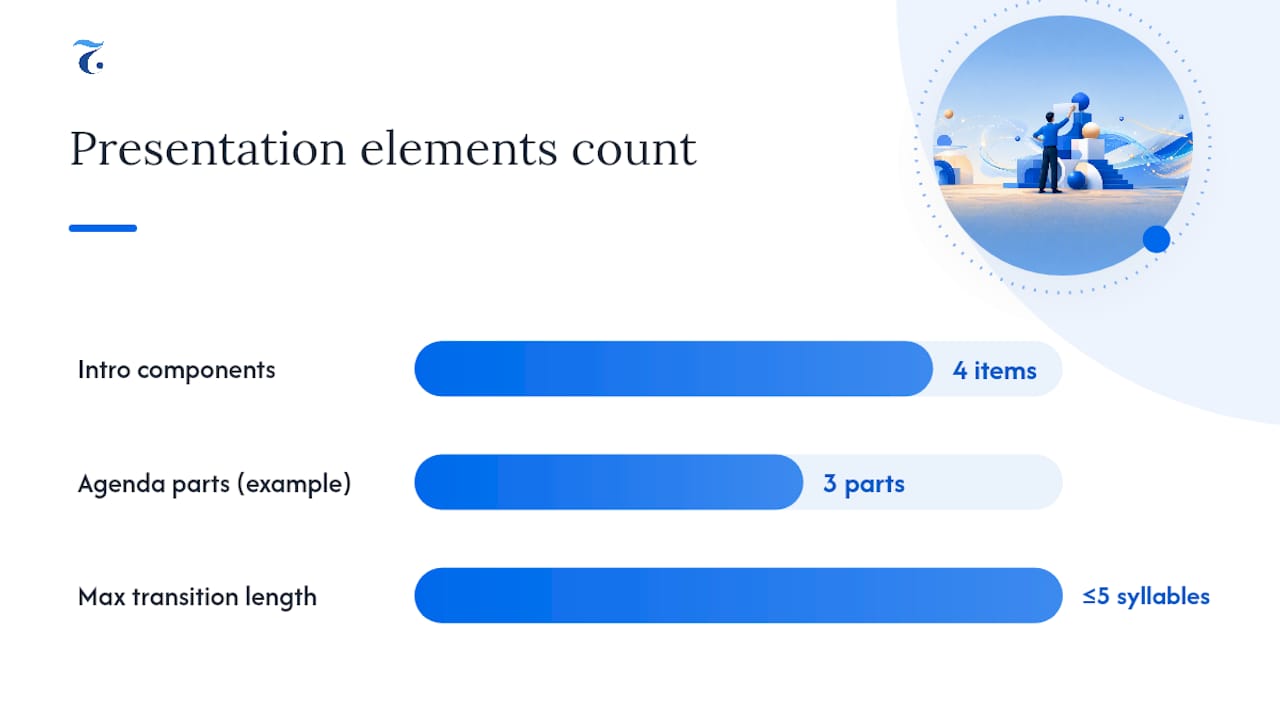
Start with the opening line. A structured self-introduction, made up of a greeting, your name, your job title, and a one-line purpose statement, is a format used across formal presentation training because it gives the audience a clear frame before you say anything else. In Thai it might sound like:
- Sawatdee krap/ka. (“Hello” — krap for men, ka for women.)
- Phom/Chan cheu [name] krap/ka. (“My name is [name].”)
- Phom/Chan pen [job title] khong [company] krap/ka. (“I am the [job title] at [company].”)
- Wan-ni phom/chan yak ja nam-sanoo [topic] krap/ka. (“Today I would like to present [topic].”)
Once you’re past the intro, signal the road map. Thai presentations lean heavily on explicit agenda statements, something like “Wan-ni chan ja baeng pen sam suan” (“Today I will divide this into three parts”), followed by transition cues such as “lam-dap thi song” (“next up”) and “sut-thai-ni” (“finally”). These signposts do more work in Thai than they do in English because Thai speech relies less on grammatical tense markers to signal sequence, so verbal cues carry the structure.
Pro Tip: Keep every transition phrase under five syllables. Short signposts get processed instantly, even by an audience half-listening while reading your slide.
For charts and data, name the source out loud. Audiences in Thai business settings expect a brief attribution, like “jaak khaawmuun khaawng [source], pi [year]” (“from data by [source], [year]”), right before you walk through the numbers, a habit Langhacks’ Thai presentation guide flags as a recurring convention.
When you open the floor, try “mee khamtham mai krap/ka?” (“Any questions?”). If nobody raises a hand, you’re not stuck: “tha mai mee khamtham, phom/chan khor jop kan wai thi ni krap/ka” (“If there are no questions, I’ll wrap up here”) gives you a graceful exit. Close with “khob khun mak krap/ka” (“Thank you very much”) and, if you’re offering follow-up, “sarmard tit-tor phom/chan tang email dai krap/ka” (“You can reach me by email”). For a longer list of situational phrases beyond the presentation context, Thai Explorer’s guide to everyday phrases is worth bookmarking.
How Should You Design a Bilingual Thai-English Slide?
Pick one layout and stay with it for the whole deck. Mixing formats mid-presentation is the fastest way to make bilingual slides feel sloppy. Three patterns work reliably:
- Thai above, English below (or the reverse): best for text-heavy slides where one language is the primary audience language and the other is a reference translation.
- Left-right split: works well when both languages carry equal weight, such as a bilingual audience in a corporate all-hands.
- One language per slide, alternating through the deck: cleanest option for long decks, but it only works if your audience can follow either language independently.
Font pairing matters more than most presenters realize. Thai script has taller ascenders and denser character shapes than Latin script, so a font pair that looks balanced in English can look cramped in Thai. Recommended pairings, based on COMSIAM’s bilingual PowerPoint guidance, include Thai fonts like Prompt, Kanit, or Sarabun matched with neutral English sans-serifs like Inter, Montserrat, or Aptos. Size ratio matters too: a common working ratio is Thai font size larger than English font size, for example around 1.3 times larger, since Thai glyphs read smaller at equal point sizes.
Pro Tip: Export your deck to PDF and open it on a different computer before presenting. Embedded Thai fonts sometimes fall back to a default font on unfamiliar machines, and you won’t catch that until it’s too late.
Stick to one message per slide, use icons instead of dense paragraphs where possible, and check readability on the actual projector or video-conference screen beforehand, since small Thai text tends to blur at a distance or over a compressed video feed. If you’re deciding how much English to lean on elsewhere in your materials, Thai Explorer’s guide on the role of English in Thai instruction breaks down where mixing languages helps versus where it muddies the message.
What Structure Should a Thai Presentation Follow?
A short talk and a long talk need different pacing, but the underlying shape stays the same: hook, agenda, two to four points, summary, questions.
- Open with a hook and the formal self-introduction, then state your agenda in one sentence (“today I will divide this into three parts”).
- Move through your points using explicit transitions. For a 10 to 20 minute talk, keep it to two main points; for 20 to 40 minutes, three to four points with a brief recap between each.
- Close with a summary line, thanks, and the Q&A prompt, followed by contact information if you’re offering follow-up.
For chart-heavy slides, name the metric, state the source, then interpret it: “jaak khaawmuun ni, ja hen wa…” (“from this data, we can see that…”). If a point requires technical precision you can’t yet express cleanly in Thai, an insight from Langhacks’ guide notes that a brief, well-signposted switch to English for that one detail reads as competent rather than as a failure, as long as you return to Thai for the transition immediately after.
How Do You Practice Thai Pronunciation Before Presenting?
Tone errors are the single biggest source of confusion in a Thai presentation, not vocabulary gaps. Thai has five tones, and getting the wrong one on a common word can change its meaning entirely, so drilling tone pairs matters more than expanding vocabulary at this stage.
- Run minimal-pair drills on words that differ only by tone, especially any that appear in your script.
- Record yourself reading your opening and closing lines, then compare against a native audio reference until the tone contour matches.
- Shadow short clips of Thai business speech, repeating immediately after each phrase rather than translating first, a method Ling-app’s guide to speaking Thai fluently points to as effective for building tone consistency under time pressure.
- Memorize your openings, transitions, and closing in full. Leave your middle content as bullet points in your head, not memorized paragraphs, so a stumble doesn’t derail the whole talk.
Pro Tip: Practice your opening line out loud at least ten times the day before. It’s the one moment your nerves are highest and your memory is shakiest, so overlearning it buys you confidence for everything after.
Run a full technical rehearsal too: test your microphone, screen share, font rendering, and, if you’re presenting over video call, your internet connection under load. For a step-by-step approach to building tone accuracy from scratch, Thai Explorer’s tone-first teaching plan walks through the same drills in more depth.
What Cultural Etiquette Should Presenters Follow in Thai?
Small language choices carry outsized weight in Thai business culture. Attaching the polite particle krap (for men) or ka (for women) to the end of sentences, especially your opening and closing lines, signals respect and is expected in almost any formal setting.
- Keep your self-introduction modest. Listing achievements at length reads as boastful; state your role and purpose plainly and let your work speak for itself.
- Invite questions warmly, but don’t force a response. Offering a graceful exit line if the room stays quiet respects the cultural preference for avoiding public correction or confrontation.
- A slight bow or a wai (palms pressed together at chest height) suits formal introductions with senior figures, though a handshake is increasingly common in corporate settings.
- Steady eye contact is fine during delivery, but hold back from prolonged direct eye contact with senior audience members during casual moments; it can read as challenging rather than confident.
- If tech fails mid-talk, a short apology such as “khor thot krap/ka” (“I’m sorry”) followed by a quick recovery keeps the room comfortable, and offering to follow up by email afterward smooths over anything you couldn’t finish live.
Getting Guided Practice Before Your Next Talk
Reading phrases and rehearsing alone gets you most of the way there, but a live run-through with a native speaker who can correct tone in real time closes the gap faster than solo practice ever will. Thai Explorer runs adult conversational and business Thai classes, along with private coaching and online sessions over Zoom, built around a curriculum aligned to the CU-TFL standard for Thai as a foreign language.
- A single coaching session focused on presentations typically runs through your actual script, corrects tone and pacing line by line, and leaves you with a rehearsed opening, transitions, and closing you can deliver from memory.
- Private lessons work well for presenters on a tight deadline who need targeted correction rather than a full course.
- Group and online formats suit professionals building longer-term fluency alongside presentation skills.
If you want that guided practice before your next presentation, Thai Explorer’s course page lists current formats and how to book a session.
What Actually Makes or Breaks a Thai Presentation
Most advice on presenting in Thai overindexes on vocabulary breadth and underindexes on tone and pacing. That’s backwards. A presenter with a modest vocabulary who nails five tone contours and pauses at the right signposts will out-communicate someone who memorized twice as many words but rushes through them at native speed with flattened tones. The data on this is consistent: slowing down and leaning on structural phrases beats grammatical complexity for comprehension.
The other place conventional advice falls short is slide design. Most guides treat bilingual slides as a translation exercise, just put the English text next to the Thai text and call it done, but learning about dual subtitles on YouTube can inspire better bilingual display patterns. That produces cluttered, competing layouts. The presenters who land well pick one layout pattern, one font pairing, and one size ratio, and repeat it slide after slide until it becomes invisible scaffolding rather than a distraction.
If you take one thing from this, prioritize your opening and closing lines above everything else. They set the tone (literally) for how the room receives you, and they’re the easiest thing to overlearn until they’re automatic.
— Paul
Where to Go From Here With Your Thai
Thai Explorer exists for exactly this kind of practical need: adults who need working Thai for real situations, not classroom theory. If your presentation is on the calendar, the fastest way to close the gap between “I know the phrases” and “I can deliver them confidently” is a session with a native instructor who listens to your actual script and corrects tone as you speak it, something no phrase list or slide template can do on its own.

Courses run in group, private, and online Zoom formats, so you can fit rehearsal around a work schedule without commuting across town. The training center sits at 10 Anson Road, #22-07, International Plaza, Singapore 079903. right above Tanjong Pagar MRT, for anyone who prefers in-person coaching before a big talk. If you’re short on time before your presentation date, book a private Thai lesson and bring your script to the first session.
Sources
- PowerPoint สองภาษา (Bilingual Presentation) — COMSIAM
- タイ語プレゼン完全ガイド — Langhacks (excerpts)
- 5 Best Tips To Speak Thai Fluently — Ling-app
FAQ
What Is “Suay Mak Mak” in Thai?
“Suay mak mak” means “very beautiful” or “very pretty” in Thai, using the intensifier “mak mak” (very very) for emphasis. It’s a compliment phrase, not a standard presentation term, so it fits casual conversation more than formal talks.
How Do You Say “Present” in Thai?
The verb “to present” is commonly translated as “nam-sanoo,” as in “wan-ni chan ja nam-sanoo [topic]” (“today I will present [topic]”). It’s the standard verb used in the formal presentation opening covered earlier in this guide.
What Does “Kap Khun Ka” Mean?
“Khob khun ka” (often written “kap khun ka”) means “thank you,” spoken by a female speaker. Male speakers use “khob khun krap” instead, since the polite particle changes with the speaker’s gender.
What Are Some Common Thai Expressions for Presentations?
The core set includes a formal self-introduction, an explicit agenda statement, transition phrases like “lam-dap thi song” (next), and a closing line such as “khob khun mak krap/ka” (thank you very much). A guided session, like those offered through Thai Explorer’s course, helps you drill these until they’re automatic under pressure.