
The fastest route to conversational Thai is a daily 30-minute split: roughly 10 minutes reviewing old vocabulary, 15 minutes learning something new, and 5 minutes speaking it out loud, starting with tone practice and one short spoken exchange on day one. Stick to that rhythm and you can expect solid basics within 3 months and real conversational traction by 6, provided the practice stays consistent rather than occasional.
TL;DR:
- Consistent daily practice of 30 minutes, including review, new input, and speaking, yields basic Thai skills within three months and conversational fluency in six.
- Structured learning stages focus on tones, script, vocabulary, and situational conversations, totaling about six months for managing daily interactions.
- Using spaced repetition, tone practice in context, and active speaking significantly accelerates tone accuracy and vocabulary retention, especially with regular feedback.
- Regular speaking, including voice recordings and conversation practice with native speakers, is crucial to prevent fossilizing errors and improve pronunciation.
- Incorporating Thai script learning early enhances tone recognition and accelerates speaking progress, supported by cultural context and polite language habits.
Table of Contents
- What Does a Realistic Thai Study Plan Look Like Stage by Stage?
- Daily and Weekly Study Templates You Can Copy Today
- An 8 to 12 Week Micro-Plan for Fast, Measurable Progress
- Which Study Methods Actually Move the Needle?
- How Do You Know Your Study Plan Is Actually Working?
- Who’s Behind This Plan and Why the Curriculum Matters
- Why Cultural Context Changes How Fast You Learn
- What Trips Up Most Adult Learners, and How to Fix It
- Keep It Simple and Start Today
- Want Feedback From an Actual Native Speaker?
- Sources
- FAQ
What Does a Realistic Thai Study Plan Look Like Stage by Stage?
A Thai study plan works best when it’s broken into stages with their own goals, rather than one long undefined slog toward “fluency.” Each stage below assumes 30 to 60 minutes of daily study, and the timelines track closely with roadmaps that map learning hours to expected outcomes, Jam Kham’s staged progression among them.
- Foundations (weeks 1 to 3): Tone awareness, basic greetings, and the five tone categories. Goal: recognize and produce all five tones in isolated syllables.
- Script and reading (weeks 3 to 8): Consonant classes, vowel forms, and how tone marks interact with them. Goal: sound out simple signage and menu items.
- Core vocabulary and grammar (weeks 6 to 14): Sentence structure, question forms, several hundred high-frequency words. Goal: introduce yourself, describe your day, ask for directions.
- Situational conversation (weeks 12 to 24): Ordering food, shopping, small talk with taxi drivers or coworkers. Goal: hold a 5-minute conversation without switching to English.
- Consolidation (month 6 onward): Idioms, faster listening comprehension, topic-specific vocabulary for work or travel. Goal: follow a casual conversation between two native speakers at normal speed.
Following this kind of staged approach, learners studying 30 to 60 minutes daily can typically read Thai script and manage basic daily conversations in about six months.read Thai script and manage basic daily conversations in about 6 months. That timeline assumes daily consistency, not weekend cramming. Skip three days and the tone discrimination you built starts to slip before the vocabulary does, which is why the next section focuses on templates you can actually repeat.
Daily and Weekly Study Templates You Can Copy Today
Here’s the 30-minute template that anchors this plan, built around the review-input-practice structure StudyThai.ai recommends for busy learners:
- Minutes 1 to 10: Spaced repetition review of previously learned vocabulary and tone pairs.
- Minutes 11 to 25: New input. Learn 5 to 8 new words, one grammar point, or one tone rule, using audio so you hear correct pronunciation from the start.
- Minutes 26 to 30: Active output. Speak 3 to 5 sentences aloud using today’s new material, or record yourself answering a simple question.
If you have 60 minutes, double the SRS review and new input blocks, and stretch output to 10 minutes with a short listening clip added at the end. On a tighter day, a 45-minute compromise keeps review at 10 minutes, trims new input to 20, and holds output at 10 to 15 so speaking never gets cut first.
Weekly rotation matters more than people expect:
- Rotate focus so two days lean vocabulary-heavy, two lean grammar, and one is pure listening and shadowing.
- Reserve weekends for a longer consolidation session, 45 to 90 minutes, reviewing the week’s material in mixed order rather than the sequence you learned it in.
- Log one voice memo per week speaking on the same simple topic, so drift or improvement becomes obvious over time.
An 8 to 12 Week Micro-Plan for Fast, Measurable Progress
Short, structured sprints beat vague long-term goals. A focused plan run over 45 to 60 minutes daily can produce genuinely useful travel-ready speaking skills within 8 weeks, and stretching that same structure to 12 weeks gives room for real conversational depth.
- Weeks 1 to 2: Train your ear on the five tones before anything else. Learn 50 survival phrases (greetings, numbers, basic questions) and do a 1-minute speaking check daily, just naming objects or answering “how are you” out loud.
- Weeks 3 to 4: Add consonant classes and vowel length, since both affect tone rules directly. Apply tone rules inside real sentences, not isolated syllables, and grow your working vocabulary to 100 to 200 words.
- Weeks 5 to 8: Shift into sentence building: subject-verb-object patterns, question forms, and negation. Practice specific scenarios, ordering food, asking prices, small talk, and stretch daily speaking output to 10 to 15 minutes.
- Weeks 9 to 12: Consolidate everything into longer exchanges. Push toward 5-minute unscripted conversations, expand vocabulary into topics you personally care about (work, hobbies, family), and start noticing your own tone mistakes before a native speaker points them out.
By week 12, most learners following this sequence can hold a short real-time conversation and read common signage without sounding it out letter by letter.
Which Study Methods Actually Move the Needle?
Not every hour of studying produces equal returns. Four methods consistently outperform passive review, and each one has a specific place in the daily template above.
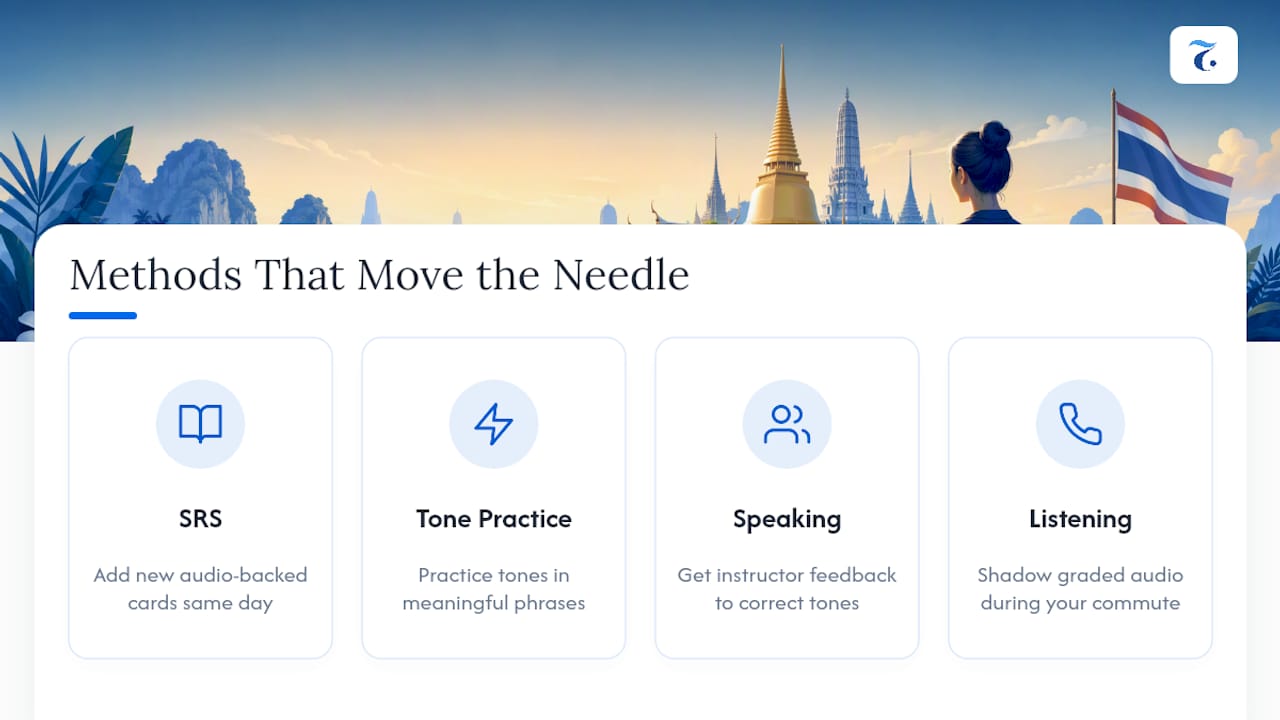
Spaced repetition (SRS): Add new vocabulary the same day you learn it, ideally as audio-backed cards rather than text-only, since Thai’s tonal spelling rules mean you need to hear the word to encode it correctly. Review daily, not every few days. A tool built specifically for memorizing Thai vocabulary will space intervals automatically so you stop wasting review time on words you already know cold.
Tone practice: Isolated tone drills help early on, but tone accuracy sticks better when practiced inside meaningful phrases rather than as disconnected syllables. Record yourself, compare against a native speaker’s audio, and get feedback on your pitch pattern within the first few weeks rather than months later.
Speaking practice: Language exchange apps offer free, low-stakes native feedback, but that feedback tends to be inconsistent since your partner isn’t trained to diagnose tone errors. Structured feedback from an instructor speeds up correction and lowers the risk of a mistake becoming permanent.
Listening and shadowing: Use commute time for graded audio, repeating phrases aloud a half-beat behind the speaker. This is the single easiest habit to bolt onto an existing routine.
Pro Tip: Record the same 30-second self-introduction every two weeks. Comparing clips side by side shows tone progress faster than any test score will.
How Do You Know Your Study Plan Is Actually Working?
Track a handful of numbers weekly rather than relying on how confident you feel, since confidence and actual accuracy often move in opposite directions during the first few months.
- Weekly study minutes logged, aiming for at least 175 (30 minutes times 6 days minimum).
- SRS retention rate, ideally staying above 80% before adding large batches of new vocabulary.
- Speaking minutes per hour of total study, which should climb from near zero to 15 to 20% by month two.
- A monthly recorded pronunciation check against native audio.
At 3 months, you should manage basic transactional exchanges. At 6 months, expect comfortable daily conversation on familiar topics. At 12 months, listening comprehension at natural speed becomes the main gap. If reading feels like the bottleneck, shift 10 extra minutes toward script drills for two weeks.
Who’s Behind This Plan and Why the Curriculum Matters
This roadmap reflects how structured Thai programs sequence learning, similar in spirit to the staged, credit-based progression used in university-level Thai studies curricula. Self-study covers a lot of ground, but it has a blind spot: nobody corrects your tone in real time.
That’s where guided instruction earns its place. Some structured Thai courses align lesson sequencing with CU-TFL benchmarks, and lessons run with native Thai instructors who are bilingual in English, so corrections happen promptly when mistakes surface. Structured courses add three things self-study can’t replicate on its own: consistent corrective feedback on tone, cultural context that makes vocabulary stick, and periodic assessments that confirm whether your self-tracking matches reality.
Why Cultural Context Changes How Fast You Learn
Thai isn’t just tones and vocabulary sitting in a vacuum. How you address people, when you use polite particles like “khrap” or “kha,” and how directly you phrase a request all shift depending on who you’re talking to, and getting this wrong doesn’t just sound awkward, it actively slows your learning because native speakers switch to English the moment they sense a communication mismatch.
Thai social hierarchy shows up constantly in language. Age, social role, and context determine word choice far more than in English, and a beginner who ignores this will plateau at “textbook Thai” that sounds stiff even when grammatically correct. Learning basic etiquette early, the wai greeting, appropriate formality levels with strangers versus friends, avoiding pointing your feet at people or religious objects, gives your vocabulary somewhere real to land.
This is also why immersion matters even for someone studying from a desk in another country. Watching Thai variety shows, following Thai social media accounts, or reading simplified news builds intuition for tone and register that grammar drills can’t teach on their own. A cultural understanding of language learning isn’t a side project bolted onto vocabulary study, it’s part of what makes the vocabulary usable in an actual conversation.
Politeness particles are a small, concrete place to start: adding “khrap” (for male speakers) or “kha” (for female speakers) to the end of sentences signals respect automatically, and native speakers notice its absence faster than they notice a wrong tone.
What Trips Up Most Adult Learners, and How to Fix It
Three problems account for most stalled Thai study plans, and all three have straightforward fixes once you know to watch for them.
Tone deafness in the early weeks. Many adult learners can’t hear the difference between tones at first, which isn’t a lack of ability, it’s a lack of exposure to a tonal system. The fix is embedding tone practice inside phrases rather than drilling syllables in isolation, since context gives your ear something to anchor to.
Delaying speech until you “feel ready.” Waiting until vocabulary feels solid before speaking out loud is the single most common mistake, and it backfires because pronunciation errors fossilize the longer they go uncorrected. Speaking badly in week one and getting corrected beats speaking well in month six with habits that are now hard to unlearn.
Script avoidance. Reading Thai script feels harder than romanized transliteration, so many learners skip it. That shortcut costs you later, since Thai spelling encodes tone information directly, meaning script literacy actually accelerates tone accuracy rather than competing with it for study time.

Inconsistent scheduling. A 30-minute daily habit beats a 3-hour weekend session almost every time, because tonal discrimination decays quickly without regular reinforcement. If your schedule is unpredictable, anchor the habit to something fixed, right after coffee, on the commute, before bed, rather than leaving it to willpower each day.
Keep It Simple and Start Today
Momentum beats intensity every time. Pick the 30-minute split, run it for seven straight days, and don’t skip the speaking portion even when it feels clumsy. Record one 30-second clip introducing yourself on day one, then again on day seven. You’ll hear the difference before you feel it, and that’s usually the moment a study plan stops feeling like a chore and starts feeling like progress.
— Paul
Want Feedback From an Actual Native Speaker?
Self-study builds the habit, but nothing replaces having someone catch your tone mistakes in real time before they turn into permanent habits. Some language schools offer group, private, and online classes specifically built around that gap, with native Thai instructors correcting pronunciation and conversation flow as you go, whether you’re learning for travel, daily life, or work.

Classes run in flexible formats so a packed schedule isn’t an excuse to skip corrective feedback:
- Group classes for shared momentum and conversation practice with peers at your level.
- Private lessons for a pace built entirely around your schedule and goals.
- Online Zoom classes for learners who want instructor feedback without a commute.
Com’s training center sits at 10 Anson Road, #22-07, International Plaza, Singapore 079903, right above Tanjong Pagar MRT, for anyone who prefers in-person sessions. If the plan above sounds like the right structure but you want a real person checking your tones, browse Com’s Thai course options and book a class that fits your schedule.
Sources
- Studythai
- 8-Week Thai Learning Plan 2026: Speak and Listen with Confidence – HelloTalk
- Thai Learning Roadmap: A0 to B2 in 4 Stages | Jam Kham
FAQ
How Long Does It Take to Learn Conversational Thai?
With a consistent 30 to 60 minute daily study plan, most learners reach basic conversational ability around the 6-month mark, with noticeable comfort in familiar topics by month 12.
How Many Hours a Day Should I Study Thai?
A 30-minute daily session, split into 10 minutes of review, 15 minutes of new learning, and 5 minutes of speaking practice, produces steady progress for most busy adults without burning out.
Should I Learn Thai Script Right Away?
Yes. Thai script encodes tone information directly, so learning to read early actually speeds up tone accuracy instead of slowing down your speaking progress.
Is It Better to Self-Study or Take a Class?
Self-study covers vocabulary and grammar well, but a class with native instructors gives you real-time correction on tones, something recordings and apps struggle to replicate consistently.
What’s the Fastest Way to Improve My Thai Tones?
Practice tones embedded in full phrases rather than isolated syllables, and get feedback from a native speaker within your first few weeks rather than after months of uncorrected practice.