Most structured Thai courses in Singapore run from short 6 to 10 week modules to multi-term programs that stretch across 6 to 12 months of study. Contact hours typically fall between 18 and 48 hours per module, and the right length depends entirely on your goal: two months for travel basics, three to six months for real conversational ability, and six to eighteen months if you want business proficiency or reading and writing skills.
TL;DR:
- Most Thai courses in Singapore range from 18 to 48 contact hours per module, with durations from 6 weeks to 12 months depending on goals.
- Intensive formats with daily lessons can reach 100 hours in six to ten weeks, suitable for rapid conversational or literacy development.
- To achieve travel basics, about 10 to 20 hours over two months suffices, while reaching conversational fluency typically requires 48 to 120 hours.
- Literacy skills and reading comprehension add extra hours, especially since Thai script is not based on the Roman alphabet.
- Matching course hours and frequency to your specific goal enables realistic planning, with weekly pace calculations providing clear timelines.
Table of Contents
- Thai Course Duration Singapore: How Providers Measure and Schedule Classes
- Typical Durations by Course Type in Singapore
- How Long It Takes to Reach Each Thai Proficiency Stage
- Choosing the Right Course Length for Your Goals
- How Course Durations Are Structured for Adult Learners
- Why Published Hours Rarely Match Real Progress
- Start Your Thai Course With a Duration That Matches Your Goal
- Sources
- FAQ
Thai Course Duration Singapore: How Providers Measure and Schedule Classes
Course listings in Singapore rarely use the same units, which is why comparing two programs can feel like comparing apples to durian. Some schools publish total contact hours, others publish weeks, and a few just list “lessons” without saying how long each one runs. Once you know how to translate between these, the comparison gets a lot easier.
A “contact hour” is time spent actually in class with an instructor, live on Zoom or in a classroom. A “lesson” is one scheduled session, which might run anywhere from 1.5 to 3 hours depending on the provider. A “term” or “module” is the full block, usually spanning multiple weeks.
Singapore’s structured Thai courses generally fall into two scheduling patterns:
- Part-time term formats: One or two lessons per week over 10 to 12 weeks, common in university and language-school evening programs.
- Intensive formats: Several hours per day over a shorter number of weeks, which compresses the calendar but demands a heavier weekly time commitment.
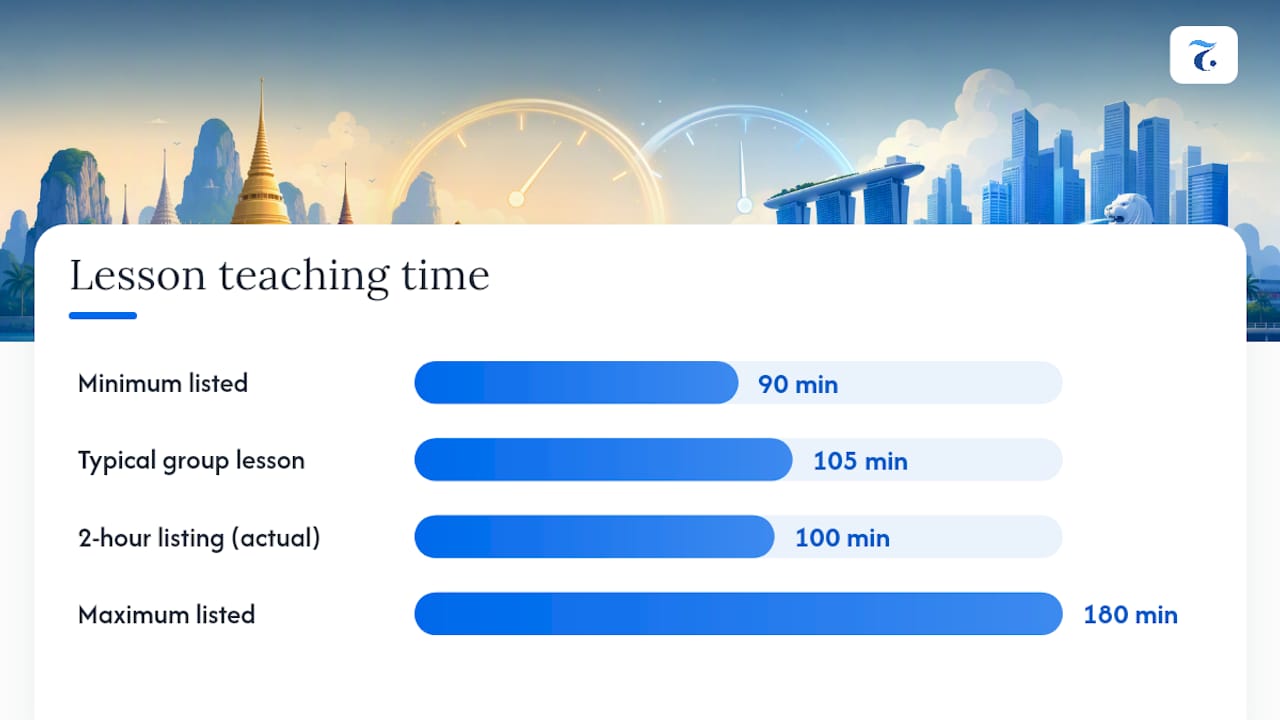
- Session length: Most lessons run 1.5 to 2 hours for group classes, with some private and intensive sessions extending to 3 hours per sitting.
The “50-minute hour” pattern (a short break built into every 60 minutes of instruction) shows up in many local listings, so a “2-hour lesson” often delivers closer to 100 minutes of actual teaching time once breaks are factored in. That distinction matters when you are calculating how many real hours a course actually gives you.
Typical Durations by Course Type in Singapore
Course length varies a lot depending on whether you enroll at a university, a private language school, or take one-on-one lessons. Here is how the main formats compare.
- University evening terms: The NUS CLS Thai program follows a 10-week term model, with one recent course running from September 22 to November 26, delivering roughly 15 to 30 contact hours across the term through scheduled evening sessions. This format suits working adults who want a structured, semester-style pace without daily commitment.
- Language-school modules: Local providers commonly break Thai into monthly or term-based modules. Lingo School of Knowledge lists roughly 18 hours per term for its Thai offering, while other module structures run as high as 48 hours per level depending on how much speaking practice is built in.
- Private lessons and intensives: One-on-one lessons offer the most flexibility and can compress a term’s worth of material into fewer calendar weeks, but they ask for more hours per week in exchange. This trade-off is worth understanding before you commit, since an intensive schedule that looks shorter on paper can still demand the same total hours as a part-time term.
- Online Zoom courses: Remote classes generally mirror the hour totals of in-person equivalents but let you swap session times more easily, which matters if your work schedule shifts week to week.
Beginner-focused marketing courses sometimes advertise even shorter formats, such as 10 lessons delivered over roughly two months, aimed squarely at travel-level conversation rather than full literacy.
How Long It Takes to Reach Each Thai Proficiency Stage
Hours on a brochure mean little until you convert them into a realistic timeline. Here is a rough map of what different hour totals typically deliver, based on how local and regional programs structure their levels.
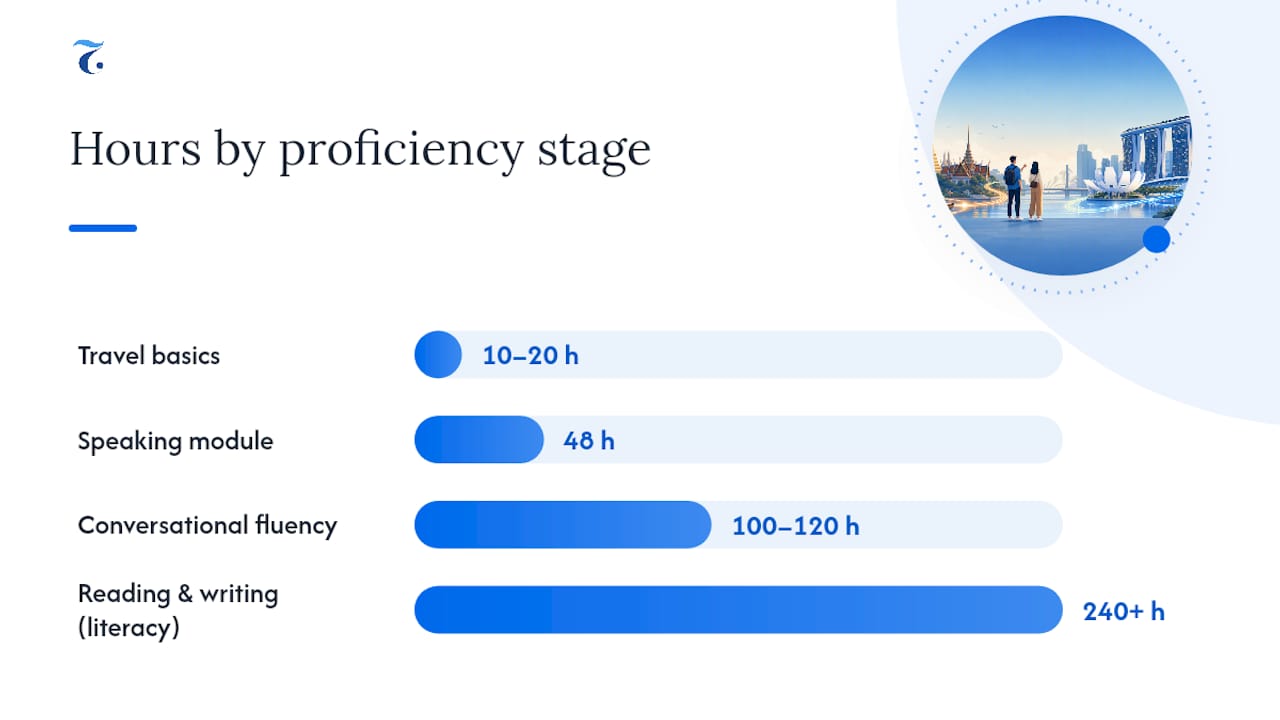
- 10 to 20 hours gets you travel basics: greetings, numbers, ordering food, and simple directions. This is roughly what a two-month, once-weekly beginner block covers.
- 48 hours is the range where many providers place a genuine speaking-focused module, similar to the structure used by the AUA Language Center’s beginner communication course. At this point, casual conversation with a patient native speaker starts to feel manageable.
- 100 to 120 hours is where conversational fluency solidifies. Chulalongkorn University’s intensive program treats each proficiency level as roughly 100 hours or six weeks in a daily intensive format, which shows how compressing the calendar increases the weekly hour demand.
- 240 hours and up, spread across multiple staged modules, is where reading and writing enter the picture. Thai script adds real time because it is not built on the Roman alphabet, and most curricula treat literacy as a separate track layered on top of spoken skills, similar to the staged progression described in guides on Thai language levels.
Frequency changes everything here. A once-weekly 2-hour class needs roughly a year to hit 100 hours. Twice weekly cuts that to about six months. An intensive workshop block, meeting daily, can get there in six to ten weeks, matching the Chulalongkorn model above.
Pro Tip: If your goal is business Thai, budget for conversational fluency first. Trying to jump straight into negotiation vocabulary before you can handle basic small talk usually backfires, because you end up memorizing phrases instead of actually understanding the language.
Choosing the Right Course Length for Your Goals
Before you sign up for anything, work out four things: your goal, your weekly availability, whether you need reading and writing, and whether you prefer group or private instruction. These four answers narrow down the field faster than scrolling through course pages.
When you talk to a provider, ask these questions directly:
- How many total contact hours does each level include?
- How is progression to the next level determined, by hours completed or by an assessment?
- What is the typical class size for group sessions?
- What is the policy for makeup lessons if I miss a session?
- How often are learners assessed, and what happens if I am not ready to move up?
A quick example: if a module lists 48 contact hours and meets twice a week for 2 hours per session, that’s 4 hours weekly, meaning the module runs about 12 weeks. A local listing showing SOAS’s beginner Thai course structure at 10 weeks and roughly 20 hours works out to about 2 hours weekly, a lighter part-time pace by comparison.
That formula (weeks needed = total hours ÷ weekly hours available) is the single most useful calculation you can do before enrolling, since it turns a vague “how long will this take” into a number you can actually plan around.
How Course Durations Are Structured for Adult Learners
Com builds its Thai courses around the same duration logic covered above, mapped to what adult learners in Singapore actually ask for: travel readiness, everyday conversation, or workplace-level Thai. Group classes typically run in term-based modules, private lessons scale to whatever pace a learner wants to set, and online Zoom courses follow the same hour structure as in-person sessions for anyone who prefers to join remotely.
Curriculum is aligned with the CU-TFL framework, and every class is led by native Thai instructors who also speak English, which keeps early lessons from stalling on translation confusion. For companies, corporate training modules follow the same staged structure, just adjusted for the vocabulary a specific team or industry actually needs.
Com recommends course length based on the goal a learner names first. Someone prepping for a trip usually starts with a short conversational block; someone aiming for workplace fluency gets pointed toward a multi-module plan that adds literacy later. The training center sits at 10 Anson Road, #22-07 International Plaza, Singapore 079903, right above Tanjong Pagar MRT, making it an easy stop before or after work. Readers who want a fuller walkthrough of formats can check the step-by-step course guide before booking a trial class.
Why Published Hours Rarely Match Real Progress
The industry’s obsession with listing “hours per term” misses the point. A published number like 18 or 48 hours tells you what a provider offers, not what you will absorb. Two learners in the same 48-hour module can walk away with wildly different fluency, because attendance, practice outside class, and how closely the lessons track real speaking situations matter more than the hour count on a brochure.
The bigger blind spot in most course comparisons is treating literacy as an afterthought. Learners often assume speaking and reading develop at the same pace, so they underestimate how many extra hours the Thai script adds once they try to move past conversational Thai. If your goal touches anything professional or long-term, plan for that literacy layer from day one rather than bolting it on later.
My take: pick the shortest course that honestly matches your goal, not the longest one that sounds impressive. A traveler does not need 240 hours, and someone aiming for business fluency should not settle for a 10-lesson crash course. Match the hours to the outcome, and let frequency, not marketing, decide your timeline.
— Paul
Start Your Thai Course With a Duration That Matches Your Goal
Com gives Singapore learners something most course listings don’t: a duration mapped to your actual goal instead of a generic module length you have to reverse-engineer yourself. Whether you need travel basics before a trip, conversational fluency for daily life, or workplace-ready Thai for a new role, Com’s group, private, and online Zoom formats let you pick a pace instead of forcing your schedule around someone else’s term dates.
Every format runs on the same CU-TFL-aligned progression, taught by native bilingual instructors, so switching between group and private lessons later doesn’t mean starting over. Corporate teams get the same staged structure, adjusted for workplace vocabulary. If you already have a goal in mind, the main course page breaks down formats and durations by level, and booking a trial class is the fastest way to find out how many weeks your specific goal actually needs.
Sources
FAQ
How long does it take to study Thai?
It depends on your goal: travel basics take about two months, conversational fluency usually takes three to six months, and business-level proficiency with reading and writing can take six to eighteen months of staged study.
Can I learn Thai in two months?
Two months is enough for travel-level basics, greetings, numbers, and simple requests, especially in a structured beginner course that meets weekly, but it is not enough time to reach conversational fluency.
How much does a Thai language course cost in Singapore?
Pricing varies widely by format and provider, from short beginner blocks to multi-term programs, so it is worth comparing total contact hours against the price rather than the course length alone.
How can I learn Thai quickly?
Intensive formats that meet several hours per day compress the calendar significantly. Chulalongkorn University’s own intensive model covers a full level in about six weeks at roughly 100 hours, though that pace demands a much heavier weekly time commitment than a part-time term.