
TL;DR:
- Thai script appears complex but follows a logical system based on consonant classes, vowel placement, and tone rules. Understanding these interactions and focusing on mid-class consonants simplifies initial learning, enabling faster recognition and pronunciation. Consistent practice with native audio, handwriting, and contextual reading accelerates mastery of the Thai alphabet efficiently.
Thai script looks intimidating at first glance. The curves, loops, and symbols stacked above and below letters seem like a code built for someone else. But this is the central myth worth dismantling early in any introduction to Thai alphabet learning: the script is not random. It follows a logical system built on consonant classes, vowel placement, and tone rules that, once understood, make reading and writing far more accessible than it appears. For Singaporeans already familiar with multiple scripts and languages, the structure of the Thai writing system is genuinely learnable with the right approach.
Table of Contents
- Understanding the structure of the Thai alphabet
- Breaking down Thai consonants: classes and sounds
- Mastering Thai vowels: placement and sounds
- Understanding tone marks and syllable tones in Thai
- Practical tips for quick mastery of the Thai alphabet
- Why traditional learning methods might slow down your Thai alphabet mastery
- Start your Thai learning journey with Thai Explorer in Singapore
- Frequently asked questions
Key Takeaways
| Point | Details |
|---|---|
| Thai alphabet structure | The Thai alphabet is an abugida with consonants classified by tone and vowels placed around consonants. |
| Consonant classes and tone | Knowing high, middle, and low consonant classes is key to mastering Thai tones correctly. |
| Vowel placements | Thai vowels appear before, after, above, or below consonants and affect pronunciation and meaning. |
| Tone marks and rules | Tone combines consonant class, syllable type, and tone marks to change meanings in Thai words. |
| Efficient learning tips | Start with middle-class consonants, practice daily with flashcards or apps, and use native audio for faster progress. |
Understanding the structure of the Thai alphabet
Thai script has roots in Old Khmer, which itself descended from South Indian Brahmic scripts. That lineage explains a lot about how the Thai writing system works, because it is not an alphabet in the Western sense. It is an abugida, meaning consonants are the primary units and each one carries an inherent vowel sound. Vowel signs then modify that inherent sound rather than standing alone as independent letters.
The Thai orthography is an abugida with consonants, vowels, and tone marks arranged around base letters. This architecture explains why Thai script can look so visually dense. You are not reading left to right in a straight line of equal units. You are reading consonants with modifications above, below, before, and after them simultaneously.
A few structural features every learner should know up front:
- 44 consonants are organized into three classes (high, mid, and low) that directly affect how a syllable is pronounced in terms of tone.
- Vowels are signs, not standalone letters. They attach to consonants and can appear in four positions around the base consonant.
- No standalone vowels exist. When a syllable starts with a vowel sound, Thai uses a silent consonant, อ, as a carrier for the vowel sign.
- Spaces separate phrases, not individual words. This is a significant shift from English and takes deliberate practice to adjust to. You learn to identify syllable boundaries rather than word boundaries.
This last point catches many beginners off guard. If you sit down expecting spaces to behave like they do in English, reading even basic Thai text feels disorienting. Once you retrain your eye to look for syllable units built around consonants, the text starts to resolve into readable pieces.
Breaking down Thai consonants: classes and sounds
Consonants are the backbone of every Thai syllable, and understanding them is the first real task in any Thai alphabet guide. There are 44 consonants divided into high, middle (9 consonants), and low classes, each playing a distinct role in setting the tone of a syllable.
Here is the breakdown:
- High class: 11 consonants. These produce falling or rising tones depending on syllable type.
- Mid class: 9 consonants. These follow the most predictable tone rules, making them the best entry point for beginners.
- Low class: 24 consonants. The largest group, requiring more work to master because of their varied tonal behavior.
The class system is not arbitrary. It reflects historical pronunciation distinctions that have been preserved in the script even as spoken Thai evolved. For learners, the practical implication is this: you cannot just memorize how a word sounds by looking at the consonant alone. You need to know its class before you can predict the tone.
Starting with the 9 middle-class consonants helps learners grasp the simplest tone rules initially, which builds confidence before tackling the more complex high and low class behaviors.
Each consonant also has a corresponding word used to identify it. For example, ก is called gaw gai, meaning “chicken.” This naming system functions like saying “A for Apple” and gives your memory something concrete to attach the character to. Working through these associations systematically makes the Thai consonant classes far more memorable than staring at symbols in isolation.
Pro Tip: Group your consonant study by class, not just by shape. Spend your first week entirely on the 9 mid-class consonants before touching high or low class. This gives you a functional reading base and correct tone intuitions from day one.
Mastering Thai vowels: placement and sounds
After consonants, vowels are where the Thai writing system gets genuinely complex, but also where it gets interesting. Thai vowels are not standalone characters in any syllable. They are signs that combine with consonants to produce complete sounds.

Thai vowels form 32 sounds from 15 to 16 symbols placed before, after, above, or below consonants. A single vowel symbol can change its meaning depending on which consonant it surrounds and where it sits. This is fundamentally different from reading English, where vowels occupy a fixed left-to-right position.
Key features of the Thai vowel system:
- Four positions: Vowel signs appear before the consonant (to its left), after it (to its right), above it, or below it. Some compound vowels occupy multiple positions at once.
- Short and long vowels: The same vowel symbol can appear in a short or long form, and the distinction changes the word’s meaning and sometimes its tone. อา (long A) and อะ (short A) are entirely different sounds with different tonal implications.
- Compound vowels: These are made of multiple glyphs combined, requiring you to recognize the components as a single unit.
- The silent carrier: When a syllable begins with a vowel sound, Thai uses อ as a placeholder consonant for the vowel sign to attach to.
Learning vowel placement is one of the biggest challenges but is crucial for both reading and pronunciation. Skipping this foundation and trying to read whole sentences too early creates confusion that is hard to undo.
Here is a practical sequence for learning vowels efficiently:
- Identify the vowel symbol in isolation before seeing it in a word.
- Note its position relative to the base consonant: before, after, above, or below.
- Practice combining the vowel with a mid-class consonant you already know to form simple syllables.
- Use flashcards daily for recognition, cycling through at least 5 to 10 new vowel combinations per session.
Pro Tip: When you encounter an unfamiliar compound vowel, break it into its component signs first. Once you can name each piece separately, the whole unit becomes readable. This deconstruction habit accelerates recognition far faster than trying to memorize compound vowels as single images.
Understanding tone marks and syllable tones in Thai
Thai has five distinct tones: mid, low, falling, high, and rising. Getting a tone wrong does not just produce an accent. It changes the word entirely. The word mai, for example, can mean “new,” “not,” “wood,” “burn,” or a question particle depending entirely on tone.
Tone is determined by consonant class, syllable type, and tone marks working together. No single factor controls tone on its own. This interdependency is what makes Thai tone rules feel overwhelming at first.
- Consonant class sets the baseline tonal behavior for a syllable.
- Syllable type (dead vs. live) modifies that baseline. A live syllable ends in a sonorant or long vowel. A dead syllable ends in a stop consonant or short vowel.
- Tone marks are written above the initial consonant and override the natural tone when present.
Here is a simplified comparison of tone outcomes:
| Consonant class | Live syllable (no mark) | Dead syllable | With mai ek (่) | With mai tho (้) |
|---|---|---|---|---|
| Mid class | Mid tone | Low tone | Low tone | Falling tone |
| High class | Rising tone | Low tone | Low tone | Rising tone |
| Low class | Mid tone | High or falling | Falling tone | High tone |
Mastering tone recognition requires exercises focusing on consonant class and tone marks together, not memorizing tones as isolated facts.
Pro Tip: Start your tone mark practice exclusively with mid-class consonants. The rules are cleanest there, giving you a working model before the exceptions introduced by high and low class consonants. Use dedicated tone exercises to drill these patterns until they feel automatic.
Practical tips for quick mastery of the Thai alphabet
Knowing the structure is one thing. Building real reading speed requires consistent, well-structured practice. Here is what actually works based on learner outcomes and teaching experience.
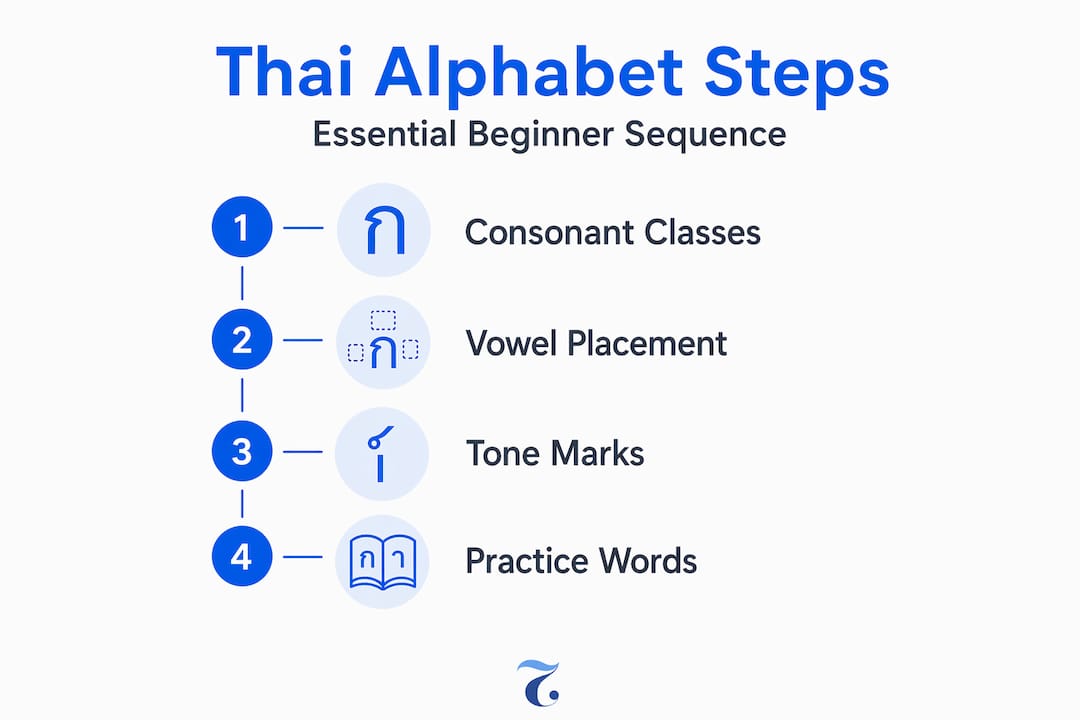
- Start with mid-class consonants only. Spend your first 5 to 7 days mastering all 9 mid-class characters before adding any others.
- Add short vowels next. Combine them with your mid-class consonants to form real monosyllabic Thai words immediately.
- Introduce tones within those words. Because you are using mid-class consonants, the tone rules are simpler.
- Move to high-class consonants, then low-class, adding their specific vowel and tone behaviors progressively.
- Practice handwriting daily. Writing characters by hand builds muscle memory that reading alone cannot.
- Use native audio for every new consonant and vowel. Tone is auditory. Reading without hearing is half the job.
Consistent 15-minute daily flashcard practice enables recognizing all consonants within 3 to 4 weeks. Short daily sessions consistently outperform longer sessions held once or twice a week because spacing out review optimizes memory retention.
Apps that break learning into steps and use native audio help accelerate progress significantly. The best ones teach you to read syllables as units rather than letter-by-letter, which is closer to how fluent readers actually process Thai script.
Pro Tip: Follow proven learning strategies that combine app-based recognition drills with real Thai text exposure, such as reading Thai menus, street signs, or product labels during your next trip to Thailand. Contextual reading builds recognition speed faster than flashcards alone.
Why traditional learning methods might slow down your Thai alphabet mastery
Here is the perspective that most resources will not tell you directly: learning the Thai alphabet the traditional way, meaning rote memorization of all 44 consonants in order before doing anything else, is one of the most effective ways to give up within two weeks.
The problem is not dedication. It is architecture. Traditional methods treat the alphabet like a list. But Thai script is a system. Consonant class, vowel position, and tone rules all interact. Learning consonants as an isolated list, divorced from their tonal implications and vowel companions, is like memorizing musical notes without ever playing a chord. The individual pieces mean nothing until they combine.
No spaces between words confuses beginners. Recognizing syllables by consonant anchor and vowels improves reading ease significantly. This is the shift that changes everything. When you train your eye to identify the consonant-plus-vowel unit rather than scanning for spaces, Thai text stops looking like a wall and starts looking like a sequence of readable blocks.
Modern stepwise methods taught by experienced instructors treat consonant classes as meaningful categories from lesson one. They pair consonants with vowels immediately so learners see functional syllables rather than abstract shapes. They use native audio so tone becomes a physical, heard reality rather than a theoretical label on a chart.
Mixing handwriting, audio pronunciation, and app-based practice also matters for a specific reason: each input channel uses a different type of memory. Hearing a tone activates auditory memory. Writing a character activates motor memory. Seeing it in a real word activates visual pattern memory. Using all three together creates more retrieval routes, which means faster and more durable recognition.
For Singaporeans balancing work, family, and study, this efficiency is not optional. It is the difference between actually learning Thai and slowly losing motivation. The smart approach uses efficient learning methods that respect your time by teaching the system, not the list.
Start your Thai learning journey with Thai Explorer in Singapore
With a clear picture of how the Thai alphabet works and what learning methods actually deliver results, the natural next step is guided instruction that keeps you moving forward without reinventing the wheel.

Thai Explorer, located directly above Tanjong Pagar MRT in Singapore, offers structured Thai language courses built for adult learners at every level. Whether you want to explore group Thai courses that take you from alphabet basics through conversational fluency, or prefer the pace control of private Thai lessons tailored to your specific goals, experienced native Thai instructors guide every step. Flexible online Zoom classes and corporate training options mean you can learn around your schedule. Start with foundational Thai language learning and build toward real-world confidence in reading, speaking, and cultural understanding.
Frequently asked questions
How many consonants are there in the Thai alphabet?
There are 44 consonants divided into high, middle, and low classes, and each class directly affects the tone rules for any syllable built on those consonants.
Where are vowels placed in Thai writing?
Thai vowels form 32 sounds from 15 to 16 symbols and can be positioned before, after, above, or below the base consonant, often in multiple positions for compound vowels.
Why is tone important in Thai language?
Tone is indicated by consonant class, syllable type, and tone marks, and getting it wrong changes the meaning of a word entirely, not just the accent.
What is the best way to start learning the Thai alphabet?
Start with 9 middle-class consonants for the simplest tone rules, then layer in vowels and tone marks, aiming for consistent 15-minute daily sessions to build recognition within 3 to 4 weeks.
Are there tools to help learn Thai reading faster?
Apps that teach Thai reading step-by-step with native audio help users master reading quickly, with many learners reaching solid recognition within 1 to 2 months of consistent use.