TL;DR:
- Thai listening often feels overwhelming due to rapid speech, but structured practice that builds recognition gradually can improve comprehension. Setting specific goals, using level-appropriate materials, and incorporating daily routines with native interaction and self-testing accelerate progress. Consistent focus on core skills and realistic expectations help learners develop natural, confident Thai listening abilities over time.
Spoken Thai has a way of stopping learners cold. You study vocabulary, you learn the tones on paper, and then a native speaker opens their mouth and the words seem to blur together at twice the speed you expected. That experience is normal, and it does not mean you have a talent problem. It means you need a structured thai listening practice guide that builds your ear the same way a workout builds a muscle: progressively, consistently, and with the right techniques. This guide gives you exactly that, covering preparation, daily routines, troubleshooting, and ways to measure real progress.
Table of Contents
- Key takeaways
- Setting yourself up for effective Thai listening practice
- Your daily Thai listening routine, step by step
- Fixing the most common Thai listening obstacles
- How to measure your Thai listening progress
- My honest take on learning to hear Thai
- Start building your Thai listening skills with Thai Explorer
- FAQ
Key takeaways
| Point | Details |
|---|---|
| Set a concrete timeline | Targeting 60-70% comprehension within 8 weeks is realistic with 45-60 minutes of daily practice. |
| Tone drills come first | Building tone recognition before expanding vocabulary prevents comprehension gaps that are hard to fix later. |
| Real interaction accelerates progress | Practicing with native speakers through language exchange apps delivers faster gains than audio alone. |
| Filter, don’t absorb everything | Training yourself to catch key information and ignore filler words is a skill you must develop deliberately. |
| Self-test without subtitles | Regular no-subtitle listening sessions are the most honest measure of how your comprehension is actually growing. |
Setting yourself up for effective Thai listening practice
Good listening practice does not start with headphones. It starts with a plan. Before you press play on your first Thai podcast, you need three things in place: a goal, the right materials, and a daily habit that you can actually maintain.
Define a goal with a number attached
Vague goals like “get better at Thai” do not work. Specific goals do. Research from structured learning programs shows that learners can reach 60-70% comprehension of familiar Thai topics within 8 weeks by practicing 45-60 minutes daily. Use that as your benchmark. Write it down: “By week 8, I will understand 60% of a slow-paced Thai conversation on everyday topics.” That number gives you something to test against.
Gather level-appropriate materials
One of the most common early mistakes is reaching for native-speed content too soon. Here is a starter material list organized by stage:
- Beginner: Thai-language learning podcasts with transcripts, Thai Explorer’s beginner audio lessons, and YouTube channels that teach basic phrases with subtitles
- Intermediate: Short Thai TV clips (3-5 minutes), Thai news summaries with English subtitles available, and voice messages from language exchange partners
- Advanced: Full Thai conversations on HelloTalk, Thai radio, unsubbed drama clips, and profession-specific audio for business learners
Build a daily practice routine
Daily practice of 45-60 minutes beats three-hour weekend sessions every time. Structure your sessions so they cover different listening modes: passive listening (background audio while commuting), active listening (focused replay with note-taking), and interactive listening (live voice calls with a native partner). This variety stops you from plateauing on one skill.
Pro Tip: Use spaced repetition software like Anki with audio cards to reinforce vocabulary in context. Hearing a word in audio form right before you forget it is far more effective than re-reading a flashcard.
| Practice Type | Duration | Focus |
|---|---|---|
| Active listening | 20 min | Tone recognition, key phrase capture |
| Passive listening | 15 min | Accent exposure, rhythm absorption |
| Interactive practice | 15 min | Live tone feedback with native speaker |
Your daily Thai listening routine, step by step
Once your materials and schedule are in place, the daily execution is where real gains happen. Here is a practical progression you can start on day one.
-
Start with tone imitation drills. Thai has five tones, and your ear needs to distinguish them before your brain can process meaning. Spend the first 10 minutes of each session on tone imitation exercises, repeating each tone at least 10 times as recommended in phonetic-focused learning plans. This builds the aural sensitivity that makes everything else easier.
-
Listen to a short audio clip twice. Pick something 2-3 minutes long. Play it once without stopping. Then play it again and pause to note what you caught. Resist the urge to read a transcript on the first pass. Your goal is training your ear, not your eyes.
-
Connect with a native speaker. Apps like HelloTalk let you find native Thai speakers who want to practice English. A 15-minute voice message exchange or live call does something recorded audio cannot: it gives you real-time tone feedback from a human who can tell you when you mishear or mispronounce. Tag your interests in your profile so your conversation partners feel natural and engaging rather than forced.
-
Review vocabulary with audio. After your listening session, pull up your Anki deck and review any new words you heard. Associate each word with the sound, not just the spelling. This step is where Thai listening skills explained in theory become real comprehension in practice.
-
End with a free-listening cool-down. Spend the last 5-10 minutes listening to Thai content you enjoy without any study pressure. A Thai pop song, a comedy clip, a short vlog. This keeps motivation high and exposes you to natural speech patterns in an enjoyable context.
Pro Tip: When practicing with a language partner, ask them specifically: “Did my tone on that word sound right?” Most partners will not correct you unless you ask directly. Specific questions get you specific, useful feedback.
By week 4, you should start adding slightly faster or more complex audio to your rotation. By week 8, test yourself against unfamiliar content. That jump in material difficulty is what takes you from controlled comprehension to actual fluency in real conversations.

Fixing the most common Thai listening obstacles
Even with a solid routine, you will hit walls. Knowing what they are before they arrive makes them much easier to break through.
You cannot distinguish similar tones. Thai tones like the mid and low tone, or the rising and falling tone, sound nearly identical to untrained ears. The fix is not more listening. It is more drilling. Go back to Thai pronunciation basics and isolate the tones you keep confusing. Drill them in minimal pairs until your brain locks in the difference.
Native speakers sound impossibly fast. This is almost always a feature of the audio you are using, not a flaw in your ability. Use the playback speed feature in apps like YouTube or podcast players. Drop the speed to 0.75x for a week. You will start catching individual words, which trains your brain to process them at full speed later. Targeted daily practice with real-life audio improves comprehension scores by up to 25% compared to generic study methods.
You miss meaning because of filler words. Thai conversations are full of particles, hesitation sounds, and self-corrections. In high-stakes listening scenarios, filtering for key information and ignoring corrected phrases dramatically improves understanding. Practice listening for nouns and verbs first. Let the particles wash over you until your ear starts categorizing them automatically.
You rely on subtitles as a crutch. Subtitles are a tool, not a destination. If you cannot understand anything without them after six weeks of practice, you are training your reading, not your listening. Wean yourself off by watching the same clip multiple times: first with subtitles, then without. Measure how much you retain.
“Consistent daily practice focused on core comprehension skills, rather than perfection, is the key to long-term success.” This is the mindset shift that separates learners who plateau from learners who break through.
Also remember: basic Thai listening skills are a practical necessity in most Thai contexts where English proficiency is limited. That real-world stakes factor is worth keeping in mind whenever motivation dips.
How to measure your Thai listening progress
Progress in listening is less obvious than progress in reading or writing. You need active measurement strategies, not just a feeling that things are getting easier.
-
Do a weekly no-subtitle test. Pick a 3-minute clip you have never heard before. Listen once, then write a summary in English of what you understood. Track the percentage of content you captured each week.
-
Ask your language partner for a comprehension score. After a conversation, ask them to rate how well you followed along on a scale of 1-10. Track that score weekly. When it climbs consistently, you are ready for harder material.
-
Take a structured comprehension quiz. Thai Explorer offers a Thai proficiency test that helps you benchmark your listening level against recognized standards. Using it at weeks 4 and 8 gives you real data.
-
Count the qualitative signs. Are you catching politeness particles like ครับ (khrap) or ค่ะ (kha) automatically? Are you understanding jokes or idioms without looking them up? Those moments signal deeper comprehension, not just word recognition.
-
Set a next-level goal. Once you hit 60-70% comprehension of familiar topics, the next target is understanding unfamiliar topics at normal speed. Self-testing by summarizing content without reading the transcript is the most reliable way to know when you are ready to move up.
Pro Tip: Keep a listening journal. After each session, write three words or phrases you caught for the first time. Reviewing that list monthly shows you concrete evidence of growth, which is powerful for motivation.
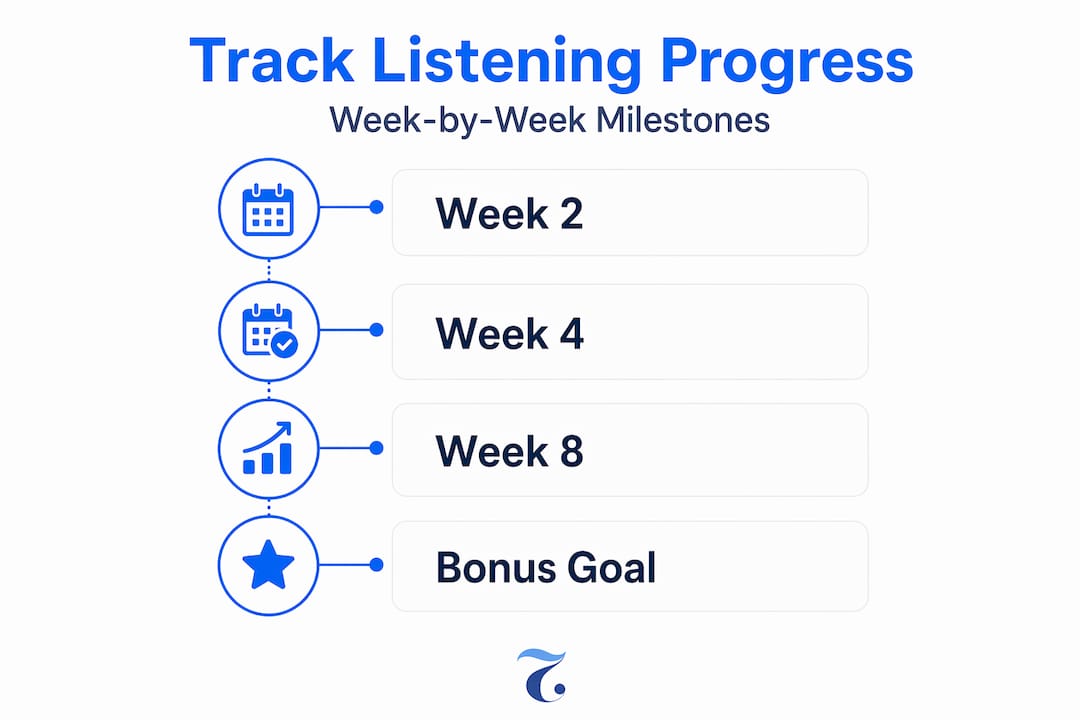
| Milestone | What it looks like | What to do next |
|---|---|---|
| Week 2 | Catching individual tones and basic greetings | Add 5 min of live partner practice daily |
| Week 4 | Following slow, familiar conversations at 60% | Introduce unfamiliar topics at slow speed |
| Week 8 | 60-70% comprehension of everyday Thai | Move to faster audio and business Thai content |
My honest take on learning to hear Thai
I have watched a lot of adult learners approach Thai listening the same way they approached grammar in school: study the rules, get them right, then apply them. That approach fails in Thai more than almost any other language. The reason is that Thai fluency lives in the ear before it lives in the mind.
In my experience, the learners who make the fastest progress are the ones who spend time with native speakers early, even when it feels uncomfortable. That discomfort is actually the signal that your ear is working hard. The ones who wait until they feel “ready” to speak with real people often find that the gap between their study Thai and real Thai is much wider than they expected.
I also want to push back on the obsession with tone perfection in the early stages. Yes, Thai tones matter. But I have seen learners freeze for ten minutes trying to get a single tone exactly right, while a conversation partner who would have understood them just fine was waiting. Cultural context carries a surprising amount of meaning. A native speaker who knows what you are trying to say will often fill in the gap even if your tone was slightly off.
The goal in the first two months is not perfection. It is pattern recognition. Get your ear used to the rhythm, the speed, and the music of Thai. Accuracy will follow naturally as you get more exposure.
— Paul
Start building your Thai listening skills with Thai Explorer

Thai Explorer offers structured adult Thai courses in Singapore and online that are built around exactly the skills covered in this guide. Whether you want conversational Thai for travel, business Thai for professional use, or flexible Zoom-based lessons that fit around your schedule, the programs are designed to develop listening, speaking, and cultural comprehension together, not as separate silos. Native bilingual instructors provide the kind of real-time tone feedback that recorded audio simply cannot replicate. Explore the full range of adult Thai courses to find the format that fits your learning style, or check out the online Thai course options if you prefer studying from home. Thai Explorer is located right above Tanjong Pagar MRT at 10 Anson Road, #22-07, International Plaza, Singapore 079903, making in-person classes easy to fit into your week.
FAQ
What is Thai listening comprehension?
Thai listening comprehension is your ability to understand spoken Thai in real time, including tones, vocabulary, and meaning in context. It is one of the four core language skills and the most direct indicator of conversational readiness.
How long does it take to improve Thai listening skills?
With 45-60 minutes of daily practice including tone drills and native speaker interaction, most learners reach 60-70% comprehension of familiar Thai topics within 8 weeks.
What is the role of listening skills in Thai fluency?
Listening is the foundation of spoken fluency. You cannot produce natural Thai speech until your ear can accurately decode tones, rhythm, and connected speech at conversational speed.
What are the best ways to improve Thai listening skills?
Daily tone drills, graded audio content, live practice with native speakers via apps like HelloTalk, and regular no-subtitle self-testing are the most effective methods for building Thai listening comprehension consistently.
Should I read Thai while practicing listening?
Not as your primary method. Reading along can become a crutch that bypasses active listening. Use transcripts for review after listening, not as a simultaneous aid, to make sure you are actually training your ear.