
TL;DR:
- An intensive Thai course involves daily, structured classes over six weeks, significantly accelerating language skills. It emphasizes immersion, daily practice, and cultural context to improve speaking, listening, and comprehension rapidly. This format is ideal for adult learners with specific goals and tight timelines seeking practical fluency.
If you’ve ever searched for the fastest way to learn conversational Thai, you’ve probably stumbled across the term “intensive Thai course” without a clear explanation of what it actually means. An intensive Thai course is not just a regular class with more homework. It’s a structured, high-frequency learning format designed to accelerate your progress through daily practice, immersive content, and a compressed timeline. Whether you’re a traveler heading to Bangkok or a professional building relationships in Thailand, understanding what separates intensive from standard programs helps you make the right call before you invest your time and money.
Table of Contents
- Key takeaways
- What is an intensive Thai language course?
- Benefits of an intensive Thai course for fast learners
- Intensive vs. regular Thai courses: what’s the difference?
- How to study Thai effectively in an intensive course
- My take on intensive Thai courses for adult learners
- Start learning Thai with Thai Explorer
- FAQ
Key takeaways
| Point | Details |
|---|---|
| Intensive means daily commitment | Expect around 3 hours of class per day, 5 days a week, over a 6-week period per level. |
| Tonal listening is the hardest skill | Immersive formats specifically address the difficulty of Thai listening comprehension for non-native speakers. |
| Faster progress than part-time study | Daily exposure in intensive formats outpaces spread-out study of 1-2 hours per week over months. |
| Culture is built into the curriculum | Advanced intensive levels integrate Thai society and culture topics, not just grammar and vocabulary. |
| Suitable for adults with clear goals | Busy professionals and travelers benefit most when they need practical speaking skills within weeks. |
What is an intensive Thai language course?
At its core, an intensive Thai language course compresses what would normally take months into a shorter, focused period of study. Chulalongkorn University’s Intensive Thai Program structures this as 3-hour daily classes, Monday through Friday, for 6 weeks per level. That works out to roughly 90 to 100 hours of instruction per level, which is a significant block of focused time compared to a casual once-a-week class.
What makes this format distinct is the pace. You’re not reviewing last week’s material at the start of every session. You build on what you covered the day before, which creates a compounding effect in your language recall and muscle memory.
Typical course structure
A standard intensive Thai language course covers four core skill areas:
- Speaking and pronunciation: Daily speaking drills with a focus on Thai tones and real conversation scenarios
- Listening comprehension: Structured exercises using native-speed audio and instructor-led dialogue
- Reading and writing: Introduction to Thai script, with reading practice built in progressively
- Cultural context: Advanced course levels incorporate Thai society, customs, and situational language use
Course formats available
Intensive courses are available in several formats depending on your schedule and learning style. In-person group classes give you live interaction and peer practice. Private sessions move at your pace and cut out time spent on concepts you already know. Online formats, like the online Thai courses offered by Thai Explorer, give you flexibility without sacrificing structure or instructor quality.
Pro Tip: If you’re preparing for travel or a work assignment in Thailand with a fixed departure date, a private intensive format lets you focus exactly on the vocabulary and situations you’ll actually face.
A well-built Thai language course syllabus at the intensive level doesn’t just throw vocabulary lists at you. It sequences skills deliberately: pronunciation and tones first, then basic social phrases, then grammar structures, then real-world conversation scenarios. Each week builds on the last.
Benefits of an intensive Thai course for fast learners
Most people who choose an intensive format do so because they need results within a defined window of time. The benefits go beyond just speed.
- Rapid conversational confidence. Daily practice means you’re not forgetting between sessions. You build instinct, not just knowledge.
- Tackles the hardest skill directly. Listening comprehension is rated the most difficult skill for foreign Thai learners. Immersive daily exposure attacks this problem head-on instead of letting it linger.
- Cultural fluency alongside language. You pick up how Thai people actually speak, not just textbook phrases. Thai Explorer’s cultural immersion approach integrates this from early lessons.
- Better retention through repetition. Seeing the same structures every day, across speaking and listening, cements them far faster than weekly review.
- Practical readiness for real situations. Whether it’s ordering food, handling business introductions, or reading signs, an intensive program gets you functional faster than any other format.
Sustained daily exposure can significantly shorten the perceived difficulty of Thai listening skills, which is the main barrier most adult learners hit in the first few months. Intensive courses are specifically designed to push through that barrier quickly.
Pro Tip: Pair your intensive course with Thai music or podcasts during your commute. Song-based learning reinforces tonal patterns and vocabulary in a way that classroom drills alone cannot replicate.

The ideal candidate for an intensive Thai language immersion program is anyone who has a deadline or a goal. Travelers, expatriates preparing to relocate, professionals building a client base in Thailand, and anyone who simply wants to learn Thai quickly without dragging the process out over years.
Intensive vs. regular Thai courses: what’s the difference?
The simplest way to frame this is through time and outcome. Here’s a direct comparison:
| Factor | Intensive course | Regular or part-time course |
|---|---|---|
| Class hours per week | 15 hours (3 hrs/day, Mon-Fri) | 2 to 4 hours per week |
| Time to complete one level | 6 weeks | 4 to 6 months |
| Best for | Fast skill acquisition, travel, career prep | Hobbyists, gradual learners, busy schedules |
| Pace | Fast, daily reinforcement | Slower, spaced sessions |
| Cost | Higher upfront, faster completion | Lower per session, longer total commitment |
| Retention | High due to daily exposure | Variable, depends on self-study habits |
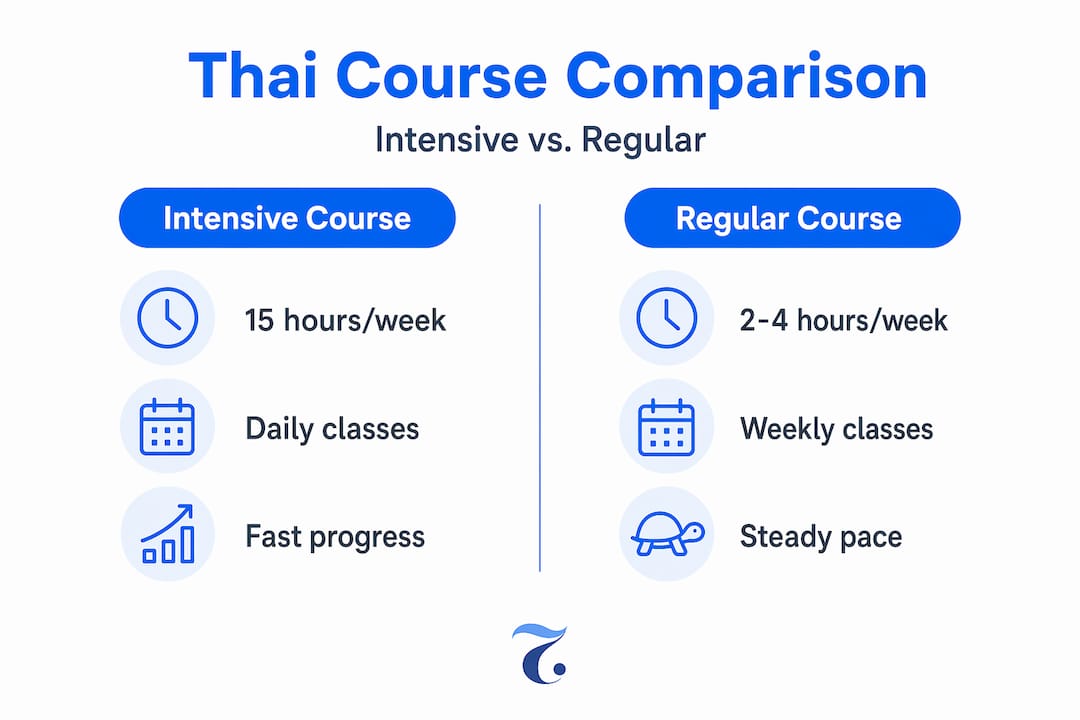
Research comparing 100-hour intensive formats to spread-out study of 1 to 2 hours per week consistently shows faster conversational progress in intensive settings. The difference isn’t just the number of hours. It’s the daily frequency that keeps new language structures active in your memory.
To put the timeline in perspective: achieving operational proficiency in Thai is estimated to require around 1,100 class hours for English speakers, placing Thai among the most demanding languages to master. An intensive course doesn’t eliminate that total. It compresses the early stages so you become functional much faster, which keeps motivation high and opens real-world practice opportunities sooner.
Part-time courses make complete sense if your schedule won’t allow daily study or if you’re learning Thai purely for personal interest with no time pressure. The tradeoff is real though. Gaps between sessions mean more review time and slower speaking development.
How to study Thai effectively in an intensive course
Getting the most from an intensive Thai course is not just about showing up. The pace demands that you stay engaged outside of class hours too.
- Review the same day, not the next morning. Spend 15 to 20 minutes after each class writing out key vocabulary and phrases from memory. Same-day review dramatically improves retention.
- Practice tones with muscle memory drills. Repetition-based speaking methods have shown accelerated speaking ability when learners treat tonal pronunciation like a physical skill, not just an academic one.
- Engage with native content daily. Thai YouTube channels, short TV clips, and language immersion practices like music and social media in Thai all reinforce what you’re building in class.
- Speak with native speakers outside class. Even short conversations with Thai colleagues, restaurant staff, or language exchange partners compound your progress rapidly.
- Manage your energy. Intensive study is mentally demanding. Build in short breaks between study sessions and treat sleep as part of your study plan. Burnout kills retention faster than any vocabulary gap.
Pro Tip: Use the first 10 minutes of every morning to review flashcards from the previous day’s class before you do anything else. You’ll be surprised how much more you retain by the end of the week.
One thing most learners underestimate is that how to study Thai effectively is as much about mindset as method. Intensive courses work best when you accept that confusion is part of the process. You won’t understand everything in week one. That discomfort is the mechanism that drives faster learning.
My take on intensive Thai courses for adult learners
I’ve seen adult learners walk into intensive Thai courses with the expectation that sheer willpower would carry them through, and I’ve seen that approach fail by week two. What actually works is treating the course as a system, not a test of endurance.
The learners I’ve watched make the fastest progress are not necessarily the most talented. They’re the ones who commit to outside-of-class practice, lean into cultural context rather than avoiding it, and ask their instructors direct questions about situations they’ll actually face. A business professional who needs to greet clients in Thai with cultural awareness will progress faster than someone studying abstract vocabulary with no real-world anchor.
The tonal structure of Thai genuinely challenges adult learners in ways that European languages don’t. Listening comprehension is the wall most people hit around weeks two and three. Foreigners integrating into Thai-speaking environments consistently rate listening as their biggest obstacle, and I think intensive courses are worth the effort precisely because they force you through that wall faster than any other format. Weekly classes let you avoid the discomfort. Daily classes don’t give you that option.
My honest advice: don’t wait until you’re three weeks from a trip to Thailand to start. The intensive format works best when you give yourself at least one full level before you need the language in real life. That buffer time is where confidence actually forms.
— Paul
Start learning Thai with Thai Explorer
Thai Explorer offers intensive Thai language courses in Singapore designed specifically for adult learners who need practical results, not just academic exposure. Classes are taught by qualified native Thai instructors who are bilingual in Thai and English, so you always understand exactly what you’re learning and why. Whether you prefer in-person group sessions or online classes, the curriculum follows a structured Thai language course syllabus aligned with CU-TFL standards, covering speaking, listening, reading, and writing from day one. For learners who want faster, personalized progress, private Thai lessons are available with flexible scheduling. Thai Explorer is located at 10 Anson Road, #22-07, International Plaza, Singapore 079903, directly above Tanjong Pagar MRT. Reach out today to find the right course format for your goals.
FAQ
What is an intensive Thai course?
An intensive Thai course is a structured language program with daily classes, typically 3 hours per day, 5 days a week, over 6 weeks per level. It covers speaking, listening, reading, and cultural content in a compressed format designed for fast skill acquisition.
How long does it take to complete an intensive Thai course?
One level of an intensive Thai course typically takes 6 weeks, with around 90 to 100 hours of instruction. Full conversational proficiency requires multiple levels and an estimated 1,100 total hours for English speakers.
Who should take an intensive Thai language course?
Intensive courses are best suited for adult learners, travelers, and professionals who need functional Thai speaking skills within a defined timeframe. They work especially well for people preparing for relocation, business trips, or extended stays in Thailand.
How does an intensive course differ from a regular Thai class?
A regular Thai class meets 2 to 4 hours per week, spreading one level over several months. An intensive course covers the same content in 6 weeks through daily sessions, which accelerates both retention and real-world speaking ability significantly.
Is an online intensive Thai course as effective as in-person?
Yes, when delivered by qualified native instructors with a structured curriculum. Online intensive formats offer the same daily practice framework with added scheduling flexibility, making them a strong option for busy professionals and learners outside Singapore.