TL;DR:
- Using polite particles like “krap” and “ka” is essential to show respect and soften speech in Thai culture.
- Mastering greetings, daily phrases, and emergency expressions enables effective communication and cultural understanding during travel and work.
Thailand rewards anyone willing to speak even a little of the language. The moment you drop a well-placed “Sawatdee krap” on a Bangkok street or thank a vendor with “Khop khun ka,” you stop being a tourist and start being a guest. This article gives you categorized examples of Thai phrases across greetings, everyday conversation, emergencies, and business contexts. Better still, each section includes cultural context so you use phrases the right way, not just the right words.
Table of Contents
- Key takeaways
- 1. Essential greetings and polite expressions
- 2. Basic conversational phrases for everyday situations
- 3. Examples of Thai phrases for emergencies and urgent needs
- 4. Business and formal Thai phrases worth knowing
- 5. Cultural tips and common etiquette linked to Thai phrases
- 6. Common Thai idioms that reveal the culture
- My honest take on learning Thai phrases
- Learn Thai the right way with Thai Explorer
- FAQ
Key takeaways
| Point | Details |
|---|---|
| Polite particles matter | Always add “krap” (men) or “ka” (women) to phrases to show respect and soften your speech. |
| Greetings open doors | “Sawatdee krap/ka” works in almost every situation and signals cultural awareness immediately. |
| Emergency phrases save lives | Knowing “Chuay duay!” (Help!) and how to ask for a doctor can make a critical difference when traveling. |
| Business Thai is more formal | Formal Thai uses indirect, polished language that differs noticeably from casual street conversation. |
| Context shapes every phrase | Thai communication is tied deeply to social hierarchy, so the same word can mean different things depending on who you say it to. |
1. Essential greetings and polite expressions
The most impactful examples of Thai phrases you will ever learn are greetings. They cost you nothing and earn you enormous goodwill. The standard greeting is Sawatdee krap/ka, where men say “krap” and women say “ka” at the end. These polite particles are not optional extras. They signal that you understand Thai social norms and respect the person in front of you.
Here are the must-know Thai phrases for greetings and basic politeness:
- Sawatdee krap/ka (sah-wah-dee krap/ka): Hello / Goodbye
- Sabai dee mai krap/ka? (sah-bye dee my?): How are you?
- Sabai dee krap/ka: I’m well, thank you
- Khop khun krap/ka (kop-koon krap/ka): Thank you
- Kho thot krap/ka (kor-toht krap/ka): Sorry / Excuse me
- Mai pen rai krap/ka (my pen rye): No worries / Never mind
The wai gesture accompanies many of these expressions. You press your palms together at chest level for peers, raise them to your nose for elders, and lift them to your forehead for monks or sacred images. The higher the hands, the deeper the respect. As a foreigner, you are not expected to initiate the wai. A genuine smile and a nod go a long way when your hands are full or you are unsure.
Pro Tip: Adding “krap” or “ka” after almost any phrase immediately softens your speech and signals respect. Even a simple “yes” becomes “chai krap/ka,” which sounds far more polite than a blunt nod.
2. Basic conversational phrases for everyday situations
Once greetings are locked in, you need phrases that handle real situations: buying food at a market, asking for directions, or flagging down a tuk-tuk. These are the best Thai phrases for travel because they solve actual problems.
Key phrases to carry with you:
- Tao rai krap/ka? (tao-rye?): How much does this cost?
- Yoo tee nai krap/ka? (yoo tee nai?): Where is…?
- Chuay chan duay dai mai krap/ka? (chooay chan doo-ay dai my?): Can you help me?
- Mai kao jai krap/ka (my kao jai): I don’t understand
- Phoot cha-cha dai mai krap/ka? (poot cha-cha dai my?): Can you speak slowly?
- Chai krap/ka: Yes
- Mai chai krap/ka: No
- Mai ow krap/ka (my ow): I don’t want it / No, thank you
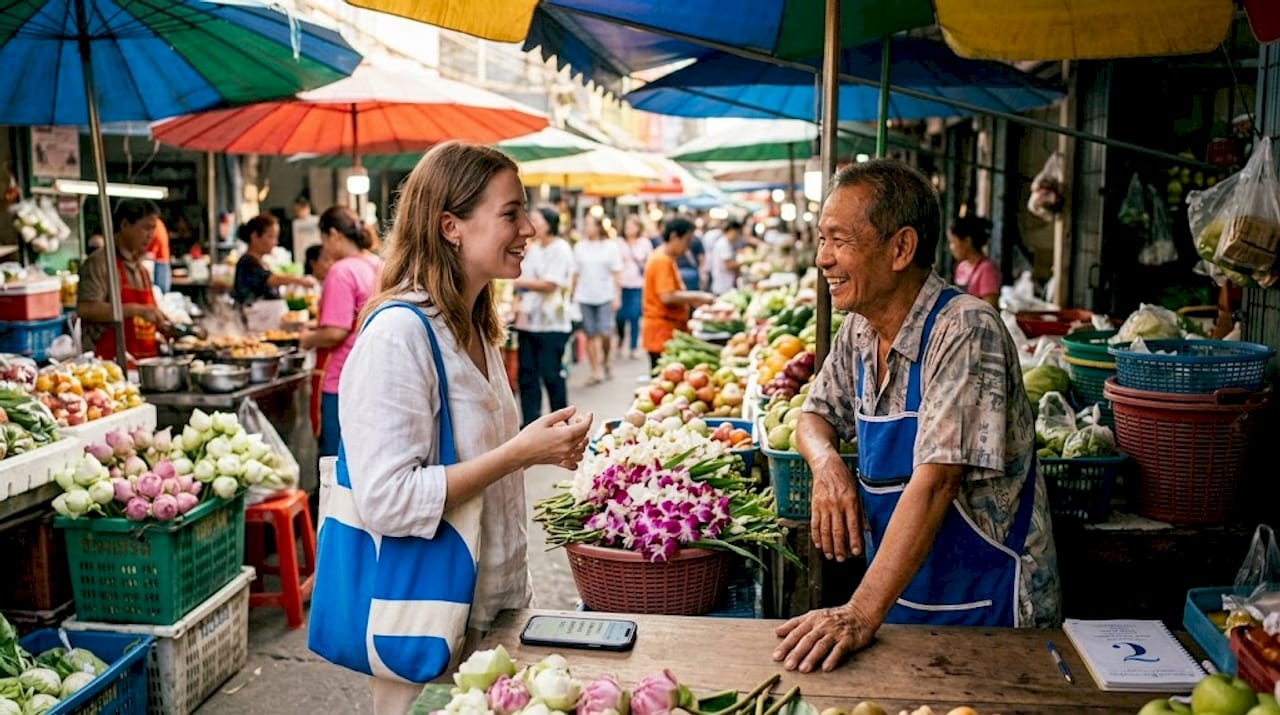
A short example dialog at a market: you point to a mango and ask “Tao rai krap?” The vendor says “20 baht.” If you want to negotiate politely, try “Lot noi dai mai krap/ka?” which means “Can you reduce the price a little?” The word “noi” (a little) is key. It softens the request and keeps things friendly, which matters deeply in Thai culture.
Body language plays a huge role alongside words. Raising your voice or showing frustration will almost always make the situation worse. Thai communication favors calm, patient tones, especially in service or market settings.
Pro Tip: If you are lost and someone cannot understand you, try showing them your destination written in Thai script on your phone. Pair it with “Yoo tee nai krap/ka?” and most people will point or walk you there themselves.
3. Examples of Thai phrases for emergencies and urgent needs
Nobody wants to use these, but knowing them is non-negotiable. When something goes wrong, clear communication can be the difference between a scary moment and a serious crisis. The key emergency phrase is ช่วยด้วย! (Chuay duay!) pronounced “chooay doo-ay!” and it means “Help!”
| Thai Phrase | Pronunciation | Meaning |
|---|---|---|
| ช่วยด้วย! (Chuay duay!) | chooay doo-ay | Help! |
| Riak police duay | ree-ak poh-lees doo-ay | Call the police |
| Tong-kan mor krap/ka | tong-kahn mor | I need a doctor |
| Pai rong-paya-bahn | pai rong-pah-yah-bahn | Take me to the hospital |
| Jep tee nee | jep tee nee | It hurts here (point to area) |
| Pen lom | pen lom | I feel faint |
| Kho yah kae puad | kor yah gae poo-at | I need pain medication |
Keep this list saved as a screenshot on your phone before you travel. Thai hospital staff in major cities often speak some English, but in smaller towns or during an emergency on the road, these phrases give you a real advantage. Speak calmly and clearly, and always add “krap” or “ka” even in urgent moments. Politeness does not slow down help; it actually makes people more willing to assist quickly.
4. Business and formal Thai phrases worth knowing
If you are traveling to Thailand for work or meeting Thai business contacts, casual street phrases will not cut it. Examples of Thai business phrases follow different rules. Formal Thai uses more polished, indirect forms compared to the relaxed speech you hear at a night market.
Here is a quick comparison between casual and formal usage:
| Situation | Casual Thai | Formal / Business Thai |
|---|---|---|
| Greeting | Sawatdee krap/ka | Yin dee tee dai roo-jak krap/ka (Pleased to meet you) |
| Introducing yourself | Phom cheu… (My name is…) | Phom cheu… yin dee tee dai pob krap (My name is… I’m pleased to meet you) |
| Making a request | Kho… noi | Run-gan-nah, kho… duay krap/ka (May I please have…) |
| Saying goodbye | La gorn krap/ka | Khob khun mak krap/ka, la gorn (Thank you very much, goodbye) |
| Agreeing | Chai, dai | Khao jai laeo krap/ka (Understood, certainly) |
In a business setting, you will also want to present and receive business cards with both hands and a slight bow. Never write on a business card in front of the person who gave it to you. These non-verbal behaviors pair with your words to create a complete impression of professionalism and cultural respect.
Pro Tip: Before a formal meeting, practicing Thai communication skills for professional contexts makes a real difference. Even a single formal greeting in Thai lands with genuine warmth from Thai colleagues.
5. Cultural tips and common etiquette linked to Thai phrases
Knowing phrases is one layer of communication. Understanding when and why to use them is the deeper layer. Thai social life runs on the concept of “saving face,” and it shapes every conversation you will have.
Raising your voice or offering public criticism is a serious social offense in Thailand. It does not just embarrass the other person. It creates tension that lingers and damages the relationship. Calm, indirect communication is not passivity; it is skill.
“In Thailand, the smile is one of the most powerful communication tools you have. It can defuse a misunderstanding, signal goodwill, and open doors that fluent words alone cannot.” — Thai Culture & Etiquette
A few practical etiquette rules that connect directly to language use:
Criticism or corrections, when truly necessary, should always happen privately and gently to avoid causing social tension. This applies whether you are disagreeing with a vendor’s price, raising a concern at a business meeting, or correcting a misunderstanding.
Respect in Thai communication reflects social hierarchy. You speak differently to a monk, an elder, a peer, and a child. Paying attention to this does not require advanced language skills. It requires awareness, a soft tone, and those ever-present polite particles.
Thai dining etiquette is also phrase-adjacent. Shared dishes and waiting for the eldest to begin are standard practice. Knowing how to say “Aroi mak krap/ka” (This is very delicious) or “Gin khao rue yang?” (Have you eaten yet?) shows cultural engagement that goes beyond just ordering food.
6. Common Thai idioms that reveal the culture
A guide to Thai everyday expressions would be incomplete without idioms. These are not phrases you need to use, but understanding them gives you a real window into how Thai people think.
“Nam jai” (น้ำใจ) literally translates to “water of the heart.” It means generosity and kindness, the kind that comes without being asked. When someone goes out of their way for you and another Thai person says “Khao mee nam jai mak,” they mean that person has genuine goodness in them. Hearing this phrase used in context tells you a great deal about what Thai culture values.
“Jai yen yen” (ใจเย็นๆ) means “cool heart” and is used to tell someone to calm down or be patient. It is part of the common Thai idioms explained by the cultural value placed on emotional restraint. You will hear it often, and knowing what it means helps you respond correctly rather than feeling dismissed.
“Sanuk” (สนุก) means fun, but it carries more cultural weight than the English translation. Thais believe that almost any activity, including work, should have an element of sanuk. If something feels joyless, it may not be worth doing. Recognizing this value helps you understand Thai workplace culture, social events, and even how people approach learning a language.
My honest take on learning Thai phrases
I’ve watched a lot of travelers approach Thailand with a phrasebook in hand and still struggle to connect. The problem usually isn’t vocabulary. It’s that they treat phrases as transactions rather than gestures. You say “Sawatdee krap,” someone smiles back, and you think: done. But the real moment comes when you say it naturally, without checking the book, and the person you’re speaking with realizes you actually mean it.
In my experience, the travelers who get the most out of Thai phrases are the ones who pair them with genuine curiosity. They mess up the tone on “mai” (which can mean “no,” “new,” “burn,” or “silk,” depending on pitch), laugh about it, and try again. Thai people respond incredibly warmly to that kind of humility.
What I’ve found is that cultural respect is not a separate module you add on top of language learning. It is the foundation. The polite particles, the soft tone, the awareness of hierarchy: these are not decorative. They are the language. Skip them, and you are only speaking half of Thai.
The most meaningful exchange I ever witnessed was a non-Thai speaker who knew maybe fifteen words but used every single one with care. The response they received was fuller, warmer, and more generous than what most fluent speakers get from a rushed recitation.
— Paul
Learn Thai the right way with Thai Explorer

Memorizing a phrase list is a starting point. Building real confidence takes structure, feedback, and context. Thai Explorer offers adult Thai courses in Singapore designed for exactly this: conversational fluency, cultural understanding, and professional communication. Whether you are preparing for a trip, engaging with Thai colleagues, or building long-term language skills, the courses are built around how adults actually learn.
Group, private, and online Zoom classes are available for all levels, taught by qualified native Thai instructors who are bilingual in Thai and English. Corporate training is also available for teams. Located right above Tanjong Pagar MRT at 10 Anson Road, #22-07, International Plaza, Singapore 079903, Thai Explorer makes quality Thai learning genuinely accessible. Explore Thai language courses in Singapore and take the next step toward fluency.
FAQ
What are the most important Thai phrases for travelers?
The must-know Thai phrases for any traveler are Sawatdee krap/ka (hello), Khop khun krap/ka (thank you), Tao rai krap/ka (how much?), and Chuay duay! (help!). Adding polite particles like “krap” or “ka” to every phrase immediately signals respect.
How do Thai polite particles work?
Men add “krap” and women add “ka” to the end of sentences and phrases. These particles are not optional in Thai. They soften speech, show respect, and are one of the clearest signals that you understand Thai social norms.
What should I know about Thai business phrases?
Examples of Thai business phrases are more formal and indirect than casual speech. Begin with a polite greeting like “Yin dee tee dai roo-jak krap/ka” (pleased to meet you) and always present or receive items, including business cards, with both hands.
What does “saving face” mean in Thai communication?
Losing face in Thailand refers to public embarrassment or criticism, which can seriously damage relationships. Calm, private, and gentle communication is always preferred, even in disagreements or corrections.
Can I get by in Thailand with just basic Thai phrases?
Yes. Even a small set of basic travel phrases paired with a genuine smile and respectful tone will take you very far. Thai people respond warmly to any sincere effort to speak their language.