TL;DR:
- Learning even a few Thai phrases transforms travel experiences by fostering genuine interactions and cultural respect.
- Outside major cities, Thai language skills improve market negotiations, local engagement, and social goodwill.
You can get by in Bangkok with English. Most hotel staff speak it, tourist menus are translated, and ride apps work without a single Thai word. But “getting by” is not the same as actually being in Thailand. The role of Thai language in travel is far bigger than solving logistics. It determines whether you experience the country as a consumer or as a guest. Learn even a handful of phrases and the interaction changes completely. Vendors smile differently. Locals lean in. Doors open that no app can unlock for you.
Table of Contents
- Key takeaways
- The role of Thai language in travel starts with practical reality
- Cultural significance of Thai as a language of respect
- Understanding the real challenges of Thai language
- Thai language skills in Thailand’s 2026 tourism shift
- My honest take on why Thai changes everything
- Start your Thai language journey before you land
- FAQ
Key takeaways
| Point | Details |
|---|---|
| English has real limits outside cities | English proficiency drops sharply in rural areas and local markets, making Thai phrases a practical necessity. |
| Politeness particles carry enormous weight | Adding “krap” or “ka” to any phrase signals respect and dramatically improves how locals respond to you. |
| Culture and language are inseparable | Speaking even basic Thai shows cultural awareness that unlocks genuine, non-transactional connections. |
| Tones matter less than effort | Thai is tonal but locals are patient. Attempting phrases with a good attitude gets better results than silence. |
| 2026 tourism favors cultural travelers | Thailand’s current tourism strategy rewards visitors who engage meaningfully, and language is the clearest way to do that. |
The role of Thai language in travel starts with practical reality
The first thing most travelers discover is that English drops significantly outside Bangkok, Chiang Mai, and the major resort islands. Step into a rural market in Chiang Rai, take a local bus in Ayutthaya, or try ordering from a street stall with no picture menu, and you will feel that gap immediately.
This is where learning Thai for travel stops being optional and starts being genuinely useful. A few core phrases cover an enormous amount of ground:
- Sawasdee krap/ka (hello) opens every interaction with warmth
- Khop khun krap/ka (thank you) closes it with respect
- Tao rai? (how much?) is your single most useful market phrase
- Pai… dai mai? (can I go to…?) handles transport questions
- Aroi mak (very delicious) tells a food vendor everything they need to hear
Knowing tao rai? alone helps you negotiate prices at local markets and sidestep the informal tourist markup that happens when a vendor clocks that you have no idea what anything costs. It is not about being cheap. It is about participating in the normal exchange rather than being outside it.
Pro Tip: Always add “krap” if you are male or “ka” if you are female to the end of your phrases. These politeness particles are not optional flourishes. They fundamentally change how a phrase lands. A request without them sounds blunt. With them, it sounds respectful. This single habit will improve almost every interaction you have.
The communicating in Thailand reality is this: Thai people in tourist-facing roles are patient and helpful. But when you step outside those zones, a small investment in basic phrases is the difference between pointing at things and actually talking to people.
Cultural significance of Thai as a language of respect
Thai is not just a communication tool. It is a social system. The way the language is structured, with its tonal nuances and social particles, reflects a culture that places enormous value on harmony, hierarchy, and face. When you attempt even imperfect Thai, you are not just saying words. You are demonstrating that you understand something about how Thai society works.
Locals notice this immediately. A phrase delivered with the right politeness particle and a genuine smile does more social work than a fluent but flat English sentence ever could.
The wai gesture, where you press your palms together and bow slightly, amplifies this further. Combine a wai with a “sawasdee krap/ka” and you have communicated cultural respect in under three seconds. Most tourists skip this entirely. The ones who do it get treated differently, and they know it.
The cultural impact of Thai language goes deeper than first impressions:
- Local vendors are more willing to explain dishes, share recipes, or suggest off-menu items
- Guesthouse owners give better rooms, local tips, and sometimes invite you for meals
- Temple staff engage with genuine warmth rather than performing a scripted tour
- Rural communities treat you as a visitor worth talking to, not a transaction to complete
Research shows that language acts as social currency in Thailand, generating goodwill that money simply cannot replicate. When 63% of high-spending visitors report deeper travel satisfaction when they use basic Thai, it is not a coincidence. They are experiencing a fundamentally different version of the same country.
“Language in Thailand is a performance of social harmony. When a foreigner makes the effort to speak Thai, they are participating in that performance. And Thai people respond to that participation with genuine warmth.”
The importance of Thai language in tourism becomes obvious when you frame it this way. You are not learning phrases to get things done. You are learning a small piece of how Thai people relate to each other, and then you are using it to relate to them.
Understanding the real challenges of Thai language
Thai is a tonal language with five distinct tones. The same syllable spoken in a different tone means a completely different thing. This sounds intimidating, and for some travelers it stops them from trying at all. That would be a mistake.

The practical reality is that context and Thai patience do a lot of the corrective work for you. If you are standing in front of a mango stall, point at the fruit, and say something that sounds approximately like “aroy” (delicious), the vendor knows exactly what you mean. They are not grading your tones. They are responding to your effort and your intent.
For short trips, the strategy is clear. Focus on a limited phrase set with polite particles rather than attempting broad vocabulary or trying to read the Thai script. Learning to read Thai takes months. Learning twenty phrases that work in real situations takes an afternoon. The return on investment is completely different.
A few practical strategies that actually help:
Write out phrases phonetically in a small notebook. Apps are great until you have no signal in a rural guesthouse.
Practice saying your phrases out loud before the trip, not just reading them silently. Tonal languages reward vocal practice more than visual study.
Accept that imperfect attempts still work. Research consistently shows that even imperfect Thai elicits smiles and goodwill from locals, because the culture genuinely values effort over perfection.
Pro Tip: You do not need to master tones to be understood. What you do need is the politeness particles. If your tones are slightly off but you end your phrase with “krap” or “ka,” locals almost always bridge the gap for you. The particles signal that your intent is respectful, and that goes a long way.
The mistake most travelers make is treating the difficulty of Thai as a reason not to try. Thai language tips for travelers consistently point in the same direction: start small, stay consistent, and let the locals do the rest.
Thai language skills in Thailand’s 2026 tourism shift
Thailand’s tourism strategy has shifted in a meaningful direction. The Tourism Authority of Thailand’s current focus is explicitly on value over volume, prioritizing travelers who engage meaningfully with Thai culture rather than simply moving through it. Language skill is the most direct expression of that engagement.
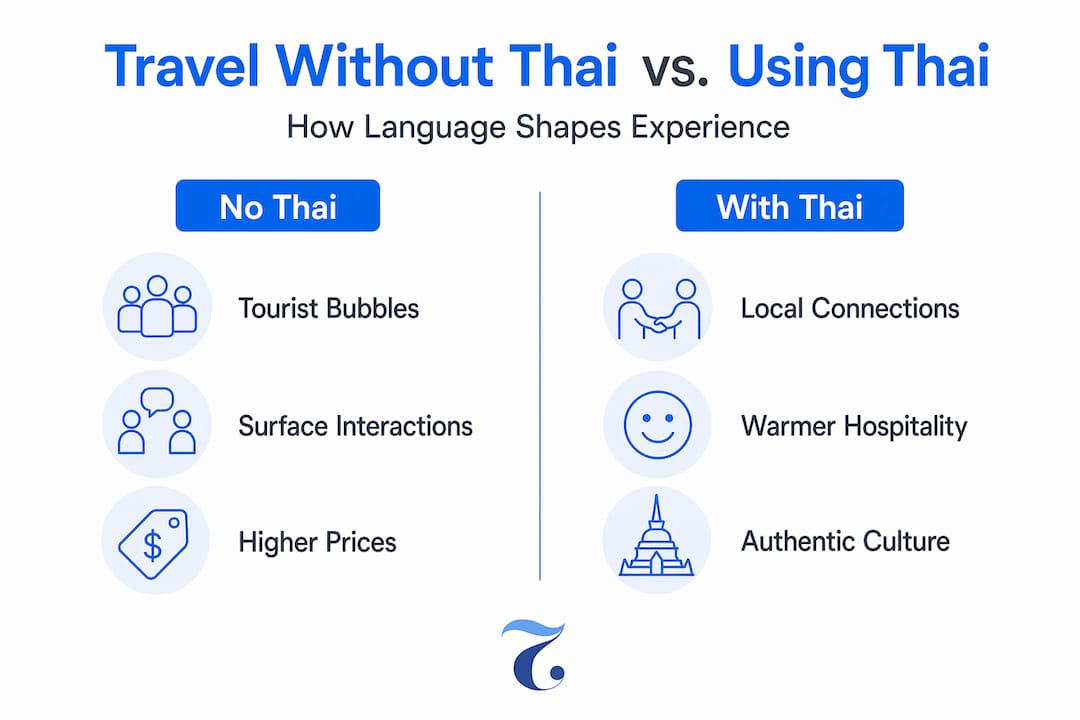
This is not just a government policy position. It reflects a real shift in what travelers expect from international experiences. The traveler who speaks a few phrases of Thai, eats where locals eat, and engages with temple staff directly is having a categorically different trip than one who stays inside the resort bubble.
The table below shows how Thai language effort maps to actual travel outcomes:
| Language effort | Typical traveler experience | Quality of local interaction |
|---|---|---|
| No Thai, English only | Tourist zone dependent | Transactional, scripted |
| Basic greetings + politeness particles | Access to local markets and eateries | Warm, noticeably more open |
| Core travel phrases (20-30) | Confident in rural areas | Genuine, often memorable |
| Conversational Thai | Full cultural integration | Deep, lasting connections |
Without Thai, travelers often remain in expatriate bubbles and face real limits on how deeply they can connect with local communities. This is documented, not anecdotal. The importance of Thai language in tourism is growing precisely because more travelers now want what only language can provide.
How Thai language enhances travel, in 2026, is inseparable from this broader shift. The traveler who invests in even basic Thai is aligned with where Thailand’s tourism culture is heading. They are not just visiting. They are participating.
My honest take on why Thai changes everything
I have watched travelers with zero Thai and travelers with twenty phrases walk into the same market. The difference in what they walk out with, not just in purchases but in experience, is remarkable.
In my experience, the fear of getting tones wrong stops more people than actual language difficulty does. I have seen people apologize in advance for their Thai and then watch a vendor light up because someone bothered to try at all. The culture rewards the attempt in a way that few travel cultures do.
What I have learned is that Thai language unlocks cultural fluency in a way that no amount of reading guidebooks can replicate. When you speak even a word of Thai, you are no longer a tourist being managed. You are a person making contact.
My take on the tonal complexity question: stop treating it as a wall and start treating it as texture. You do not need to speak Thai perfectly to benefit from speaking it at all. The bar for positive response from Thai people is genuinely low. A real attempt with a genuine smile will outperform careful silence every single time.
If you are planning a trip to Thailand and you have not started learning even the basics yet, that is time left on the table. Start with greetings and politeness particles. Add food phrases. Add one direction phrase. That is already a different trip.
— Paul
Start your Thai language journey before you land
Thai Explorer offers structured adult Thai language courses built specifically for real-world communication, including conversational Thai that travelers can use from day one in Thailand. Whether you want to prepare for an upcoming trip, deepen your cultural engagement, or build toward business fluency, the programs are designed around practical outcomes, not textbook exercises.
Courses are available as group classes, private sessions, and online Zoom lessons, so you can learn around your schedule no matter where you are. Thai Explorer’s instructors are qualified native Thai speakers who are bilingual in Thai and English, which means you get clear explanations and real cultural context at every step. If you are ready to stop getting by and start genuinely connecting, explore the full range of Thai language programs at Thai Explorer and find the level that fits where you are right now.
FAQ
Why does Thai language matter for travelers?
The role of Thai language in travel goes beyond logistics. Knowing basic phrases helps you navigate markets, order food confidently, and connect with locals in ways that English simply cannot replicate outside tourist centers.
How much Thai do I need to learn before visiting Thailand?
For most trips, 20 to 30 core phrases with polite particles cover greetings, food ordering, transport, and basic negotiations. You do not need script reading or broad vocabulary for a meaningful travel experience.
Is Thai too difficult to learn for a short trip?
Thai is tonal, but locals are patient with foreign attempts and context does much of the interpretive work. Focusing on pronunciation of key phrases and adding politeness particles makes even imperfect Thai highly effective in real situations.
What are “krap” and “ka” and why do they matter?
These are gender-specific politeness particles added to the end of Thai phrases. Males use “krap” and females use “ka.” They signal respect and are considered basic courtesy in Thai communication, making a noticeable difference in how locals receive you.
How does speaking Thai connect to Thailand’s tourism goals in 2026?
Thailand’s Tourism Authority is actively prioritizing cultural engagement and quality experiences over high visitor volume. Travelers who use Thai language skills are directly aligned with this shift, gaining richer, more authentic access to local culture and community.