TL;DR:
- Immersive Thai learning emphasizes active daily engagement with language and culture to develop fluency effectively. It involves speaking, listening, reading, and cultural participation rather than passive exposure, which accelerates progress and deepens understanding. Consistent, deliberate practice through structured routines, digital tools, and real-world interactions transforms learners from passive observers to active communicators in Thai.
Immersive Thai learning is the practice of surrounding yourself with the Thai language and culture daily to build fluency through active use rather than passive study. Unlike traditional classroom methods that treat language as an academic subject, Thai language immersion treats it as a living system you participate in. You speak, listen, read, and engage with Thai culture in ways that mirror how native speakers acquired the language. Tools like the Ling app, structured courses aligned with the CU-TFL (Chulalongkorn University Proficiency Test of Thai as a Foreign Language), and daily conversation practice all play a role in making this approach work for adult learners worldwide.
What is immersive Thai learning and how does it differ from traditional study?
Immersive Thai learning is defined by active participation in the language across multiple contexts every day. Traditional study isolates grammar rules and vocabulary lists. Immersion integrates them into real communication from the start.

The core distinction is engagement. In a traditional Thai class, you might memorize the word for “water” (น้ำ, nam). In an immersive approach, you use that word to order a drink, label your water bottle in Thai, and recognize it in a Thai song. The word becomes anchored to experience rather than a flashcard. This is why immersion bridges classroom knowledge and real-world language use through deliberate practice, not passive exposure.
Thai language immersion also demands cultural participation. Understanding wai (the Thai greeting gesture), recognizing the significance of sanuk (the Thai value of fun and enjoyment), and knowing how to address someone respectfully all shape how you communicate. Language and culture are inseparable in Thai, and immersive learning treats them that way from day one.
How does active immersion work in the brain?
Active immersion works by forcing the brain to build direct associations between Thai words and real-world meaning, bypassing the mental translation step that slows most learners down. The ultimate goal of immersion is to think directly in Thai using visual aids, gestures, and contextual understanding rather than translation. That shift from “I hear Thai, translate to English, then respond” to “I hear Thai and respond in Thai” is the defining breakthrough of successful immersion.
Duke Language School’s research on active immersion confirms that immersion is effective only when learners actively participate: speaking, listening, noticing repeated language patterns, and using Thai regularly in real contexts. Simply being surrounded by Thai speakers without engaging produces minimal progress. The brain needs repeated, meaningful encounters with language to build durable neural pathways.
“Presence in a Thai-speaking environment is not immersion. Engagement is immersion.”
This distinction matters enormously for learners who assume moving to Bangkok or Chiang Mai will automatically produce fluency. Living in Thailand without purposeful engagement often leads to defaulting to English, particularly in larger urban centers. The immersive environment only works when you choose to use it.
Pro Tip: Set a daily “Thai-only window” of 20 to 30 minutes where you think, speak, or write exclusively in Thai. Even a short, focused block trains your brain to stop reaching for English as a crutch.
What are effective immersive Thai learning methods for beginners?
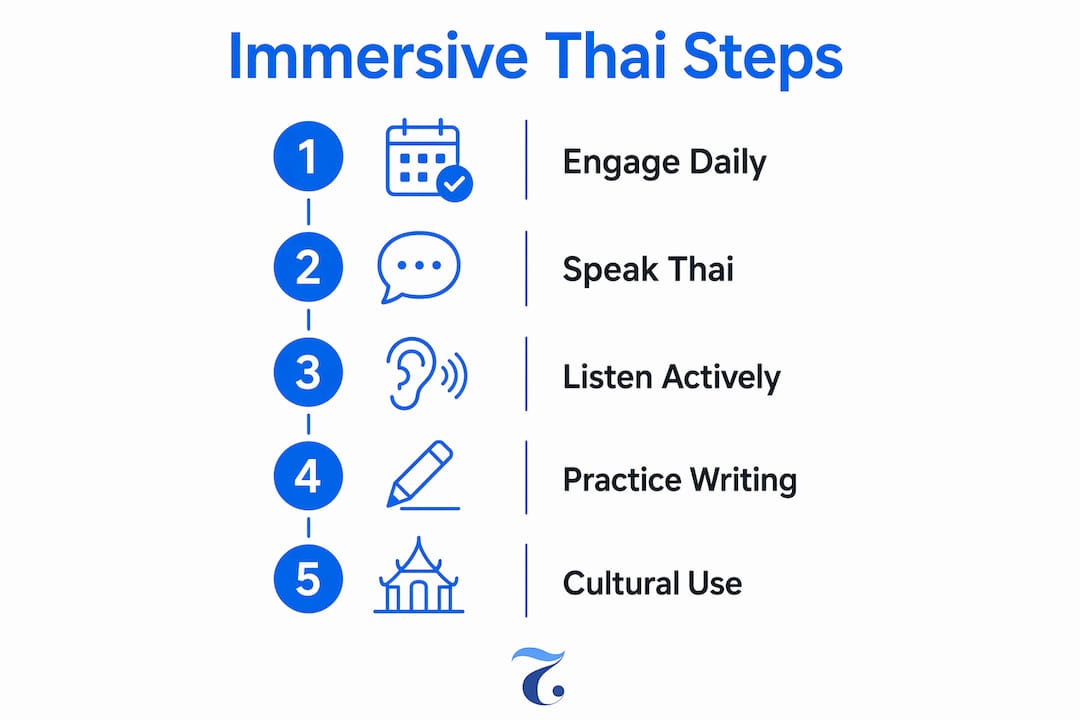
Beginners benefit most from a structured sequence that builds speaking confidence early, establishes script literacy, and creates daily habits that compound over time.
-
Start speaking from week one. Many learners delay speaking until they feel “ready.” That moment rarely arrives. Functional conversational Thai is achievable quickly with structured early speaking and reading focus. Prioritize greetings, numbers, and basic requests before worrying about grammar rules.
-
Learn Thai script within the first month. Thai script is not optional for serious immersion. The Thai writing system includes 44 consonants and 32 vowels, and script familiarity greatly improves phonetic understanding and vocabulary acquisition. Learners who skip the script consistently struggle with tones because they rely on romanized transliterations that misrepresent how Thai actually sounds. A step-by-step reading guide can accelerate this process significantly.
-
Use structured apps for daily micro-sessions. Daily short sessions outperform longer, less frequent ones for speaking confidence and retention. The Ling app’s 10 to 15 minute daily sessions are designed specifically for this rhythm. Consistency beats intensity every time.
-
Change your phone language to Thai. This single habit creates hundreds of micro-immersion moments daily. You encounter the same vocabulary repeatedly in context, which is exactly how the brain builds retention.
-
Listen to Thai media from day one. Thai podcasts, YouTube channels, and music expose you to natural speech rhythm, tonal patterns, and colloquial vocabulary that no textbook captures. Start with content that has Thai subtitles so you can connect sound to script simultaneously.
Pro Tip: Record yourself speaking Thai for 60 seconds each morning, then listen back. This practice reveals pronunciation gaps you cannot hear in real-time and builds the habit of self-correction that accelerates fluency.
How to integrate Thai immersion techniques when not in Thailand
Living outside Thailand does not prevent effective immersion. It requires more intentionality, but the tools available in 2026 make a genuinely immersive environment achievable from Singapore, London, or anywhere else.
-
Use AI conversation partners daily. AI tools now simulate natural Thai conversation with real-time feedback on grammar and pronunciation. They are available at any hour, patient with repetition, and free from the social pressure that makes some learners hesitant to practice with native speakers.
-
Install a Thai keyboard and type in Thai. Consuming Thai media with subtitles, using AI conversation partners, and installing Thai keyboards enhance immersive practice outside Thailand. Typing in Thai forces you to recall vocabulary actively rather than passively recognizing it.
-
Shadow native audio recordings. Active shadowing and recording oneself with native audio help internalize pronunciation and boost confidence without needing live partners initially. Choose a short Thai audio clip, listen once, then speak along with it simultaneously. This trains your mouth and ear together.
-
Join Thai cultural communities locally. Singapore has a substantial Thai community, Thai restaurants, Buddhist temples, and cultural events. Attending these creates authentic social contexts where Thai is the natural medium of communication.
-
Follow a structured daily Thai practice routine. Consistency across short sessions builds more fluency than weekend study marathons. A practical guide to Thai listening practice can help you structure your daily audio habits effectively.
The key principle across all of these strategies is deliberate engagement. Every tool and technique listed above requires you to produce or process Thai actively, not just consume it passively.
What are the benefits and challenges of Thai language immersion?
Immersive Thai learning produces outcomes that traditional study rarely achieves, but it also comes with real challenges that learners should understand before starting.
| Factor | Immersive Thai learning | Traditional classroom only |
|---|---|---|
| Speed to conversational fluency | Faster, often within months | Slower, grammar-focused |
| Tonal accuracy | Higher, through repeated audio exposure | Lower, reliant on transliteration |
| Cultural understanding | Deep, integrated from the start | Surface-level, often separate |
| Learner effort required | High, daily active engagement | Moderate, scheduled sessions |
| Plateau risk | Lower with varied input | Higher with repetitive drills |
The primary benefit of immersion is the transition from translating to thinking in Thai. Once that shift happens, conversation becomes natural rather than effortful. Cultural fluency follows: you begin to understand mai pen rai (the Thai attitude of not worrying) not as a phrase but as a social value that shapes how Thai speakers communicate.
The central challenge is that immersion paired with structured learning forms the most effective path to Thai fluency. Immersion alone, without a structured framework, can leave gaps in grammar and reading that slow progress. The learners who advance fastest combine daily immersive habits with regular instruction from qualified native speakers who can correct errors before they become ingrained.
Plateaus are also real. When you stop noticing new patterns in your input, you need to increase the complexity of your exposure. Move from Thai children’s shows to Thai news. Move from ordering food to discussing your work in Thai. Deliberate escalation keeps the brain engaged.
Key takeaways
Immersive Thai learning works because active engagement with language and culture, not passive exposure, is what builds genuine fluency.
| Point | Details |
|---|---|
| Active beats passive | Speaking, listening, and noticing patterns daily produces far more progress than simply being around Thai. |
| Script literacy is non-negotiable | Learning Thai’s 44 consonants and 32 vowels within the first month unlocks tonal accuracy and vocabulary growth. |
| Short daily sessions win | Ten to fifteen minutes of focused practice every day outperforms sporadic long study blocks for retention. |
| Immersion works anywhere | AI partners, Thai keyboards, and local cultural communities replicate immersive environments outside Thailand. |
| Structure amplifies immersion | Combining self-directed immersion with qualified instruction closes grammar gaps and prevents bad habits. |
Why active immersion changed how I think about language learning
I have watched hundreds of adult learners attempt Thai, and the pattern is consistent. The ones who progress fastest are not the ones with the most natural talent. They are the ones who stop treating Thai as a subject and start treating it as a medium.
The most common mistake I see is what I call “passive accumulation.” Learners collect vocabulary lists, finish app streaks, and attend weekly classes, but they never put themselves in situations where Thai is the only option. They are studying about Thai rather than in Thai. That distinction sounds subtle. The results are not.
What actually works is social discomfort. Ordering your coffee in Thai when you could easily use English. Texting a Thai-speaking colleague in Thai instead of switching to English out of convenience. These small choices compound. Within weeks, you stop noticing that you are “practicing.” You are just communicating.
I also want to address the perfection trap. Many adult learners hesitate to speak because they fear making tonal errors, which in Thai can genuinely change meaning. That fear is understandable. But native Thai speakers are remarkably patient with learners who try. Mispronouncing a tone is far less of a barrier than staying silent. The learners who embrace imperfection and engage socially consistently outpace those who wait until they feel ready.
Start small. Pick one daily context where you will use Thai exclusively. Build from there. The immersion compounds faster than you expect.
— Paul
Start your immersive Thai learning journey with Thai Explorer
Thai Explorer offers structured Thai language courses designed specifically for adult learners who want more than vocabulary drills. Whether your goal is conversational fluency for travel, professional communication, or cultural connection, the curriculum combines immersive techniques with expert instruction from qualified native Thai speakers who are bilingual in Thai and English.

Group classes, private sessions, and online Zoom learning are all available, so you can build your immersive practice around your schedule. The curriculum is aligned with the CU-TFL framework, giving your learning a clear, measurable structure. Thai Explorer is located at 10 Anson Road, #22-07, International Plaza, Singapore 079903, directly above Tanjong Pagar MRT. Explore Thai courses in Singapore and find the format that fits your learning goals.
FAQ
What is Thai immersion in simple terms?
Thai immersion is the practice of actively using the Thai language and engaging with Thai culture every day, across speaking, listening, reading, and real-world situations. It goes beyond classroom study by making Thai the medium of daily life rather than a subject you study.
How long does it take to become conversational through immersion?
With consistent daily practice combining structured lessons and active immersion habits, most adult learners reach functional conversational Thai within a few months. Early speaking practice and script focus accelerate this timeline significantly.
Can I do Thai language immersion without living in Thailand?
Yes. Digital tools including AI conversation partners, Thai keyboards, and Thai media with subtitles replicate immersive environments effectively outside Thailand. Local Thai cultural communities and structured courses provide additional authentic practice.
Do I need to learn the Thai script for immersion to work?
Learning Thai script is strongly recommended. The script encodes tonal information that romanized systems cannot accurately represent, and script familiarity greatly improves phonetic understanding. Most learners can read basic Thai script within two to four weeks of focused practice.
What is the biggest mistake learners make with Thai immersion?
The most common mistake is passive exposure without active engagement. Simply living in Thai-speaking environments without active engagement results in minimal progress. Immersion requires deliberate speaking, listening, and cultural participation, not just proximity to the language.