
TL;DR:
- Thai tones are essential pitch patterns that distinguish word meanings in the language and must be mastered diligently. They include mid, low, falling, high, and rising tones, each with a unique pitch shape that directly affects word comprehension. Understanding how consonant class, vowel length, and tone marks interact is crucial for proper tone production and effective Thai communication.
Thai tones are the five specific pitch patterns that define the meaning of every syllable in the Thai language, making them the single most critical feature for any learner to master. Standard Thai has five distinct lexical tones: mid, low, falling, high, and rising. These are not stylistic flourishes or emotional coloring. Tone is a mandatory part of word identity, and changing the tone of a single syllable fundamentally changes the definition of the word. For anyone serious about speaking Thai clearly, understanding how these tones work is the foundation everything else is built on.
Thai tones explained: what the five tones actually sound like
Each of the five tones in Thai has a distinct pitch shape. Learning to hear and reproduce those shapes is the first real skill you develop as a Thai learner. The descriptions below use English pitch analogies to make each tone feel concrete rather than abstract.
- Mid tone: A steady, level pitch with no rise or fall. Think of the flat, neutral tone you use when reading a list aloud in English. In Thai, the word maa (มา) spoken at mid tone means “to come.”
- Low tone: A pitch that sits slightly below your natural speaking level and stays there. It is not dramatically low, just noticeably dropped. The word mài (ไม้) at low tone means “wood” or “stick.”
- Falling tone: Starts at a high pitch and drops sharply downward, similar to the way an English speaker says “No!” with strong emphasis. The word mâa (ม้า) at falling tone means “horse.”
- High tone: Begins at a raised pitch and climbs slightly, like the upward lilt at the end of an English question, but shorter and more clipped. Máa (หมา) at high tone means “dog.”
- Rising tone: Starts low and sweeps upward, covering the widest pitch range of all five tones. English speakers sometimes compare it to the exaggerated “Reeeally?” of a surprised response. Mǎa (หม้า) at rising tone means “mother.”
The classic example Thai teachers use is the syllable maa spoken five ways, each producing a completely different word. These pitch descriptions help learners connect unfamiliar Thai sounds to pitch movements they already know from English, which speeds up recognition significantly.
Pro Tip: Record yourself saying each tone and compare it to a native speaker recording. Your ear will catch errors your brain cannot predict in advance.
How do consonant classes, vowel length, and tone marks work together?
Understanding how Thai tones are produced requires knowing three components: consonant class, vowel length, and tone marks. These three factors interact to determine the tone of every syllable. A syllable’s tone depends on the initial consonant’s class, the vowel length, and any tone mark present.
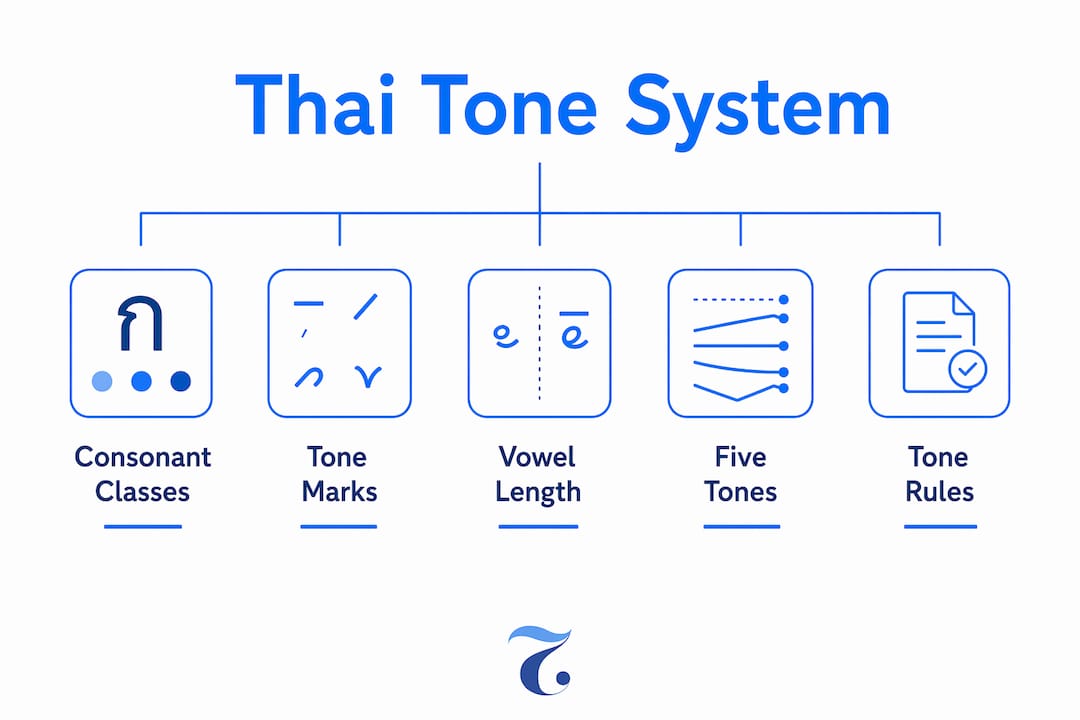
The three consonant classes
Thai consonants are divided into three classes: high, mid, and low. Each class carries a different default tone behavior. High class consonants include letters like ข (kh) and ส (s). Mid class includes ก (k) and จ (j). Low class is the largest group and includes ม (m) and น (n). The class of the initial consonant sets the tonal “baseline” for the entire syllable before any tone mark is applied.

Live vs. dead syllables and vowel length
A live syllable ends in a vowel or a sonorant consonant (m, n, ng, l, y, w). A dead syllable ends in a stop consonant (p, t, k) or a short vowel with no final consonant. Vowel length (long vs. short) and syllable type (live vs. dead) combine with consonant class to produce a 5-tone matrix that governs tone production. Dead syllables with low class consonants, for example, default to a high tone, which surprises many learners who expect a low tone.
Tone marks (wannayuk) and how they override defaults
Thai tone marks (wannayuk) are placed above the initial consonant and visually signal a pitch change. The four main marks are mai ek (่), mai tho (้), mai tri (๊), and mai chattawa (๋). The critical point most learners miss is that the same tone mark produces different tones depending on the consonant class. Mai ek on a mid class consonant produces a low tone. Mai ek on a high class consonant also produces a low tone. But mai ek on a low class consonant produces a falling tone. The mark itself does not tell you the tone. The consonant class does.
| Tone mark | Mid class result | High class result | Low class result |
|---|---|---|---|
| Mai ek (่) | Low tone | Low tone | Falling tone |
| Mai tho (้) | Falling tone | Rising tone | High tone |
| Mai tri (๊) | High tone | Not used | Not used |
| Mai chattawa (๋) | Rising tone | Not used | Not used |
Pro Tip: Learn the three consonant classes as vocabulary groups before you study tone marks. Trying to memorize tone marks without knowing consonant classes is like learning traffic signals without knowing which country you are driving in.
Why do learners find Thai tones so challenging?
The core difficulty is a mindset problem before it is a pronunciation problem. Most English speakers treat tone as emotional expression, not word meaning. In Thai, tones are not optional accents but fundamental lexical elements. Using the wrong tone is a vocabulary error, not an accent issue. Saying maa with a mid tone when you mean “horse” (falling tone) is the equivalent of saying “cat” when you mean “dog” in English.
Several specific pitfalls trip up learners at every level:
- Ignoring consonant class: Many learners memorize tone marks in isolation and then wonder why their tones are wrong. The mark alone is never enough information.
- Treating tone marks as the whole system: Tone marks only appear in a fraction of Thai words. Most syllables have no mark at all, meaning the tone comes entirely from consonant class, vowel length, and syllable type.
- Confusing falling and high tones: These two tones are the most commonly swapped by English speakers because both start at a relatively high pitch. The falling tone drops; the high tone holds or rises slightly.
- Neglecting dead syllables: Dead syllables follow different tonal rules than live syllables, and learners who skip this distinction make systematic errors across entire word categories.
You can explore common Thai pronunciation mistakes that stem directly from these tone-related errors to see how they play out in real conversation. The good news is that these are rule-based errors, not random ones. Once you understand the system, you can correct them systematically.
Practical steps for mastering Thai tones faster
Tone mastery is not about talent. It is about practice sequence and method. Follow these steps in order and you will build a solid tonal foundation faster than learners who jump straight into vocabulary lists.
- Learn the three consonant classes first. Group the 44 Thai consonants into high, mid, and low class before you study anything else about tones. Apps like Anki with pre-built Thai consonant class decks make this manageable in two to three weeks of daily review.
- Understand live vs. dead syllables. Practice identifying whether a syllable ends in a stop or a sonorant. This single skill unlocks the default tone rules for hundreds of words with no tone marks.
- Drill each tone in isolation. Use tone recognition drills that isolate one tone at a time before mixing them. Trying to distinguish all five tones simultaneously before you can hear each one clearly is counterproductive.
- Listen to native audio daily. Platforms like YouTube channels run by native Thai speakers, Thai podcasts, and apps like Pimsleur Thai provide the repetitive native input your ear needs to calibrate. Practicing with native audio and interactive tone calculators accelerates accurate tone acquisition.
- Speak out loud from day one. Reading tone rules silently does not train your vocal muscles. Record yourself, compare to native models, and repeat. Consistent speaking and listening practice with feedback is the method that produces results.
- Integrate tones with vocabulary learning. Every new word you learn should be learned with its tone. Never write a Thai word in your notes without marking the tone. Treat tone as part of the word’s spelling, because in Thai, it is.
- Use a structured Thai pronunciation guide to work through the full tone matrix systematically rather than picking up rules piecemeal from random sources.
Mastering consonant classes before tone marks is the single most effective sequencing decision a Thai learner can make. It transforms the tone system from a chaotic collection of exceptions into a logical, predictable framework.
Key takeaways
Thai tones are a rule-governed system where consonant class, vowel length, and tone marks combine to produce five distinct pitches that change word meaning entirely.
| Point | Details |
|---|---|
| Five lexical tones | Mid, low, falling, high, and rising tones each produce different word meanings from the same syllable. |
| Consonant class is foundational | Learn high, mid, and low consonant classes before studying tone marks to avoid systematic errors. |
| Tone marks are context-dependent | The same mark produces different tones on different consonant classes, so class knowledge is non-negotiable. |
| Dead syllables follow separate rules | Syllables ending in stop consonants default to tones that differ from live syllable rules. |
| Practice sequence matters | Drill tones in isolation with native audio before combining them in full vocabulary practice. |
Why tone learning clicked for me later than it should have
When I first started working with Thai learners, I noticed the same pattern repeating. Students would spend weeks memorizing tone marks and still produce wrong tones consistently. The frustration was real, and most of them blamed their ear or their accent. The actual problem was almost always the same: they had skipped consonant classes.
The moment a learner truly internalizes that mai ek does not have a single sound but three possible sounds depending on consonant class, something shifts. The system stops feeling arbitrary and starts feeling logical. Thai is one of the most rule-consistent tonal languages in Southeast Asia. The rules are just layered in a way that punishes learners who try to shortcut the sequence.
What I tell every student now is this: do not rush to speak full sentences before your tones are grounded. A sentence with wrong tones does not just sound foreign. It communicates the wrong words. One learner I worked with kept saying what he thought was “I want rice” but was consistently producing the tone for a word that means something far less polite. Native speakers were too kind to correct him, which made the habit worse.
The wins come faster than most learners expect once the foundation is right. Getting a tone correct and watching a native speaker’s face light up with genuine recognition is one of the most motivating moments in language learning. Celebrate those moments. They compound.
— Paul
Start mastering Thai tones with expert guidance

Thai Explorer’s adult Thai courses in Singapore are built around exactly the kind of structured tone instruction this article describes. Native Thai instructors who are bilingual in Thai and English walk you through consonant classes, tone marks, and pronunciation drills in a sequence designed to prevent the common errors most self-study learners make. Group, private, and online Zoom classes are available, so you can learn at the pace and format that fits your schedule. Whether you are preparing for travel, business conversations, or deeper cultural connection, explore the Thai language courses at Thai Explorer and build tonal accuracy from the ground up. Classes are held at 10 Anson Road, #22-07, International Plaza, Singapore 079903, right above Tanjong Pagar MRT.
FAQ
How many tones does Thai have?
Thai has five lexical tones: mid, low, falling, high, and rising. Each tone produces a distinct word meaning when applied to the same syllable.
What is the hardest Thai tone for English speakers to learn?
The rising tone is most commonly cited as the hardest because it covers the widest pitch range and has no close equivalent in standard English speech patterns.
Do all Thai words have tone marks?
No. Most Thai syllables carry no tone mark at all. Their tone is determined entirely by consonant class, vowel length, and syllable type (live or dead).
Why does the same tone mark sound different in different words?
The same tone mark produces different tones depending on the consonant class of the initial consonant. Mai ek on a mid class consonant gives a low tone, while mai ek on a low class consonant gives a falling tone.
Can you understand Thai without getting tones right?
Context helps in simple situations, but incorrect tone usage is a vocabulary error that regularly causes genuine misunderstanding. Relying on context alone limits you to the simplest exchanges and creates bad habits that are harder to correct later.