TL;DR:
- Effective Thai vocabulary learning combines high-frequency word focus, audio-first training, and spaced repetition for long-term retention. Prioritizing listening and speaking before script prevents fossilization of incorrect tones, essential in tonal languages like Thai. Consistent, context-based review routines and controlled addition of new words foster durable mastery of practical conversational skills.
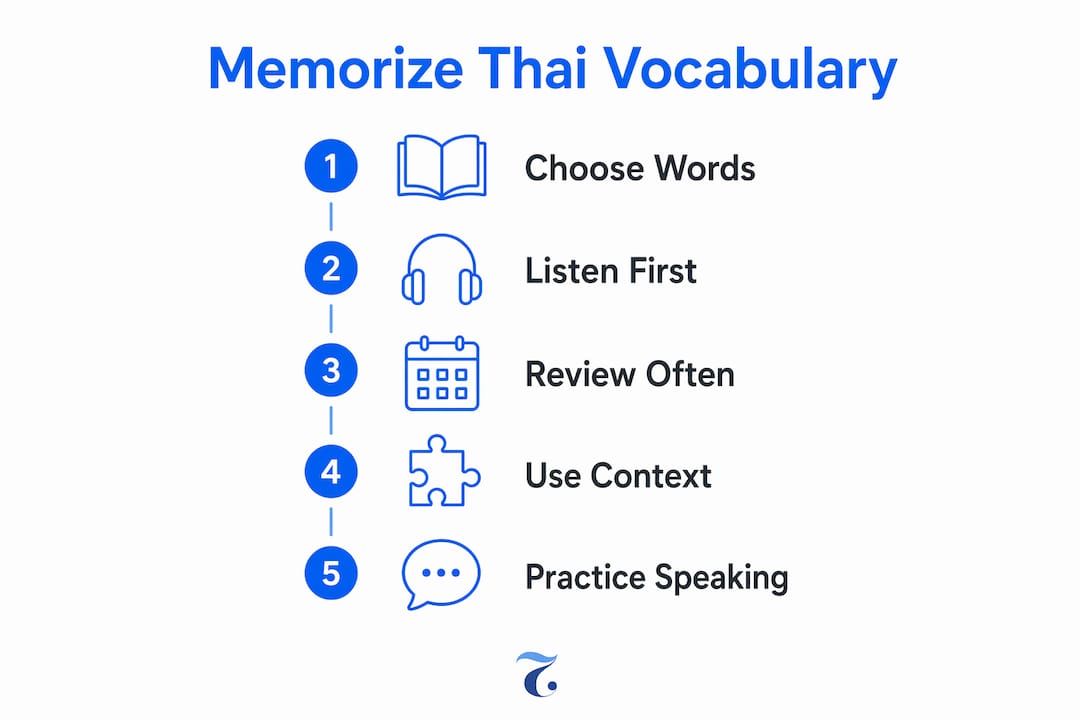
The most effective way to memorize Thai vocabulary combines high-frequency word selection, audio-first learning, and spaced repetition review into a single daily system. Thai presents a unique challenge: five distinct tones mean that mispronouncing a word does not just sound odd, it changes the meaning entirely. Tools like Anki, HelloTalk, and Ling-app are built around this reality, pairing native-speaker audio with structured review intervals. Whether you are a traveler preparing for a trip to Bangkok, an expat settling into daily life, or a student working toward the CU-TFL proficiency standard, the techniques below give you a clear, repeatable path to building durable Thai vocabulary.
How to memorize Thai vocabulary: start with high-frequency words
The fastest way to build Thai vocabulary is to ignore rare words entirely at first. 500 to 1,000 high-frequency words cover approximately 80% of daily Thai conversations, which means you can hold a functional conversation long before you have mastered the full lexicon. That statistic has a direct implication: time spent on obscure vocabulary in the early stages is time stolen from the words you will actually use every day.
The recommended intake is 5 to 10 new words per day. This pace feels slow, but it is the rate at which your review system can absorb new material without collapsing under the weight of forgotten words. Going faster creates a backlog that discourages most learners within weeks.
Organize your early vocabulary around practical categories:
- Greetings and politeness markers: สวัสดี (sawasdee), ขอบคุณ (khob khun), ขอโทษ (kho thot)
- Food and ordering: ข้าว (khao, rice), น้ำ (nam, water), อร่อย (aroi, delicious)
- Directions and transport: ซ้าย (sai, left), ขวา (khwa, right), รถไฟฟ้า (rot fai fa, BTS Skytrain)
- Numbers and prices: หนึ่ง (neung, one) through สิบ (sip, ten)
- Time expressions: วันนี้ (wan nee, today), พรุ่งนี้ (prung nee, tomorrow)
Pro Tip: Link every new word to a specific scenario you will actually encounter. “Delicious” is more memorable when you mentally attach it to the moment you first try pad kra pao at a street stall, not when you encounter it on an abstract flashcard.
Apps like Ling-app and Anki both offer frequency-ranked word lists, so you do not have to guess which words matter most. Start there, and resist the temptation to branch out until your core 500 words are solid.
Why audio must come before Thai script
Thai script is logically consistent once you understand it, but throwing it at beginners alongside vocabulary learning is one of the most common mistakes new learners make. Audio input must precede script learning because Thai’s tonal nature means that reading a word without first hearing it correctly risks locking in a wrong pronunciation permanently. Linguists call this “fossilization,” and it is far harder to undo than to prevent.
Thai has five tones: mid, low, falling, high, and rising. The word “mai” (ไม้) changes meaning across all five. Spoken correctly, these tones become intuitive over time. Learned from text first, they become a source of persistent errors that native speakers will politely tolerate but rarely correct.
“Non-native speakers often fossilize incorrect tones early, making audio-focused early learning critical for long-term speaking skill.”
Phonetic transcription, also called romanization, is a legitimate bridge tool for the first one to two months. Beginners benefit from romanization during the initial listening and speaking phase, targeting around 200 words before engaging with Thai script. Romanization is not a crutch if you use it correctly. It is scaffolding you remove once your tonal ear is calibrated.
Practical tools for audio-first learning include:
- Ling-app: Provides native-speaker audio for every word and phrase, with tonal context built into each lesson
- HelloTalk Voicerooms: Connects you with native Thai speakers for real-time conversation practice, exposing you to natural tonal variation
- Thai Explorer’s listening practice resources: Structured audio exercises designed for adult learners at each proficiency level
Once you can hear and reproduce the five tones with reasonable accuracy, connecting spoken words to Thai script becomes significantly easier. The script then reinforces what your ear already knows rather than contradicting it. For a structured approach to this transition, Thai Explorer’s Thai pronunciation guide walks through tone marks and their relationship to spoken sound.
How does spaced repetition maximize Thai vocabulary retention?
Spaced repetition is the practice of reviewing a word just before you are about to forget it, then extending the review interval each time you recall it correctly. Reviewing just before forgetting can increase memory efficiency by more than three times compared to unstructured review. That multiplier is the reason spaced repetition sits at the center of every serious vocabulary memorization system.
The mechanics work like this:
- You learn a new word today.
- You review it tomorrow.
- If correct, you review it again in three days.
- Correct again: review in one week.
- The interval keeps doubling until the word is in long-term memory.
The key discipline is clearing your review queue before adding new words. Reviewing due vocabulary first prevents the review debt that causes most self-study learners to abandon their systems. If you skip reviews to learn new words, the forgotten old words pile up until the backlog feels unmanageable.
Pro Tip: Designate one day per week as a “zero new words” day. Use it entirely to clear weak words and overdue reviews. This single habit prevents the burnout that kills most self-study Thai programs.
The top apps for implementing spaced repetition with Thai vocabulary are compared below:
| App | Spaced repetition | Native audio | Custom decks | Best for |
|---|---|---|---|---|
| Anki | Yes (fully customizable) | User-added or shared decks | Yes | Intermediate learners who want full control |
| Memrise | Yes (algorithm-based) | Yes (native video clips) | Limited | Beginners who want guided content |
| StudyThai | Yes (Thai-specific) | Yes | Yes | Learners focused on Thai exclusively |
Apps like Anki and Memrise allow you to customize review intervals based on your own progress, which means the system adapts to your weaknesses rather than treating every word identically. Pair any of these with a daily 15 to 20 minute session and you have a retention engine that compounds over time.
What study routines actually build lasting Thai vocabulary?
Effective Thai vocabulary learning is less about how many words you study and more about how consistently your review system integrates those words into active use. Structured daily practice of 15 to 20 minutes outperforms longer, infrequent sessions because memory consolidation happens during sleep and rest, not during extended cramming.
A practical daily routine looks like this:
- Morning (10 minutes): Clear your Anki or Memrise review queue completely before doing anything else
- Midday (5 minutes): Use one new word in a sentence, spoken aloud, in a real or imagined context
- Evening (5 minutes): Listen to a short Thai audio clip on HelloTalk or a Thai podcast and identify words you recognize
The midday step matters more than most learners realize. Learning vocabulary in context-rich sentences with native-speaker audio improves both tone accuracy and long-term recall compared to isolated word drilling. The sentence does not need to be complex. “I want to eat pad thai” is more memorable than a flashcard showing “pad thai” alone, because it activates grammar, tone, and personal desire simultaneously.
Another technique worth adopting is the episodic anchor. Linking vocabulary to personal daily experiences creates stronger retrieval cues than rote flashcard memorization. If you learned the word สวย (suay, beautiful) while watching a Thai sunset, that visual memory becomes a retrieval hook every time you need the word. Abstract drilling cannot replicate that kind of encoding.
Avoid the trap of memorizing long isolated word lists. This approach feels productive but produces shallow encoding. Words learned in lists are forgotten in lists. Words learned in sentences, attached to sounds and situations, survive. For practical ideas on daily Thai practice without living in Thailand, Thai Explorer’s resource library covers routines that work for Singapore-based learners with busy schedules.
Key takeaways
Memorizing Thai vocabulary efficiently requires audio-first learning, spaced repetition review, and contextual sentence practice working together as a single daily system.
| Point | Details |
|---|---|
| Start with high-frequency words | The top 500 to 1,000 words cover 80% of daily conversation; learn these before anything else. |
| Audio before script | Hear and reproduce tones correctly before engaging with Thai script to prevent fossilization. |
| Use spaced repetition daily | Reviewing just before forgetting boosts memory efficiency by more than three times. |
| Clear reviews before new words | Always complete your review queue first to prevent backlog and burnout. |
| Learn in context, not in lists | Sentence-based learning with native audio produces stronger, longer-lasting recall. |
What I have learned from watching learners get this wrong
After years of observing how adult learners approach Thai vocabulary, one pattern stands out above all others: the learners who progress fastest are not the ones who study the most hours. They are the ones who protect their review queue like it is a financial account they cannot afford to overdraw.
The most common failure mode I see is what I call “new word addiction.” Learners get a dopamine hit from adding fresh vocabulary to their decks, but they skip or delay reviews because reviewing feels less exciting than discovering new words. Within three weeks, they have 200 overdue cards, a growing sense of dread, and a system they quietly abandon. The fix is not more motivation. It is a structural rule: no new words until today’s reviews are done.
The second mistake I see constantly is learning Thai vocabulary from text before training the ear. I have spoken with expats in Bangkok who have studied Thai for two years and still cannot be understood by taxi drivers, not because their vocabulary is small, but because their tones were set incorrectly in the first month and never corrected. Audio-first learning is not a preference. It is the only approach that works for a tonal language. Thai Explorer’s tone exercises are worth doing before you touch a single flashcard.
The third insight is about context. Words you learn in sentences you care about stick. Words you learn from generic frequency lists fade. Build your vocabulary around the conversations you actually want to have, whether that is ordering food in Chiang Mai, negotiating a lease in Bangkok, or connecting with Thai colleagues in Singapore.
— Paul
Build your Thai vocabulary with structured guidance from Thai Explorer
Thai Explorer offers adult Thai language courses in Singapore designed around the exact principles covered in this article: audio-first instruction, structured vocabulary progression, and real conversational practice from the first lesson. Courses are taught by qualified native Thai instructors who are bilingual in Thai and English, so tonal accuracy and contextual usage are built into every session. Group classes, private lessons, and online Zoom options are available to fit your schedule. Whether you are preparing for travel, building professional Thai communication skills, or simply want to hold a real conversation, explore Thai Explorer’s Thai language courses to find the right fit. The school is located at 10 Anson Road, #22-07, International Plaza, Singapore 079903, right above Tanjong Pagar MRT.
FAQ
How many Thai words should I learn per day?
Learning 5 to 10 new Thai words per day is the optimal rate for sustainable retention. Going beyond this without a solid review system leads to backlog and burnout.
Should I learn Thai script before vocabulary?
No. Spend the first one to two months building vocabulary through listening and speaking with phonetic transcription. Introducing Thai script after your tonal foundation is established produces far better results.
What is the best app to memorize Thai words?
Anki and Memrise are the most widely used tools for Thai vocabulary memorization because both use spaced repetition with native audio support. Anki offers more customization; Memrise is better for beginners who prefer guided content.
Why do I keep forgetting Thai words I have already studied?
Forgetting usually means you are adding new words faster than you are reviewing old ones. Clear your full review queue every day before adding anything new, and designate one day per week to tackle weak and overdue cards only.
How long does it take to hold a basic Thai conversation?
With consistent daily practice of 15 to 20 minutes focused on high-frequency vocabulary and audio input, most adult learners can hold basic conversations within two to three months of starting.